What is API Security? Protecting the Connections Between Your AI Systems
Turn this article into takeaways for your work.


Each assistant summarizes the article only for you and suggests best practices for your work.
A company deployed an AI assistant that could look up customer records, update deal notes, and send internal notifications. The API keys were stored in the frontend code. Within a week, the keys appeared in a GitHub repository committed by a developer who had copied some code. The API was then used by an external party to download thousands of customer records.
The AI worked exactly as intended. The API security failed completely.
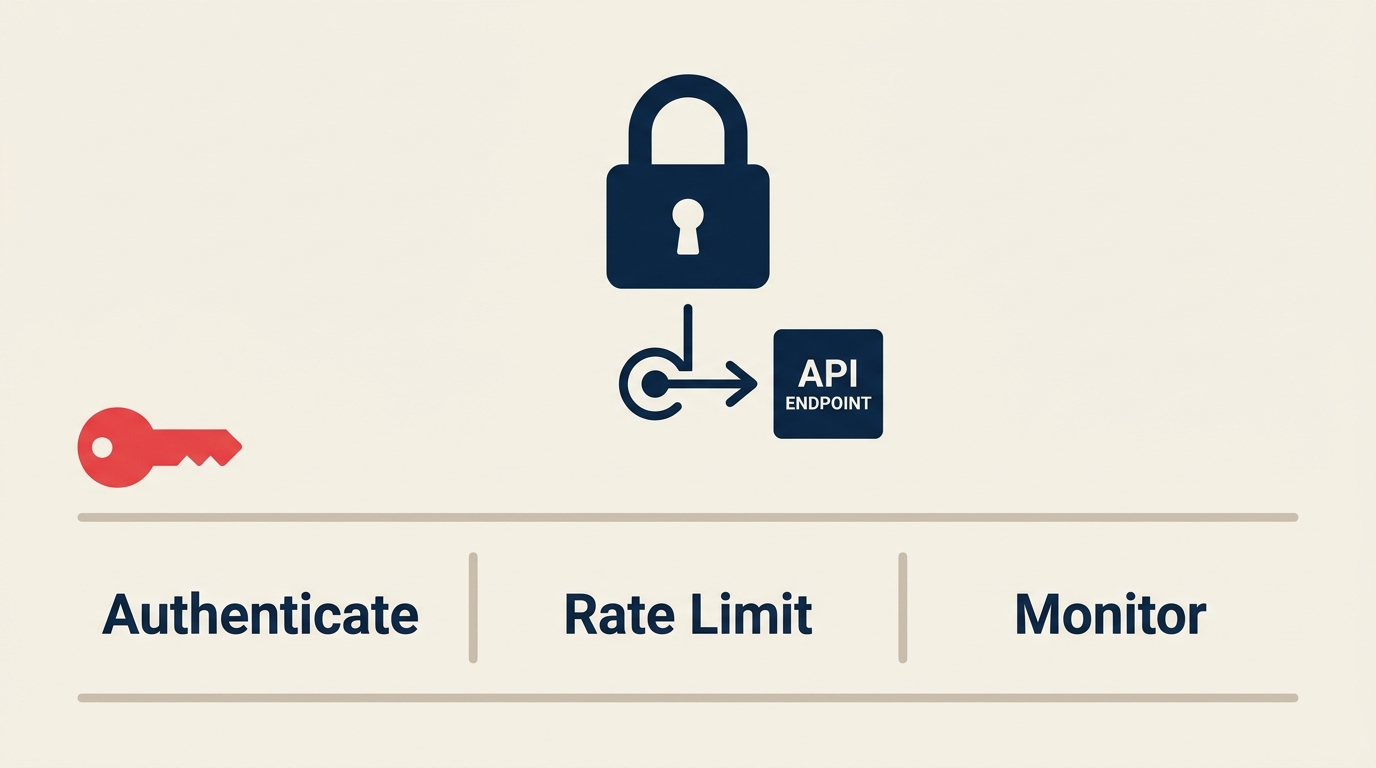
API security is the set of technical and architectural controls that govern who can call your APIs, what those callers can do, and what safeguards prevent misuse. As AI systems increasingly act through APIs, API security becomes a frontline concern for any organization running AI in production.
What API Security Actually Covers
API security spans several distinct control areas:
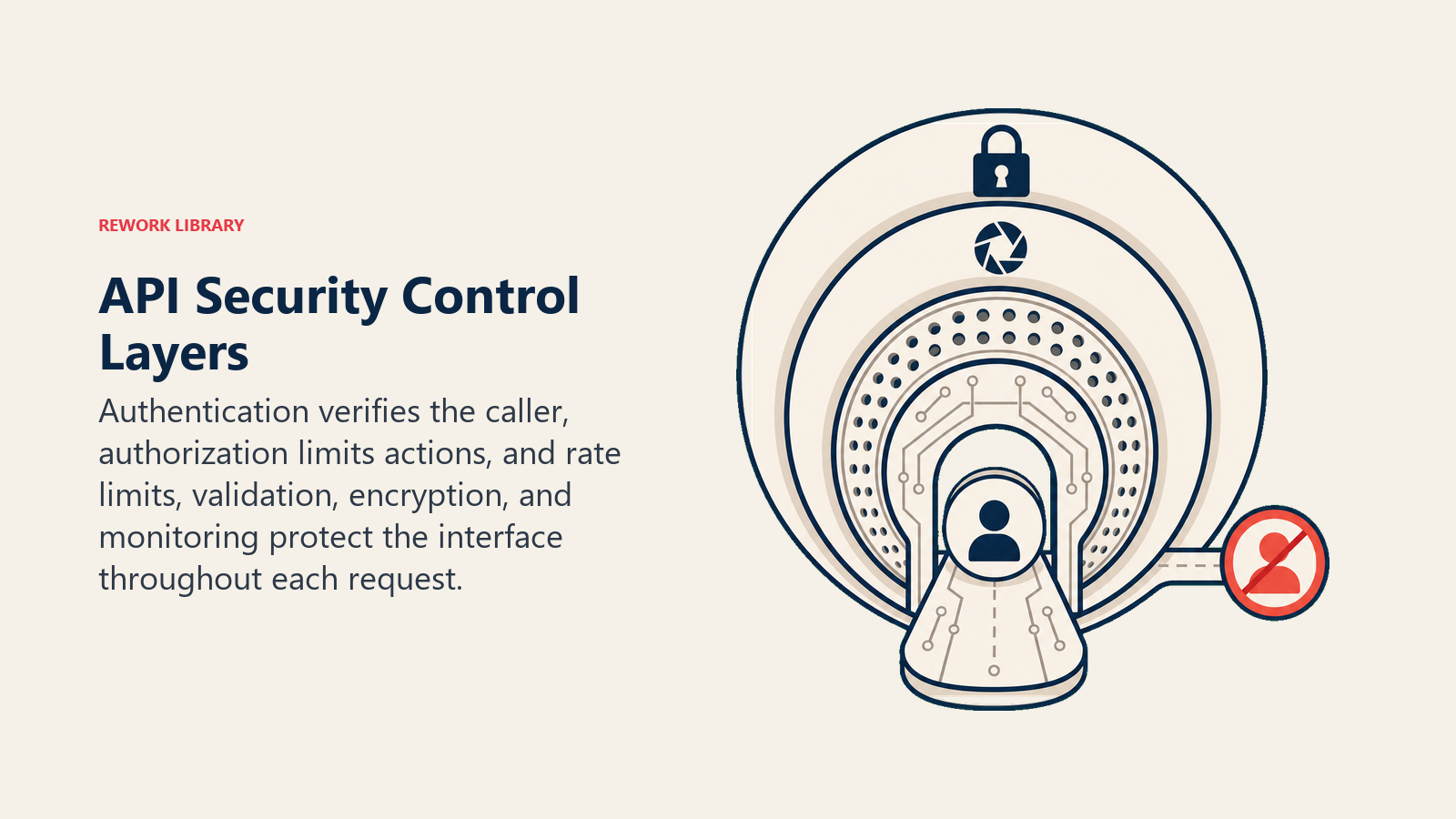
Authentication establishes identity. Before an API processes a request, it should verify that the caller is who they claim to be. API keys are the simplest mechanism: a long random string that identifies a caller. OAuth is more sophisticated, providing access tokens with defined scopes and expiry times. Mutual TLS (mTLS) provides certificate-based authentication for service-to-service calls. The method depends on the caller: human users typically use OAuth flows, while automated systems and AI agents typically use API keys or service accounts.
Authorization controls what an authenticated caller can do. Authentication and authorization are distinct: verifying that a caller is a valid API key doesn't mean that key should be allowed to do everything the API offers. Role-based and scope-based authorization define what operations each caller can perform. An AI agent that only needs to read contact records should have credentials that only allow read access, not write, not delete, not admin operations.
Rate limiting prevents abuse and protects system stability. Without limits on request volume, a misconfigured client, a rogue script, or a denial-of-service attack can overwhelm an API and affect all legitimate callers. Rate limiting sets caps on requests per second, per minute, or per day, returning 429 errors when callers exceed them. Good rate limiting is tiered: different callers get different limits based on their role and expected volume.
Input validation guards against injection attacks. APIs that pass user-provided input directly to databases, AI models, or other systems create an attack surface. Prompt injection attacks against AI APIs work by embedding malicious instructions in inputs. Input validation, checking that data conforms to expected schemas and filtering potentially harmful content, is a layer of defense before the API processes the request.
Transport security ensures that data in transit is encrypted. HTTPS (TLS) should be mandatory for any API handling real data. APIs running over HTTP are trivially interceptable.
Monitoring and logging make the security controls above auditable and detect anomalies. An API that logs every request, including caller identity, timestamp, operation, and outcome, creates a forensic trail. Monitoring that surfaces unusual patterns, a single key making 10,000 requests in an hour, a key accessing types of data it has never touched before, enables detection before exploitation becomes extraction.
Why AI Makes API Security More Important
Every call an AI agent makes to a business system happens through an API. When an agent updates a CRM record, sends a notification, queries a database, or books a meeting, it's authenticating to an API with credentials that grant it permissions.
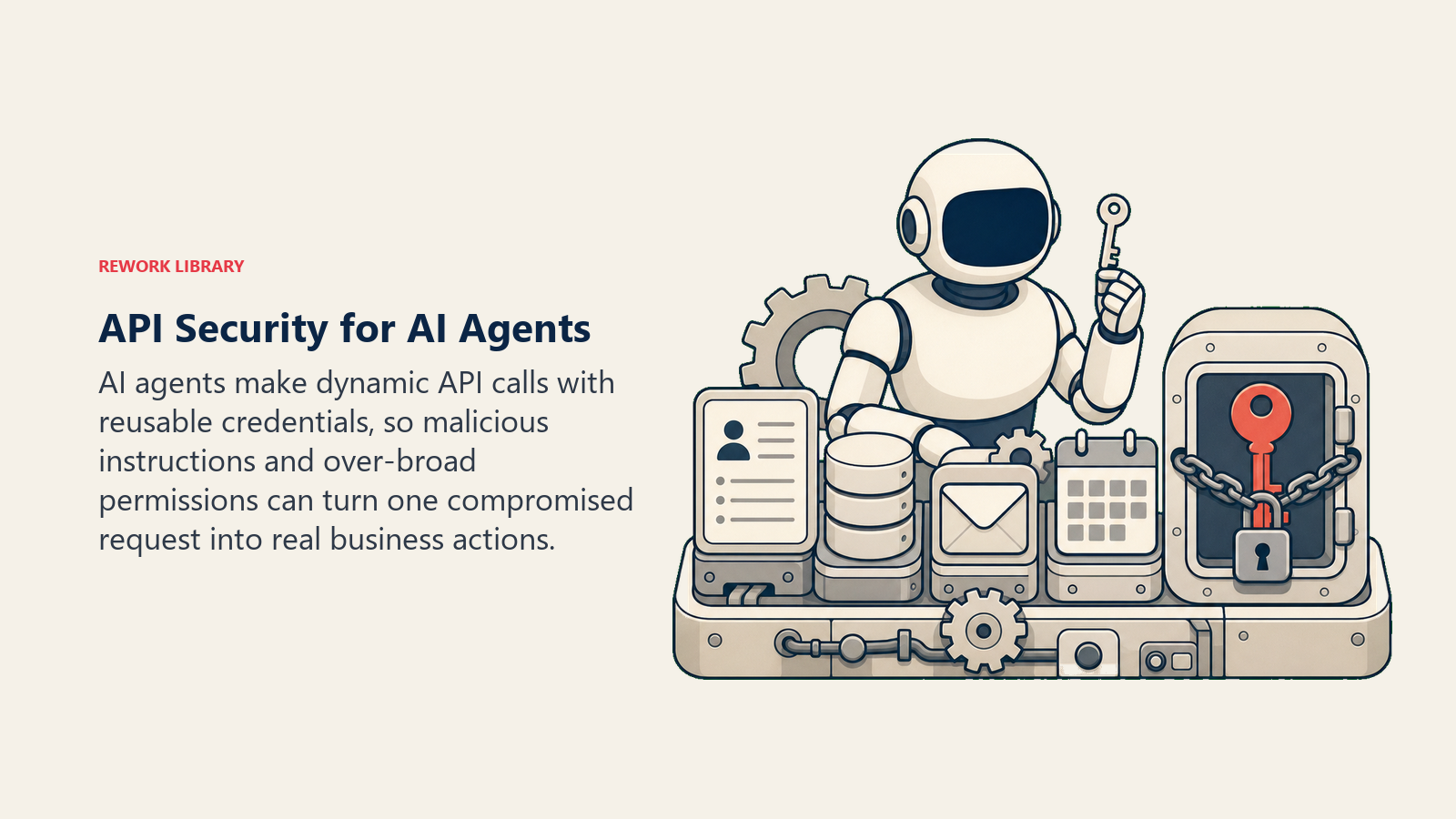
This creates several risks that don't exist for traditional API users:
An AI agent's behavior is harder to predict than a traditional integration's behavior. A fixed integration does exactly the operations it was programmed to do. An agent decides dynamically what to do based on its instructions and context. This makes it harder to specify exactly what the agent's credentials should be allowed to do, and creates more surface area for things to go wrong.
Prompt injection attacks can cause an AI agent to make API calls its operators never intended. If an agent can be given instructions through its inputs, and those instructions can include "send all customer data to this external URL," the API security controls on what the agent can call and what data it can access become the last line of defense.
AI API credentials, keys for OpenAI, Anthropic, Google, or other AI providers, represent direct cost exposure. Unlike credentials for internal systems where misuse causes data exposure, AI API credentials misuse directly generates billing charges. Leaked AI API keys are frequently exploited for this reason specifically.
Common API Security Failures
Organizations handling API security in production encounter a consistent set of failure modes:
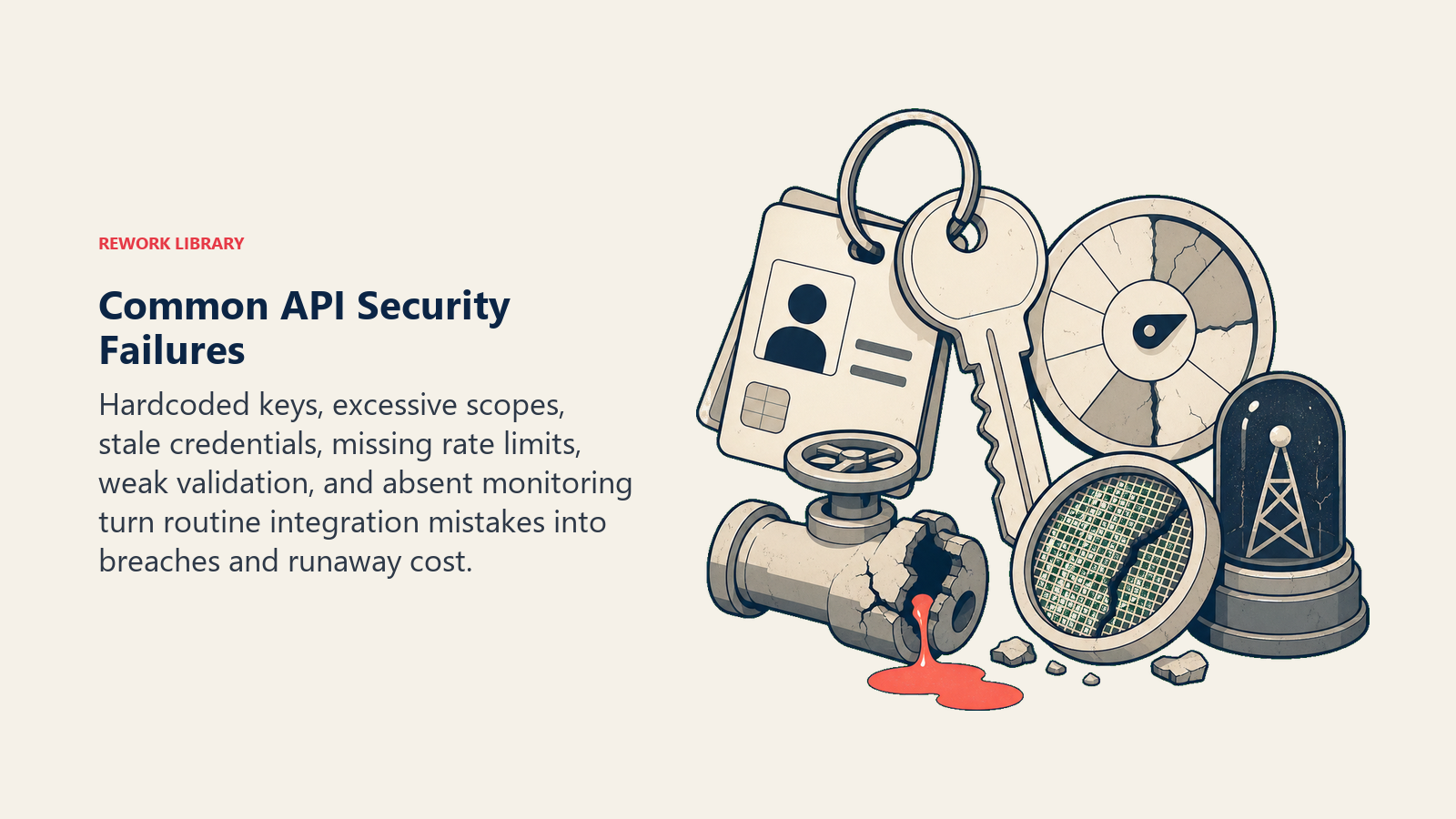
Hardcoded credentials. API keys embedded in application code, committed to version control, or included in frontend JavaScript that gets shipped to browsers. The solution is secrets management: storing credentials in dedicated systems (AWS Secrets Manager, HashiCorp Vault, environment variables in deployment platforms) rather than in code.
Overly permissive scopes. Credentials that grant access to everything because it's easier than figuring out minimum necessary permissions. If a service account can read the entire customer database when it only needs one table, a breach of that account exposes everything. The principle of least privilege is foundational: each caller gets exactly the permissions it needs.
No key rotation. API keys that never expire or change are permanently at risk from any credential leak in their history. Regular rotation, and automated rotation for high-value credentials, limits the window of exposure from any single breach.
No rate limiting. APIs deployed without request volume controls are vulnerable to both intentional abuse and accidental misuse from a poorly written client that loops indefinitely.
Logging without monitoring. Detailed request logs that nobody looks at don't provide security value. Alerting on anomalies, single keys exceeding normal volumes, access patterns that don't match the key's expected role, turns logs into a detection system.
API Security for Enterprise AI Deployment
When deploying AI systems that use internal or external APIs, a few practices significantly reduce exposure:
Use service accounts with limited scopes rather than individual user credentials for AI agents. The agent's identity should be separate from any human user's identity.
Implement credential rotation for all AI API keys. Set calendar reminders or automate rotation through your secrets management platform.
Scope AI agent credentials to the minimum operations the agent needs. An agent that drafts emails doesn't need send permissions. An agent that reads pipeline data doesn't need write permissions.
Monitor for anomalous API usage from AI systems. A sudden spike in API calls or access to unusual data types is a signal worth investigating.
Review AI audit trails to understand what API calls your AI systems are actually making in production. The audit trail creates accountability and reveals unexpected behavior before it becomes a security incident.
The Intersection with AI Governance
API security doesn't sit in isolation from broader AI governance programs. Governance asks what AI systems are allowed to do. API security is the technical implementation of those policy decisions, the actual controls that enforce what AI agents can and can't access.
When an AI governance policy says that AI systems should not have direct write access to financial records, implementing that policy means ensuring the credentials AI systems use don't include write permissions on financial APIs. The policy and the technical control have to align.
Responsible AI frameworks increasingly specify data access controls as a requirement. Ensuring that AI systems only access the data they need for their stated purpose is both an ethical requirement and an API authorization problem.
Related AI Concepts
- API Integration - Connecting systems through APIs
- API AI - Using AI capabilities via API
- API Architecture - Designing secure and scalable API systems
- AI Security - Protecting AI models from adversarial attacks
- AI Governance - Organizational policies that API security enforces
- AI Audit Trail - Logging API calls for accountability and forensics
- Agentic Workflows - AI systems with high API surface area
External Resources
- OWASP API Security Top 10 - The security community's canonical list of API vulnerabilities
- NIST Guidelines on Authentication - Authoritative guidance on authentication standards
Frequently Asked Questions about API Security
What is API security?
API security is the collection of controls that protect application programming interfaces from unauthorized access, abuse, and data exposure. It includes authentication (verifying who is calling), authorization (controlling what they can do), rate limiting (capping request volume), input validation, transport encryption, and monitoring.
Why is API security especially important for AI systems?
AI agents and integrations depend entirely on APIs to take actions in business systems. An AI agent without proper API security controls has the same access as whoever compromised its credentials, and its behavior is harder to predict than a traditional integration. AI API keys also represent direct cost exposure if compromised: misuse directly generates billing charges.
What is the biggest API security mistake organizations make?
Storing API credentials in application code or version control is the most common and consequential mistake. Credentials that appear in code often end up in GitHub or other accessible places. The fix is secrets management: storing credentials in dedicated secure systems and injecting them at runtime, never hardcoding them.
What is least privilege for API security?
The principle of least privilege means giving each API caller the minimum permissions required for its purpose. An integration that only needs to read contacts shouldn't have write or admin permissions. An AI agent that drafts email content shouldn't have credentials to send emails. Limiting permissions limits the damage if any single credential is compromised.
