What is an AI Center of Excellence? Your Internal AI Catalyst
Turn this article into takeaways for your work.


Each assistant summarizes the article only for you and suggests best practices for your work.
An AI Center of Excellence (AI CoE) is a centralized or federated team that sets standards, builds shared platforms, trains employees, and coordinates AI adoption across an enterprise. It exists to turn scattered, one-off AI projects into a coordinated capability, combining governance, enablement, and innovation so the organization scales AI value while managing risk. Most run on one of four operating models: centralized, federated, hub-and-spoke, or distributed.
Marketing wants AI for campaigns. Sales wants AI for forecasting. Operations wants AI for automation. IT wants standards. Finance wants ROI. Who coordinates? Who sets priorities? Who builds shared capabilities? An AI Center of Excellence provides the answer.
Defining AI Center of Excellence
An AI Center of Excellence (AI CoE) is a centralized or federated organizational structure that establishes standards, builds capabilities, shares best practices, and accelerates artificial intelligence adoption across an enterprise. It combines governance, enablement, and innovation functions to maximize AI value while managing risks.
According to Gartner, "AI Centers of Excellence are critical success factors for scaling AI beyond pilot projects, with organizations having CoEs achieving 3x higher AI adoption rates and 2x better ROI than those without." The model emerged as enterprises realized that scattered AI efforts created inefficiency, inconsistency, and missed opportunities.
Unlike traditional IT centers focused on delivery, AI CoEs emphasize enablement, equipping business units with machine learning tools, expertise, and frameworks while maintaining strategic alignment and risk management through AI governance.
Executive Perspective
For business leaders, an AI Center of Excellence is your vehicle for scaling AI from isolated experiments to enterprise capability: it's the difference between 10 disconnected AI projects and coordinated transformation that compounds value.
Think of an AI CoE like a corporate university combined with a consulting practice. It teaches the organization how to fish (build AI capabilities), provides expert fishermen (data scientists) for complex challenges, and ensures everyone follows fishing regulations (governance standards).
In practical terms, an AI CoE provides reusable AI platforms, shared data infrastructure, expert resources that move between projects, standardized practices that prevent reinventing wheels, and strategic direction ensuring AI investments align with business priorities.
Operating Models
Structural approaches to AI CoEs:
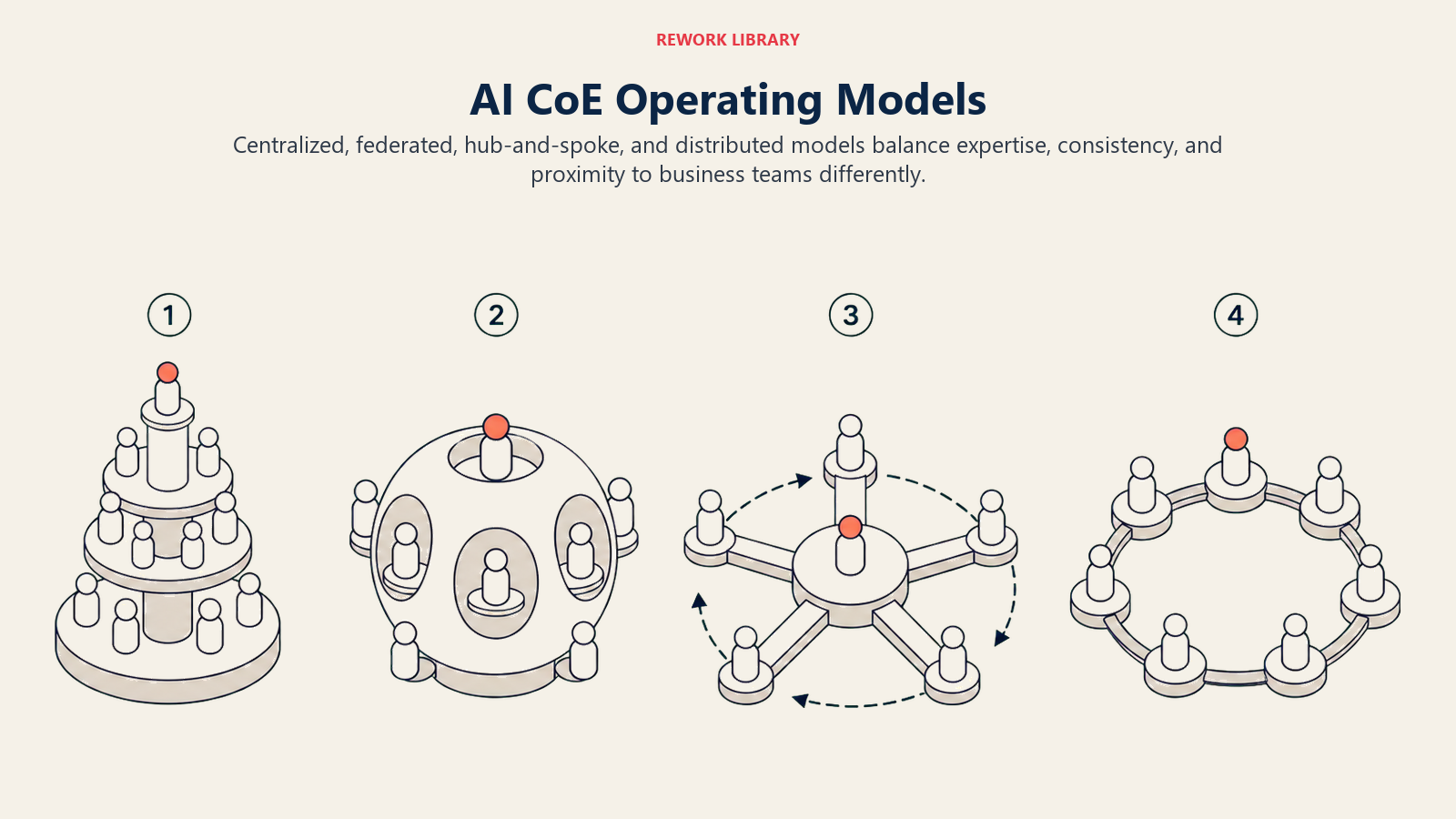
Model 1: Centralized CoE Structure: Single team serves entire organization Pros: Deep expertise, consistent standards, efficient resource use Cons: Bottleneck at scale, distance from business needs Best for: Early-stage AI adoption, smaller organizations Example: 20-person centralized team supporting 5,000 employees
Model 2: Federated CoE Structure: Central standards team + embedded AI teams in business units Pros: Business alignment with expertise sharing Cons: Complex coordination, potential inconsistency Best for: Large organizations with distinct business units Example: 10-person central team + 50 embedded specialists
Model 3: Hub-and-Spoke Structure: Central platform team + rotating embedded resources Pros: Balances efficiency and business proximity Cons: Requires strong coordination and role clarity Best for: Mid-size scaling organizations Example: Central platform + data scientists rotate through units
Model 4: Distributed Network Structure: AI champions in each unit with community of practice Pros: Maximum business alignment and agility Cons: Inconsistent quality, duplicated effort Best for: Mature AI organizations with strong culture Example: AI-first companies where all teams have AI capability
Core Functions
What AI CoEs deliver:
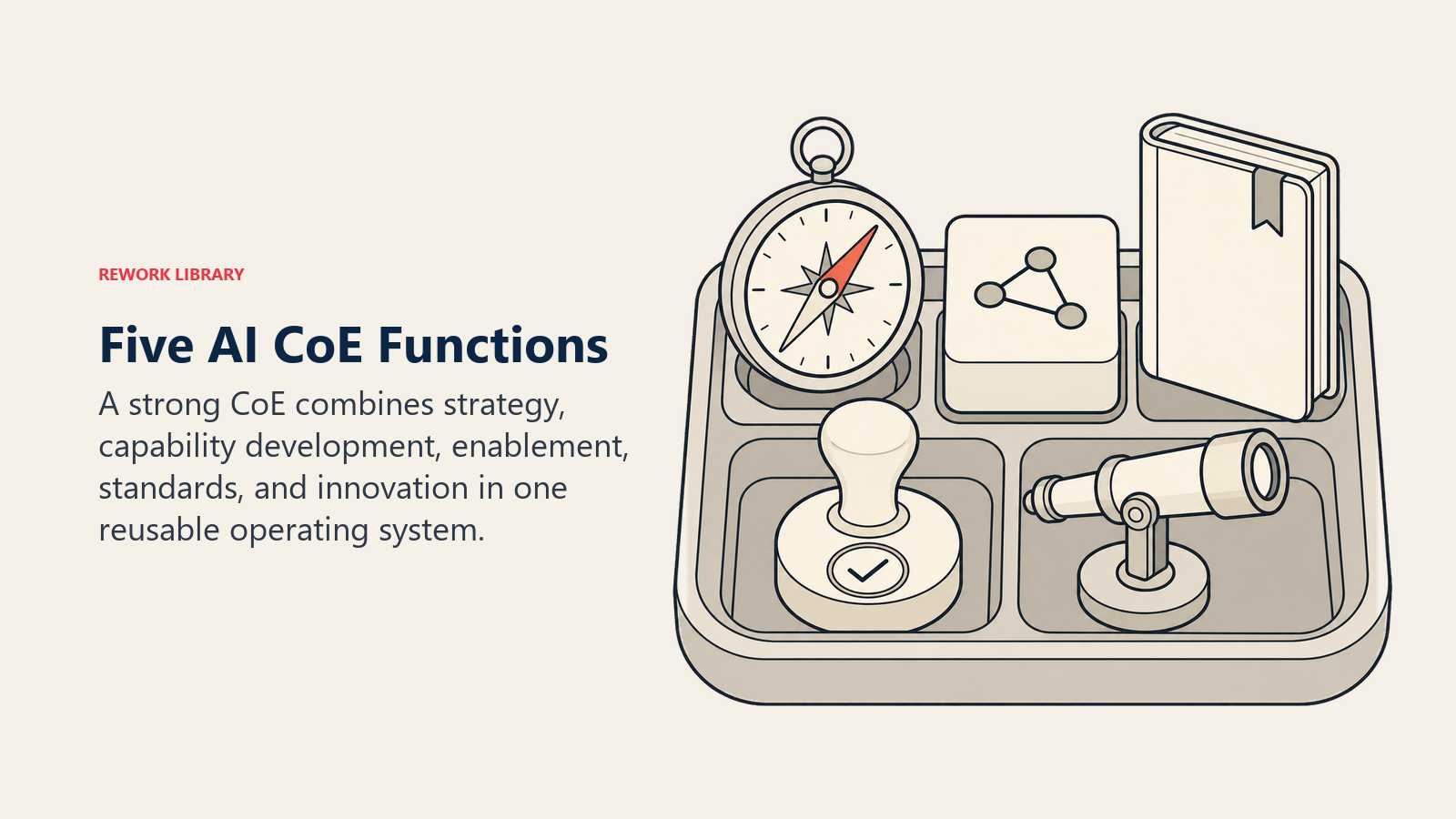
Strategy & Governance:
- Define AI vision and strategic priorities
- Establish AI governance frameworks
- Manage AI investment portfolio
- Align AI initiatives with business objectives
- Example: Quarterly AI strategy reviews with C-suite
Capability Development:
- Build and maintain shared AI platforms
- Develop reusable models and components
- Create data pipelines and infrastructure
- Implement MLOps tooling
- Example: Self-service ML platform reducing time-to-production from 6 months to 6 weeks
Enablement & Training:
- Upskill employees across AI maturity levels
- Create AI learning paths and certifications
- Provide office hours and expert consulting
- Build internal AI community
- Example: Trained 5,000 employees in prompt engineering
Standards & Best Practices:
- Define technical standards and methodologies
- Create templates and accelerators
- Establish quality assurance processes
- Share lessons learned across initiatives
- Example: Model development templates reducing project startup time by 40%
Innovation & Research:
- Monitor AI trends and emerging technologies
- Run proof-of-concepts for new capabilities
- Partner with vendors and research institutions
- Pilot cutting-edge applications
- Example: Early generative AI experimentation before enterprise-wide rollout
Success Metrics
Measuring CoE effectiveness:
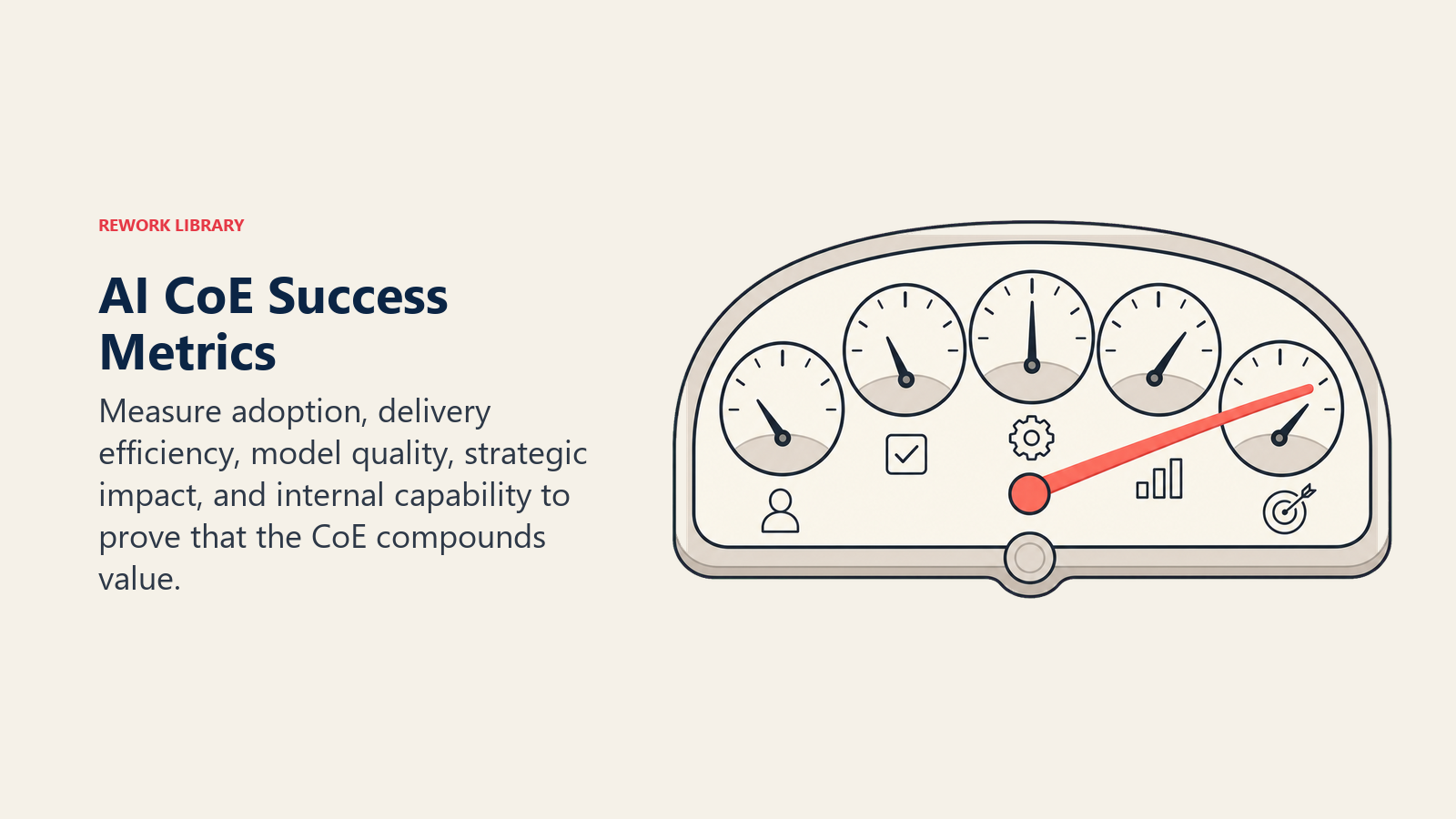
Adoption Metrics:
- Number of AI use cases in production
- Percentage of employees using AI tools
- Business units with active AI projects
- AI-enabled revenue or cost savings
- Target: 50%+ business units with AI projects within 24 months
Efficiency Metrics:
- Time from concept to production deployment
- Reuse rate of shared components and models
- Cost per AI project (should decrease over time)
- Resource utilization and allocation
- Target: 50% reduction in time-to-production year-over-year
Quality Metrics:
- Model performance benchmarks met
- Governance compliance rate
- Incident frequency and severity
- User satisfaction with CoE services
- Target: 95%+ governance compliance, <2% critical incidents
Strategic Impact:
- AI contribution to revenue growth
- Competitive positioning improvements
- Strategic initiative success rate
- Executive satisfaction with AI progress
- Target: 20%+ of strategic initiatives AI-enabled within 3 years
Capability Metrics:
- Internal AI talent growth
- Training completion and certification rates
- External recognition (publications, patents)
- Vendor relationship value
- Target: 80%+ employee AI literacy within 3 years
Real-World CoE Success
Organizations scaling AI effectively:
Financial Services Example: Capital One's CoE started with 10 data scientists in 2016, scaled to 11,000 AI/ML practitioners by 2024 through federated model with central platform team and embedded specialists, resulting in AI powering 85% of customer interactions and $2B+ in value.
Manufacturing Example: Siemens' AI CoE created shared computer vision platform deployed across 300+ factories, reduced individual project costs from $500K to $50K through reusable components, and improved quality defect detection by 40% while standardizing approach globally.
Retail Example: Walmart's AI CoE built internal ML platform used by 200+ teams, provided 40-hour AI training to 10,000 employees, and reduced ML project startup time from 6 months to 2 weeks, enabling experiments that led to $100M+ inventory optimization.
Healthcare Example: Cleveland Clinic's AI CoE established governance framework ensuring HIPAA compliance, trained clinical staff in AI literacy, and deployed 15 clinical AI applications with 98% physician trust scores by combining technical excellence with medical expertise.
Implementation Roadmap
Building your AI CoE:
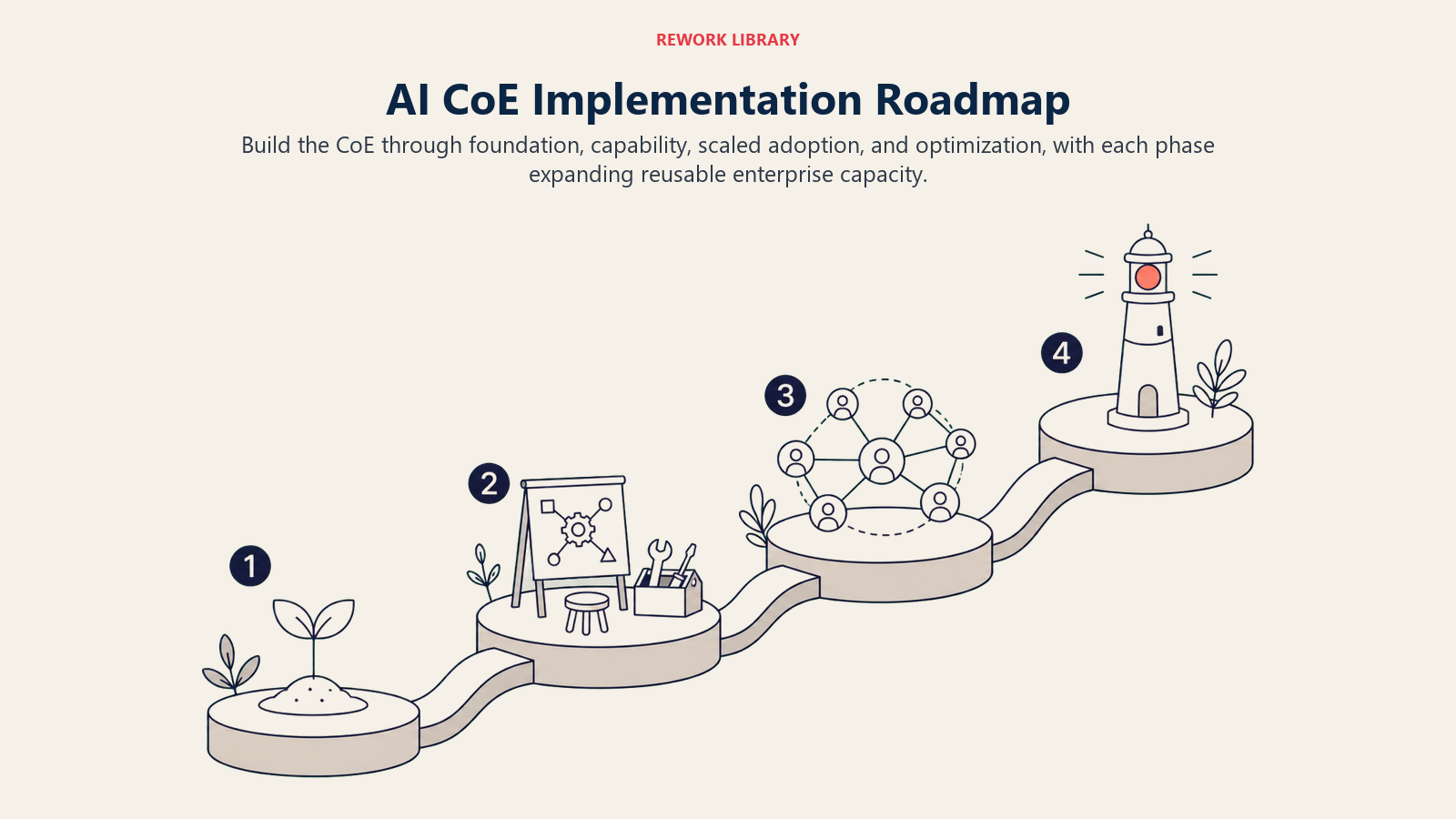
Phase 1: Foundation (Months 0-6)
- Secure executive sponsorship and budget
- Define charter, scope, and success metrics
- Recruit core team (5-10 people to start)
- Establish initial governance framework
- Launch 2-3 pilot projects for quick wins
Phase 2: Capability Build (Months 6-12)
- Deploy shared AI platform infrastructure
- Create standards and templates
- Develop training curriculum
- Build community of AI practitioners
- Scale to 10-15 active projects
Phase 3: Scale Adoption (Months 12-24)
- Expand team to 20-50 based on demand
- Implement federated or hub-and-spoke model
- Launch organization-wide training programs
- Develop deep partnerships with business units
- Target 50+ AI applications in production
Phase 4: Optimize & Innovate (Months 24+)
- Transition to self-service platform model
- Focus on advanced capabilities and innovation
- Embed AI into all strategic initiatives
- Export best practices industry-wide
- Achieve 100+ production AI systems
Common CoE Failures
Pitfalls that doom Centers of Excellence:
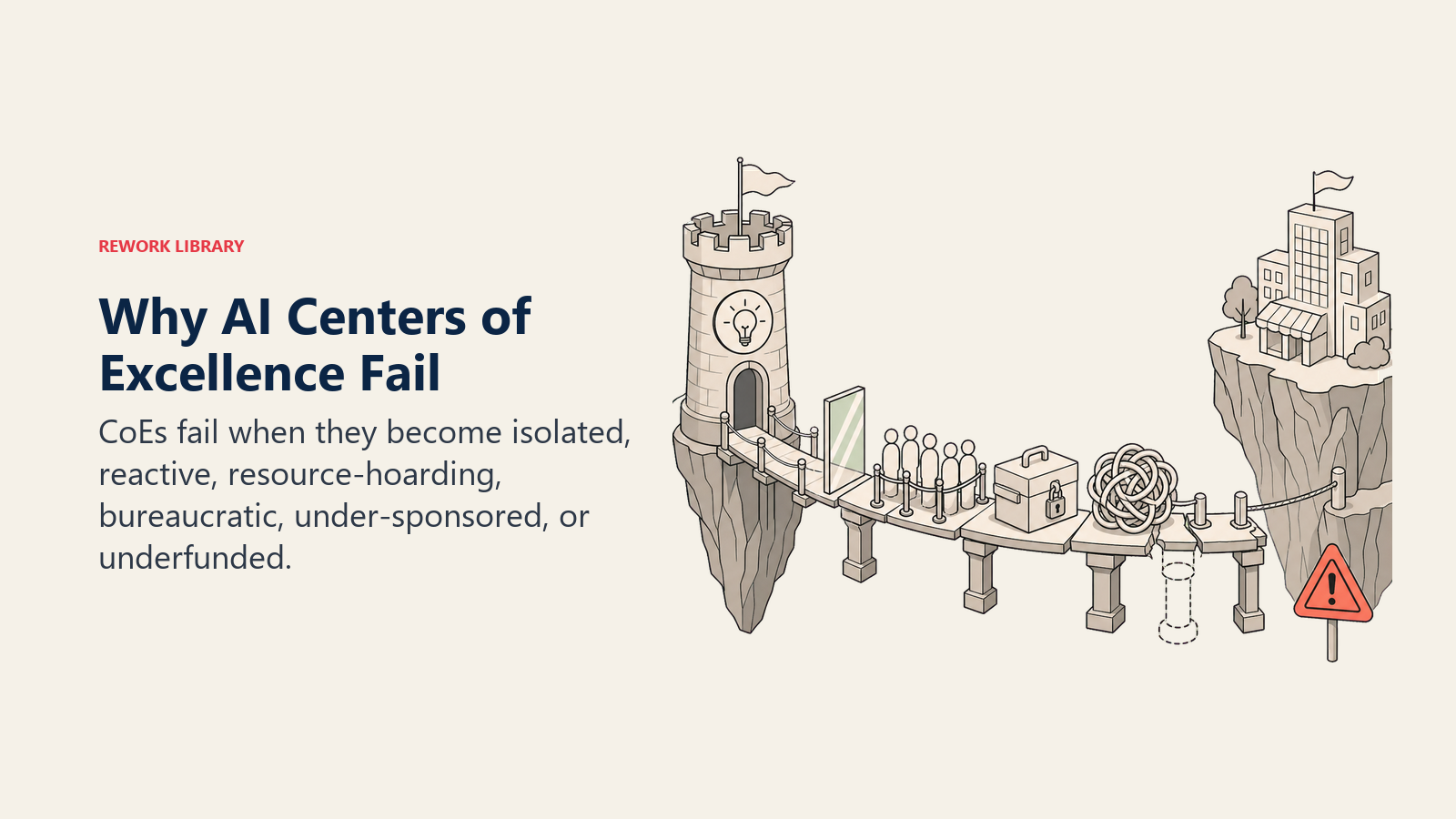
• Ivory Tower Syndrome: CoE disconnected from business reality → Solution: Embed team members in business units, measure business outcomes not just technical metrics
• Order Taker Model: CoE just executes requests without strategy → Solution: Establish clear prioritization based on strategic value
• Resource Hoarding: Central team won't share expertise → Solution: Incentivize enablement over delivery, measure success by organization capability
• Standards Bureaucracy: Process kills innovation → Solution: Balance governance with agility, make compliance easy not painful
• Lack of Executive Air Cover: CoE undermined by competing priorities → Solution: C-level sponsorship with authority to enforce standards and allocate resources
• Underfunding: Ambitious charter, inadequate budget → Solution: Fund CoE as % of overall AI investment (typically 15-20%)
Organizational Design
Staffing your AI CoE:
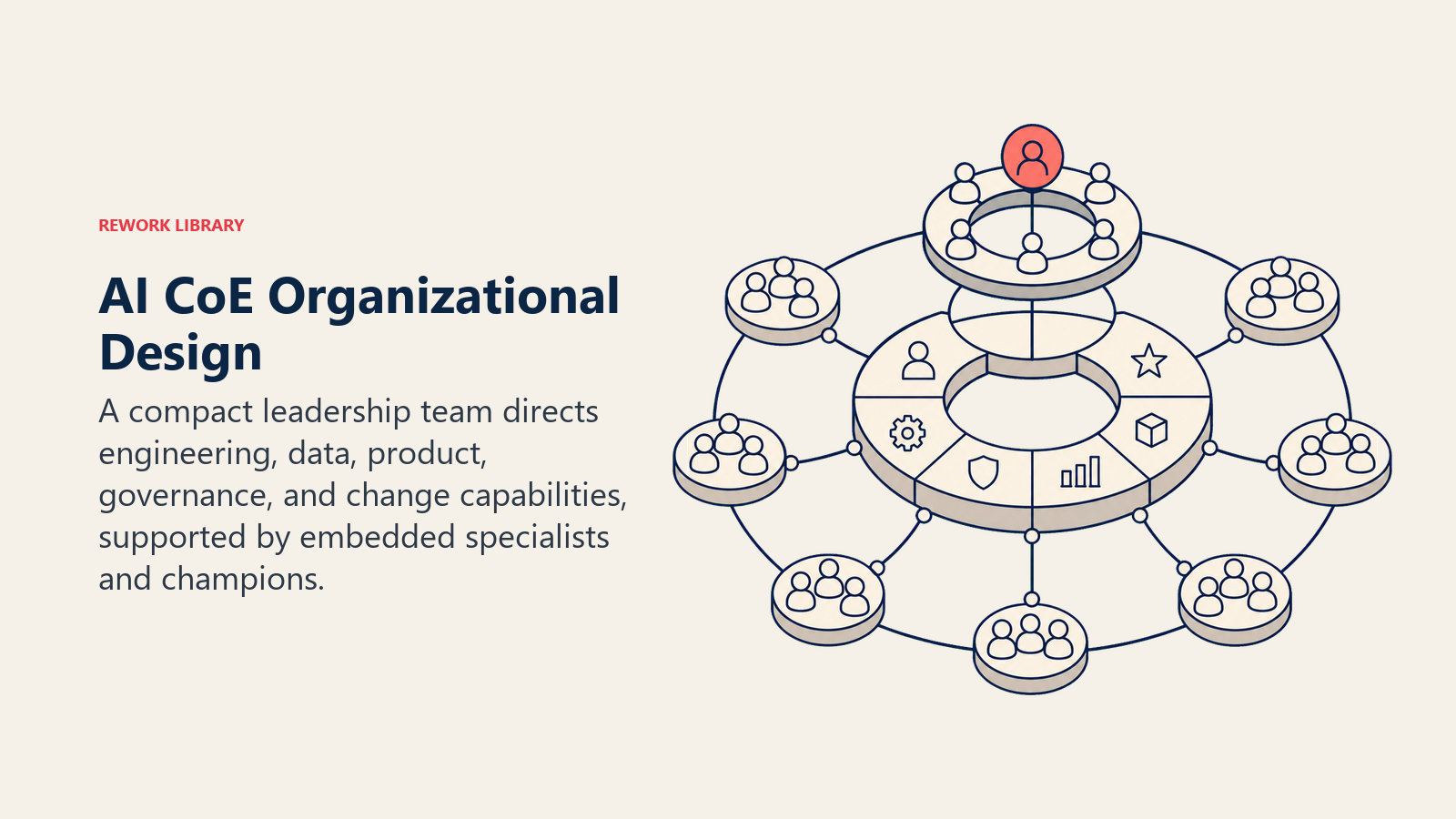
Leadership Team:
- Chief AI Officer or VP-level leader reporting to CEO/CTO
- Head of AI Strategy
- Head of AI Engineering
- Head of AI Governance
- Example: 4-5 senior leaders for enterprise CoE
Core Capabilities:
- Machine learning engineers (40% of team)
- Data engineers (30% of team)
- AI product managers (15% of team)
- AI governance and ethics specialists (10% of team)
- Change management and training (5% of team)
- Example: 30-person CoE for 10,000-employee organization
Extended Network:
- Business unit embedded data scientists
- AI champions in each department
- External advisors and partners
- Academic and research partnerships
Evolution Path: Year 1: 5-10 people, Year 2: 15-30 people, Year 3: 30-50 people, Year 4+: 50-100+ people depending on organization size and AI maturity
Building Your CoE
Steps to launch AI Center of Excellence:
- Build expertise with AI Talent Strategy
- Drive adoption via AI Change Management
- Create advantage through AI Competitive Advantage
- Prevent problems using AI Governance
Frequently Asked Questions about AI Center of Excellence
What is an AI Center of Excellence?
An AI Center of Excellence (AI CoE) is a centralized or federated organizational structure that establishes standards, builds capabilities, shares best practices, and accelerates AI adoption across an enterprise, combining governance, enablement, and innovation functions to maximize AI value while managing risks.
What are the four operating models for AI CoEs?
Centralized CoE (single team serves all, best for early-stage), Federated CoE (central standards plus embedded teams, best for large orgs), Hub-and-Spoke (central platform plus rotating resources, best for mid-size scaling), and Distributed Network (champions in each unit, best for mature AI organizations).
What are the five core functions of an AI CoE?
Strategy & Governance (AI vision and investment), Capability Development (shared platforms and infrastructure), Enablement & Training (upskilling employees), Standards & Best Practices (templates and methodologies), and Innovation & Research (monitoring trends and piloting new tech).
What metrics measure AI CoE success?
Adoption (AI use cases in production, employee usage), Efficiency (time-to-production, cost per project), Quality (model performance, compliance rate), Strategic Impact (AI revenue contribution, competitive positioning), and Capability (talent growth, training completion).
What are common reasons AI Centers of Excellence fail?
Ivory Tower Syndrome (disconnected from business), Order Taker Model (no strategy), Resource Hoarding (won't share expertise), Standards Bureaucracy (process kills innovation), Lack of Executive Air Cover (undermined by competing priorities), and Underfunding (ambitious charter without adequate budget).
Related Resources
Explore these related concepts to build your AI Center of Excellence:
- AI Governance - Framework for CoE governance function
- AI Talent Strategy - Building the team for your CoE
- MLOps - Technical infrastructure CoEs provide
- AI Change Management - Enablement strategies for CoEs
External Resources
- Gartner AI Research - Enterprise AI adoption frameworks
- MIT Sloan Management Review - AI organizational strategy research
- Stanford HAI - AI implementation best practices
Part of the AI Terms Collection. Last updated: 2026-02-09
