AI Total Cost of Ownership: The Hidden Budget Multipliers
Turn this article into takeaways for your work.


Each assistant summarizes the article only for you and suggests best practices for your work.
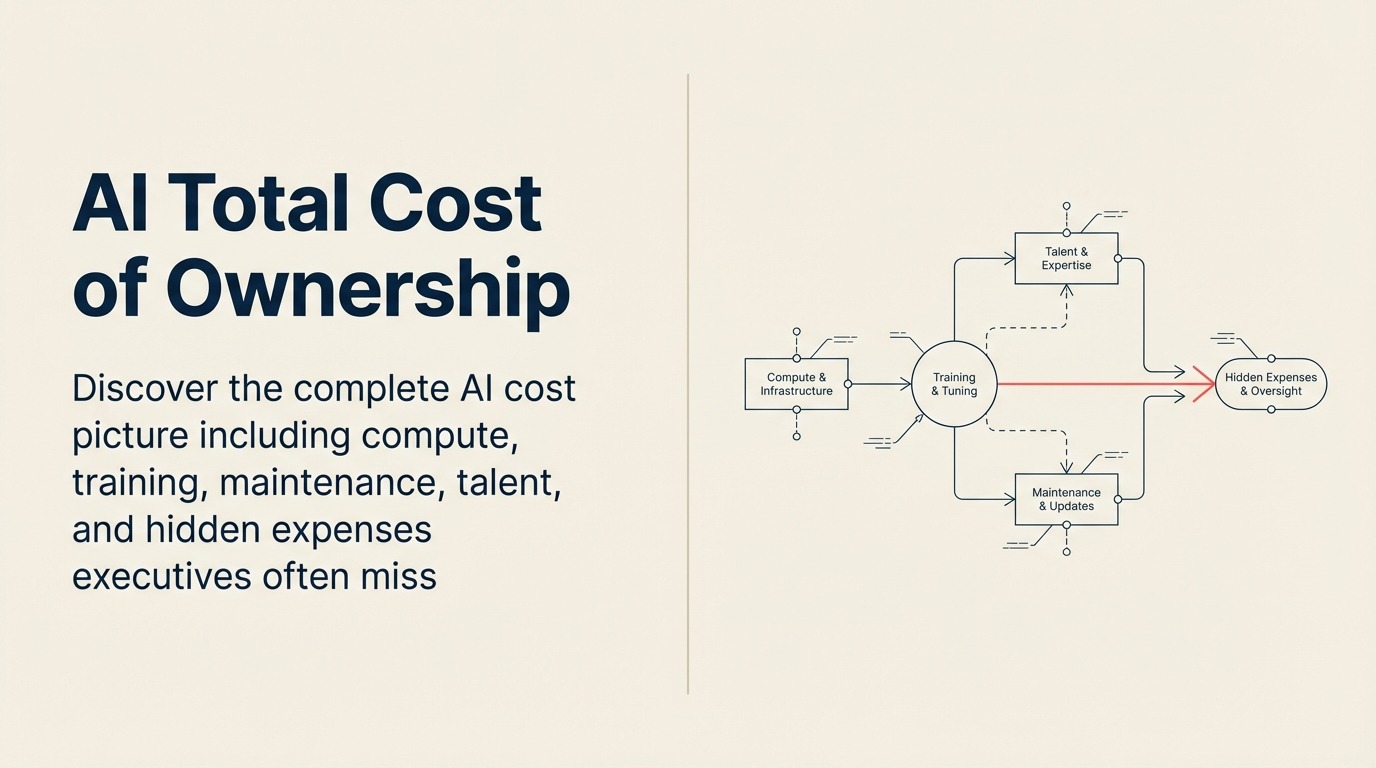
Your vendor quotes "$20 per user per month" for their AI platform. Finance approves the $50K annual budget. Six months later, you're spending $280K with no end in sight. API costs exploded, you hired three ML engineers, cloud compute bills doubled, and you haven't even reached production. This is AI's total cost of ownership trap.
The Evolution of AI Cost Models
AI cost accounting emerged in the early 2010s when companies realized cloud ML services had unpredictable expenses. Google's 2016 TensorFlow release democratized AI but introduced infrastructure complexity. The field matured after the 2019 "AI winter" when overspending killed dozens of well-funded AI initiatives.
According to Deloitte's 2024 AI Survey, AI Total Cost of Ownership is defined as "the comprehensive financial burden of deploying and maintaining AI systems, encompassing direct costs (software, compute, storage) and indirect costs (talent, training, integration, governance) over the complete lifecycle."
The breakthrough came when enterprises like Netflix and Uber published actual spending data showing AI costs were 3-8x initial projections, with compute and talent driving most overruns.
AI TCO for Business Leaders
For business leaders, AI Total Cost of Ownership means calculating the complete multi-year expense of AI initiatives including obvious costs (software licenses, API fees) and hidden costs (compute resources, specialized talent, data infrastructure, ongoing training, integration work, and governance overhead) to budget accurately.
Think of AI TCO like buying a car. The sticker price is just the start. You also pay for fuel, insurance, maintenance, parking, and registration. AI has similar "operating costs" that often exceed the initial investment.
In practical terms, a $100K AI software purchase typically requires $200-400K in first-year additional spend for infrastructure, personnel, and integration - costs that recur annually.
Seven Cost Components
AI Total Cost of Ownership consists of these essential elements:
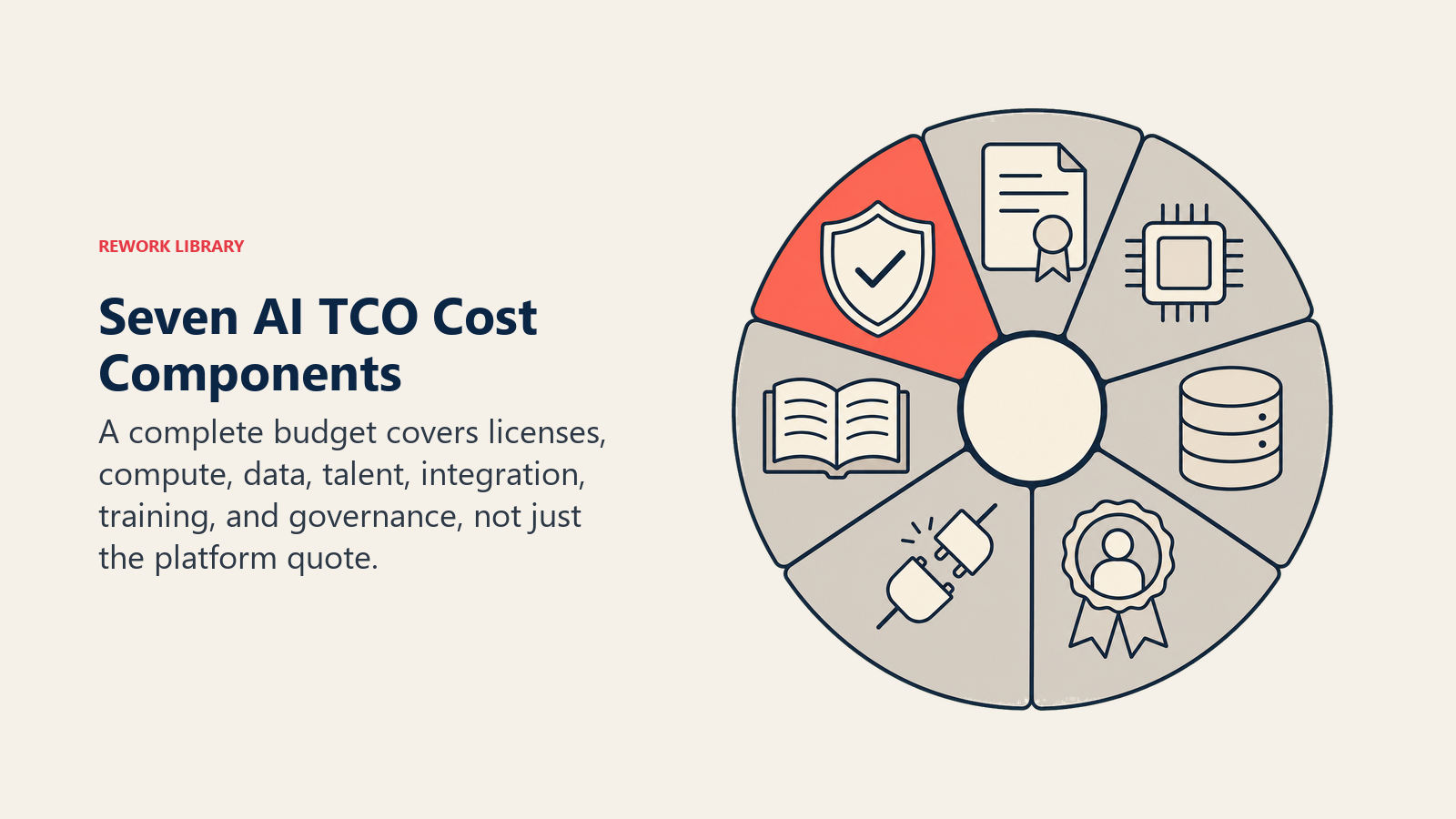
• Software Licenses: Base platform fees for AI tools, typically subscription-based, ranging from $10K-$500K+ annually depending on scale and capabilities
• Compute Resources: Cloud GPU/TPU costs for training and inference, often the largest expense, scaling with usage and model complexity
• Data Infrastructure: Storage, vector databases, data pipelines, and ETL tools to feed AI systems with quality information
• Talent Costs: ML engineers, data scientists, and AI specialists commanding $150K-$350K salaries, plus recruiting and onboarding expenses
• Integration & Customization: Development work connecting AI to existing systems, fine-tuning models, building interfaces, and creating workflows
• Training & Change Management: Employee education, stakeholder onboarding, documentation, and organizational adoption programs
• Governance & Compliance: Security audits, compliance reviews, monitoring systems, and risk management frameworks
The True Cost Calculation
AI TCO calculation follows this comprehensive approach:
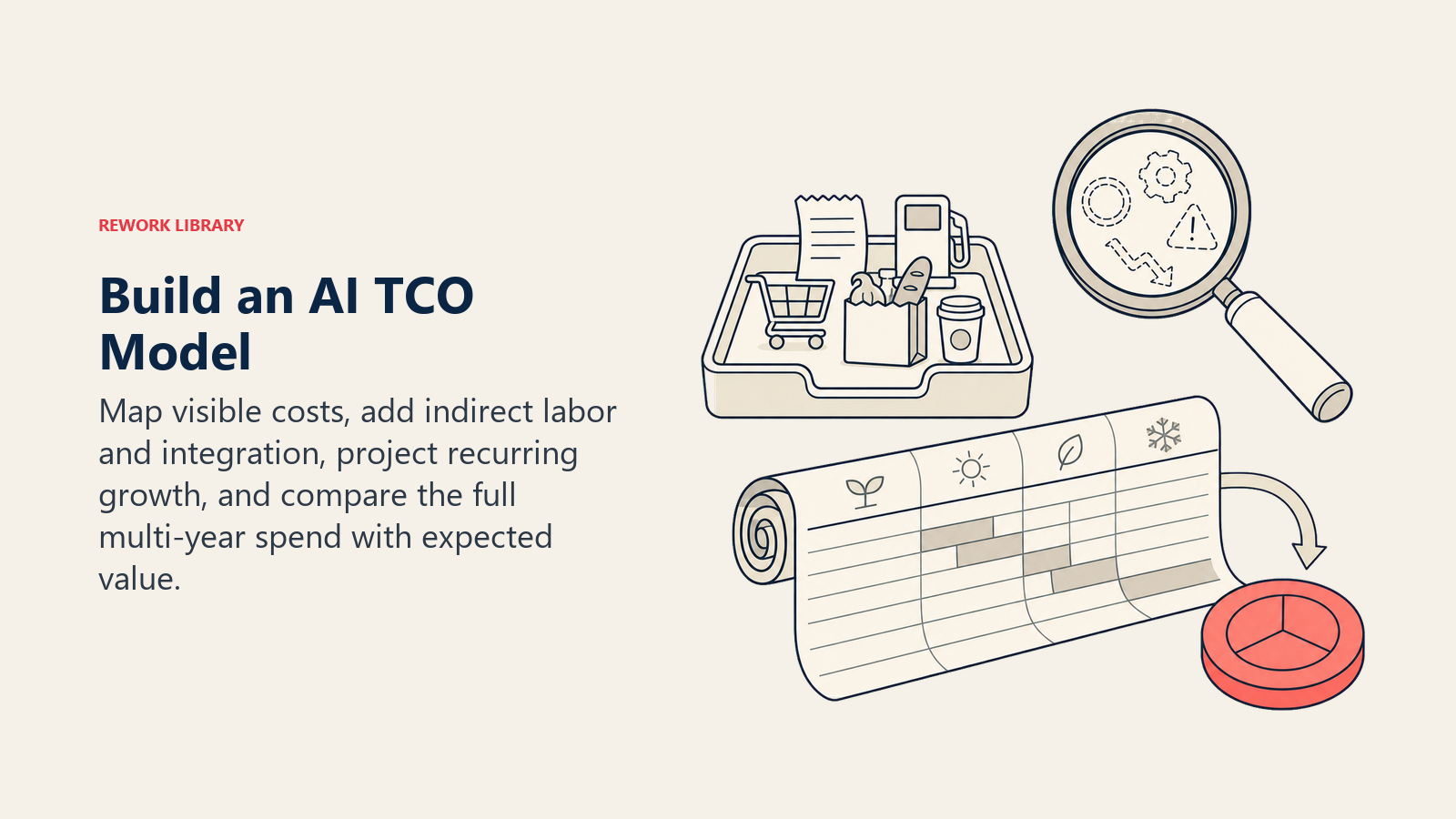
Map Direct Costs: List obvious expenses - $50K platform license, $30K annual API quota, $40K cloud compute estimate = $120K visible costs
Calculate Indirect Costs: Add hidden expenses - 2 FTE engineers ($300K), integration work ($80K), training ($20K), security review ($15K) = $415K in year one
Project Recurring Expenses: Estimate ongoing costs - compute scales 2x annually ($80K year 2), maintenance (20% of initial = $25K), additional features ($30K) = growing operational burden
This reveals true first-year cost of $535K for a "$50K AI platform" - a 10.7x multiplier executives must understand.
TCO by Deployment Model
AI costs vary dramatically by approach:
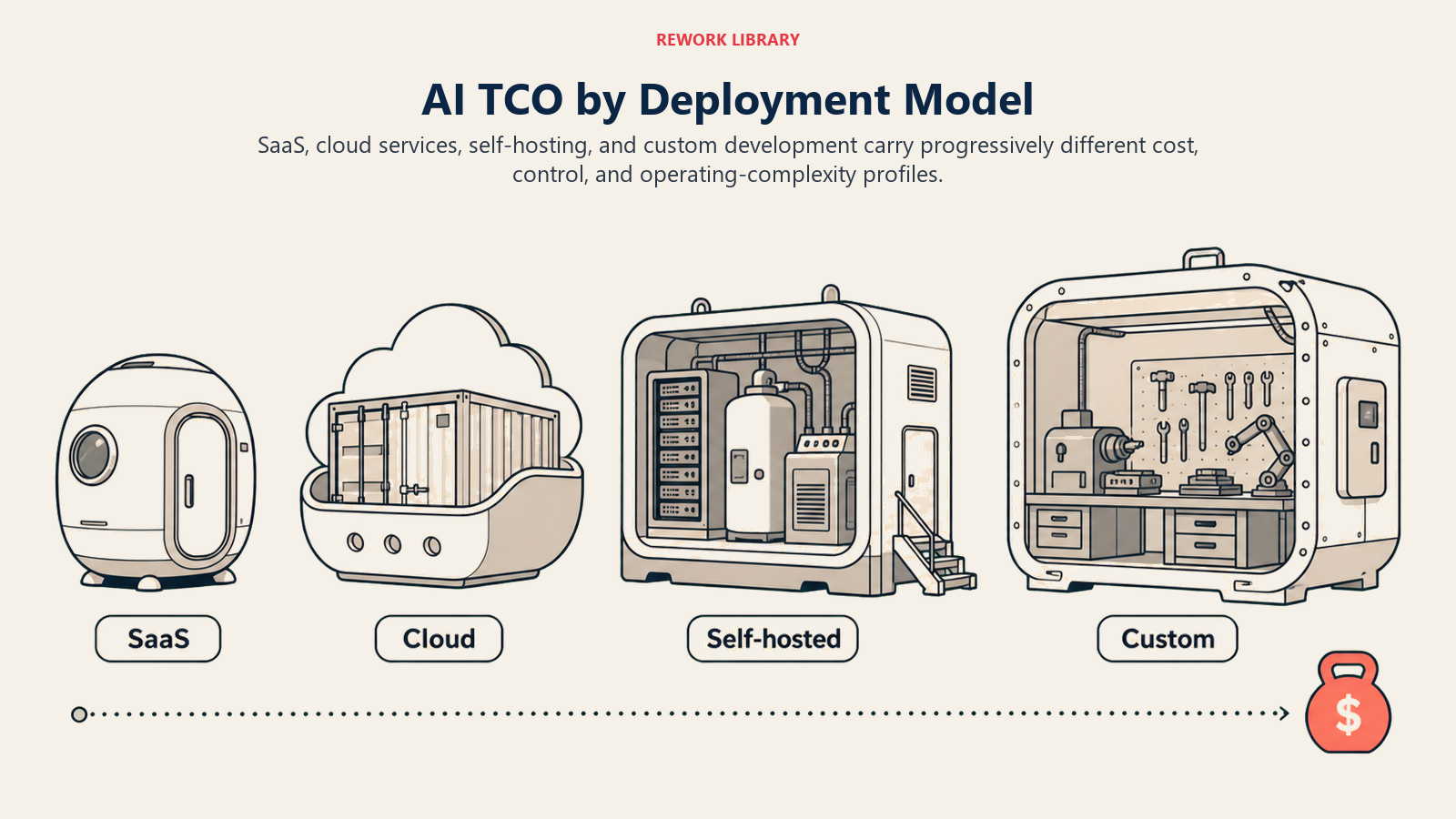
Model 1: SaaS AI Tools Best for: Quick deployment, limited customization Typical TCO: 2-3x list price annually Example: $50K ChatGPT Enterprise license + $30K API overages + $20K integration + $50K training = $150K total Hidden cost: Limited control, vendor lock-in
Model 2: Cloud AI Services Best for: Moderate customization, scalable infrastructure Typical TCO: 4-6x initial estimate Example: $100K in planned cloud spend + $250K compute overruns + $200K engineering + $50K data infrastructure = $600K total Hidden cost: Unpredictable compute bills, requires specialized talent
Model 3: Self-Hosted AI Best for: Maximum control, sensitive data Typical TCO: 6-10x infrastructure cost Example: $200K GPU servers + $400K engineering team + $100K maintenance + $80K power/cooling + $40K monitoring = $820K total Hidden cost: Ongoing hardware refresh, operational complexity
Model 4: Custom AI Development Best for: Unique competitive advantage Typical TCO: 10-15x initial scope Example: $500K initial build + $600K engineering + $200K compute + $150K data work + $100K ongoing = $1.55M total Hidden cost: Continuous model updates, data quality maintenance
Real-World TCO Examples
Here's what companies actually spend:
Enterprise AI Deployment: Global retailer implemented AI-powered demand forecasting. Initial quote: $300K. Actual TCO year one: $1.8M including $300K software, $400K cloud compute, $600K for 3 data scientists, $300K integration work, $200K training data preparation. By year three, TCO dropped to $900K annually as setup costs amortized.
Mid-Market Implementation: Manufacturing company adopted AI quality control. Initial investment: $80K for vision AI software. True TCO: $340K including $80K license, $120K for cameras and edge devices, $90K consulting, $50K engineering time. Ongoing annual cost: $140K (software + maintenance + compute).
Cost Optimization Strategies
Strategy 1: Start with APIs Approach: Use vendor APIs like OpenAI before building custom Savings: 60-80% reduction in first-year costs Trade-off: Less customization, per-use pricing
Strategy 2: Serverless Inference Approach: Pay-per-use rather than dedicated infrastructure Savings: 40-50% on compute for variable workloads Trade-off: Higher per-request costs at scale
Strategy 3: Model Optimization Approach: Use smaller, faster models where appropriate Savings: 50-70% reduction in compute costs Trade-off: Potential accuracy decrease
Strategy 4: Phased Rollout Approach: Pilot with small user group before full deployment Savings: Prevents 200-300% cost overruns from premature scaling Trade-off: Slower time to full value
Building Your TCO Model
Ready to calculate true AI costs?
- Understand investment evaluation via Business Metrics
- Measure returns properly with AI ROI Measurement
- Make smart decisions using AI Build vs Buy framework
- Compare options via AI Vendor Evaluation
Frequently Asked Questions about AI Total Cost of Ownership
What is AI Total Cost of Ownership?
AI Total Cost of Ownership is the comprehensive financial burden of deploying and maintaining AI systems including direct costs (software, compute, storage) and indirect costs (talent, training, integration, governance) over the complete lifecycle.
What's the typical TCO multiplier for AI projects?
Most AI initiatives cost 3-8x the initial software license or quote. A $100K platform typically requires $300-800K in total first-year spending when including compute, talent, integration, and training costs.
What are the seven key components of AI TCO?
Software licenses, compute resources, data infrastructure, talent costs, integration and customization, training and change management, and governance and compliance. All seven must be budgeted.
What's usually the largest AI cost component?
For most organizations, talent costs (ML engineers, data scientists at $150K-$350K each) represent 40-60% of total AI spending, followed by compute resources at 20-30%.
How can companies reduce AI TCO?
Start with vendor APIs instead of building, use serverless for variable workloads, optimize models for efficiency, phase rollouts to prevent premature scaling, and leverage existing talent before hiring specialists.
External Resources
- Gartner TCO Calculator - Cost modeling tools
- AWS Cost Management - Cloud AI cost optimization
Related Resources
Explore these related concepts to master AI investment planning:
- AI ROI Measurement - Quantifying returns on AI investments
- AI Build vs Buy - Decision framework for custom vs vendor solutions
- AI Vendor Evaluation - Comparing AI platforms and providers
- MLOps - Best practices for managing AI operations efficiently
- Model Serving - The infrastructure layer that drives a significant portion of ongoing AI compute costs
Part of the AI Terms Collection. Last updated: 2026-02-09
