What are Reasoning Models? AI That Actually Thinks Through Problems
Turn this article into takeaways for your work.


Each assistant summarizes the article only for you and suggests best practices for your work.
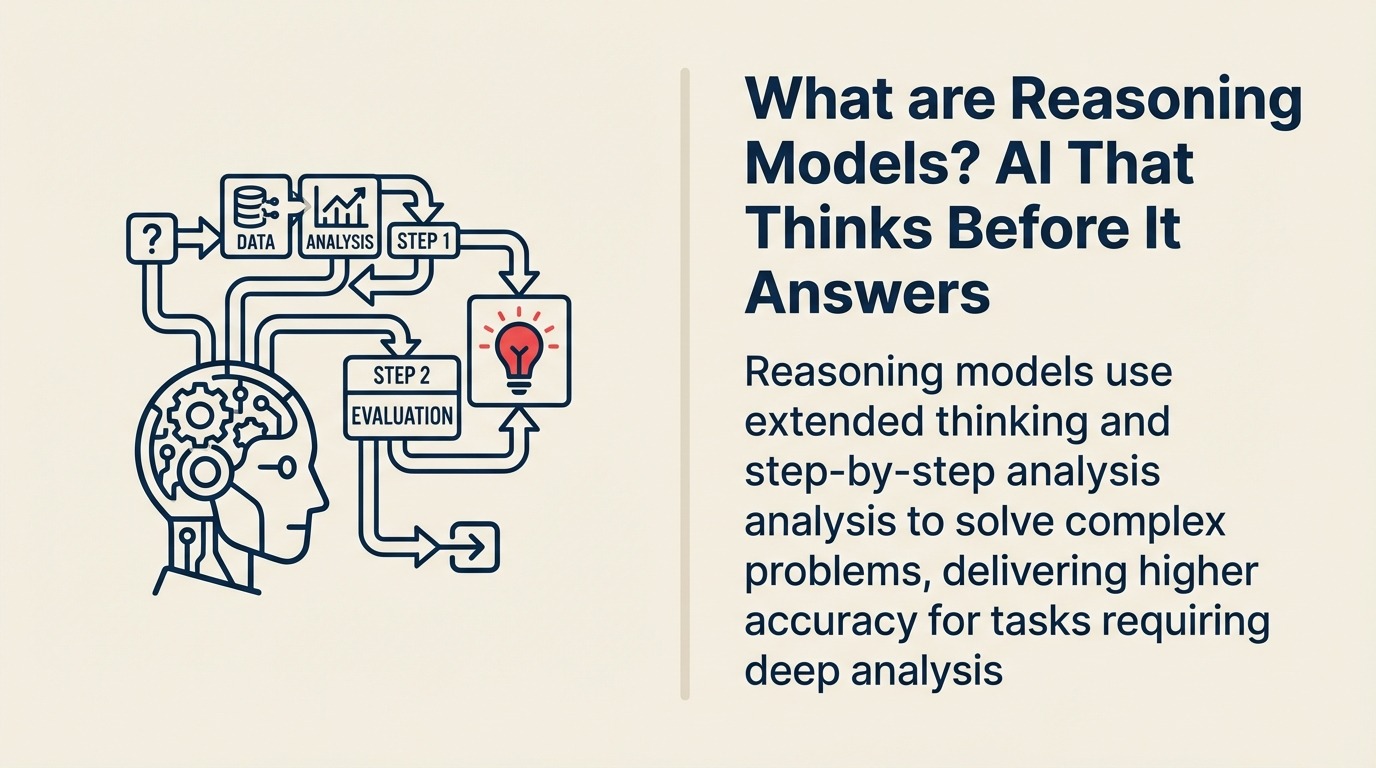
Ask a standard large language model a complex question, and it starts typing immediately, sometimes arriving at the wrong answer with perfect confidence. But reasoning models pause, think through the problem step-by-step, reconsider their approach, and then deliver an answer. This fundamental shift from instant response to deliberate thinking has transformed AI from a fast pattern matcher into a problem solver that rivals human experts on complex analytical tasks.
From Fast Guessing to Careful Thinking
Reasoning models emerged as a distinct category in 2024 with OpenAI's o1 release, which demonstrated that giving AI time to "think" before responding dramatically improved performance on complex tasks. What started as an experimental approach became a paradigm shift.
OpenAI defines reasoning models as "AI systems that employ extended computation time at inference to engage in deliberate problem-solving, breaking down complex questions into steps, considering multiple approaches, and validating conclusions before generating responses."
The field exploded when researchers discovered that models using chain-of-thought reasoning scored 83% on qualifying exams for the International Mathematics Olympiad, compared to 13% for standard models, showing that thinking time matters as much as model size.
Making Sense for Business Leaders
For business leaders, reasoning models mean access to AI that can handle complex strategic analysis, multi-step problem solving, and detailed technical work, delivering expert-level thinking for tasks where getting the right answer matters more than getting a fast answer.
Think of it as the difference between asking someone for an instant gut reaction versus asking them to analyze the situation, consider alternatives, and present a reasoned recommendation. Both have their place, but complex decisions deserve careful thought.
In practical terms, reasoning models enable you to automate sophisticated financial analysis, get reliable answers to nuanced legal questions, and solve complex technical problems that would stump fast-response AI systems.
Key Characteristics of Reasoning Models
Reasoning models exhibit these essential capabilities:
• Extended Thinking Time: Takes seconds or minutes to analyze problems instead of generating instant responses, using additional computation for deeper analysis
• Step-by-Step Breakdown: Decomposes complex problems into smaller sub-problems, solving each systematically rather than attempting direct pattern matching
• Self-Correction: Identifies errors in reasoning chains and backtracks to try alternative approaches, improving accuracy through iterative refinement
• Transparency: Shows the reasoning process, allowing you to understand how the model arrived at conclusions and verify the logic
• Accuracy Over Speed: Optimizes for correctness on complex tasks rather than low latency, trading response time for solution quality
How Reasoning Models Work
Reasoning models operate through these mechanisms:
Problem Analysis: The model examines the question, identifies what type of problem it is, and determines what information and approaches are relevant to solving it
Reasoning Chain Generation: The model generates multiple reasoning paths, working through the problem step-by-step and exploring different solution approaches before committing to an answer
Validation and Synthesis: The model checks its reasoning for errors, verifies conclusions against the problem requirements, and synthesizes a final answer with supporting explanation
This process transforms a question from a pattern-matching task into a genuine problem-solving exercise.
Types of Reasoning Approaches
Reasoning models employ several techniques:
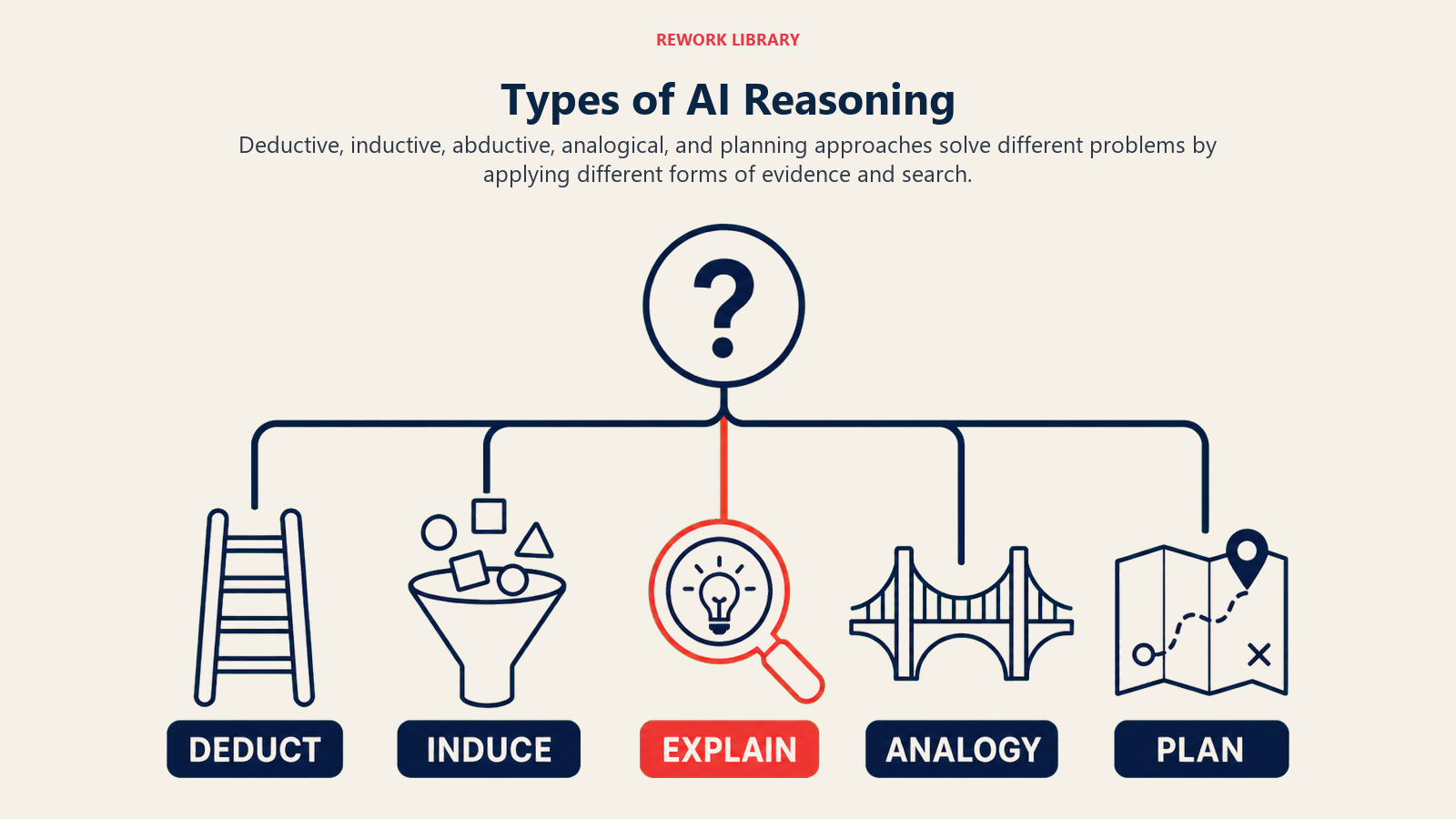
Type 1: Chain-of-Thought (CoT) Reasoning Best for: Multi-step logical problems Key feature: Explicit step-by-step thinking Example: Breaking down a business case into market analysis, financial projections, and strategic recommendations
Type 2: Tree-of-Thought Reasoning Best for: Problems with multiple solution paths Key feature: Exploring and comparing alternative approaches Example: Evaluating multiple product positioning strategies before selecting the optimal one
Type 3: Reflexion Reasoning Best for: Complex tasks requiring iteration Key feature: Self-critique and refinement Example: Iteratively improving a market entry strategy based on identified weaknesses
Type 4: Debate-Based Reasoning Best for: Questions with competing perspectives Key feature: Arguing multiple viewpoints Example: Analyzing a merger from financial, operational, and cultural perspectives
Reasoning Models in Action
Here's how businesses actually use reasoning models:
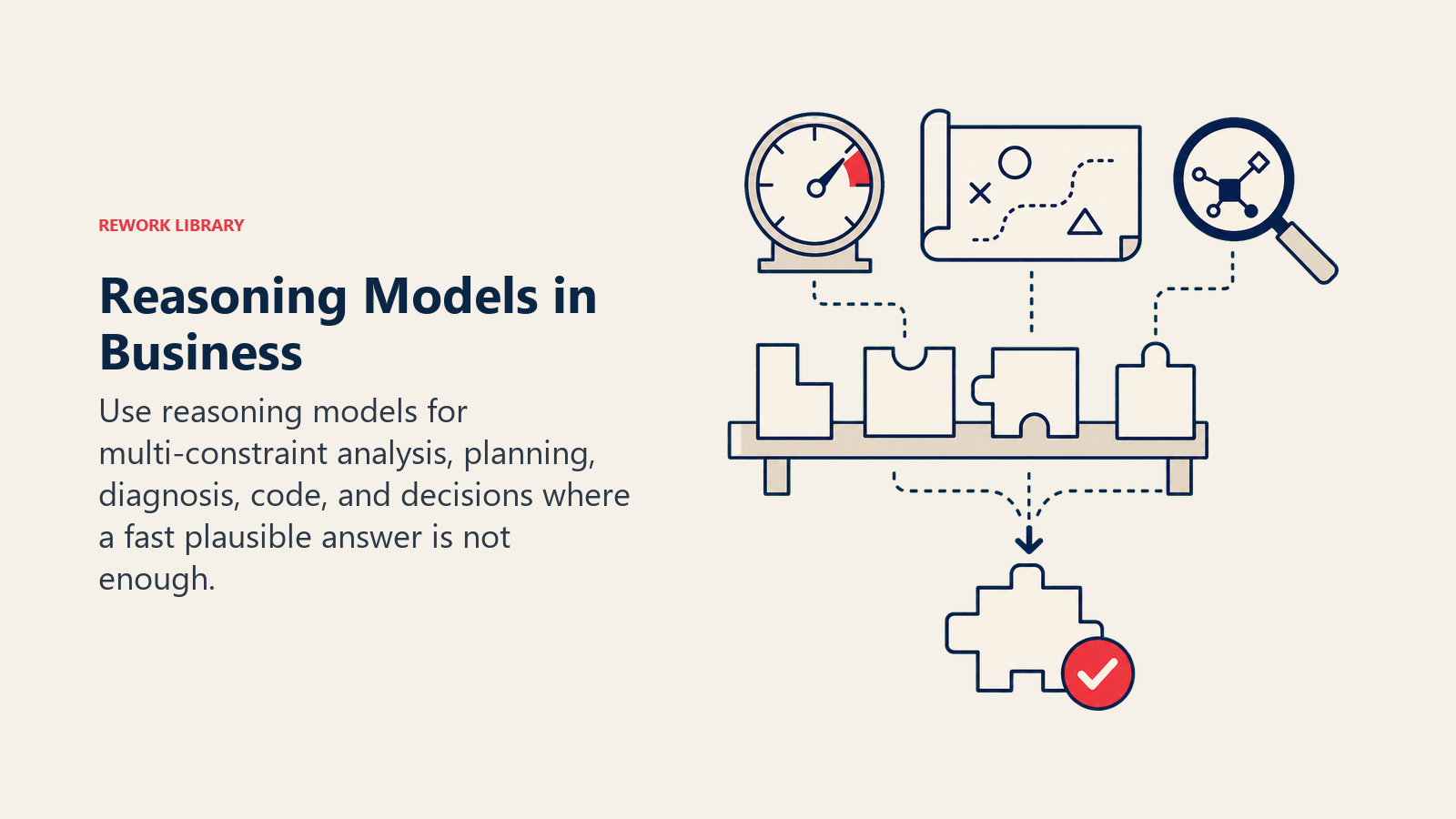
Management Consulting Example: McKinsey uses OpenAI's o1 model for complex strategy analysis, achieving 78% accuracy on case interview questions compared to 45% for GPT-4. The reasoning model's ability to break down multi-faceted business problems reduced consultant review time by 60%.
Financial Analysis Example: Goldman Sachs deployed reasoning models for M&A due diligence, analyzing financial statements, market positioning, and synergy opportunities. The models identified 23% more potential issues than standard AI while reducing false positives by 40%.
Legal Research Example: LexisNexis uses Claude's extended thinking mode for complex legal question analysis. For multi-jurisdiction regulatory questions, reasoning accuracy improved from 67% to 91%, with transparent reasoning chains enabling lawyer verification.
When to Use Reasoning vs. Standard Models
Use Standard Models When:
- Simple questions with clear answers
- Speed matters more than perfection
- Pattern recognition sufficient
- Cost sensitivity high
- Example: Customer FAQ, content generation, basic classification
Use Reasoning Models When:
- Complex multi-step problems
- High cost of errors
- Need to verify reasoning
- Strategic decisions
- Example: Financial analysis, legal research, technical troubleshooting, strategic planning
Your Path to Reasoning Model Mastery
Ready to leverage AI's thinking capabilities?
- Understand the foundation with Chain-of-Thought
- Explore advanced prompting via Prompt Engineering
- Learn about AI capabilities with Large Language Models
External Resources
Explore authoritative research and documentation on reasoning models:
- OpenAI o1 System Card - Technical documentation on OpenAI's reasoning model capabilities and performance
- Anthropic's Chain-of-Thought Research - Research papers on extended thinking and reasoning approaches
- DeepMind's AlphaGeometry - Breakthrough in AI mathematical reasoning
Learn More
Expand your understanding of related AI concepts:
- Few-Shot Learning - Teaching AI through examples
- AI Agents - Autonomous AI systems
- Fine-tuning - Customizing models for specific tasks
- Retrieval-Augmented Generation - Combining AI with knowledge bases
Frequently Asked Questions about Reasoning Models
What are Reasoning Models?
Reasoning models are AI systems that use extended computation time to think through problems step-by-step, breaking down complex questions, considering multiple approaches, and validating conclusions before responding.
What's the difference between reasoning models and standard AI?
Standard AI models generate responses immediately through pattern matching. Reasoning models take additional time to analyze problems, generate reasoning chains, self-correct errors, and validate conclusions, trading speed for accuracy on complex tasks.
How much better are reasoning models at complex tasks?
On problems requiring multi-step analysis, reasoning models typically achieve 2-5x higher accuracy than standard models. OpenAI's o1 scored 83% on math olympiad qualifying exams versus 13% for GPT-4.
Are reasoning models slower than standard models?
Yes, reasoning models take seconds to minutes instead of responding instantly. The extended thinking time is intentional, trading latency for higher quality on tasks where accuracy matters more than speed.
Which reasoning model should I use?
OpenAI's o1 and o1-mini excel at STEM problems and technical analysis. Anthropic's Claude with extended thinking mode performs well on strategic and analytical business questions. Choose based on your specific use case and cost constraints.
When should I use reasoning models vs standard models?
Use reasoning models for complex analysis, strategic decisions, technical problem-solving, and any task where errors are costly. Use standard models for simple questions, content generation, and applications where speed matters more than perfect accuracy.
Part of the AI Terms Collection. Last updated: 2026-02-09

Co-Founder, Rework.com