What is AI Talent Strategy? The CEO's Guide to AI Skills
Turn this article into takeaways for your work.


Each assistant summarizes the article only for you and suggests best practices for your work.
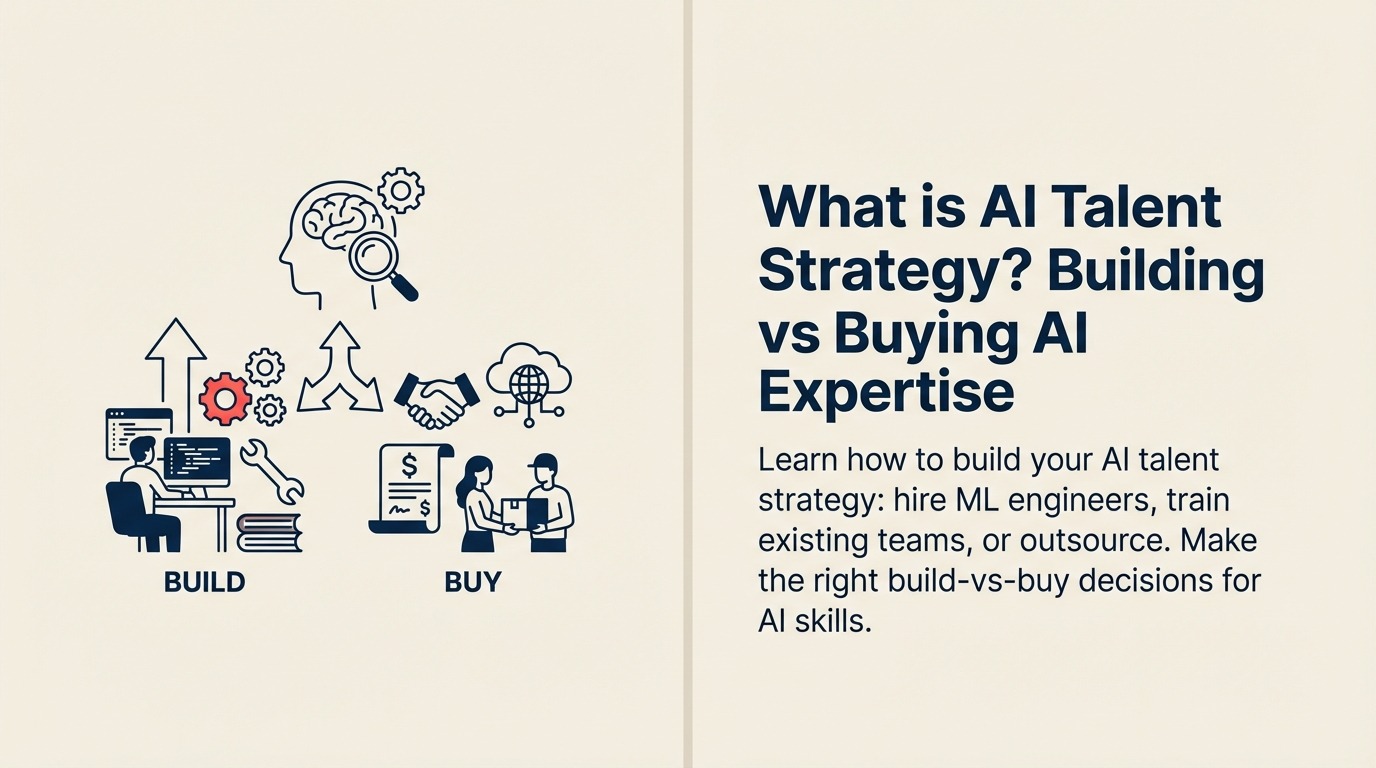
Your competitors are hiring AI engineers at $300K+ salaries. Should you join the bidding war? Or train your existing team? Or outsource entirely? Your AI talent strategy determines whether your AI investments deliver returns or burn cash.
Defining AI Talent Strategy
AI talent strategy is the systematic approach to acquiring, developing, and retaining the human capabilities required to build, deploy, and maintain AI systems that drive business value. It encompasses decisions about building internal expertise, partnering with external resources, and developing organizational AI literacy.
According to McKinsey, "The AI talent gap is the top barrier to AI adoption, with 63% of executives citing lack of skills as their primary challenge." The strategy emerged as organizations realized that buying AI tools without the talent to use them effectively wastes investment.
Unlike traditional tech hiring, AI talent strategy must address rapidly evolving machine learning capabilities, scarce specialized skills, and the need for cross-functional collaboration between data scientists, domain experts, and business leaders.
Executive Perspective
For business leaders, AI talent strategy is your answer to the build-vs-buy question that determines whether you'll own your AI future or rent it indefinitely – the difference between sustainable competitive advantage and perpetual vendor dependence.
Think of AI talent like manufacturing capability. You can own the factory (internal team), lease space (consultants), or outsource production (vendors). Each choice has implications for control, costs, and strategic flexibility.
In practical terms, AI talent strategy means deciding which AI capabilities to develop in-house, what skills your leadership team needs, whether to create an AI Center of Excellence, and how to upskill thousands of employees for the AI era.
Core Talent Roles
Critical AI roles to consider:
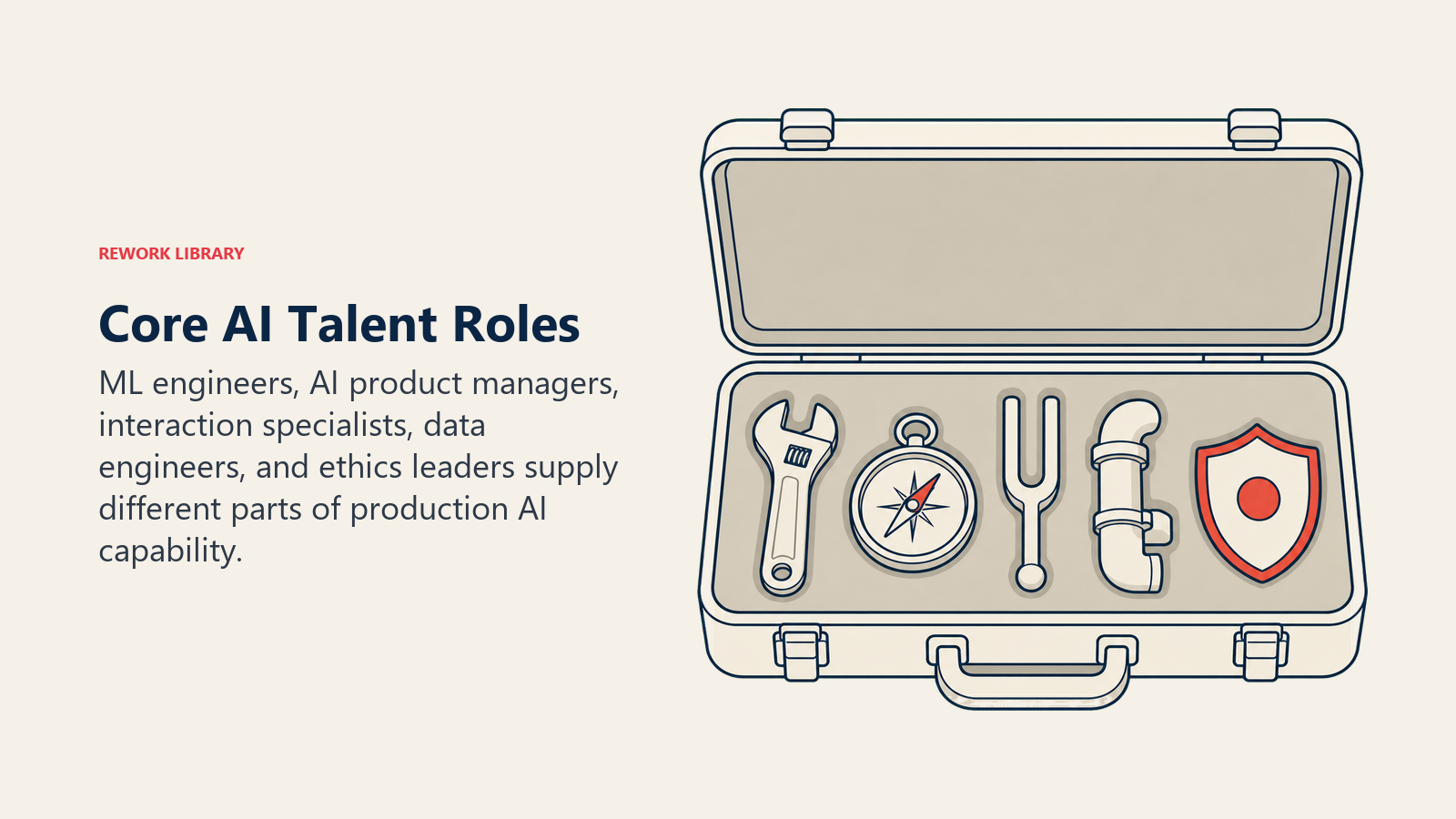
• ML Engineers: Build and optimize models, require deep technical expertise in algorithms and infrastructure, typical salary $150-300K
• AI Product Managers: Translate business needs into AI solutions, bridge technical and business teams, don't need coding but must understand AI capabilities
• Prompt Engineers: Optimize large language model interactions, relatively new role with lower barrier to entry, salary $80-150K
• Data Engineers: Build data pipelines that feed AI systems, often more critical than ML engineers for success
• AI Ethics Officers: Ensure responsible AI aligned with AI governance policies, increasingly required for regulated industries
The Build-Train-Buy Framework
Organizations face three strategic options:
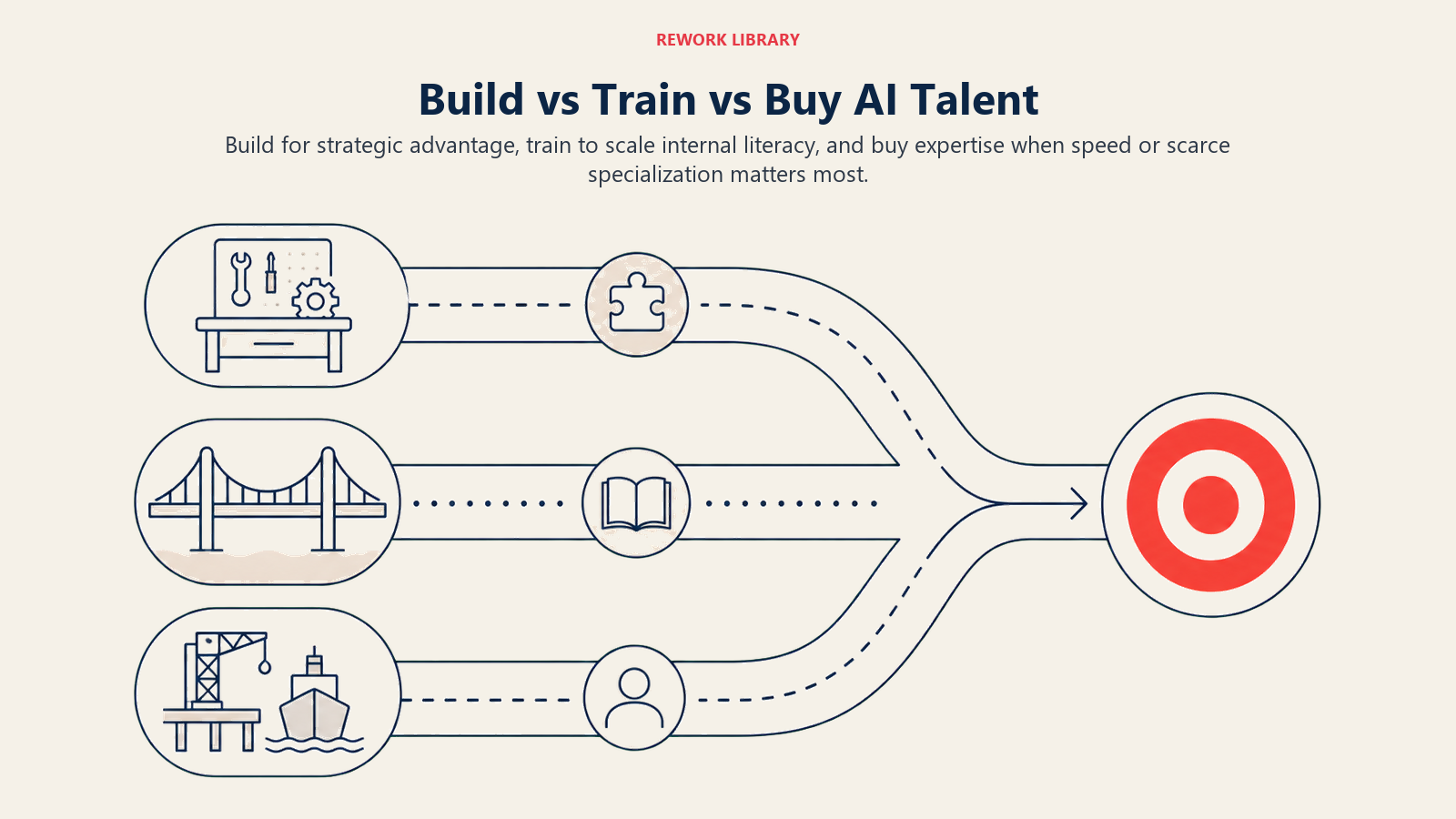
Option 1: Build Internal Team Best for: Core competitive capabilities Investment: High upfront cost, long-term value Timeline: 12-24 months to productivity Example: Google's AI teams driving search advantage
Option 2: Train Existing Employees Best for: Scaling AI literacy organization-wide Investment: Moderate training costs, high retention value Timeline: 3-6 months for basic proficiency Example: AT&T's $1B workforce reskilling program
Option 3: Buy External Expertise Best for: Speed-to-market and specialized needs Investment: Premium rates, flexible engagement Timeline: Immediate availability Example: Startups using AI consultancies to launch fast
Most successful strategies combine all three approaches based on criticality and scarcity of skills.
Talent Acquisition Strategies
Approaches to building your team:
Traditional Hiring:
- Compete for scarce PhDs in competitive market
- Offer $300K+ compensation packages
- Expect 6-12 month hiring cycles
- Risk: Talent war with tech giants
Alternative Talent Pools:
- Boot camp graduates with 3-6 month training
- Career switchers from physics, math backgrounds
- Remote international talent at 50% cost savings
- Risk: Quality variability and retention challenges
Acqui-hiring:
- Acquire small AI companies for their teams
- Fast track to experienced team
- Typical cost: $1-3M per engineer
- Risk: Integration and culture fit issues
Training and Development Models
Approaches to upskilling your workforce:
Executive AI Literacy:
- 2-day workshops on AI capabilities and limitations
- Focus on strategic decision-making, not coding
- ROI: Better project prioritization and oversight
- Investment: $5-10K per executive
Technical Upskilling:
- 3-6 month intensive programs for engineers
- Hands-on projects with machine learning tools
- ROI: Convert $100K engineers to $150K AI specialists
- Investment: $10-20K per employee
Organization-wide AI Skills:
- Prompt engineering training for all knowledge workers
- Focus on using AI tools effectively, not building them
- ROI: 20-30% productivity gains across organization
- Investment: $500-1,000 per employee
Organizational Models
Structure options for AI teams:
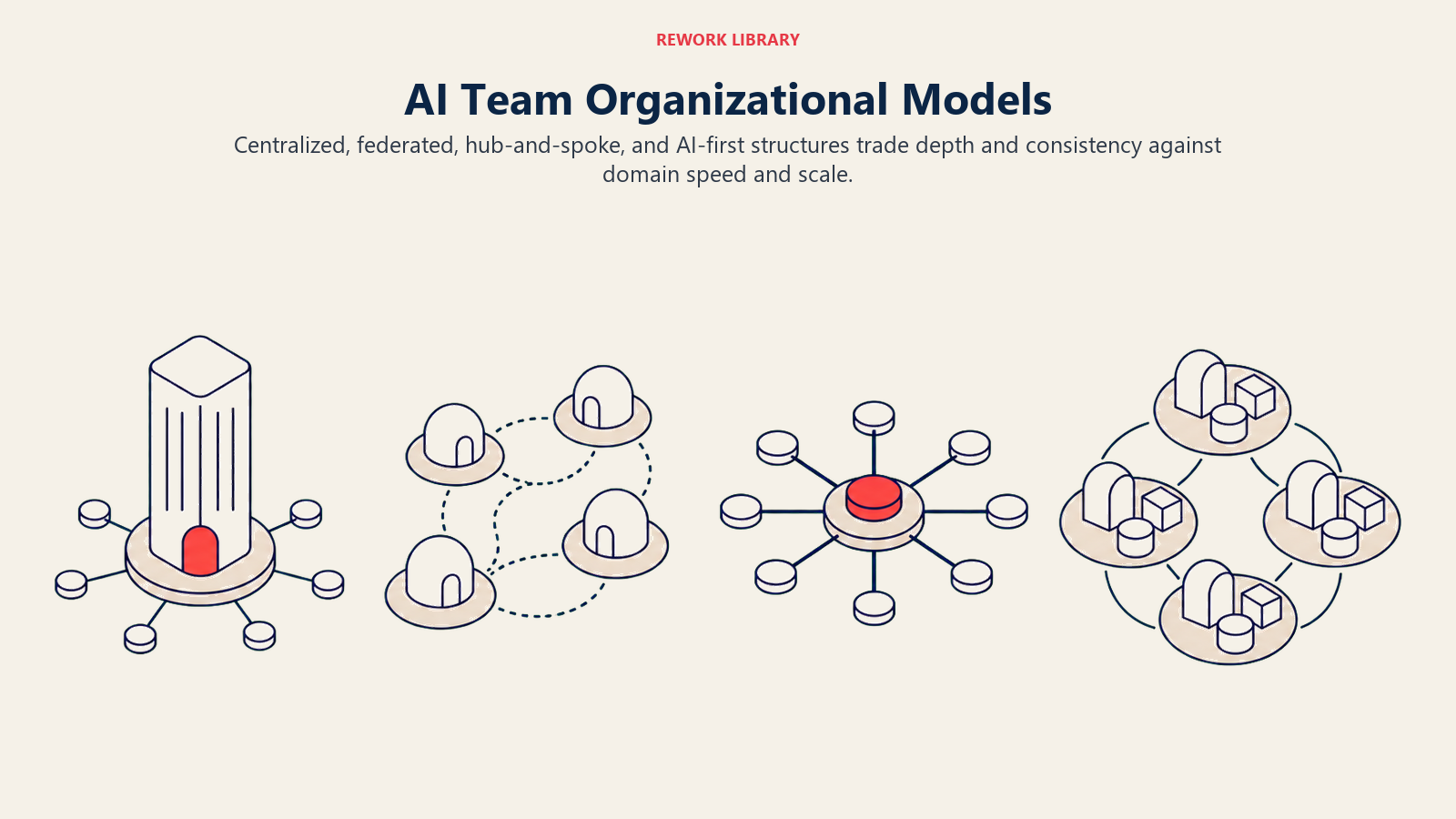
Centralized AI Team:
- Single team serves entire organization
- Pros: Deep expertise, consistent standards
- Cons: Bottleneck for scaling, disconnect from business
- Best for: Early-stage AI adoption
Federated Model:
- AI capabilities in each business unit
- Pros: Domain expertise, faster execution
- Cons: Inconsistent quality, duplicated effort
- Best for: Large organizations with distinct businesses
Hub and Spoke:
- Central excellence team + embedded specialists
- Pros: Expertise sharing with business alignment
- Cons: Complex coordination and reporting
- Best for: Scaling AI across multiple units
AI-First Organization:
- Every team has AI capabilities
- Pros: Maximum agility and innovation
- Cons: Requires massive investment and culture change
- Best for: Tech companies and AI-native startups
Real-World Talent Strategies
Organizations winning the AI talent war:
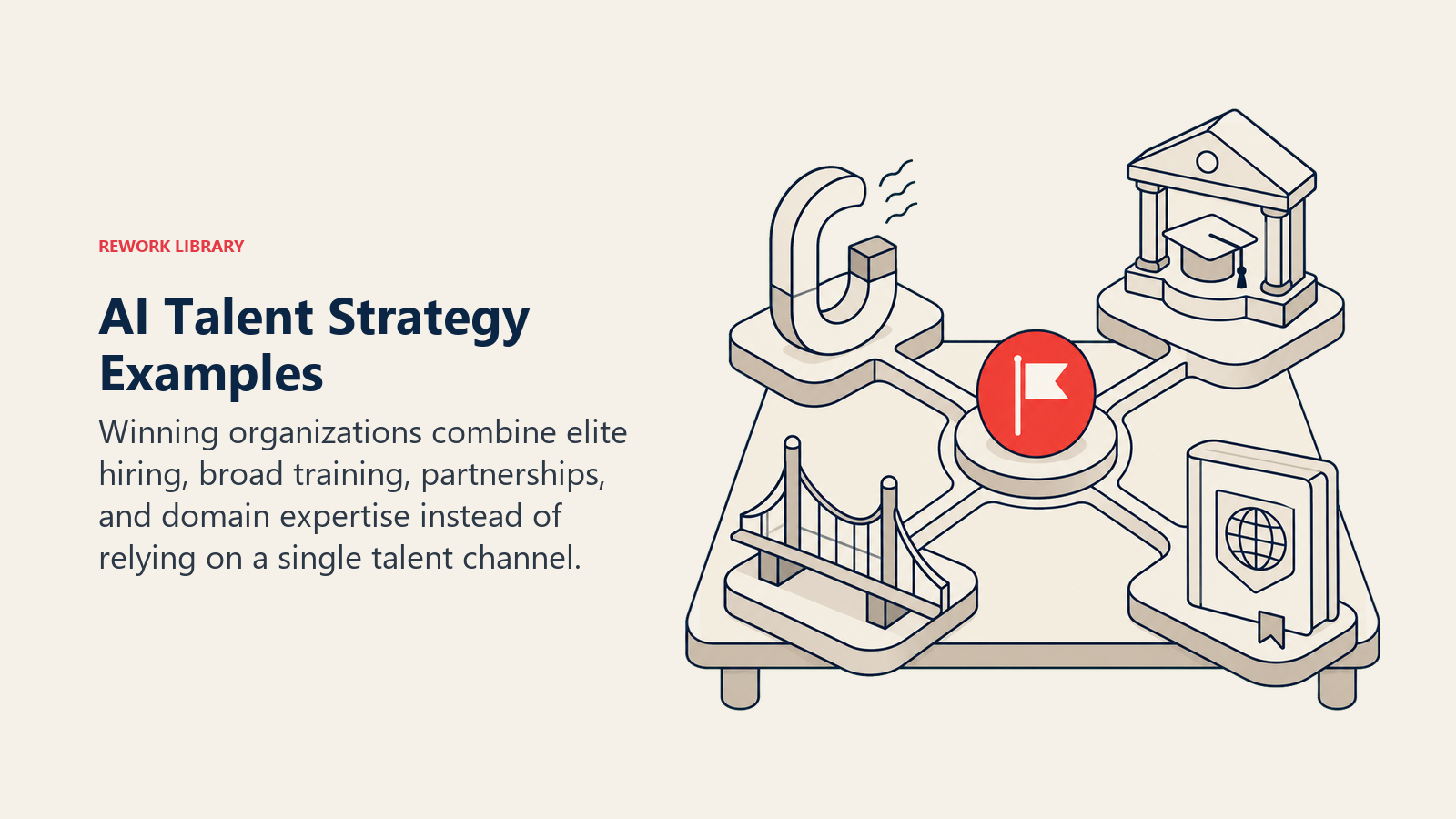
Technology Example: Microsoft's AI talent strategy combines aggressive PhD recruitment, $10B OpenAI partnership for expertise access, and mandatory AI training for all product managers, resulting in AI features across their entire product portfolio within 18 months.
Financial Services Example: JPMorgan Chase created an internal AI university training 10,000 employees while hiring 1,500 AI specialists, enabling deployment of 400+ AI use cases while building long-term capability rather than vendor dependence.
Retail Example: Walmart's strategy focused on training existing domain experts in AI rather than hiring data scientists, resulting in higher success rates because AI solutions addressed real business problems understood by practitioners.
Common Strategy Mistakes
Pitfalls to avoid:
• Unicorn Hunting: Seeking impossible combination of skills → Solution: Hire for potential and train, focus on complementary team skills
• Random Acts of Hiring: Hiring AI talent without clear strategy → Solution: Define use cases first, then talent needs
• Training Theater: Courses without application → Solution: Learning tied to real projects with measurable outcomes
• Vendor Dependence: Outsourcing all AI work → Solution: Maintain "intelligent buyer" capability internally
• Ignoring Culture: Hiring AI talent into non-AI culture → Solution: Create environment where AI talent thrives including autonomy, resources, and leadership support
ROI Calculation Framework
Evaluating your talent investments:
Internal Team ROI:
- Cost: $150K average salary + 50% overhead = $225K per engineer
- Output: 2-4 production AI features per year
- Value: $500K-2M per feature depending on use case
- Break-even: 12-18 months with sustained value
Training ROI:
- Cost: $10K training + 3 months partial productivity loss = $40K
- Benefit: 20% productivity gain = $20K annual value per $100K employee
- Break-even: 2 years with compounding benefits
Outsourcing ROI:
- Cost: $200-400 per hour for consultants = $400K-800K per project
- Benefit: Fast delivery + knowledge transfer
- Trade-off: Higher cost but lower risk and faster time-to-value
Building Your Strategy
Steps to effective AI talent approach:
- Understand team structure with AI Center of Excellence
- Manage talent retention through AI Change Management
- Build strategic capability for AI Competitive Advantage
- Implement MLOps to maximize team productivity
Frequently Asked Questions about AI Talent Strategy
What is AI Talent Strategy?
AI talent strategy is the systematic approach to acquiring, developing, and retaining human capabilities required to build, deploy, and maintain AI systems that drive business value, encompassing decisions about building internal expertise, partnering with external resources, and developing organizational AI literacy.
What are the critical AI roles I need to hire?
ML Engineers (build models, $150-300K), AI Product Managers (translate business to AI solutions), Prompt Engineers (optimize LLM interactions, $80-150K), Data Engineers (build data pipelines), and AI Ethics Officers (ensure responsible AI).
Should I build, train, or buy AI talent?
Most successful strategies combine all three: Build internal teams for core competitive capabilities, Train existing employees for organization-wide AI literacy, and Buy external expertise for speed and specialized needs. Choice depends on criticality and scarcity of skills.
What are the three organizational models for AI teams?
Centralized AI Team (single team serves entire organization, best for early-stage), Federated Model (AI in each business unit, best for large organizations), and Hub and Spoke (central excellence team plus embedded specialists, best for scaling).
How do I calculate ROI on AI talent investments?
Internal Team: $225K per engineer producing 2-4 features worth $500K-2M each, breaks even in 12-18 months. Training: $40K cost generating $20K annual value per employee, breaks even in 2 years. Outsourcing: $400K-800K per project with faster delivery but higher cost.
External Resources
- LinkedIn Talent Insights - AI hiring trends and benchmarks
- Stanford AI Index - AI talent market data
- Coursera for Business - AI training programs
Related Resources
Explore these related concepts to deepen your understanding of AI talent:
- AI Center of Excellence - Organizational structure for building AI capability
- Prompt Engineering - Essential skill for AI-enabled workforce
- MLOps - Infrastructure and practices your AI team needs
- AI Governance - Framework for managing AI talent and outputs
Part of the AI Terms Collection. Last updated: 2026-02-09

Co-Founder, Rework.com
On this page
- Defining AI Talent Strategy
- Executive Perspective
- Core Talent Roles
- The Build-Train-Buy Framework
- Talent Acquisition Strategies
- Training and Development Models
- Organizational Models
- Real-World Talent Strategies
- Common Strategy Mistakes
- ROI Calculation Framework
- Building Your Strategy
- External Resources
- Related Resources