What are AI Guardrails? Your Safety Net for AI Deployment
Turn this article into takeaways for your work.


Each assistant summarizes the article only for you and suggests best practices for your work.
Your customer service AI starts giving medical advice. Your chatbot generates offensive content. Your AI assistant shares confidential information with the wrong person. These nightmares keep executives awake, and guardrails are the solution. Effective guardrails determine whether AI is a liability or an asset.
The Safety Innovation
AI guardrails emerged as a critical discipline when businesses started deploying large language models at scale in 2023. Early deployments without proper guardrails led to high-profile failures: chatbots generating harmful content, AI sharing private information, and systems producing biased outputs.
NIST defines AI guardrails as "technical and operational controls that constrain AI system behavior, preventing outputs that violate safety policies, ethical standards, legal requirements, or operational boundaries while maintaining system utility."
The field evolved rapidly from simple content filters to sophisticated multi-layer systems combining input validation, output verification, and behavioral constraints.
Guardrails in Business Terms
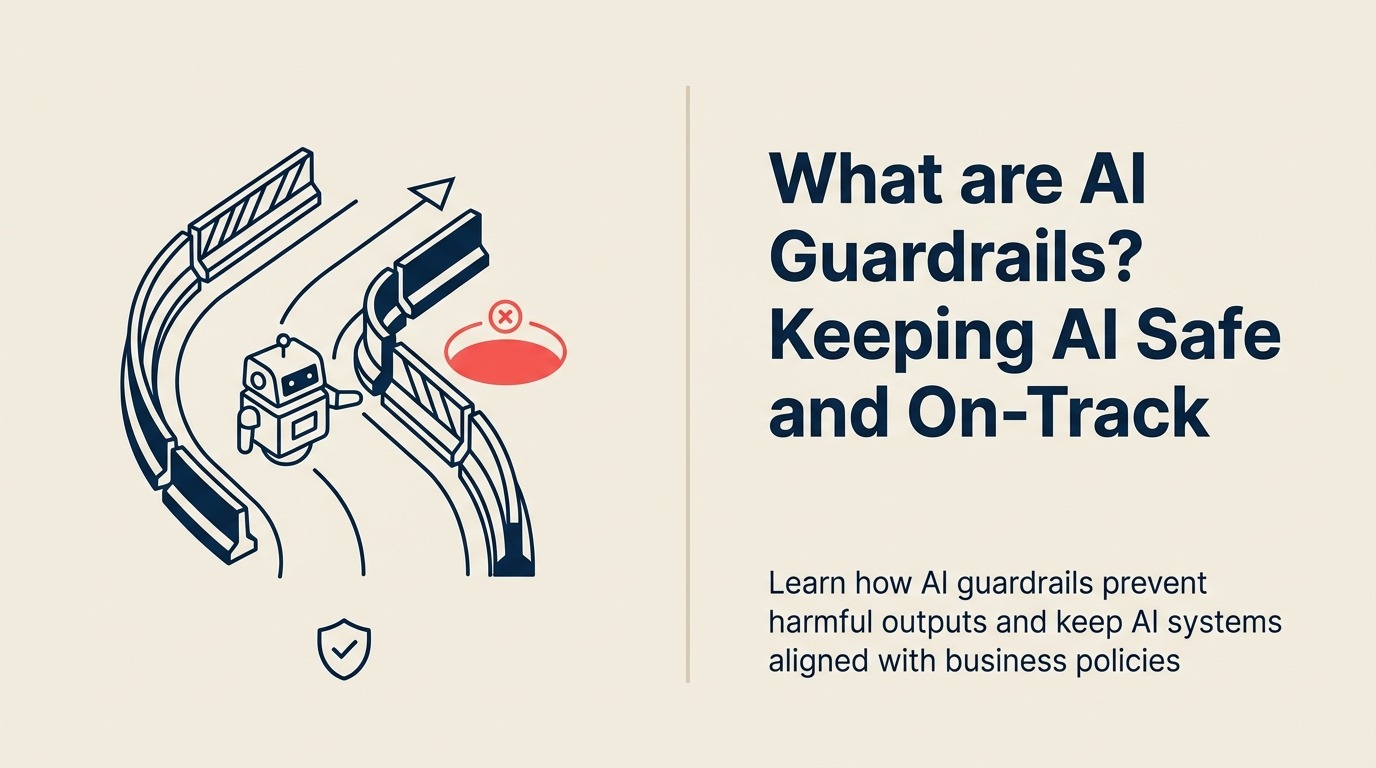
For business leaders, AI guardrails are safety mechanisms that prevent AI from generating harmful, biased, confidential, or off-topic content, ensuring your AI systems stay aligned with company policies, legal requirements, and brand values.
Think of guardrails as both training and supervision. Just as you train employees on company policies and monitor compliance, guardrails teach AI acceptable behavior and automatically block violations before they reach users.
In practical terms, this means preventing customer service AI from making commitments your company can't keep, stopping chatbots from engaging with inappropriate topics, and ensuring AI respects data privacy regardless of how cleverly someone prompts it.
Guardrail Components
AI guardrail systems consist of these essential layers:
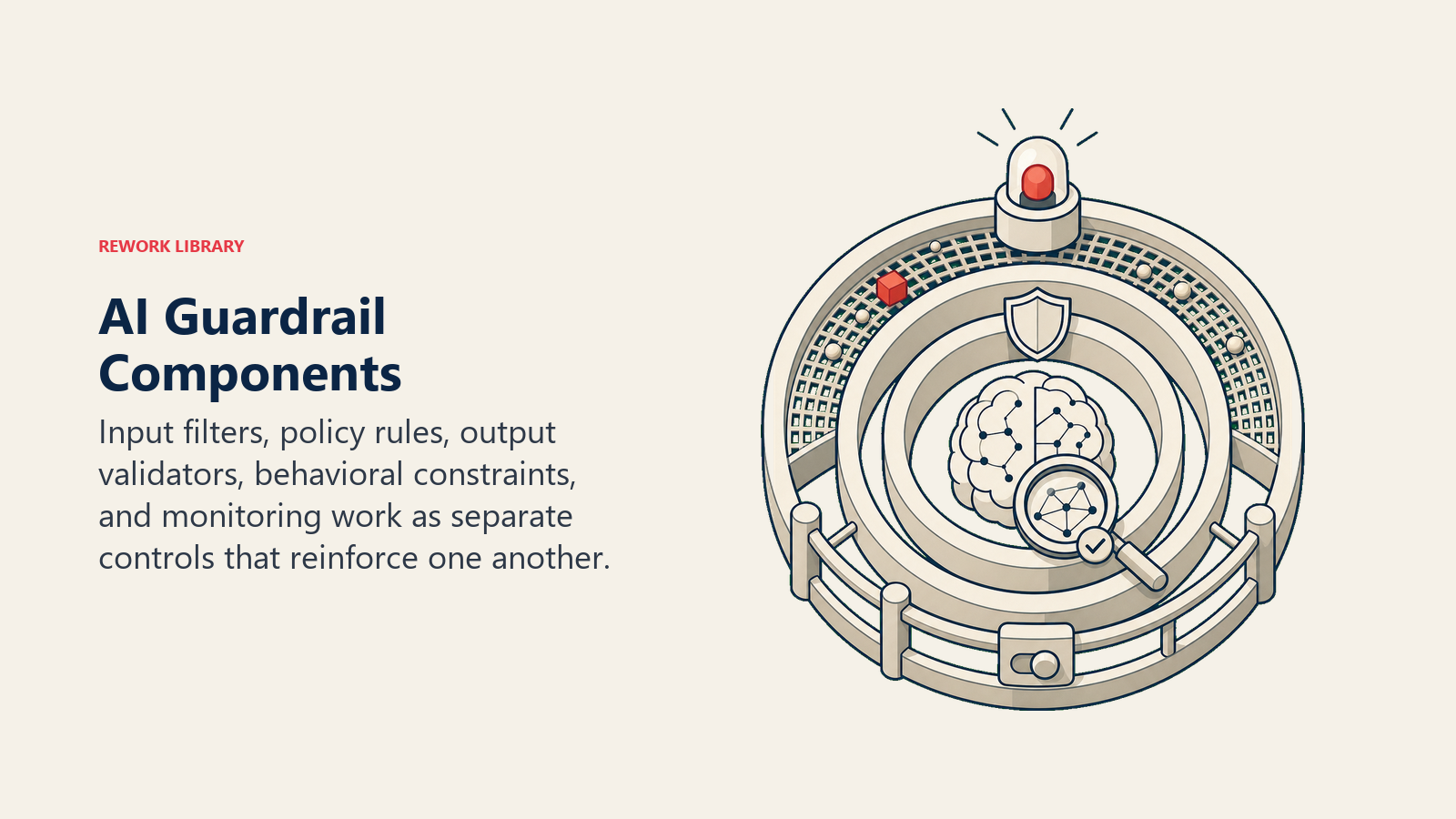
• Input Filters: Front-line defense that detects problematic user inputs like jailbreak attempts, injection attacks, or requests for prohibited content before processing
• Content Policies: Defined boundaries specifying what topics, behaviors, and outputs are acceptable, creating clear rules the AI must follow
• Output Validators: Checks that review generated content before delivery, scanning for policy violations, sensitive data, hallucinations, or harmful content
• Behavioral Constraints: Rules governing how AI responds to edge cases, like refusing medical advice or escalating sensitive requests to humans
• Monitoring Systems: Continuous tracking of AI behavior to detect policy violations, emerging risks, and patterns requiring policy updates
How Guardrails Work
Guardrail systems operate through multiple checkpoints:
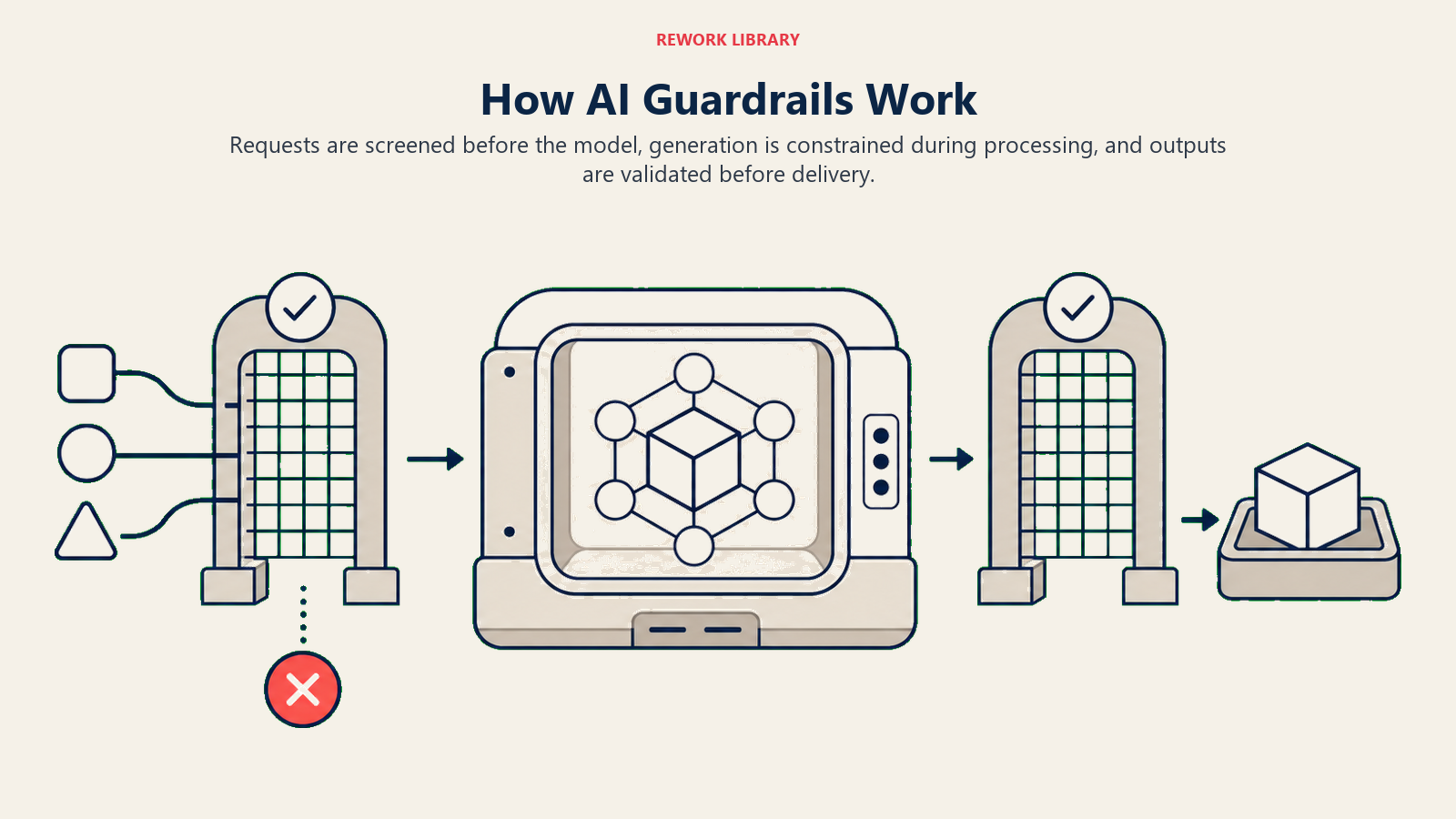
Pre-Processing: User input passes through filters checking for prompt injection, jailbreak attempts, and prohibited topics before reaching the AI model
Generation Constraints: The AI generates responses within defined boundaries, guided by system prompts and fine-tuning that reinforce acceptable behavior
Post-Processing: Generated output undergoes validation checking for policy compliance, sensitive data, factual accuracy, and brand alignment before delivery
This multi-layer approach ensures safety even if individual layers fail, creating robust protection against both intentional attacks and accidental violations.
Types of Guardrails
Different guardrail approaches serve different needs:
Type 1: Content Guardrails Best for: Preventing harmful outputs Key feature: Topic and language filtering Example: Blocking profanity, violence, adult content
Type 2: Factual Guardrails Best for: Ensuring accuracy Key feature: Verification and validation using retrieval-augmented generation Example: Preventing hallucinations, requiring citations
Type 3: Privacy Guardrails Best for: Protecting sensitive data Key feature: PII detection and masking Example: Preventing disclosure of customer information
Type 4: Operational Guardrails Best for: Maintaining scope Key feature: Topic and capability boundaries Example: Customer service AI staying within support topics
Guardrail Success Stories
Here's how businesses implement effective guardrails:
Healthcare Example: Kaiser Permanente's AI assistant uses multi-layer guardrails preventing medical diagnosis, requiring verification of treatment information, and escalating complex cases to professionals, maintaining zero HIPAA violations across 2M+ interactions.
Financial Services Example: JPMorgan's contract AI employs guardrails ensuring legal compliance, preventing unauthorized commitments, and requiring human review for high-risk clauses, processing 12,000 agreements annually with 100% policy compliance.
Retail Example: Amazon's recommendation AI uses guardrails preventing age-inappropriate suggestions, respecting user preferences, and blocking problematic product associations, maintaining brand safety across billions of recommendations.
Implementing Guardrails
Ready to deploy AI safely?
- Understand Large Language Models behavior
- Learn Prompt Engineering for system prompts
- Explore AI Red Teaming for testing
- Study AI Orchestration for complex systems
Learn More
Expand your understanding of related AI safety concepts:
- AI Hallucination - Understanding and preventing false outputs
- Fine-tuning - Building safety into model behavior
- AI Agents - Applying guardrails to autonomous systems
- Responsible AI - Broader AI ethics framework
External Resources
- Anthropic's Constitutional AI Research - Safety frameworks and guardrail implementation
- OpenAI Safety Systems - Technical approaches to AI safety and alignment
- Google's Responsible AI Practices - Industry guidelines for safe AI deployment
Frequently Asked Questions about AI Guardrails
What are AI Guardrails?
AI guardrails are technical and operational controls that constrain AI system behavior, preventing outputs that violate safety policies, ethical standards, legal requirements, or operational boundaries while maintaining usefulness.
What's the difference between guardrails and content moderation?
Content moderation reviews output after generation. Guardrails are multi-layer systems including input filters, generation constraints, output validators, and behavioral rules that work before, during, and after AI processing.
What are the main types of AI guardrails?
Content Guardrails (preventing harmful outputs), Factual Guardrails (ensuring accuracy), Privacy Guardrails (protecting sensitive data), and Operational Guardrails (maintaining scope and boundaries).
What components make up a guardrail system?
Input filters (detect problematic requests), content policies (define boundaries), output validators (check generated content), behavioral constraints (govern edge cases), and monitoring systems (track violations).
Part of the AI Terms Collection. Last updated: 2026-02-09
