What is LLMOps? Running Large Language Models in Production
Turn this article into takeaways for your work.


Each assistant summarizes the article only for you and suggests best practices for your work.
LLMOps is the set of operational practices for deploying, monitoring, and maintaining large language model (LLM) applications in production. It covers prompt management, evaluation, retrieval pipelines, cost and latency monitoring, and safety guardrails, the work that keeps an LLM feature reliable after it ships, not just when it demos well.
A prototype that answers questions correctly in a Friday demo and a feature that holds up for 50,000 users a day are different engineering problems. The model is the same. Everything around it, how prompts get versioned, how quality gets measured, how a bad response gets caught before a customer sees it, is not. That surrounding discipline is LLMOps.
Why LLMOps Exists as Its Own Discipline
Teams that already run MLOps sometimes ask why LLMs need a separate playbook. The answer is that LLM applications fail in ways traditional ML models don't, and traditional ML tooling wasn't built to catch them.
A classic ML model, a churn predictor or a fraud scorer, takes structured input and returns a number. You can write a unit test for it: input X should produce output near Y. An LLM takes unstructured text, a prompt, and returns unstructured text, a response, and there's no single correct answer to check against. The same question asked twice can produce two different, both defensible, responses. Quality is probabilistic, not binary.
LLM applications also introduce failure modes that don't exist in classic ML: a prompt template that silently breaks when a vendor updates their model, a retrieval step that returns the wrong document and the model confidently answers from it anyway, a cost spike because someone added one more paragraph to a system prompt that runs on every request. None of these show up as a training metric. They show up in production, often quietly, which is exactly the kind of problem AI observability exists to catch.
The LLMOps Lifecycle
LLMOps isn't one tool or one step. It's a set of connected practices that run continuously once an LLM feature ships.
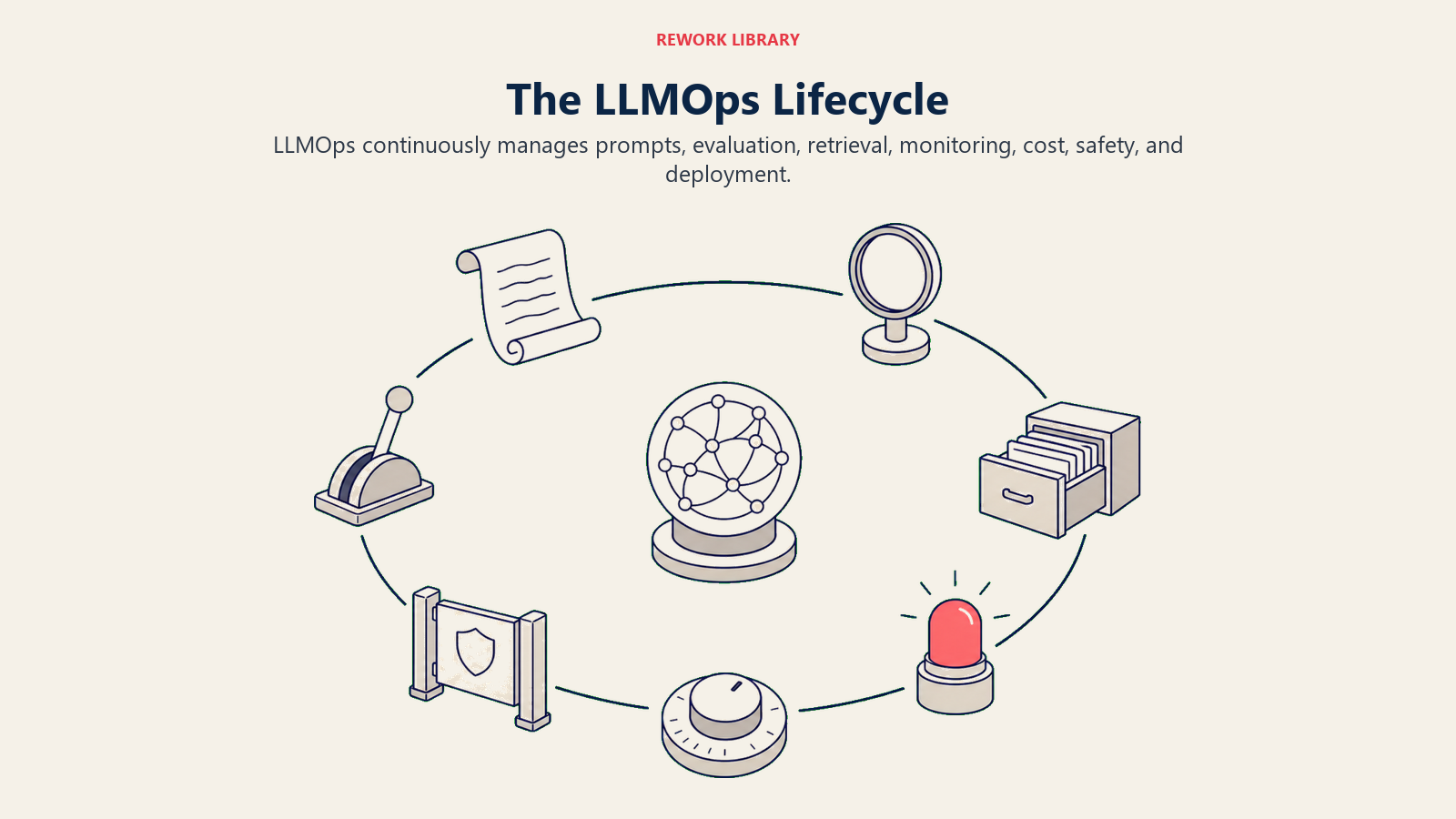
Prompt management. Prompts are the interface between your application and the model, and they need the same discipline as code: version control, change review, and rollback. A prompt that works well against one model version can degrade against the next one, silently, unless someone is tracking which prompt version shipped with which model version and what happened to output quality when either changed.
Evaluation. Because LLM outputs aren't checkable with a simple assertion, teams build evaluation sets: representative inputs paired with graded expected behavior, scored by automated scorers, reference models, or human raters. Evals run before a prompt or model change ships (to catch regressions) and continuously in production (to catch drift). Without an eval set, "did this change make the product better or worse" is a guess.
RAG pipeline management. Most business LLM applications use retrieval-augmented generation to ground responses in company data rather than relying on what the model memorized during training. LLMOps covers the retrieval half of that pipeline too: keeping the knowledge base current, monitoring retrieval quality (is the system finding the right document, not just a document), and catching the case where retrieval succeeds but the model still ignores the retrieved context.
Monitoring and observability. Production LLM systems need logs of every prompt and response, traces of multi-step chains, and metrics on latency, error rate, and output quality over time. This is the same three-pillar discipline used across AI observability generally, applied specifically to prompts, tokens, and model calls.
Cost and latency management. Every LLM call has a per-token cost and a response-time cost, and both scale directly with usage. LLMOps tracks cost per request, cost per feature, and latency percentiles, and applies techniques like caching, prompt trimming, and model routing (sending easy queries to a cheaper model and hard ones to a frontier model) to keep both under control as traffic grows.
Guardrails and safety. Production LLM applications need checks that run before a response reaches a user: filtering for harmful content, catching prompt injection attempts, blocking outputs that leak sensitive data, and enforcing that the model stays on-topic for its intended use case. Guardrails are the last line of defense between a model's raw output and the person reading it.
Deployment and versioning. Rolling out a new prompt, a new model version, or a new retrieval index needs the same staged-rollout discipline as any production software change: canary releases, A/B comparison against the current version, and a fast rollback path when an eval score or a user-facing metric moves the wrong way.
LLMOps vs. MLOps
LLMOps grew out of MLOps, and the two share a lot of DNA: both care about versioning, monitoring, and reliable deployment. But the object being operated on is different enough that the practices diverge in specific ways.
| Dimension | MLOps | LLMOps |
|---|---|---|
| Core artifact | A trained model with fixed, numeric outputs | A prompt plus a model (often a third-party API, not something you trained) |
| Quality check | Accuracy, precision, recall against a labeled test set | Evaluation sets scored by automated scorers, reference models, or human raters |
| Primary failure mode | Data drift, model decay, degraded accuracy over time | Hallucination, prompt regression, retrieval failure, silent vendor model changes |
| What gets versioned | Model weights, training data, feature pipelines | Prompt templates, retrieval indexes, model version, and the combination of all three |
| Cost driver | Training compute (mostly front-loaded, then periodic retraining) | Inference (ongoing, scales directly with usage, per API call) |
| Typical deployment | You train and own the model | You often call someone else's model via API and operate everything around it |
The practical takeaway: if your team already runs MLOps, you're not starting from zero. But an MLOps pipeline built for a churn model won't catch a prompt regression or a retrieval failure, because it was never built to look for those things.
The LLMOps Tools Landscape
The tooling category is young and still consolidating, but a few types of tools have become common in production LLM stacks.
Observability and tracing platforms like LangSmith and Langfuse capture the full trace of a request through prompts, retrieval calls, and model responses, so teams can debug a specific bad output by replaying exactly what the system saw and returned.
Evaluation and monitoring platforms like Arize handle both offline evals (before a change ships) and production monitoring (drift, quality scores, and anomaly detection on live traffic), often across both traditional ML and LLM workloads in the same platform.
Experiment tracking tools like Weights and Biases, originally built for classic ML training runs, have extended into prompt and LLM experiment tracking, letting teams compare prompt variants and model versions side by side with logged metrics.
Most teams don't adopt all of these at once. A common starting point is structured logging of every LLM call (prompt, response, model version, token counts, latency), then layering in a dedicated observability platform once the volume of production traffic makes manual review impractical, then adding systematic evaluation once there's enough logged data to build a representative eval set. Our LLM observability platform comparison prices 12 of them at real trace volume.
Key Facts
- Gartner predicts that 40% of organizations deploying AI will use dedicated AI observability tools to monitor model performance, bias, and outputs by 2028, per a Gartner press release on AI observability adoption.
- Gartner predicts at least 30% of generative AI projects will be abandoned after proof of concept by the end of 2025, citing poor data quality, inadequate risk controls, escalating costs, or unclear business value.
- 74% of executives report first-year ROI from AI deployments, but only 39% report enterprise-level EBIT impact, according to McKinsey's State of AI research on the gap between piloting and scaling AI.
- Enterprise generative AI software spend reached $37 billion in 2025, up from $11.5 billion in 2024, a 3.2x year-over-year increase, according to Menlo Ventures' 2025 State of Generative AI in the Enterprise report.
- Only 16% of enterprise AI deployments qualify as true autonomous agents, with most production systems still built around fixed-sequence or routing-based workflows around a single model call, per the same Menlo Ventures report.
- 37% of enterprises now use five or more models in production, up from 29% the year before, according to a16z's 2025 enterprise AI report, a sign of the multi-model orchestration LLMOps increasingly has to manage.
Why LLMOps Matters for Enterprise AI
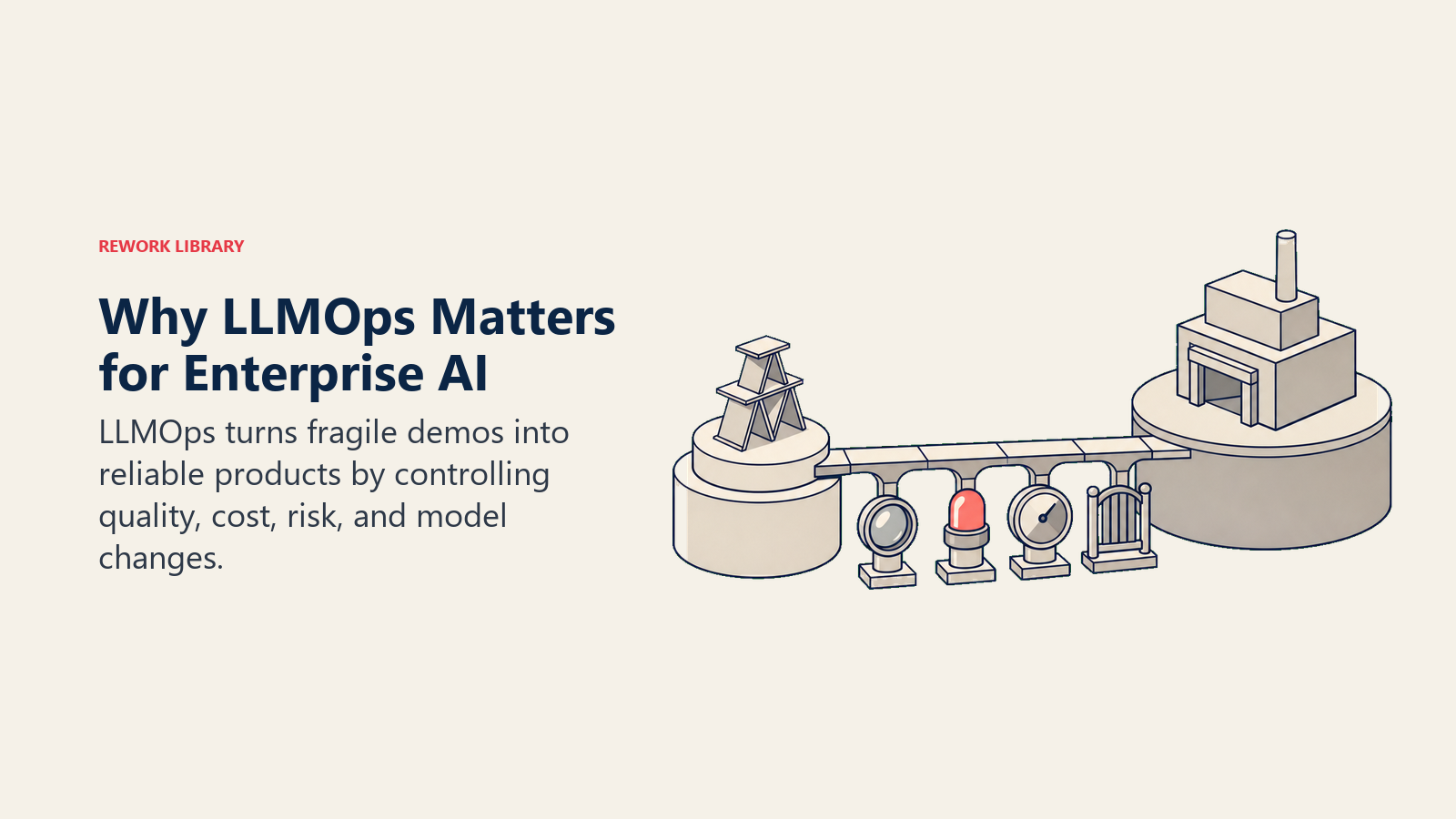
The gap between a working demo and a production-grade LLM feature is exactly where most enterprise AI initiatives stall. Gartner's prediction that 30% of generative AI projects get abandoned after proof of concept, and the Menlo Ventures finding that most deployments are still simple single-model workflows rather than mature agentic systems, both point at the same underlying problem: building the model call is the easy part. Operating it reliably, at scale, with predictable cost and acceptable risk, is the part that separates a pilot from a product.
That's also where the McKinsey ROI gap shows up. 74% of executives report some first-year return, but only 39% see impact at the enterprise level, which tracks with what happens when a team ships an LLM feature without the operational layer around it. It works for the first few hundred users, then a prompt update silently breaks it, or costs spike as usage grows, or nobody notices output quality sliding until a customer complains. LLMOps is the difference between an AI feature that survives contact with real usage and one that has to be quietly walked back six months in.
The multi-model trend adds another layer: a16z found enterprises are increasingly running five or more models in production rather than betting on one, routing routine tasks to cheaper models and reserving frontier models for harder reasoning. That routing decision, and the cost and quality tracking it requires, is itself an LLMOps function. As LLM applications get more complex, from single prompts to RAG pipelines to multi-step agentic workflows, the operational surface area grows with them. Teams that treat LLMOps as an afterthought tend to find out about problems from users. Teams that build it in from the start find out from their own monitoring, before it becomes a support ticket.
Frequently Asked Questions about LLMOps
What is LLMOps?
LLMOps is the set of operational practices for deploying, monitoring, and maintaining large language model applications in production. It covers prompt management, evaluation, RAG pipeline management, observability, cost and latency control, and safety guardrails, the work required to keep an LLM feature reliable after launch.
How is LLMOps different from MLOps?
MLOps operates on a trained model with numeric, checkable outputs and focuses on data drift and model decay. LLMOps operates on a prompt plus a model, often accessed via API rather than trained in-house, and focuses on prompt regressions, hallucination, and retrieval failures. LLMOps borrows MLOps' discipline around versioning and monitoring but applies it to a different set of failure modes.
Do you need specialized LLMOps tools to get started?
Not on day one. Many teams start with structured logging of every LLM call (prompt, response, model version, tokens, latency) in their existing systems. Dedicated platforms like LangSmith, Langfuse, Arize, or Weights and Biases add value once production traffic volume makes manual review impractical or once you need systematic evaluation at scale.
What is a prompt evaluation set and why does it matter?
An evaluation set is a collection of representative inputs paired with graded expected behavior, scored by automated scorers, reference models, or human raters. Because LLM outputs aren't checkable with a simple pass/fail assertion the way traditional software is, an eval set is how teams catch whether a prompt or model change made the product better or worse before it ships.
How does RAG fit into LLMOps?
Retrieval-augmented generation adds a retrieval step before the model generates a response, grounding it in company data. LLMOps covers keeping that retrieval pipeline healthy: monitoring whether the system finds the right documents, catching cases where the model ignores good retrieved context, and keeping the underlying knowledge base current.
What causes most LLM applications to fail once they hit real users?
Common causes include prompt regressions after a vendor updates a model, retrieval pipelines returning the wrong context, cost spikes from unmonitored token usage, and quality drift that goes unnoticed without ongoing evaluation. These failures are typically silent, they don't throw errors, they just quietly produce worse outputs, which is why observability and evaluation are core LLMOps functions rather than optional extras.
What are guardrails in LLMOps?
Guardrails are checks that run before an LLM's output reaches a user: filtering harmful content, catching prompt injection attempts, blocking sensitive data leakage, and keeping responses on-topic. They're the last operational layer between a model's raw output and the person reading it.
Is LLMOps only relevant for teams building their own models?
No. Most enterprise LLM applications call a third-party model via API rather than training one, which means LLMOps practices, prompt management, evaluation, RAG monitoring, cost tracking, and guardrails, are exactly what a team needs regardless of whether they trained the underlying model.
Related AI Concepts
- MLOps - The broader discipline LLMOps extends, covering the full machine learning lifecycle
- AI Observability - The logs, traces, and metrics discipline LLMOps applies specifically to LLM calls
- Large Language Models - The model category LLMOps exists to operate reliably
- Retrieval-Augmented Generation - The retrieval pipelines LLMOps has to keep healthy alongside the model
- AI Hallucination - A core failure mode LLMOps evaluation and guardrails are built to catch
- Inference - The production phase where LLMOps cost and latency practices apply
- Prompt Engineering - The upstream practice LLMOps versions and monitors in production
- Model Monitoring - The ongoing tracking discipline LLMOps applies to deployed LLM behavior
External Resources
- LangSmith - Observability and evaluation platform for LLM applications
- Langfuse - Open source LLM observability and tracing platform
- Arize AI - ML and LLM observability and evaluation platform
- Weights and Biases - Experiment tracking extended to LLM prompt and model comparison
