What is the EU AI Act? The World's First Comprehensive AI Law
Turn this article into takeaways for your work.


Each assistant summarizes the article only for you and suggests best practices for your work.
Your company uses AI to screen resumes, recommend products, or price services. If you have European customers or operations, the EU AI Act is now your compliance framework. It's the world's first comprehensive AI regulation, effective from 2025, creating obligations that reshape how global companies develop and deploy artificial intelligence.
Defining the EU AI Act
The EU AI Act (formally: Regulation (EU) 2024/1689) is comprehensive legislation establishing harmonized rules for artificial intelligence systems across the European Union. Adopted in 2024 and effective from August 2025, it uses a risk-based approach to regulate AI based on potential harm to fundamental rights and safety.
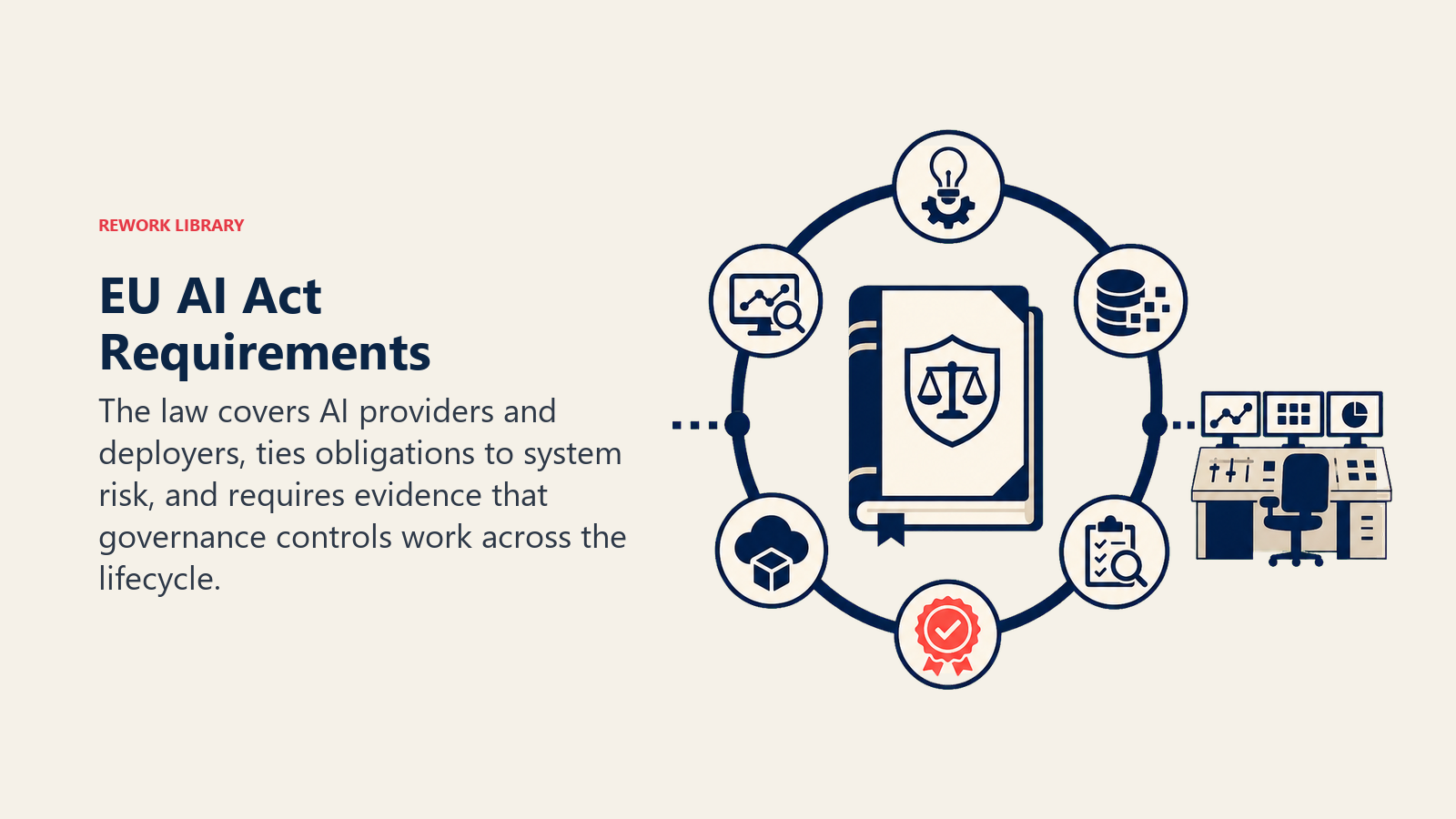
According to the European Commission, "The AI Act aims to ensure that AI systems placed on the EU market and used in the Union are safe and respect existing law on fundamental rights and Union values."
Unlike voluntary guidelines, this is binding law with significant penalties – up to €35 million or 7% of global turnover – making it comparable in impact to GDPR for data privacy.
Executive Perspective
For business leaders, the EU AI Act is your new compliance baseline that demands immediate action – waiting until enforcement begins means you're already behind, risking market access and facing substantial penalties.
Think of the AI Act like product safety regulations. Just as you can't sell unsafe products in Europe, you can't deploy high-risk AI without meeting strict requirements. It's not optional for any company serving European markets.
In practical terms, this means inventorying all AI systems, classifying their risk levels, implementing compliance measures for high-risk applications, and documenting everything before enforcement deadlines hit.
Risk-Based Classification
The Act categorizes AI into four tiers:
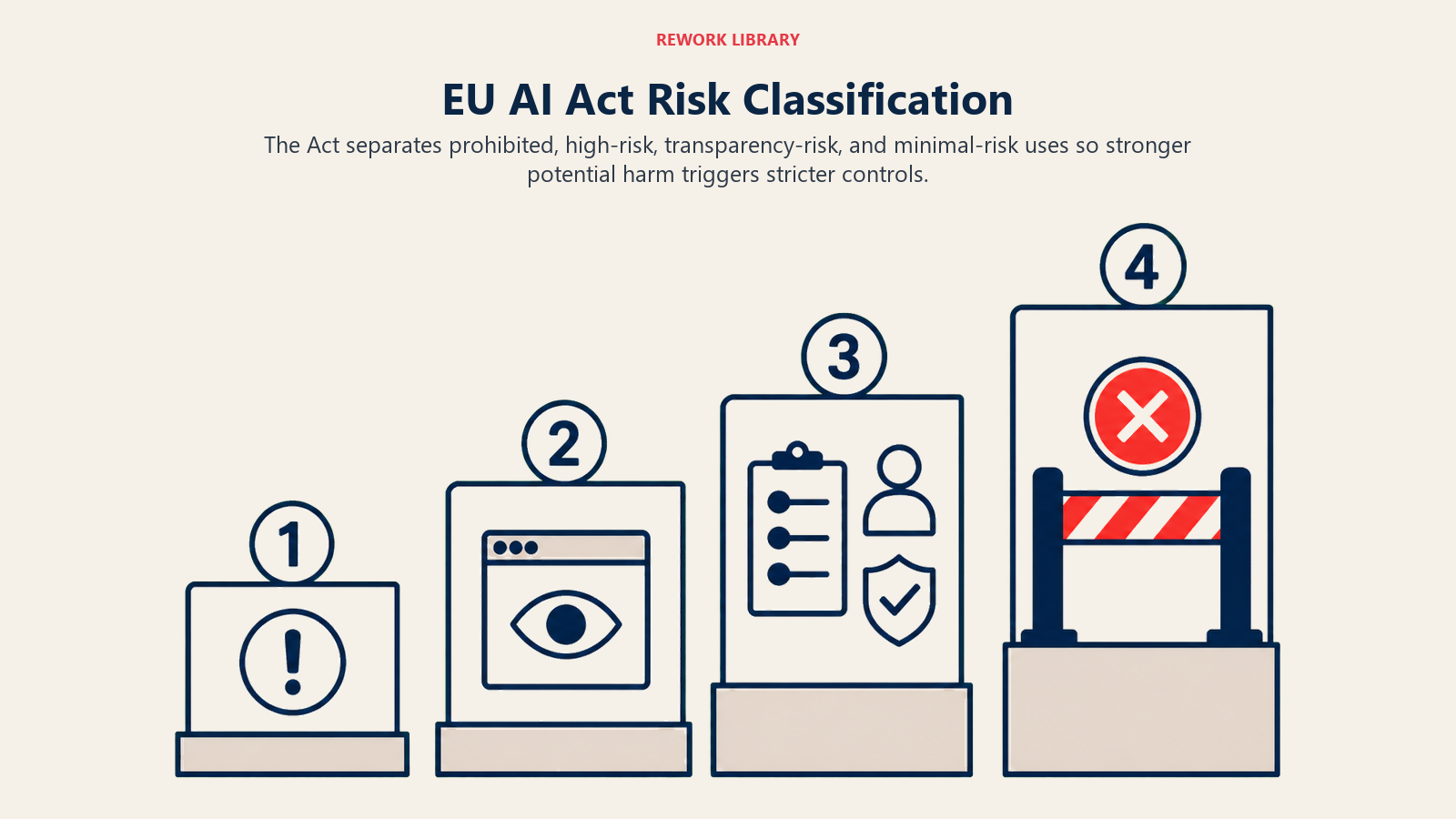
• Unacceptable Risk (Prohibited): AI systems that manipulate behavior, exploit vulnerabilities, conduct social scoring by governments, or use biometric identification in public spaces (with limited exceptions). These are banned outright.
• High Risk (Strict Requirements): AI in critical infrastructure, education, employment, essential services, law enforcement, migration, or administration of justice through machine learning systems. These face comprehensive compliance obligations.
• Limited Risk (Transparency Requirements): AI with transparency obligations like chatbots, emotion recognition, or deepfakes using generative AI. Users must know they're interacting with AI.
• Minimal Risk (No Obligations): AI in applications like video games or spam filters. Voluntary codes of conduct encouraged but not required.
Compliance Timeline
Critical deadlines for implementation:
February 2025: Prohibition of unacceptable risk AI systems takes effect
August 2025: Full AI Act enters into force with governance structures operational
August 2026: Obligations for general-purpose AI models begin, affecting large language models
August 2027: Full compliance required for high-risk AI systems already on market
Organizations should be implementing compliance programs now, not waiting for deadlines.
High-Risk AI Requirements
Detailed obligations for high-risk systems:
Before Deployment:
- Risk management system throughout lifecycle
- Data governance ensuring quality, relevance, and representativeness
- Technical documentation demonstrating compliance
- Record-keeping capabilities for traceability
- Transparency and user information requirements
- Human oversight measures through human-in-the-loop design
- Accuracy, robustness, and cybersecurity standards
During Operation:
- Continuous monitoring and incident reporting via model monitoring
- Post-market surveillance
- Serious incident reporting to authorities
- Ongoing conformity assessment
Quality Management:
- ISO-compliant quality management system
- Regular audits and reviews
- Corrective action procedures
Real-World Compliance Examples
How companies are adapting:
HR Technology Example: Workday redesigned their AI recruiting tools to meet high-risk classification requirements, implementing bias testing, explainability features, and human review processes, investing $12M in compliance but maintaining European market access worth $500M annually.
Financial Services Example: PayPal's credit scoring AI underwent complete compliance review, adding explainable AI capabilities, risk management documentation, and continuous monitoring systems, turning compliance into competitive advantage by offering "AI Act compliant" solutions to European banks.
Healthcare Technology Example: Philips proactively certified their diagnostic AI systems under the Act's medical device provisions, establishing them as the compliance standard before competitors caught up, gaining market share among risk-averse European hospitals.
Global Impact Beyond Europe
The Act's extraterritorial reach:
US Companies Must Comply If:
- Offering AI systems to EU customers
- Using AI outputs in the EU
- Monitoring EU individuals with AI
Compliance Extends To:
- System providers (developers)
- Deployers (users of AI systems)
- Importers and distributors
- Third-party organizations in AI value chain
This creates a "Brussels Effect" where EU standards become global defaults, similar to GDPR's impact on privacy practices worldwide.
Enforcement and Penalties
The regulatory stick is substantial:
Penalty Structure:
- Prohibited AI violations: €35M or 7% of global turnover
- High-risk requirement violations: €15M or 3% of global turnover
- Information obligation violations: €7.5M or 1% of turnover
Enforcement Mechanisms:
- National supervisory authorities in each member state
- European AI Office for cross-border coordination
- Market surveillance and conformity assessments
- Right for individuals to lodge complaints
Early enforcement is expected to focus on prohibited systems and high-profile high-risk applications to set precedents.
Compliance Checklist
Essential steps to meet requirements:
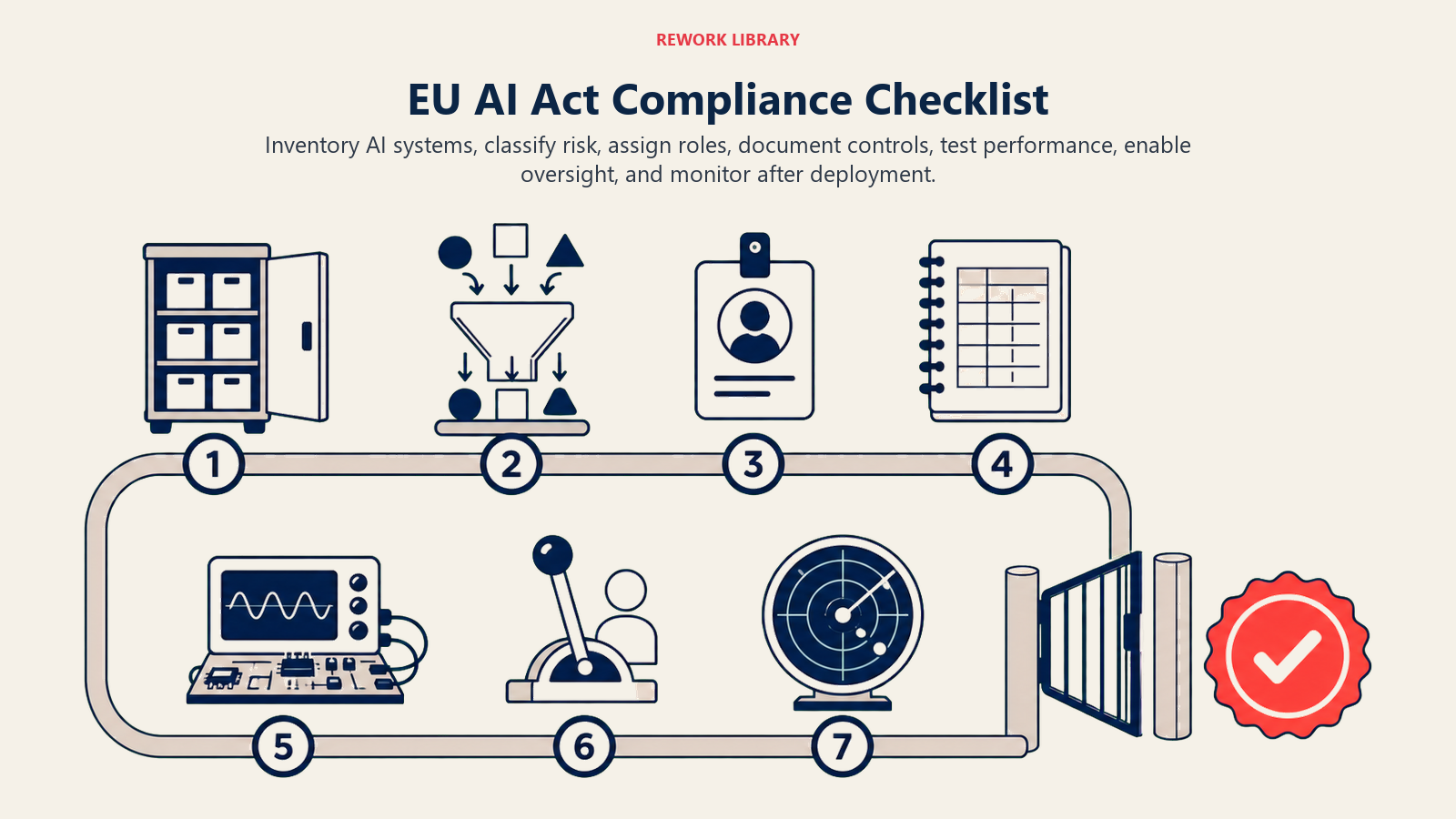
Phase 1: Assessment (Now)
- Inventory all AI systems in use or development
- Classify each system by risk category
- Identify high-risk systems requiring compliance
- Review prohibited use cases to eliminate violations
Phase 2: Documentation (Q1-Q2 2026)
- Create technical documentation for high-risk AI
- Establish risk management frameworks
- Document data governance processes
- Implement quality management system
Phase 3: Technical Implementation (Q3-Q4 2026)
- Add human oversight capabilities
- Implement monitoring and logging systems
- Build explainability features aligned with AI governance
- Establish incident reporting procedures
Phase 4: Validation (Q1 2027)
- Conduct conformity assessments
- Obtain CE marking for applicable systems
- Train staff on compliance requirements
- Prepare for regulatory inspections
Common Compliance Gaps
Typical mistakes companies make:
• Underestimating Scope: Assuming only obvious AI is covered → Solution: Comprehensive AI inventory including embedded and procured systems
• Waiting Too Long: Planning to comply right before deadlines → Solution: Start now; compliance takes 12-18 months for complex systems
• Documentation Weakness: Poor or missing technical documentation → Solution: Document as you build, not after deployment
• Vendor Blindness: Not ensuring third-party AI complies → Solution: Due diligence on all AI vendors and contractual compliance requirements
Opportunities in Compliance
Strategic advantages from early action:
- Market Differentiation: "AI Act compliant" becomes selling point
- Risk Reduction: Avoid devastating penalties and enforcement actions
- Operational Excellence: Compliance drives better AI governance and quality
- Global Standards: Position for other jurisdictions adopting similar frameworks
Leading organizations view compliance as competitive advantage, not burden.
Building Compliance Capability
Your roadmap to AI Act readiness:
- Start with AI Governance framework as foundation
- Implement Explainable AI for transparency
- Address Bias in AI through systematic testing
- Establish MLOps for ongoing compliance
Learn More
Explore related AI compliance and governance concepts:
- AI Governance - Build frameworks for responsible AI management
- AI Ethics - Understand ethical foundations of AI regulation
- Explainable AI - Meet transparency requirements for high-risk AI
- Bias in AI - Address fairness obligations under the Act
- Jailbreak - How attackers bypass safety controls and why it's a compliance risk under the Act
External Resources
- EU AI Act Official Text - Full legal text and amendments
- European Commission AI Guidelines - Implementation guidance for businesses
- Stanford HAI: AI Regulation - Global AI policy research and analysis
Frequently Asked Questions about EU AI Act
What is the EU AI Act?
The EU AI Act is the world's first comprehensive AI regulation, adopted in 2024 and effective from August 2025, establishing harmonized rules for artificial intelligence systems across the European Union using a risk-based approach with penalties up to €35M or 7% of global turnover.
What are the four risk categories in the EU AI Act?
Unacceptable Risk (prohibited systems like social scoring), High Risk (strict requirements for employment, education, law enforcement AI), Limited Risk (transparency requirements for chatbots and deepfakes), and Minimal Risk (no obligations for applications like video games).
When does the EU AI Act take full effect?
Prohibition of unacceptable AI begins February 2025. Full Act enters force August 2025. General-purpose AI obligations start August 2026. Complete compliance for high-risk AI required by August 2027.
Do US companies need to comply with the EU AI Act?
Yes, if they offer AI systems to EU customers, use AI outputs in the EU, or monitor EU individuals with AI. The Act has extraterritorial reach covering providers, deployers, importers, and distributors serving European markets.
What are the main requirements for high-risk AI systems?
Risk management throughout lifecycle, data governance for quality and representativeness, technical documentation, record-keeping for traceability, transparency and user information, human oversight, accuracy and cybersecurity standards, continuous monitoring, and quality management systems.
What are the penalties for non-compliance?
Prohibited AI violations: €35M or 7% of global turnover. High-risk requirement violations: €15M or 3% of turnover. Information obligation violations: €7.5M or 1% of turnover. Similar to GDPR, penalties can be severe for serious violations.
Part of the [AI Terms Collection]. Last updated: 2026-02-09

Co-Founder, Rework.com
On this page
- Defining the EU AI Act
- Executive Perspective
- Risk-Based Classification
- Compliance Timeline
- High-Risk AI Requirements
- Real-World Compliance Examples
- Global Impact Beyond Europe
- Enforcement and Penalties
- Compliance Checklist
- Common Compliance Gaps
- Opportunities in Compliance
- Building Compliance Capability
- Learn More
- External Resources