What is Claude AI?
Turn this article into takeaways for your work.


Each assistant summarizes the article only for you and suggests best practices for your work.
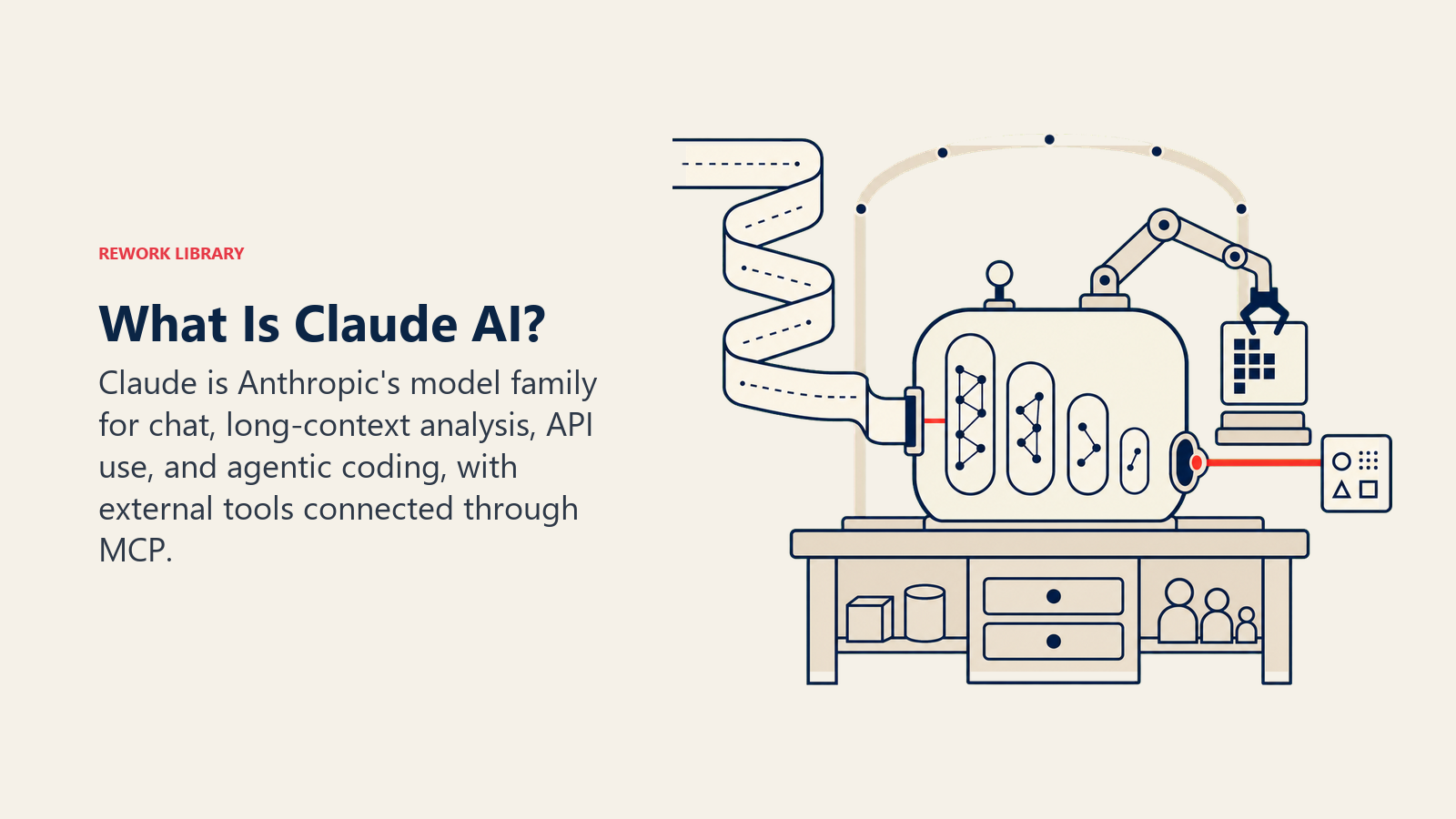
Claude is a family of large language models built by Anthropic, an AI safety and research company founded in 2021. You can chat with Claude at claude.ai, use it inside apps through Anthropic's API, or run it as a coding agent through Claude Code. Anthropic is the company; Claude is the product line, and in 2026 both names show up constantly in AI buying conversations.
That single-sentence version covers the basics, but "what is Claude" and "what is Anthropic" are really two questions people ask together, because you can't evaluate the product without knowing who built it and why. This guide covers both: the company's background, the current model lineup, what Claude Code and MCP actually do, what Claude costs in July 2026, how it stacks up against ChatGPT and Gemini, and where its real limits are.
What is Anthropic, the Company Behind Claude?
Anthropic was founded in January 2021 by Dario Amodei and Daniela Amodei, along with several other researchers who had previously worked on safety and research teams at OpenAI. Dario Amodei serves as CEO and Daniela Amodei as President. The company is structured as a Public Benefit Corporation headquartered in San Francisco, with a stated purpose of "the responsible development and maintenance of advanced AI for the long-term benefit of humanity." A separate Long-Term Benefit Trust, whose members have included former Federal Reserve Chair Ben Bernanke, has a role in governance decisions tied to that mission.
Anthropic describes itself first as an AI safety and research company, not a consumer app maker, and that framing shows up in how it talks about its own products: safety research feeds into product design, and product usage feeds insights back into research.
The business itself has grown fast. Anthropic raised $30 billion in a Series G round in February 2026 at a $380 billion post-money valuation, with revenue run-rate at $14 billion at the time and customers spending $1 million or more annually up to 500-plus accounts, including eight Fortune 10 companies. Three months later, Anthropic closed a $65 billion Series H round at a $965 billion post-money valuation, with revenue run-rate having crossed $47 billion. That's a jump from roughly $1 billion in annualized revenue at the end of 2024, driven largely by enterprise and developer demand for Claude and Claude Code.
The Claude Model Family in 2026: Opus, Sonnet, Haiku, and Fable
Claude isn't one model, it's a lineup, and Anthropic ships each tier for a different job. As of July 2026, the current generation is:
- Claude Fable 5: Anthropic's most capable widely released model, positioned for long-running agents and the highest-capability workloads. It reached general availability on June 9, 2026, with a 1-million-token context window.
- Claude Opus 4.8: The model for complex agentic coding and enterprise work where a wrong answer is expensive. Also a 1-million-token context window.
- Claude Sonnet 5: Anthropic's own recommended balance of speed and intelligence, and the default model inside Claude Code. Also a 1-million-token context window.
- Claude Haiku 4.5: The fastest, cheapest tier, built for high-volume and latency-sensitive tasks, with a 200,000-token context window.
Every current model handles text and image input, multilingual tasks, and vision, and all are accessible through the Claude API, Amazon Bedrock, Google Cloud, and Microsoft Foundry, not just claude.ai. Anthropic also offers Claude Mythos 5, an invitation-only model for defensive cybersecurity work under a program called Project Glasswing, but that's a narrow enterprise track rather than something most businesses will touch.
Picking a tier is mostly a cost-versus-capability call: start with Sonnet for general production use, drop to Haiku for simple, high-volume tasks, and reserve Opus or Fable for work where getting it wrong is costly. See reasoning models for how Claude's thinking modes fit into that decision.
Claude Code and the Model Context Protocol (MCP)
Two things distinguish Claude in 2026 beyond the chat models themselves.
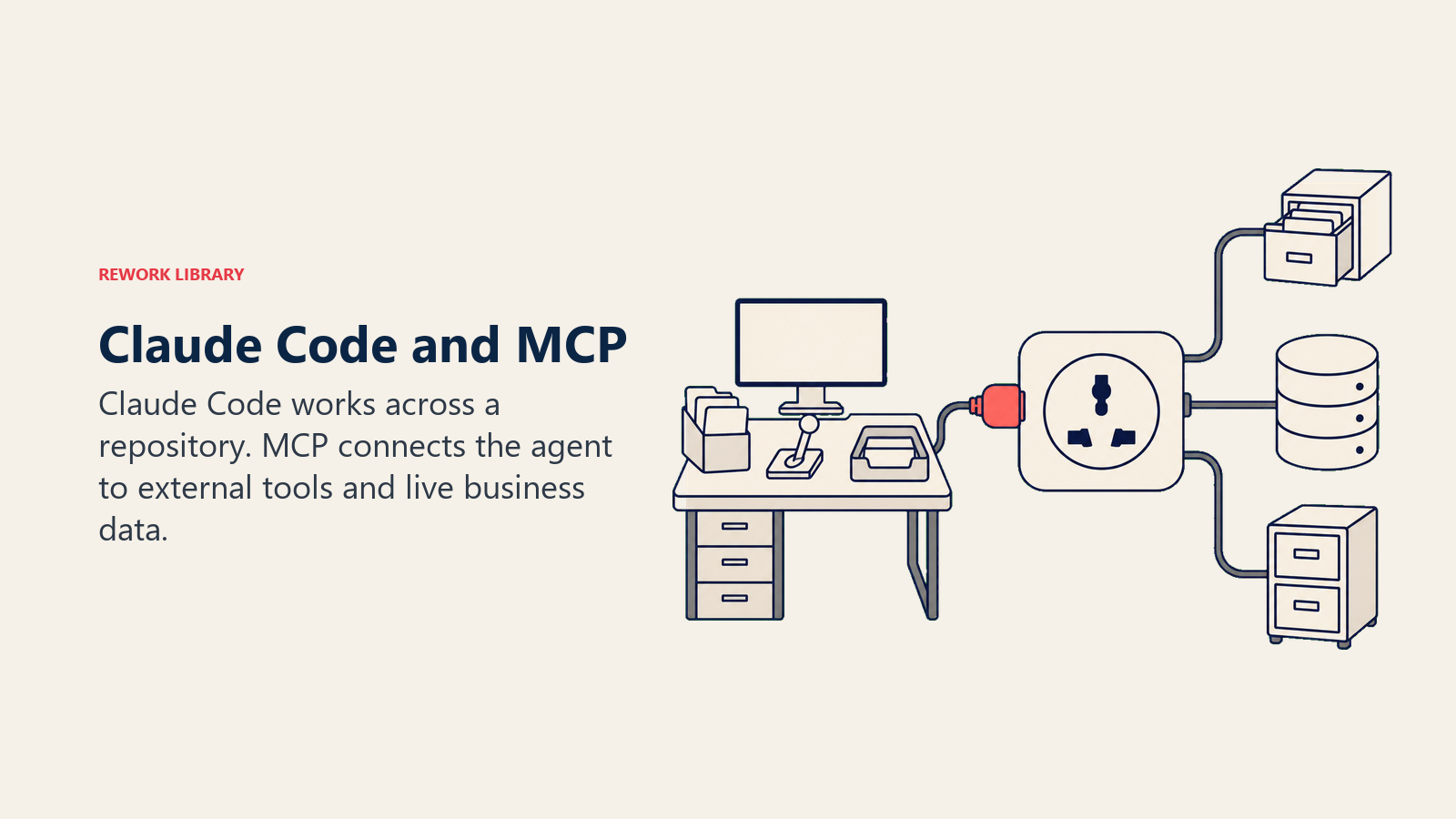
Claude Code is Anthropic's agentic coding tool: it reads a codebase, writes and edits files, runs tests, and opens changes for review, all from a terminal or IDE rather than a chat window. It's included with Pro, Max, Team, and Enterprise subscriptions. It has grown from a May 2025 launch into a real line of business: run-rate revenue passed $2.5 billion by February 2026, more than doubling since the start of that year, with business subscriptions quadrupling over the same period and enterprise use now accounting for over half of all Claude Code revenue.
Model Context Protocol (MCP) is the open standard Anthropic created and open-sourced in November 2024 for connecting AI models to external tools and data, a CRM, a database, a file system, without writing custom integration code for every combination of AI app and system. OpenAI adopted MCP in March 2025, Google DeepMind in April 2025, and by December 2025 Anthropic had donated the specification to the Agentic AI Foundation, a directed fund under the Linux Foundation co-founded with Block and OpenAI. MCP is no longer "Anthropic's protocol" in a governance sense, but Anthropic built it, and it's the reason a growing share of AI agents can plug into business software without bespoke plumbing. For the full picture, see Model Context Protocol.
One practical result of that open standard: since MCP lets any tool expose a standard connector, some of the day-to-day business software teams already run, including work and CRM platforms like Rework, can offer an MCP server so a team member can ask Claude questions against their own live pipeline, tasks, or lead data instead of exporting spreadsheets first. That's not unique to Rework, it's the same pattern MCP was built to enable across any connected tool, but it's a concrete example of what "AI that talks to your business systems" looks like once the integration layer is standardized.
Claude Pricing and Plans (July 2026)
Claude's pricing splits into individual, team, and API tiers.
| Plan | Price | Best for |
|---|---|---|
| Free | $0 | Trying Claude on web, iOS, Android, and desktop |
| Pro | $17/month billed annually ($200 upfront), or $20/month billed monthly | Individuals who want Claude Code and higher usage limits |
| Max | From $100/month (5x Pro usage) up to $200/month (20x Pro usage) | Heavy individual users, power coders |
| Team | Standard seat: $20/month annual or $25 monthly. Premium seat: $100/month annual or $125 monthly. For 2-150 people | Small and mid-size teams needing SSO, admin controls, central billing |
| Enterprise (self-serve) | $20/seat plus usage at API rates | Larger orgs needing SCIM, audit logs, compliance API |
| Enterprise (sales-assisted) | Custom | Large organizations negotiating dedicated terms |
| API | Pay per token, by model | Developers building Claude into their own products |
API pricing runs per million tokens (input/output): Haiku 4.5 at $1/$5, Sonnet 5 at $3/$15 (with introductory pricing of $2/$10 through August 31, 2026), Opus 4.8 at $5/$25, and Fable 5 at $10/$50. Claude Code is bundled into Pro, Max, Team, and Enterprise rather than billed separately for most users, though heavy agentic usage can still draw on API-rate consumption depending on the plan.
Who Uses Claude and What It's Used For
Claude is built for a wide range of knowledge work, but its clearest strengths in 2026 show up in a handful of categories:
- Software development: reading and writing code across a full repository, debugging, and opening pull requests through Claude Code, which is the fastest-growing part of Anthropic's business.
- Research and analysis: summarizing long documents, comparing sources, and reasoning through multi-step questions, aided by context windows large enough to hold entire codebases or document sets at once.
- Content and drafting: writing, editing, and restructuring text for marketing, product, and internal communications.
- Customer-facing and internal support: answering policy questions, drafting responses, and triaging routine requests when connected to a company's own data through tools or MCP.
- Data and operations work: reconciling records, extracting structured data from unstructured documents, and running repeatable analysis tasks.
Anthropic's own numbers back up the enterprise skew: business customers spending over $100,000 annually grew roughly 7x in a single year, and accounts spending $1 million or more went from a dozen two years earlier to more than 500 by early 2026. For a broader look at where AI assistants fit into daily workflows, see AI copilots and prompt engineering for how to get better output from any of these models, Claude included.
Claude vs ChatGPT vs Gemini
All three are large language model products, but they've settled into somewhat different centers of gravity by mid-2026.
| Claude (Anthropic) | ChatGPT (OpenAI) | Gemini (Google) | |
|---|---|---|---|
| Maker | Anthropic, PBC | OpenAI | Google DeepMind |
| AI assistant market share (May 2026) | 10.3% | 46.4% | 27.7% |
| Monthly active users | ~245 million | ~1.1 billion | ~662 million |
| Best known for | Coding agents, long-context reasoning, enterprise trust | Broadest consumer reach, multimodal features | Deep integration with Google Workspace and Search |
| Coding tool | Claude Code | Codex | Gemini CLI / Jules |
| Top context window | 1 million tokens (Fable 5, Opus 4.8, Sonnet 5) | Varies by model | Varies by model |
| Governance structure | Public Benefit Corporation | Capped-profit under nonprofit oversight | Public company subsidiary (Alphabet) |
ChatGPT still leads on raw consumer reach: it fell below 50% market share for the first time only in early 2026, and remains the default most people try first. Gemini's advantage is distribution through Google's existing products. Claude's advantage shows up more in enterprise coding, agentic workflows, and long-document reasoning, which is also where its revenue growth has concentrated. For a deeper side-by-side aimed at picking one, see Claude vs ChatGPT vs Gemini and the broader roundup of best AI chatbots.
Safety and Constitutional AI: How Anthropic Trains Claude
Anthropic's safety approach centers on a method it calls Constitutional AI. Instead of relying mainly on large volumes of human-labeled examples to teach a model what's harmful, Anthropic writes a short set of explicit principles (a "constitution") and trains the model in two phases: first, the model critiques and rewrites its own draft responses against those principles, then it's refined further using reinforcement learning from AI feedback. The stated benefit is legibility: when Claude behaves a certain way, there's a written document explaining the intended reasoning, rather than an opaque pattern learned from thousands of anonymous human raters.
That safety framing is baked into Anthropic's corporate structure too. The Public Benefit Corporation status and the Long-Term Benefit Trust exist specifically so that safety and long-term-benefit considerations have a formal seat at the table alongside commercial growth. See AI safety and reinforcement learning from human feedback for how Constitutional AI relates to the broader field, and AI governance for how companies apply oversight to systems like Claude once they're deployed.
Limitations of Claude
Claude is a genuinely capable model family, but it isn't a solved problem:
- Knowledge cutoff: current-generation models have a reliable knowledge cutoff around January 2026, so they need connected tools or web search for anything more recent.
- Hallucination risk: like every large language model, Claude can produce confident, plausible-sounding answers that are wrong, especially on narrow or fast-moving topics.
- Smaller consumer footprint: at roughly 245 million monthly users against ChatGPT's 1.1 billion, Claude has a smaller everyday consumer presence and ecosystem of third-party integrations, even where it leads on enterprise and developer use.
- Cost at scale: heavy agentic use through Claude Code or the API can get expensive quickly on the higher-capability tiers (Opus and Fable), which is why model selection matters for cost control.
- Still needs human oversight: Claude Code opens pull requests for review rather than merging unsupervised, and most serious agentic deployments keep a human in the loop for judgment calls, by design rather than as a stopgap.
Key Facts
- $965 billion valuation. Anthropic raised $65 billion in a Series H round in May 2026, with revenue run-rate crossing $47 billion at the time. Anthropic, "Anthropic raises $65B in Series H funding"
- $380 billion valuation three months earlier. Anthropic's Series G round in February 2026 raised $30 billion at a $380 billion post-money valuation, with run-rate revenue at $14 billion, more than 500 customers spending $1 million-plus annually (up from a dozen two years prior), and eight Fortune 10 companies as customers. Anthropic, "Anthropic raises $30 billion in Series G funding"
- Claude Code passed $2.5 billion in run-rate revenue by February 2026, more than doubling since the start of that year, with business subscriptions quadrupling and enterprise use exceeding half of all Claude Code revenue. Anthropic, "Anthropic raises $30 billion in Series G funding"
- MCP passed 97 million combined monthly SDK downloads and over 10,000 active public MCP servers by the time Anthropic donated the standard to the Linux Foundation's Agentic AI Foundation in December 2025. Anthropic, "Donating the Model Context Protocol"
- ChatGPT held 46.4% of AI assistant market share in May 2026, versus 27.7% for Gemini and 10.3% for Claude, with ChatGPT falling below 50% share for the first time since January 2026. TechCrunch, "ChatGPT's market share slips below 50% for first time"
- Claude's top-tier models (Fable 5, Opus 4.8, Sonnet 5) support a 1-million-token context window, roughly 555,000 words, while Haiku 4.5 supports 200,000 tokens. Anthropic, Claude Platform Docs: Models overview
Frequently Asked Questions about Claude AI
What is Claude AI in simple terms?
Claude is a family of AI models built by Anthropic that you can chat with, use through an API, or run as a coding agent. It reads and generates text, analyzes images, and, through Claude Code, can read and write code and run tasks across a codebase.
What is Anthropic?
Anthropic is the company that builds Claude. It's a Public Benefit Corporation founded in 2021 by Dario and Daniela Amodei, structured specifically around AI safety research alongside commercial product development, and headquartered in San Francisco.
Is Claude free to use?
Yes, Claude has a free plan with no credit card required, covering web, iOS, Android, and desktop access with core chat, image, and code features. Paid plans (Pro, Max, Team, Enterprise) add higher usage limits, Claude Code, and admin controls.
What's the difference between Claude Opus, Sonnet, Haiku, and Fable?
They're different capability and cost tiers of the same model family. Fable 5 is Anthropic's most capable widely released model for long-running agents, Opus 4.8 targets complex agentic coding and enterprise work, Sonnet 5 balances speed and intelligence as the Claude Code default, and Haiku 4.5 is the fastest, cheapest option for high-volume tasks.
What is Claude Code?
Claude Code is Anthropic's agentic coding tool. It works from a terminal or IDE, reads your codebase, writes and edits files, runs tests, and opens pull requests, and it's included with Pro, Max, Team, and Enterprise subscriptions rather than sold separately for most users.
What is Model Context Protocol and why does it matter?
MCP is an open standard, created by Anthropic in 2024, that lets AI models connect to external tools and data sources without custom integration code for every combination. It's now governed by the Linux Foundation and supported by OpenAI, Google, and Microsoft, which is why a growing number of business tools can plug into Claude and other AI assistants using one shared connector standard.
Is Claude safe to use for business data?
Anthropic trains Claude using a method it calls Constitutional AI, where the model is trained against a written set of principles rather than relying only on human-labeled examples. Team, Enterprise, and API usage generally don't train Anthropic's models on customer content by default, and Enterprise plans add compliance features like SSO, audit logs, and HIPAA-ready options, but businesses should still review the specific data-handling terms for the plan they choose.
How is Claude different from ChatGPT and Gemini?
All three are capable general-purpose AI assistants, but ChatGPT has the largest consumer user base by far, Gemini benefits from deep integration with Google's products, and Claude has concentrated its growth in enterprise coding, agentic workflows, and long-context reasoning tasks.
Can Claude connect to the software my business already uses?
Often, yes, through Model Context Protocol connectors. Since MCP is now an open, widely adopted standard rather than a closed integration, many business tools, including work and CRM platforms, can expose an MCP server so a team can query their own live data from within Claude instead of exporting it manually first.
Related AI Concepts
- Model Context Protocol - The open standard Anthropic created for connecting Claude and other models to business tools
- Large Language Models - The underlying technology Claude and its competitors are built on
- What is Agentic AI? - How Claude Code and similar tools move from answering questions to completing tasks
- AI Copilots - The collaborative, human-in-the-loop pattern most Claude business deployments use today
- AI Safety - The broader field Anthropic's Constitutional AI approach sits within
- Claude vs ChatGPT vs Gemini - A deeper side-by-side comparison for choosing between them
- Best AI Coding Tools 2026 - How Claude Code stacks up against other AI coding assistants
External Resources
- Anthropic: Series H Funding Announcement - Latest valuation and revenue run-rate figures
- Anthropic: Series G Funding Announcement - Claude Code revenue and enterprise customer growth
- Anthropic: Donating the Model Context Protocol - MCP adoption stats and Linux Foundation governance
- Claude Platform Docs: Models Overview - Full technical specs for every current Claude model
- Claude Pricing - Official, current pricing for every plan
- TechCrunch: ChatGPT's Market Share Slips Below 50% - AI assistant market share comparison
Part of the AI Terms Collection. Last updated: 2026-07-20

Co-Founder, Rework.com
On this page
- What is Anthropic, the Company Behind Claude?
- The Claude Model Family in 2026: Opus, Sonnet, Haiku, and Fable
- Claude Code and the Model Context Protocol (MCP)
- Claude Pricing and Plans (July 2026)
- Who Uses Claude and What It's Used For
- Claude vs ChatGPT vs Gemini
- Safety and Constitutional AI: How Anthropic Trains Claude
- Limitations of Claude
- Key Facts
- Related AI Concepts
- External Resources