What is the Technological Singularity?
Turn this article into takeaways for your work.


Each assistant summarizes the article only for you and suggests best practices for your work.
The technological singularity is a hypothetical point where AI-driven progress becomes so fast and recursive, each generation of AI designing a smarter one, that growth turns irreversible and uncontrollable for humans to predict or steer. It's a threshold, not a specific technology, and researchers disagree sharply on whether or when it will arrive.
Picture a lab where an AI system helps write the code for its own successor. That successor writes code faster and better than the one before it. Each new version compounds the last, and the loop tightens with every cycle. At some point, the argument goes, human oversight can't keep pace anymore.
The word borrows from math and physics, where a singularity marks a point past which the normal rules stop applying and prediction breaks down. Applied to AI, it means the same thing: a moment where the usual pace of technological progress, gradual and humanly paced, no longer holds.
This isn't fringe science fiction chatter. Frontier AI labs, government agencies, and Nobel laureates argue about it in public. Here's where the idea came from, what would actually have to happen, and what it means for the person running a business today.
Key Facts
- AI Impacts surveyed 2,778 published AI researchers in October 2023 and found a 50% probability of "high-level machine intelligence" by 2047, thirteen years earlier than the 2060 estimate the same survey produced just a year before. AI Impacts, 2023 Expert Survey
- In that same survey, the median AI researcher placed at least a 5% probability on advanced AI leading to human extinction. AI Impacts, Survey of 2,778 AI Authors
- The Forecasting Research Institute's Longitudinal Expert AI Panel found both AI experts and professional superforecasters put roughly an 80% probability on AGI arriving before the year 2100, with median estimated years of 2050 for experts and 2047 for superforecasters. Forecasting Research Institute, LEAP Wave 8
- Ray Kurzweil's 2005 book "The Singularity Is Near" set 2045 as the year of the singularity and 2029 for AI passing a valid Turing test, both reaffirmed in his 2024 follow-up, "The Singularity Is Nearer." Wikipedia, The Singularity Is Near
- Vernor Vinge's 1993 essay predicted greater-than-human intelligence within 30 years and said he would be surprised if it happened before 2005 or after 2030, a window that has already closed. Vernor Vinge, The Coming Technological Singularity
- As of May 2026, more than 80% of the code merged into Anthropic's own production codebase was authored by its Claude models rather than human engineers. Anthropic, When AI Builds Itself
- Anthropic reports Claude's reliable independent task length grew from about 4 minutes in March 2024 to roughly 12 hours in March 2026, a rough gauge of how much unsupervised work today's AI can already handle. Anthropic, When AI Builds Itself
Where the Idea Came From
The word "singularity" started in math and physics. British mathematician I.J. Good borrowed it for AI in 1965. Good had worked alongside Alan Turing as a codebreaker at Bletchley Park, and his paper "Speculations Concerning the First Ultraintelligent Machine" made a simple, unsettling argument: "Let an ultraintelligent machine be defined as a machine that can far surpass all the intellectual activities of any man however clever. Since the design of machines is one of these intellectual activities, an ultraintelligent machine could design even better machines; there would then unquestionably be an 'intelligence explosion.'" He called it "the last invention that man need ever make."
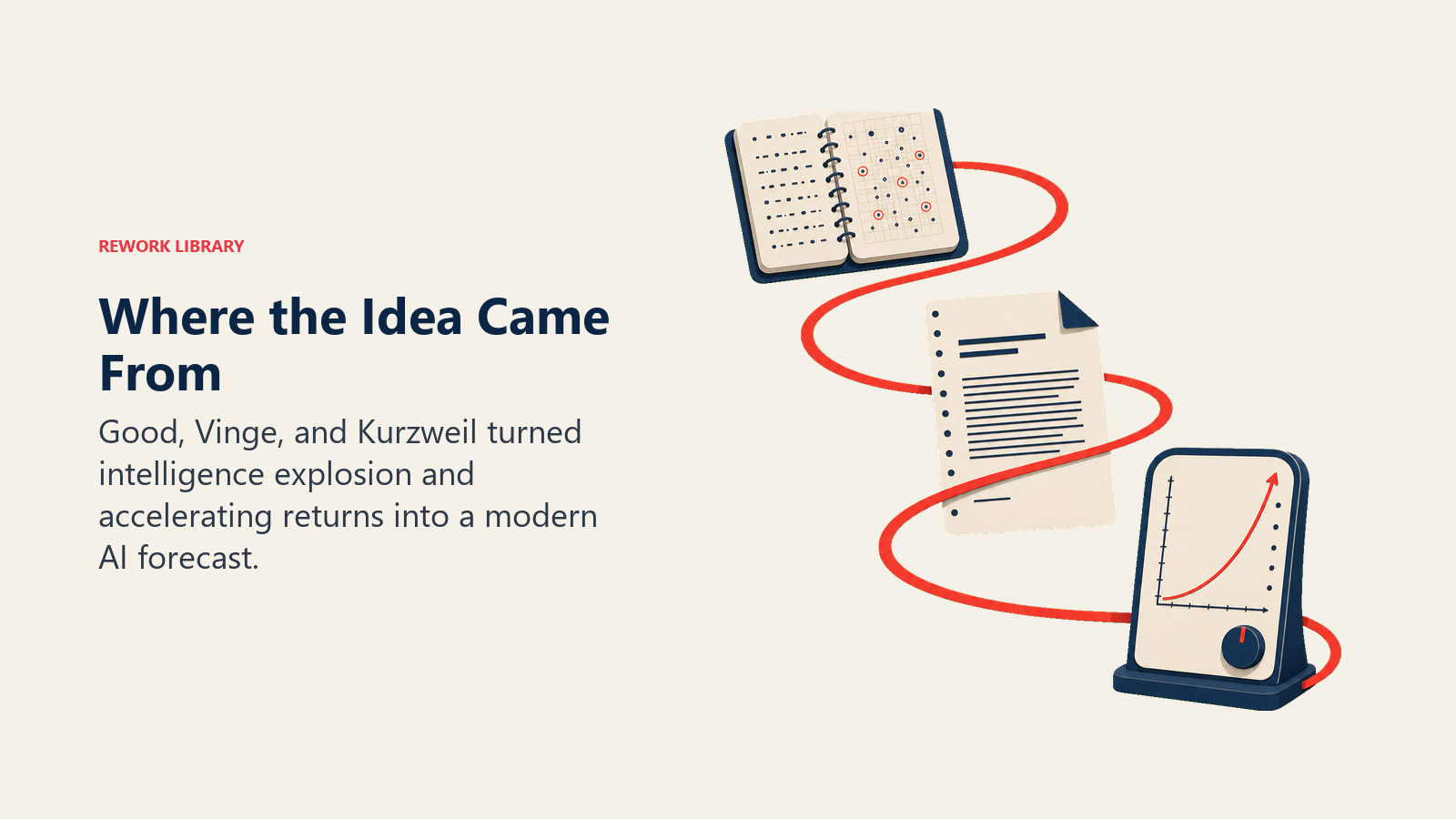
The idea stayed mostly in academic circles for nearly thirty years. Computer scientist and science fiction writer Vernor Vinge revived it in his 1993 essay "The Coming Technological Singularity," which opened with a blunt claim: "Within thirty years, we will have the technological means to create superhuman intelligence. Shortly after, the human era will be ended." Vinge said he would be surprised if it happened before 2005 or after 2030. Both dates have now passed without anything resembling a singularity, which is one reason skeptics cite Vinge's essay as a cautionary example rather than a roadmap.
Inventor and futurist Ray Kurzweil made the idea mainstream. His 2005 book "The Singularity Is Near" set 2045 as the year the singularity arrives, built on what he calls the law of accelerating returns: the observation that computing power, and by extension AI capability, tends to grow exponentially rather than in a straight line. Kurzweil also predicted AI would pass a valid Turing test by 2029. He reaffirmed both dates in his 2024 follow-up, "The Singularity Is Nearer."
How an Intelligence Explosion Would Actually Work
The mechanics behind Good's original argument are simpler than the term "singularity" makes them sound. The idea runs on a feedback loop:
- An AI system reaches a capability level where it can meaningfully help design, train, or improve the next AI system.
- That next system is smarter or more capable than the one that helped build it.
- The improved system helps build an even better one, faster than the previous round took.
- Each cycle shortens, so gains that used to take years start taking months, then weeks, then less.
This is what researchers call recursive self-improvement, and it's no longer purely theoretical. Machine learning systems already write meaningful amounts of the software that trains their successors. Anthropic reports that as of May 2026, more than 80% of the code merged into its own production codebase was written by its Claude models, not human engineers, and the company frames this work explicitly as adjacent to recursive self-improvement research.
Anthropic is careful about the distinction, though. "We are not there yet, and recursive self-improvement is not inevitable," the company wrote, pointing out that its models still lack the independent judgment to choose which research problems are worth pursuing in the first place. That gap, between AI that helps build better AI and AI that decides on its own what "better" should mean, is exactly where the theoretical singularity and the current state of the technology part ways. The loop Good described needs nobody in that judgment seat. Nothing built so far removes that seat.
What Researchers Actually Predict for 2026 and Beyond
Ask AI researchers when a singularity-level event might happen and the range is wide, but not as wide as pop-culture debate makes it sound.
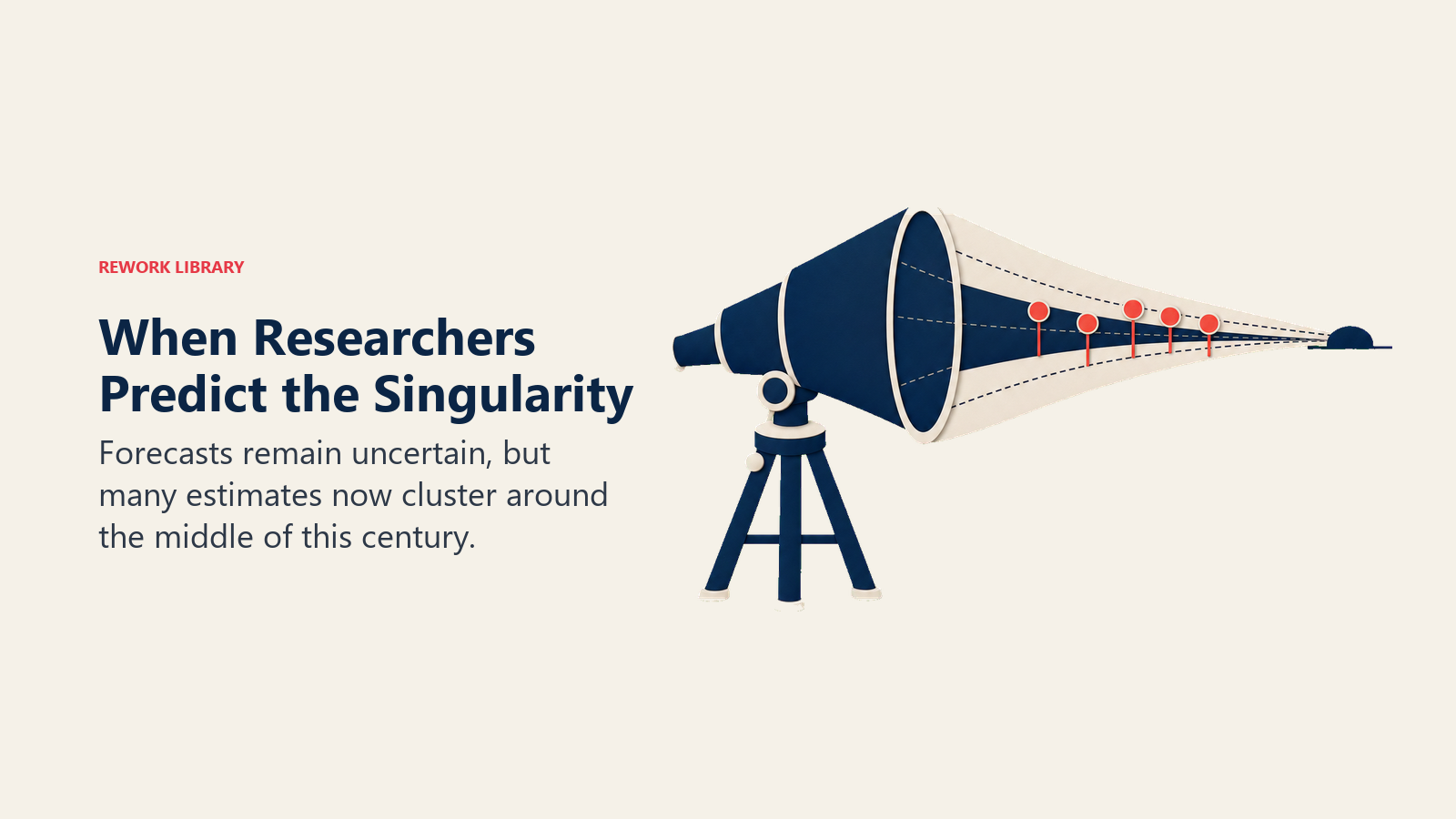
AI Impacts, a research group that runs the largest recurring survey of published AI researchers, polled 2,778 authors from top venues like NeurIPS and ICML in October 2023. The aggregate forecast gave a 50% probability of "high-level machine intelligence," AI that can perform every task better or more cheaply than humans, by 2047. That's thirteen years earlier than the same survey found just one year before, when the 50% mark sat at 2060. The same respondents' median estimate put at least a 5% probability on advanced AI causing human extinction, a number low enough for most to dismiss and high enough that the field mostly doesn't treat it as zero either.
A separate effort, the Forecasting Research Institute's Longitudinal Expert AI Panel, tracks both AI experts and professional superforecasters (forecasters with a strong track record across many domains, not just AI) on the same questions over time. In its most recent wave, both groups put the probability of AGI arriving before the year 2100 at roughly 80%. Where they differ is timing: experts' median estimate lands around 2050, while superforecasters, typically the more skeptical group on dramatic near-term claims, land close behind at 2047.
The pattern across these surveys holds even as the exact years shift: estimates keep compressing, not expanding, year over year. Whether that trend continues, or stalls the way computing predictions have stalled before, is the entire disagreement covered below.
Singularity vs AGI vs ASI: What's the Difference
People use these three terms as if they mean the same thing. They don't. Each describes a different piece of the same argument.
| Term | What It Means | Status as of July 2026 |
|---|---|---|
| Technological Singularity | The hypothetical threshold event itself: the point where AI-driven progress becomes too fast and recursive for humans to predict or control | Theoretical. A possible future turning point, not a technology |
| AGI (Artificial General Intelligence) | AI that matches human-level performance across most cognitive tasks, not just the narrow ones today's models excel at | Not achieved. Actively debated whether current foundation models are close or still fundamentally narrow |
| ASI (Artificial Superintelligence) | AI that exceeds human intelligence across virtually every domain, the capability level that, in Good's and Kurzweil's framing, would trigger the intelligence explosion | Purely hypothetical. No credible claim of ASI exists today |
In the classic version of the argument, AGI comes first, then ASI, and the fast transition between them (assuming it happens quickly, through recursive self-improvement) is what people call the singularity. Skip any one link in that chain and the whole scenario changes shape. That link is also exactly where the disagreement below lives.
Why Many Researchers Push Back
Not everyone in AI takes the singularity seriously as a near-term possibility, and the skepticism doesn't come from outside the field.
Cognitive scientist Steven Pinker has argued there is "not the slightest reason to believe in a coming singularity," comparing it to earlier predicted technologies, domed cities and flying cars, that never showed up on schedule despite confident forecasts. Computing power alone, he argues, doesn't resolve the harder problems of judgment and understanding.
Jeff Hawkins, a neuroscientist and AI researcher, makes a hardware argument: self-improving systems eventually run into physical limits on how big and fast computers can get, at which point the exponential curve bends back toward an ordinary S-curve, the pattern most technologies actually follow instead of runaway growth.
Cognitive scientist and AI researcher Gary Marcus has made the sharper 2026 version of this case: that large language models already show diminishing returns from added compute and data, and that treating scaling alone as a path to AGI is, in his words, "just a fantasy." He argues current systems still have "no principled solution to hallucinations" because they work with statistical patterns in language rather than explicit facts and reasoning over those facts.
The disagreement isn't really about whether AI keeps improving. Nearly everyone agrees it will. It's about whether improvement compounds the way Good's original argument assumed, in an accelerating loop, or whether it keeps hitting walls, data limits, hardware costs, and the hard problem of judgment, that flatten the curve well before anything resembling a singularity could occur.
What This Means for Business Leaders
None of this is really about a sudden robot uprising, and treating it that way misses the part that actually matters for a company operating today.

The useful takeaway isn't a date on a calendar. It's the direction of travel: AI systems are already taking on longer, more independent chains of work with less step-by-step supervision, the same mechanic underneath every version of the singularity argument, just at a smaller and more manageable scale. Agentic AI systems that plan a sequence of actions and execute them with only occasional human sign-off are the practical, present-day version of "AI doing more without a person in every step." That's worth planning around regardless of whether a full singularity ever arrives.
Three things matter more than the timeline debate for a leader deciding how to deploy AI today. First, AI safety practices, testing systems for unexpected behavior before they touch production decisions, matter more as systems take on longer, less-supervised tasks, not less. Second, AI alignment work, making sure a system optimizes for what you actually meant rather than a literal reading of an instruction, gets harder to skip as autonomy increases. Third, AI governance structures, clear ownership of what an AI system is and isn't allowed to decide on its own, are the practical tool for keeping a person in the judgment seat that current systems still lack.
Whether or not a singularity ever arrives, the underlying trend, AI systems taking on more of the work with less oversight per task, is already reshaping how forward-looking companies structure decisions. The question worth asking isn't when the singularity happens. It's which decisions in your business still need a human, and which ones don't anymore.
Learn More
Part of the AI Terms Collection. Last updated: 2026-07-20

Co-Founder, Rework.com