What are AI Model Cards? Nutrition Labels for AI Systems
Turn this article into takeaways for your work.


Each assistant summarizes the article only for you and suggests best practices for your work.
You wouldn't market medication without listing ingredients, dosage, and side effects. Why deploy AI without documenting capabilities, limitations, and risks? AI model cards provide standardized transparency documentation that helps stakeholders understand artificial intelligence systems, make informed decisions about use, and establish accountability for AI deployment.
Defining AI Model Cards
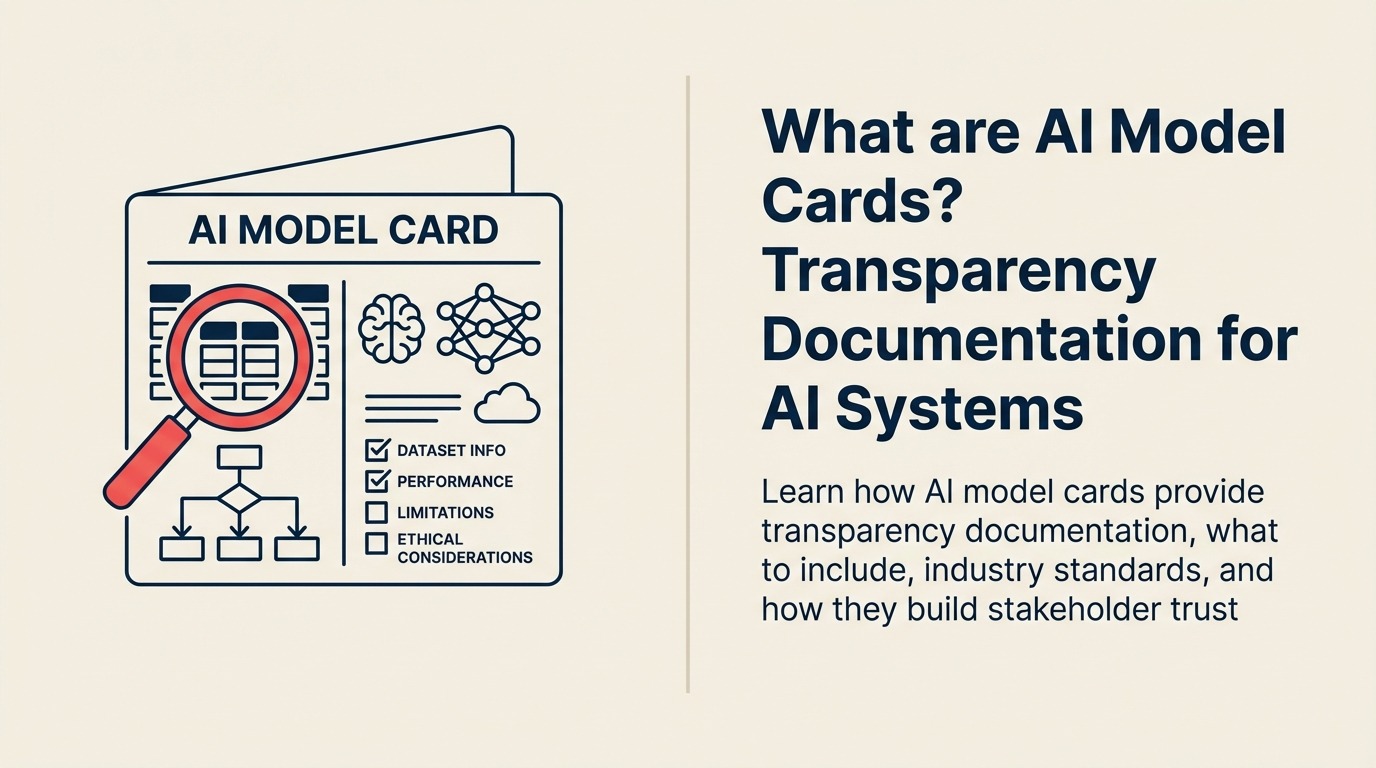
AI model cards are structured documents that describe machine learning models' characteristics, intended use, limitations, performance metrics, ethical considerations, and other relevant information. Introduced by researchers at Google in 2019, they provide standardized transparency for AI systems similar to nutrition labels for food products.
According to the original paper by Mitchell et al., "Model cards are short documents accompanying trained machine learning models that provide benchmarked evaluation in a variety of conditions, such as across different cultural, demographic, or phenotypic groups, and intersectional groups that are relevant to the intended application domains."
Model cards emerged as AI systems proliferated across industries, but understanding of their capabilities, limitations, and appropriate use cases remained opaque to non-experts, creating risks.
Business Imperative
For business leaders, model cards are your AI transparency layer that builds stakeholder trust, demonstrates responsible AI practices, and reduces liability by documenting exactly what your AI can and cannot do.
Think of model cards like product specifications. Just as you provide technical specs for products sold, model cards document AI capabilities. This protects you legally (we disclosed limitations), operationally (users understand proper use), and reputationally (demonstrates transparency commitment).
In practical terms, model cards enable informed procurement decisions, support compliance with emerging AI governance requirements, facilitate third-party audits, and provide documentation for regulatory submissions.
Core Model Card Sections
Essential components of comprehensive model cards:
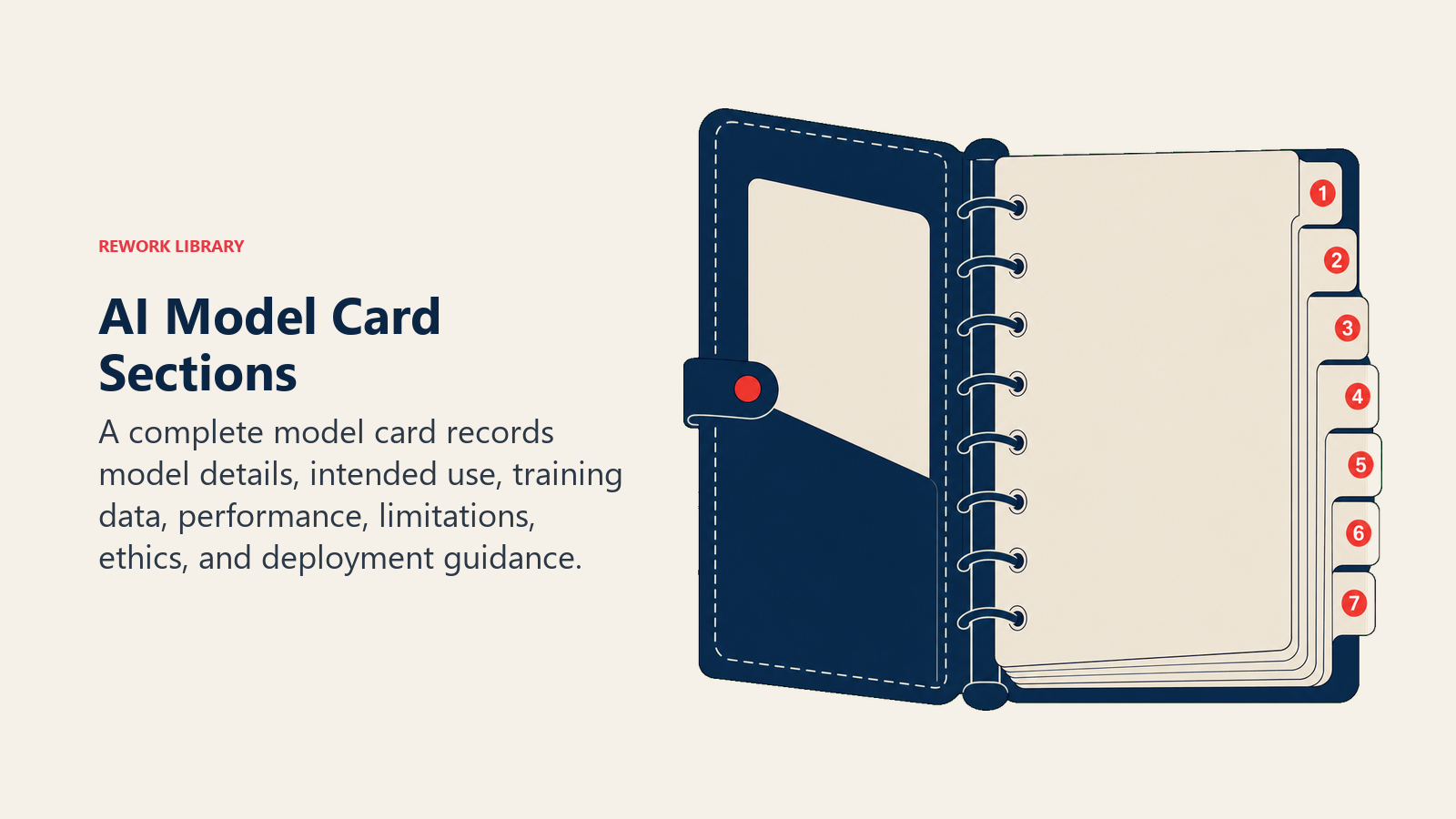
• Model Details: Developers, version, type (e.g., large language model, computer vision), architecture, date released, license
• Intended Use: Primary use cases, intended users, out-of-scope uses that should be avoided, prohibited applications
• Training Data: Dataset characteristics, size, collection methods, preprocessing, known limitations or bias in AI issues
• Performance Metrics: Accuracy, precision, recall, F1 scores, performance across demographic groups, benchmark comparisons
• Limitations: Known failure modes, edge cases, degraded performance scenarios, confidence thresholds, uncertainty quantification
• Ethical Considerations: Fairness testing results, privacy implications, environmental impact, potential negative consequences
• Recommendations: Best practices for deployment, required human-in-the-loop oversight, monitoring requirements, update frequency
Model Card Standards
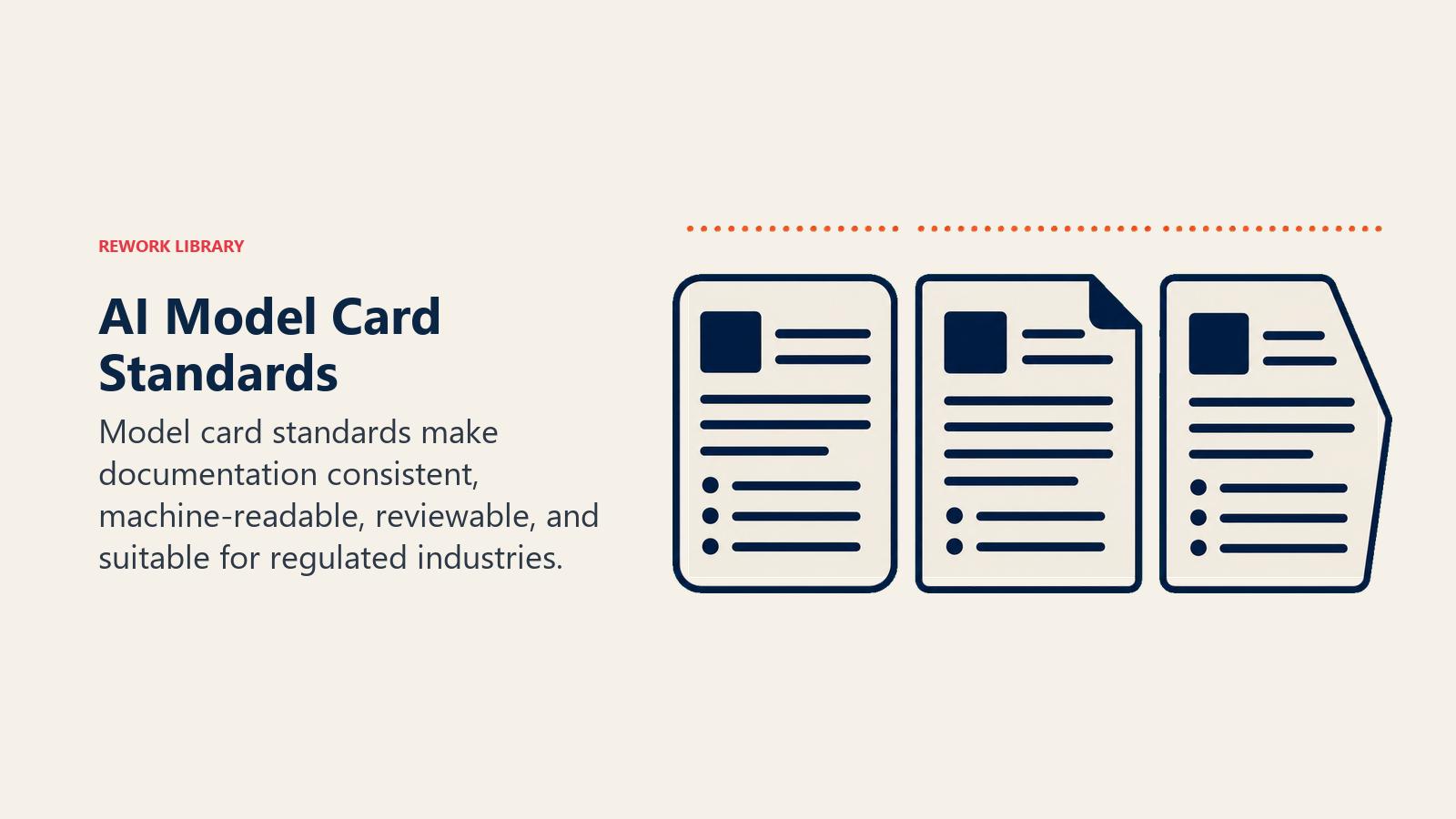
Emerging standardization efforts:
Google's Model Card Toolkit:
- Open-source framework for generating model cards
- Templates for common model types
- JSON schema for machine-readable cards
- Integration with ML platforms
- Example: TensorFlow models include generated cards
Hugging Face Model Cards:
- Required for all models on platform
- Standardized YAML frontmatter + markdown
- Automated completeness checking
- Community rating based on documentation quality
- Example: 500,000+ models documented
VerifyML Model Cards:
- Focus on financial services compliance
- Enhanced fairness metrics
- Regulatory alignment sections
- Audit trail integration with AI audit trail
- Example: Used by major banks for model risk management
Healthcare AI Model Cards:
- CONSORT-AI and SPIRIT-AI extensions
- Clinical validation results
- Patient population characteristics
- Regulatory clearance status
- Example: FDA submissions include model cards
Industry Convergence: Organizations like Partnership on AI and NIST are working toward unified model card standards applicable across industries.
Real-World Model Card Examples
How leading organizations use model cards:
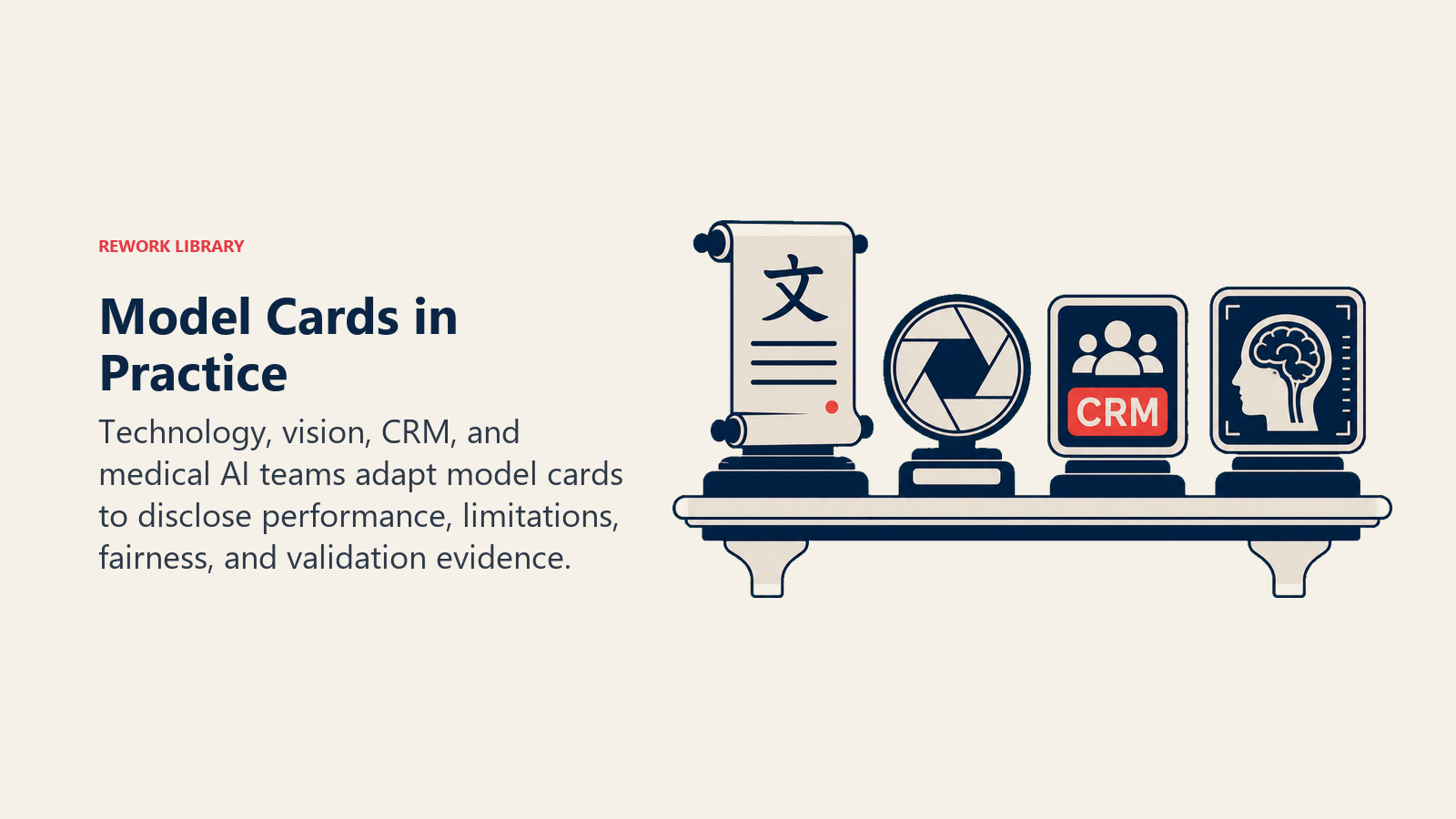
OpenAI's GPT Model Cards: Detailed documentation of GPT models includes capabilities (text generation, translation), known limitations (factual errors, bias), use case guidelines (content creation approved, legal advice discouraged), and safety mitigations, building trust and managing expectations for millions of API users.
Google Cloud Vision API Model Card: Documents facial detection model with performance metrics across skin tones and genders, disclosing historical performance gaps (lower accuracy for darker skin) and improvements made, demonstrating commitment to fairness and enabling informed deployment decisions by customers.
Salesforce's Einstein Model Cards: CRM AI features include model cards describing prediction types, required data quality, accuracy expectations, fairness testing results, and customer configuration requirements, supporting explainable AI obligations and customer trust.
IBM Watson Health Imaging Model Cards: Medical AI models document clinical validation studies, patient population performance, comparison to human radiologists, known failure modes, and regulatory clearances, essential for healthcare provider procurement and FDA compliance.
Model Card Development Process
Creating effective documentation:
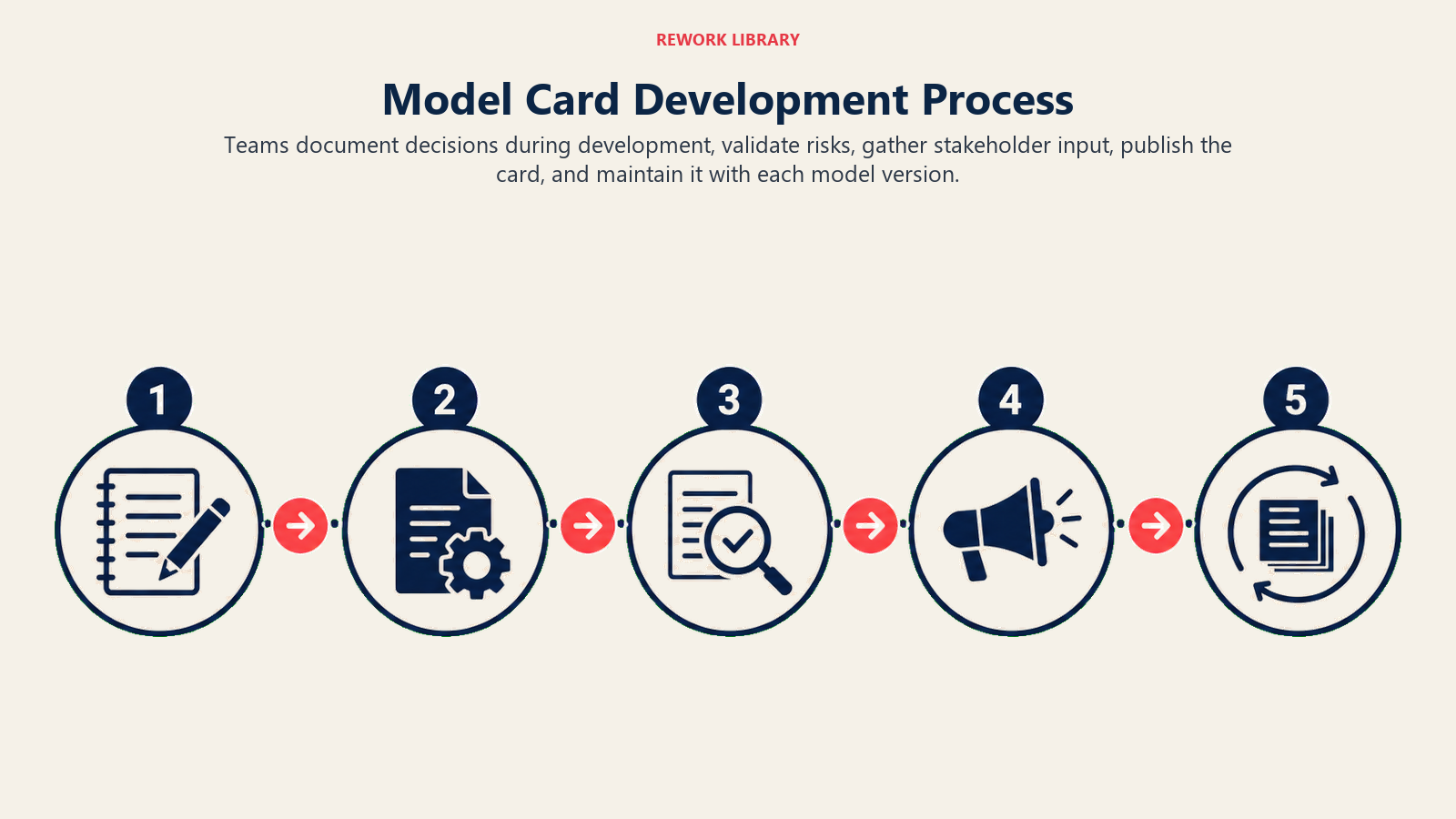
Phase 1: Model Development
- Document decisions during development, not after
- Track dataset characteristics and curation choices
- Record architecture decisions and rationale
- Benchmark across diverse test sets
- Document known issues discovered
Phase 2: Validation & Testing
- Performance testing across demographic groups
- Fairness metrics calculation
- Edge case and adversarial testing through AI red teaming
- Bias audits and mitigation efforts
- Environmental impact assessment
Phase 3: Stakeholder Input
- Domain expert review
- Affected community consultation
- Legal and compliance review
- Ethics committee assessment
- Customer/user feedback incorporation
Phase 4: Documentation
- Complete all model card sections
- Use accessible language (avoid excessive jargon)
- Include visualizations for complex metrics
- Provide examples of appropriate/inappropriate use
- Link to technical documentation for details
Phase 5: Publication & Maintenance
- Publish with model deployment
- Version model cards with model versions
- Update as performance data accumulates
- Revise if use cases evolve
- Archive previous versions
Benefits of Model Cards
Value delivered to different stakeholders:
For Developers:
- Forced documentation of design decisions
- Facilitates team knowledge transfer
- Supports debugging and improvement
- Demonstrates due diligence
For Deployers:
- Informed procurement decisions
- Appropriate use case matching
- Risk assessment for deployment
- Integration planning (monitoring, oversight)
For Regulators:
- Standardized compliance review
- Transparency into AI capabilities
- Basis for audit and enforcement
- Industry best practice benchmarking
For End Users:
- Understand AI limitations
- Appropriate reliance levels
- Awareness of potential biases
- Informed consent for AI-mediated decisions
For Organizations:
- Demonstrate responsible AI commitment
- Reduce liability through disclosure
- Enable scalable AI governance
- Build stakeholder trust
Model Cards vs. Related Practices
Complementary documentation approaches:
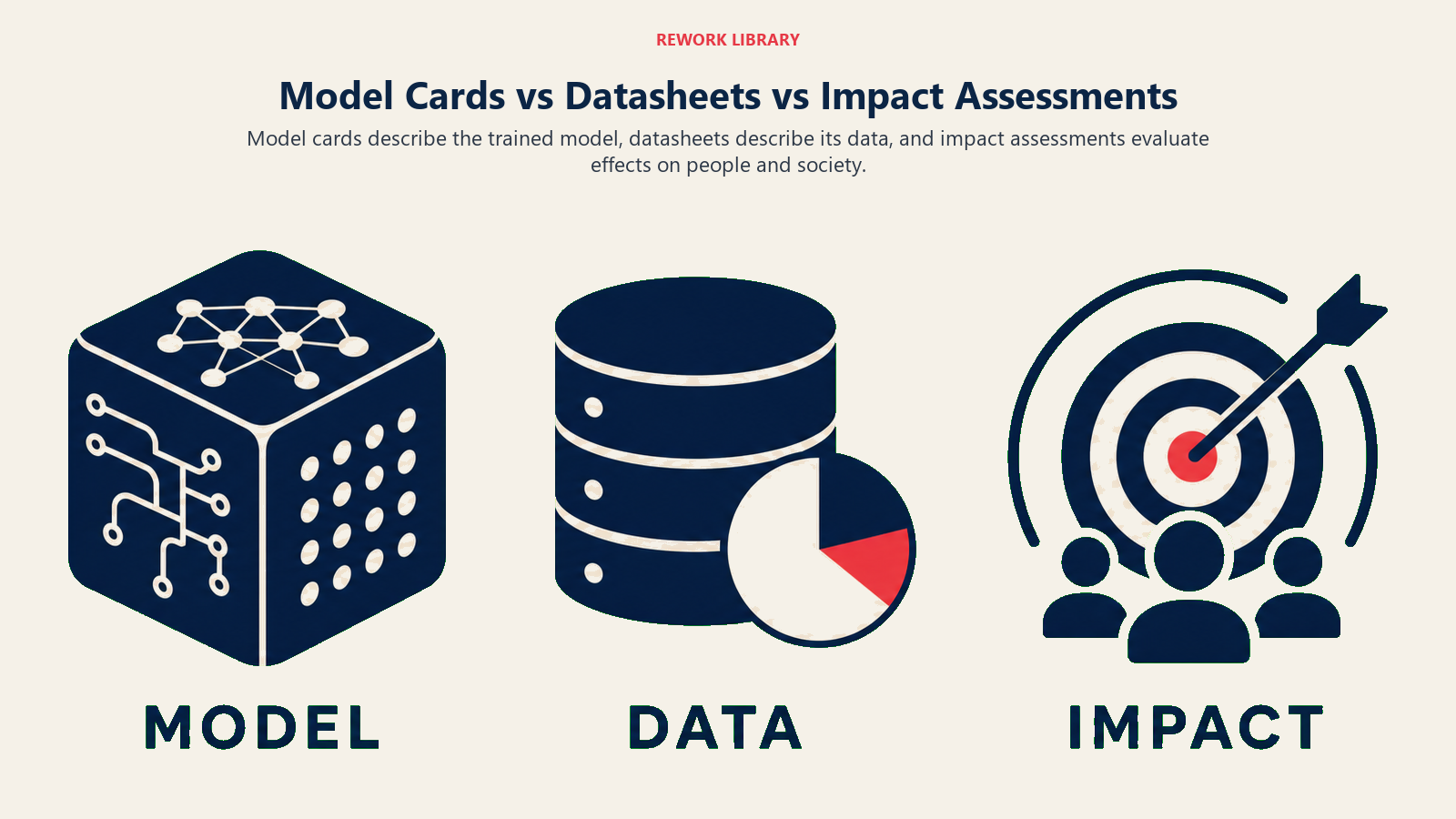
Model Cards vs. Datasheets:
- Model cards: Document the trained model
- Datasheets: Document the training dataset
- Relationship: Datasheets inform model card training data section
- Example: ImageNet datasheet referenced in vision model card
Model Cards vs. FactSheets:
- Model cards: Primarily technical documentation
- FactSheets: Broader accountability documentation (IBM's approach)
- Relationship: FactSheets include model cards plus governance info
- Example: FactSheet covers model card + approval process + monitoring
Model Cards vs. Impact Assessments:
- Model cards: Describe model capabilities and limitations
- Impact assessments: Analyze societal and stakeholder effects
- Relationship: Impact assessments inform ethical considerations section
- Example: AI impact assessment feeds model card
All three practices should be integrated into comprehensive AI documentation.
Common Model Card Challenges
Issues and solutions:
• Incompleteness: Sections left blank or superficial → Solution: Automated completeness checking and peer review requirements in MLOps pipelines
• Technical Jargon: Documentation inaccessible to stakeholders → Solution: Plain language summaries with technical details in appendices
• Static Documentation: Model cards not updated as models evolve → Solution: Version control and update triggers in deployment workflow
• Gaming Metrics: Showing only favorable performance data → Solution: Standardized benchmark requirements and third-party validation
• One-Size-Fits-All: Generic templates not tailored to use case → Solution: Industry-specific model card standards (healthcare, finance, etc.)
Regulatory Landscape
Model cards in compliance frameworks:
EU AI Act Requirements:
- High-risk AI systems must provide transparency documentation
- Model cards satisfy many technical documentation requirements
- Required information aligns with model card sections
- Non-compliance penalties up to 3% of global revenue
NYC Automated Employment Decision Tools Law:
- Bias audit results must be publicly available
- Model cards provide standardized publication format
- Fairness metrics section addresses legal requirements
- Annual updates required
FDA AI/ML Medical Devices:
- Algorithm Change Protocol submissions include model information
- Model cards structure required documentation
- Performance across populations required
- Ongoing monitoring and updates mandated
Financial Services Model Risk Management (SR 11-7):
- Model validation requires comprehensive documentation
- Model cards provide standardized format
- Limitations section critical for risk assessment
- Periodic review and updates required
Building Model Card Practice
Implementation roadmap:
Step 1: Establish Standards (Month 1)
- Select model card template/format
- Define organizational requirements beyond standard
- Integrate into AI development lifecycle
- Create review and approval process
Step 2: Pilot Program (Months 2-3)
- Select 3-5 models for initial model cards
- Train teams on documentation requirements
- Generate cards and gather feedback
- Refine templates and processes
Step 3: Scaling (Months 4-6)
- Require model cards for all new models
- Backfill cards for existing production models
- Automate card generation where possible
- Implement quality assurance processes
Step 4: Integration (Months 7-12)
- Link model cards to AI governance workflows
- Integrate with model registries and catalogs
- Public-facing cards for customer-facing AI
- Regular update and maintenance processes
Step 5: Maturity (Ongoing)
- Continuous improvement of documentation
- Industry benchmark participation
- Community contribution to standards
- Recognition as transparency leader
Future of Model Cards
Emerging trends:
- Dynamic Model Cards: Auto-updating with production performance data
- Interactive Model Cards: Stakeholders query specific concerns
- Multilingual Cards: Accessibility across languages and cultures
- Verified Cards: Third-party attestation of accuracy
- Standardization: Industry and regulatory convergence on formats
- Machine-Readable: Automated compliance checking and comparison
Organizations should implement extensible model card systems preparing for these advances.
Your Model Card Strategy
Building comprehensive AI transparency:
- Start with AI Governance policy requiring documentation
- Implement Explainable AI to inform model cards
- Conduct AI Impact Assessment for ethical considerations
- Establish MLOps integrating card generation
Learn More
Explore related AI transparency and governance concepts:
- Explainable AI - Make AI decisions interpretable to inform model cards
- AI Governance - Establish model card policies and standards
- Bias in AI - Address fairness metrics in model cards
- AI Impact Assessment - Evaluate risks documented in cards
External Resources
- Hugging Face Model Cards - Platform standardization
- Partnership on AI - Industry standards and best practices
Frequently Asked Questions about AI Model Cards
What are AI Model Cards?
AI model cards are structured documents that describe machine learning models' characteristics, intended use, limitations, performance metrics, ethical considerations, and relevant information. They provide standardized transparency for AI systems similar to nutrition labels for food products.
What are the core sections of an AI model card?
Model Details (developers, version, type), Intended Use (use cases and prohibited applications), Training Data (dataset characteristics), Performance Metrics (accuracy across groups), Limitations (failure modes), Ethical Considerations (fairness and privacy), and Recommendations (deployment best practices).
Who should create model cards?
Model cards should be created by AI development teams with input from domain experts, affected communities, legal/compliance teams, ethics committees, and potential users. Documentation should begin during development and be refined through validation and stakeholder review.
What's the difference between model cards and datasheets?
Model cards document the trained AI model (capabilities, performance, limitations). Datasheets document the training dataset (collection methods, composition, biases). Datasheets inform the training data section of model cards. Both are complementary transparency practices.
Are model cards legally required?
Requirements vary by jurisdiction and industry. The EU AI Act requires technical documentation for high-risk AI (model cards satisfy many requirements). NYC requires bias audit publication for hiring AI. FDA expects documentation for medical AI. Financial services need model documentation. Requirements are expanding globally.
How often should model cards be updated?
Model cards should be versioned with model versions. Updates required when: model is retrained, performance characteristics change, new use cases emerge, limitations are discovered, or regulations require it. At minimum, annual review is best practice.
Part of the [AI Terms Collection]. Last updated: 2026-02-09

Co-Founder, Rework.com
On this page
- Defining AI Model Cards
- Business Imperative
- Core Model Card Sections
- Model Card Standards
- Real-World Model Card Examples
- Model Card Development Process
- Benefits of Model Cards
- Model Cards vs. Related Practices
- Common Model Card Challenges
- Regulatory Landscape
- Building Model Card Practice
- Future of Model Cards
- Your Model Card Strategy
- Learn More
- External Resources