What are Large Language Models? The AI Revolution in Human Language
Turn this article into takeaways for your work.


Each assistant summarizes the article only for you and suggests best practices for your work.
ChatGPT reached 100 million users in just two months back in 2023. By mid-2026, that early curiosity has turned into daily infrastructure: Claude, GPT-5.6, and Gemini 3.2 Pro now process millions of business documents, contracts, and codebases every day. These Large Language Models aren't just chatbots; they're fundamentally changing how businesses operate, communicate, and create value. And the model landscape itself has shifted fast, from a handful of general chat assistants to a mix of reasoning specialists, low-cost workhorses, and open-weight alternatives that rival the frontier. But what exactly makes them so powerful, and what changed to get here?
The Technology Behind the Buzz
Large Language Models emerged from decades of natural language processing research, but the breakthrough came in 2017 with the transformer architecture. The term "large" refers to their billions of parameters, adjustable values that encode language understanding.
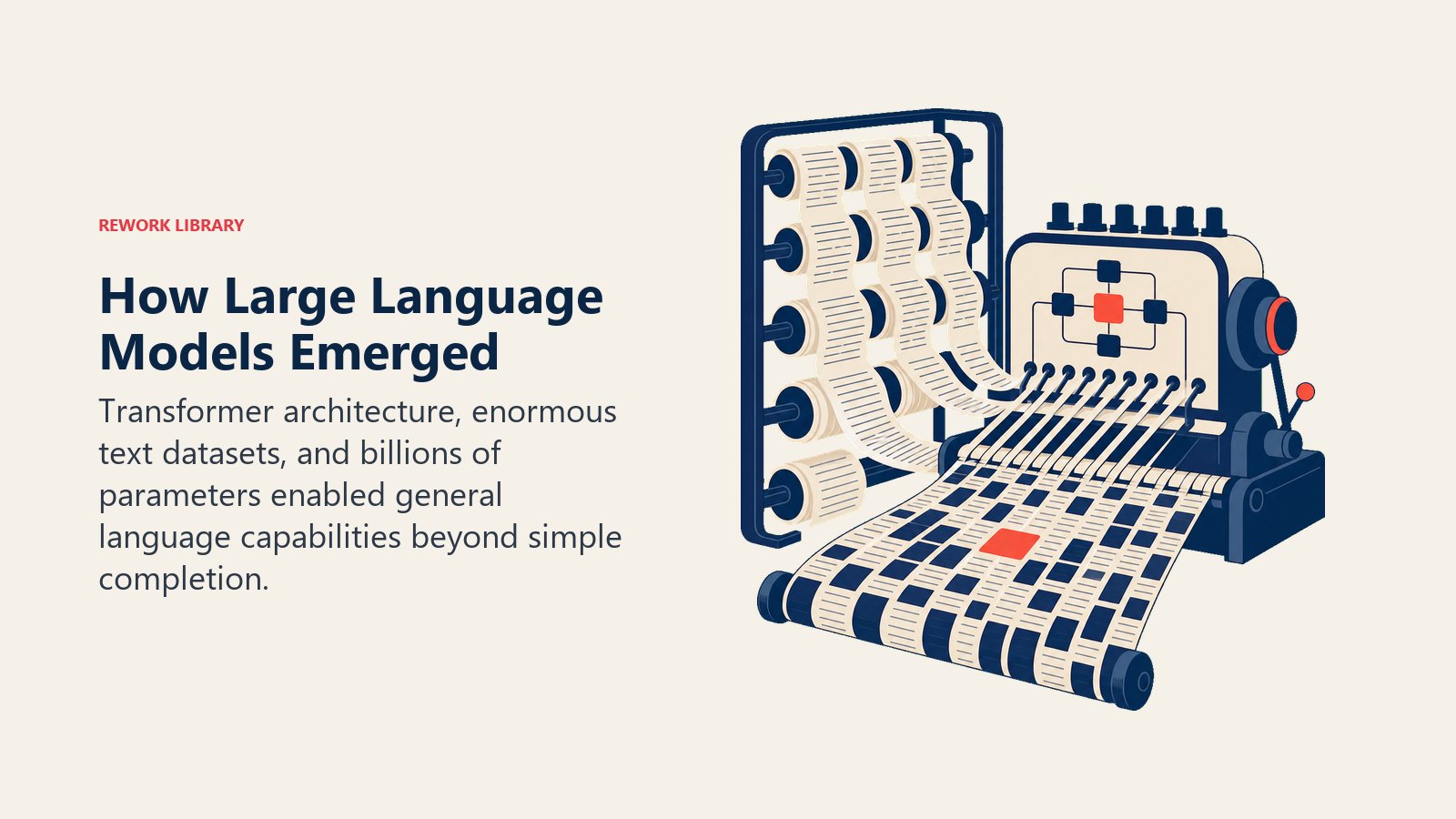
According to Stanford's AI Lab, LLMs are defined as "neural network models trained on vast amounts of text data to understand and generate human language by predicting the next word in a sequence, developing emergent capabilities far beyond simple text completion."
The revolution began with OpenAI's GPT-3 in 2020, demonstrating that sufficiently large models could perform tasks they weren't explicitly trained for, from writing code to analyzing contracts.
Breaking It Down for Business
For business leaders, LLMs are AI systems that can read, write, analyze, and reason in human language at a level approaching human expertise, but with the speed and scale of computers.
Think of an LLM as having a highly educated assistant who has read virtually everything ever written, can work 24/7, never forgets, and can have thousands of conversations simultaneously. Unlike traditional software that follows scripts, LLMs understand context, nuance, and intent.
In practical terms, this means AI that can draft your emails, analyze your contracts, answer customer questions, write your code, and even help strategize, all in natural language.
The Architecture of Understanding
LLMs consist of these essential elements:
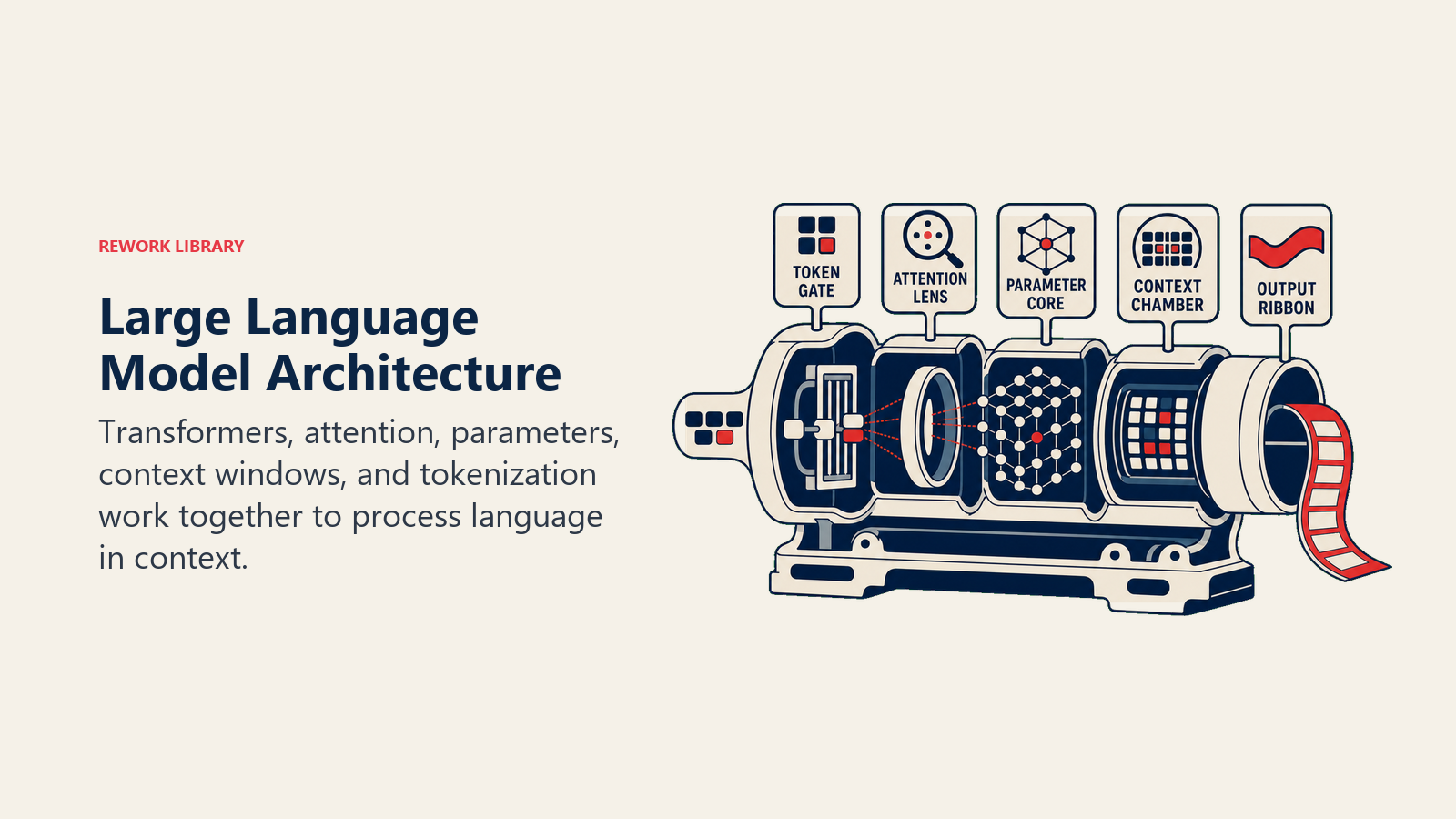
• Transformer Architecture: The neural network design that processes words in context, understanding that "bank" means different things in "river bank" versus "investment bank"
• Attention Mechanisms: Systems that determine which words in a sentence relate to each other, grasping complex relationships and dependencies
• Billions of Parameters: The "knowledge" encoded in numerical weights, representing patterns learned from training data
• Context Window: The amount of text the model can consider at once. Early GPT-3 era models topped out around 4,000 tokens; by mid-2026, frontier models like Gemini 3.2 Pro hold up to 2 million tokens, and 1-million-token windows (Claude Opus 4.8, GPT-5.6 Sol) are now common at the top end
• Tokenization System: How text is broken into processable units, enabling understanding of any language or even code
How LLMs Process Language
The LLM process follows these steps:
Input Tokenization: Your text is converted into tokens (word pieces), with each token assigned a numerical representation the model can process
Context Analysis: The transformer architecture examines all tokens simultaneously, understanding relationships and meaning through attention mechanisms
Prediction Generation: Based on patterns learned during training, the model predicts the most likely next tokens, generating coherent, contextual responses
This happens billions of times per second, creating fluent, relevant text that often seems indistinguishable from human writing.
Categories of Large Language Models
LLMs generally fall into four main types:
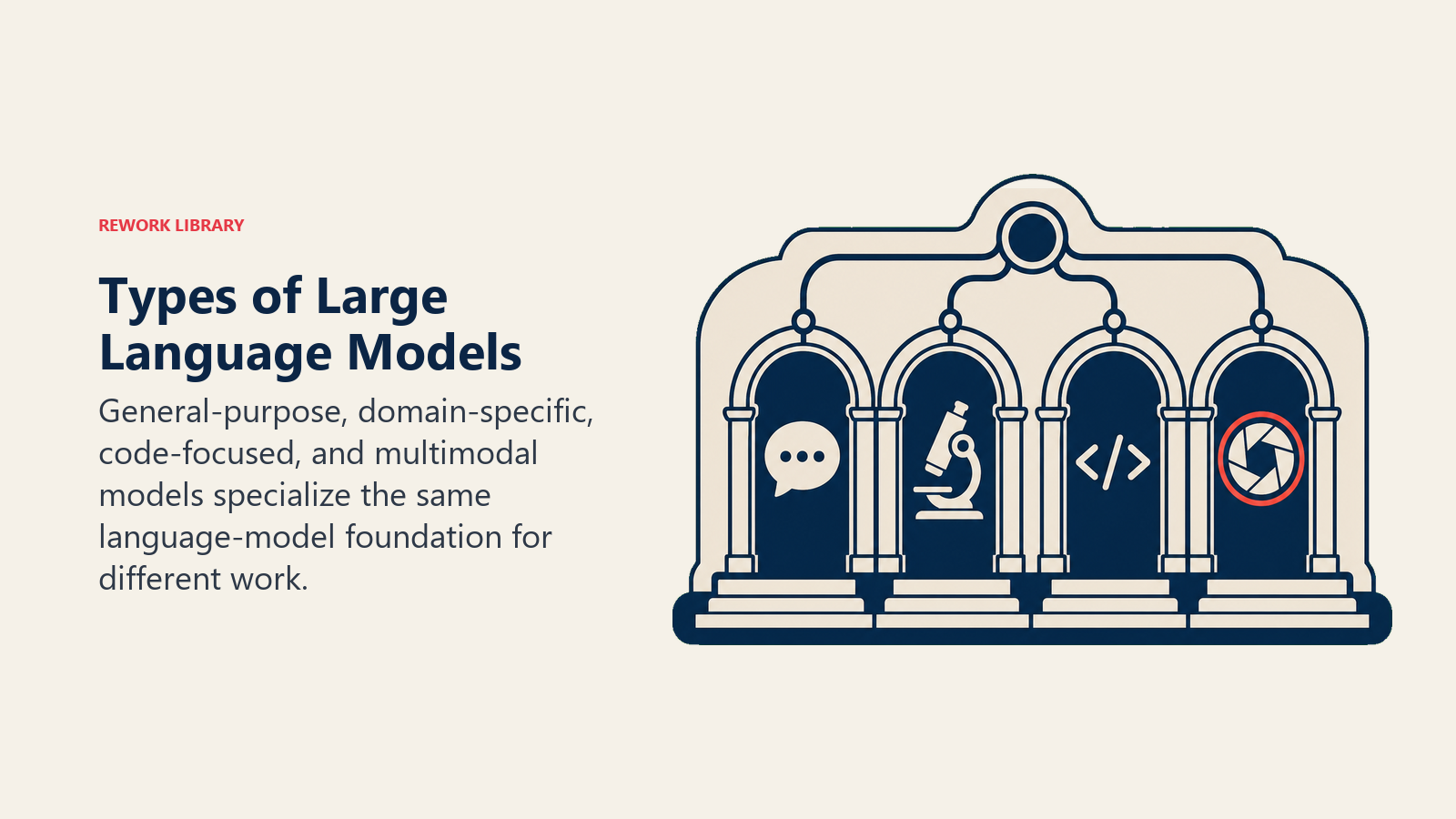
Type 1: General Purpose Models Best for: Wide range of tasks, from writing to analysis Key feature: Broad knowledge and capabilities Example: GPT-5.6, Claude Opus 4.8, Gemini 3.2 Pro
Type 2: Specialized Domain Models Best for: Industry-specific applications Key feature: Fine-tuned on specialized data Example: BloombergGPT for finance, Med-PaLM for healthcare
Type 3: Code-Focused Models Best for: Software development and technical tasks Key feature: Trained on programming languages Example: GitHub Copilot, Claude Code, and open-weight coding specialists like Qwen3-Coder
Type 4: Multimodal Models Best for: Tasks involving text, images, video, and other media Key feature: Understand and generate multiple formats Example: GPT-5.6 (native vision), Gemini 3.2 Pro (native video reasoning)
Two cross-cutting shifts matter more than the category labels. First, most 2026 frontier models now ship with a reasoning mode (sometimes called "extended thinking" or "deep think") that trades speed for step-by-step problem solving on math, code, and multi-step business logic, rather than reasoning being a separate model type. Second, open-weight models (Llama, Qwen, DeepSeek, Mistral) have closed most of the performance gap with proprietary frontier models while running at a fraction of the cost, so the buying decision is no longer just "which lab" but "closed frontier model, open-weight model, or a smaller, cheaper model that's good enough for the task."
Key Facts
- Global corporate AI investment hit $581.7 billion in 2025 ($344.7 billion of it private capital), with the US alone investing $285.9 billion, 23 times China's $12.4 billion. Stanford HAI AI Index 2026
- Generative AI reached 53% population adoption within three years of ChatGPT's launch, a faster curve than the personal computer or the internet. Stanford HAI AI Index 2026
- The performance gap between the best closed model and the best open-weight model has narrowed to roughly 3 percentage points as of early 2026, down from a much wider spread a year earlier. Stanford HAI AI Index 2026
- Enterprise generative AI spending reached $37 billion in 2025, up 3.2x from $11.5 billion in 2024, with applications now capturing more than half of that spend. Menlo Ventures, 2025 State of Generative AI in the Enterprise
- Anthropic holds roughly 40% of enterprise LLM API spend (up from 12% in 2023), while OpenAI's share fell to 27% (from 50%) as buyers spread workloads across more providers. Menlo Ventures, 2025 State of Generative AI in the Enterprise
- The price to reach a fixed level of LLM performance has fallen between 9x and 900x per year depending on the benchmark, with the median pace accelerating to roughly 200x per year since January 2024. Epoch AI, LLM inference price trends
- 88% of organizations report regular AI use in at least one business function, up from 78% a year earlier, though most still say they haven't captured "significant" enterprise-wide value yet. McKinsey, The State of AI
LLMs Transforming Business
Here's how businesses actually use LLMs, including some hard lessons from the past two years:
Customer Service Example: Klarna's 2023 experiment (replacing roughly 700 support agents with an LLM assistant handling two-thirds of queries) became the industry's cautionary tale. By 2025 the company was rehiring human agents after satisfaction on complex issues slipped, and its CEO admitted, "We focused too much on efficiency and cost." Klarna's current model, and the one most enterprises have converged on for 2026, is a hybrid: LLMs resolve routine requests instantly, and humans step in for anything needing empathy or judgment.
Legal Example: A&O Shearman (formed by the 2024 merger of Allen & Overy and Shearman & Sterling) now runs its ContractMatrix Analyze module, built with Harvey and Microsoft, across 4,000-plus lawyers in 43 jurisdictions. Early adopters report accuracy above 95% on playbook-based review, a 30% cut in contract review time, and roughly 2 to 3 hours saved per lawyer per week.
Software Development Example: AI-generated code is no longer a novelty; GitHub reports its Copilot now generates on the order of 46% of code written on the platform, in line with industry estimates that 41 to 46% of new code is AI-assisted in 2026. Replit alone counts more than 500,000 business users and a presence in 85% of the Fortune 500.
What changed in 2026
A few things separate today's LLM landscape from where it stood even a year ago:
- Reasoning is standard, not a separate product. Most frontier models (Claude Opus 4.8, GPT-5.6 Sol, Gemini 3.2 Pro) now offer a reasoning or "thinking" mode you toggle on for harder problems, instead of needing a dedicated reasoning-only model.
- Open-weight models are close enough to matter. The best open-weight models trail the best closed models by roughly 3 percentage points on capability benchmarks, down sharply from a year earlier, which is why more enterprises now run a mix of frontier and open-weight models by task.
- Token costs kept collapsing. Reaching the same performance bar now costs a fraction of what it did in 2024, with price-per-performance improving by triple digits annually on several benchmarks, which is what makes running LLMs across every workflow, not just flagship use cases, economically viable.
- Context windows stopped being the bottleneck. Million-token-plus context windows mean models can now ingest entire codebases, contract sets, or quarters of financial filings in one pass.
- The market corrected on hype. Klarna's public reversal on all-AI customer service, and McKinsey's finding that most companies still haven't captured "significant" value from gen AI, pushed the conversation from "replace people" to "pair LLMs with the right human oversight."
Starting Your LLM Journey
Ready to leverage LLMs in your business?
- Master interaction with prompt engineering techniques
- Understand limitations like AI hallucination
- Explore integration via AI APIs
- Consider AI governance frameworks for responsible deployment
Related Resources
Explore these related AI concepts to deepen your understanding:
- Generative AI - The broader category of AI systems that create new content
- Deep Learning - The foundational technology powering modern LLMs
- Foundation Models - Pre-trained models that serve as the base for specialized applications
- Conversational AI - How LLMs enable natural human-computer dialogue
External Resources
- OpenAI GPT Research Papers - Technical documentation on large language model development
- Anthropic's Claude Technical Documentation - Safety and capabilities of modern LLMs
- Google DeepMind LLM Research - Academic perspectives on language model architecture
Part of the [AI Terms Collection]. Last updated: 2026-07-16

Co-Founder, Rework.com