What is PolyAI?
Turn this article into takeaways for your work.


Each assistant summarizes the article only for you and suggests best practices for your work.
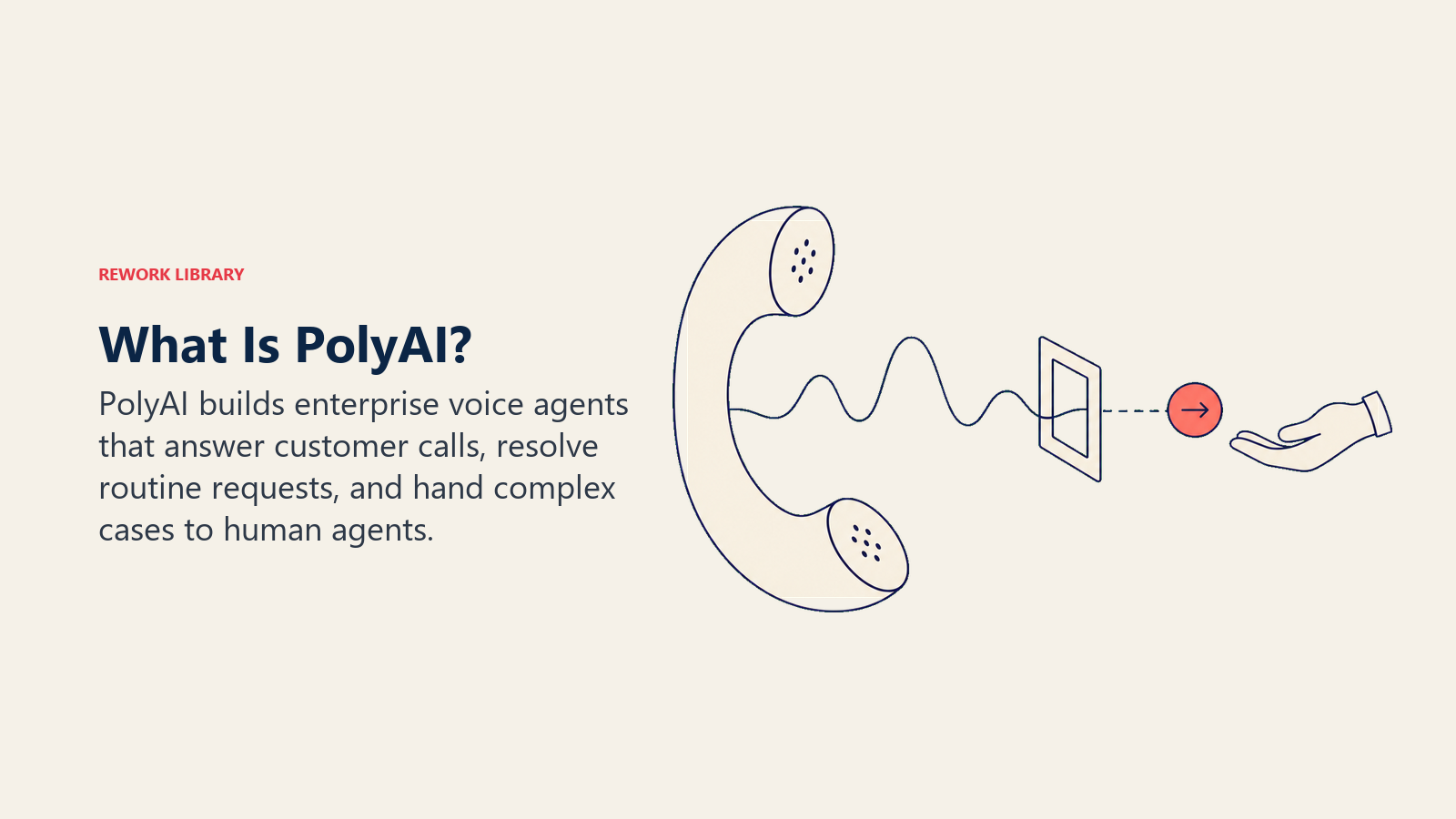
PolyAI is an enterprise voice AI company that builds conversational voice assistants for customer service call centers. Its AI agents answer inbound phone calls, understand natural spoken language, resolve routine requests like bookings, payments, and account questions, and transfer complex cases to a human agent when needed.
That's a different product from Poly.AI, also marketed as PolyBuzz, a consumer chat app from Cloud Whale Interactive Technology that lets people talk to AI characters and celebrity personas for entertainment. This article covers the enterprise company at poly.ai, the one banks, hotel chains, and utilities hire to answer their phones, not the character chatbot app with a similar name.
Who Built PolyAI
PolyAI was founded in 2017 as a spinout from the University of Cambridge's dialogue systems research group. CEO and cofounder Nikola Mrkšić previously worked on Apple's Siri before starting the company, which set out to replace scripted IVR menus ("press 1 for billing") with AI that lets callers speak naturally.

The company has raised more than $200 million to date. Its most recent round, an $86 million Series D closed in December 2025, was co-led by Georgian, Hedosophia, and Khosla Ventures, with participation from NVIDIA's venture arm NVentures, Citi Ventures, and Zendesk Ventures, among others. That round valued PolyAI at $750 million, up 50% from a $500 million valuation in May 2024, according to Forbes.
Named enterprise customers include PG&E, Unicredit, Caesars Entertainment, Golden Nugget, and the restaurant chain Fogo de Chão, spanning energy, banking, and hospitality.
Key Facts: PolyAI
- PolyAI raised an $86 million Series D in December 2025 at a $750 million valuation, up 50% from $500 million in May 2024, pushing total funding past $200 million, according to Forbes.
- PolyAI reports 100+ enterprise customers and 2,000+ live deployments across 45 languages in 25+ countries, per PolyAI's own funding announcement.
- The company was founded in 2017 as a University of Cambridge dialogue-systems spinout; CEO Nikola Mrkšić previously worked on Siri at Apple, per Forbes.
- A Forrester Consulting Total Economic Impact study commissioned by PolyAI (published July 2025) found a composite customer achieved 391% ROI over three years with payback in under six months, according to PR Newswire.
- The same Forrester study found $10.3 million in agent labor cost savings over three years, alongside a 50% reduction in call abandonment rate and a 25% decrease in agent attrition, per PR Newswire.
- PolyAI reported $15 million in GAAP revenue for the fiscal year ending January 2025, up from $8.9 million the prior year, with 2025 annual recurring revenue expected to reach $40 million, according to Forbes.
What PolyAI Actually Does
PolyAI builds what it calls "dialog agents": AI voice agents that pick up an inbound call, hold a natural back-and-forth conversation with the caller, and either complete the request themselves or route it to a human. The company says its assistants run on a proprietary voice AI model called Raven, trained specifically on enterprise phone conversations rather than adapted from a general-purpose chatbot, a choice PolyAI positions as a differentiator against rivals that layer voice on top of third-party models from providers like OpenAI or ElevenLabs.

In practice, the assistants handle a fixed set of task types across most deployments:
Account management and authentication. Verifying who's calling, pulling up account details, and updating records without asking a human agent to type anything.
Call routing. Understanding what the caller actually needs, even when they don't use the exact menu language, and sending them to the right queue or person.
Billing and payments. Taking a payment over the phone, explaining a charge, or setting up a payment plan.
Booking and reservations. Scheduling appointments, hotel rooms, or restaurant tables, the kind of transactional call that used to eat up front-desk staff time.
FAQ and troubleshooting. Answering common questions and walking callers through basic fixes before a request needs a specialist.
Order management. Checking order status, processing changes, or handling returns over the phone.
This is where conversational AI and agentic AI overlap: the assistant isn't just answering a question, it's carrying out multi-step actions inside the caller's account, then deciding on its own when a case is outside its authority and needs a human in the loop. Calls that do get transferred typically hand off with a summary of the conversation so the human agent isn't starting from zero.
Industries PolyAI Serves
PolyAI targets industries where phone calls remain a primary customer contact channel and call volume is high enough that automating even a portion of it moves the needle. Based on its published customer list and case studies, the strongest concentrations are:
Banking and financial services. Card registration, account servicing, and fraud-related calls, exemplified by its work with Unicredit.
Hospitality and hotels. Front desk requests, reservations, and restaurant bookings, the use case behind its Caesars Entertainment and Golden Nugget deployments.
Restaurants and retail. Reservation and ordering volume that spikes at predictable hours, as with Fogo de Chão.
Energy and utilities. Outage reporting and account calls, illustrated by its PG&E deployment.
Healthcare, insurance, and telecom. Appointment scheduling, claims questions, and account servicing, all high-call-volume categories where PolyAI markets its platform.
The common thread isn't the industry label so much as the call pattern: high volume, mostly repetitive requests, with a smaller share of complex cases that genuinely need a person.
PolyAI vs Other Conversational AI Platforms
PolyAI competes in a crowded field of enterprise conversational AI vendors, but the players differ in what they were originally built to do.
| Platform | Primary focus | Model approach | Best fit |
|---|---|---|---|
| PolyAI | Outbound and inbound phone voice agents | Proprietary voice model (Raven), built voice-first | Enterprises with high call center volume wanting a dedicated voice specialist |
| Cresta | Real-time agent assist plus generative AI for live human agents | Layers generative AI on top of existing agent workflows | Contact centers that want to augment human agents rather than replace calls outright |
| Parloa | Enterprise voice AI agents for phone and chat | LLM-agnostic, lets enterprises swap underlying models | Enterprises wanting flexibility to change model providers over time |
| Google Cloud CCAI | Contact center AI built on Dialogflow and Google's infrastructure | Google's own foundation models, deep GCP integration | Organizations already standing on Google Cloud infrastructure |
| Amazon Connect (with Lex/Q) | Cloud contact center platform with AI layered in | AWS-native models (Lex, Amazon Q) | AWS-native teams wanting contact center infrastructure and AI in one vendor |
None of these platforms are interchangeable once you look past the "voice AI" label. PolyAI's pitch is depth in one channel (the phone call) rather than breadth across every support surface, which is worth weighing against a broader AI vendor evaluation that also covers your chat, email, and messaging channels.
How PolyAI Is Priced
PolyAI does not publish pricing. Its website links to a pricing page that requires booking a demo or talking to sales, with no published per-minute, per-seat, or per-call rate card. That's typical for enterprise voice AI vendors selling into large call centers, where implementation involves custom integration work with existing telephony and CRM systems, and cost realistically scales with call volume, number of languages supported, and how many use cases get automated.
Buyers evaluating PolyAI should expect a sales-led process rather than a self-serve signup, and should push for a clear breakdown of setup fees versus ongoing usage costs before committing, the kind of exercise an AI total cost of ownership framework is built for. A headline ROI figure like the Forrester study's 391% is a useful directional signal, but it describes a composite customer built from four interviews, not a guarantee for any specific deployment.
Why PolyAI Matters for the Business
For a call center leader, the pitch is straightforward: routine calls that currently tie up human agents (a status check, a booking, a payment) can be resolved by an AI voice agent around the clock, without a caller ever having to navigate a menu tree. That frees human agents for calls that need judgment, empathy, or negotiation, and it can compress the queue during peak call volume instead of forcing callers to wait.
The business case gets stronger when the voice data itself feeds back into the organization. Call transcripts and outcomes from an automated voice layer can flow into call analytics and broader natural language processing pipelines, surfacing patterns in why customers call, what they're frustrated about, and where the automated flow breaks down and needs a redesign. That turns a cost-reduction tool into an ongoing source of customer insight, provided someone on the team is actually looking at the data rather than treating the voice agent as a black box.
Limitations to Know
PolyAI is a strong fit for a specific problem, not a universal customer service platform. A few limitations are worth weighing before a pilot:
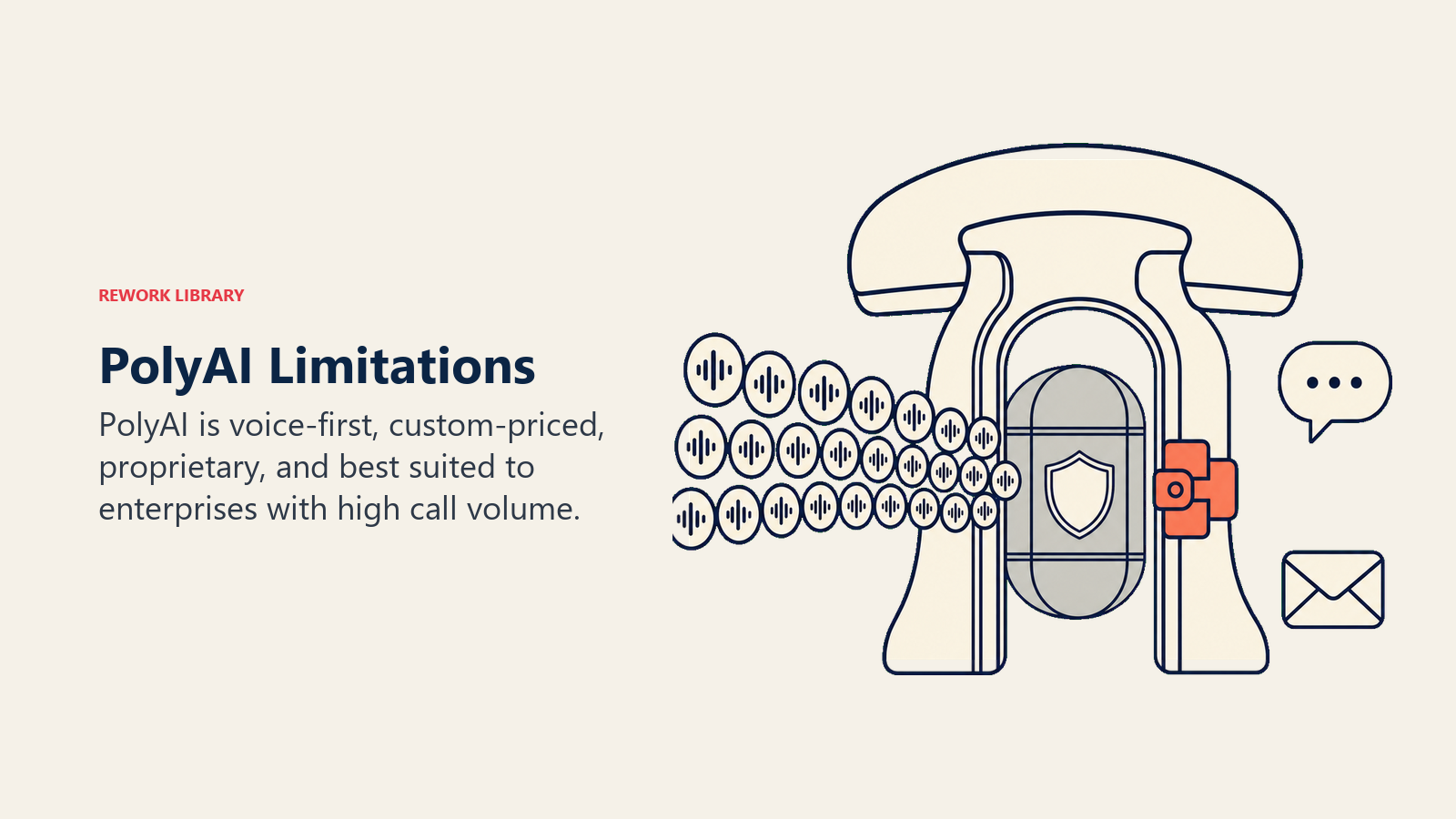
- No published pricing. Every deal is quoted individually, which makes early-stage budgeting harder than with a self-serve SaaS tool.
- Voice-first, not a full omnichannel suite. PolyAI's depth is phone calls. Teams wanting one platform across voice, chat, email, and social will likely need to pair it with another tool or a broader helpdesk.
- Proprietary model, less flexibility. Building on PolyAI's own Raven model is a differentiator for voice quality, but it's a tighter commitment than an LLM-agnostic platform that lets you swap providers later.
- Built for high call volume. The setup and integration investment makes the most sense for organizations with call centers processing thousands of calls a month, not small teams handling a trickle of inbound calls.
- Enterprise sales cycle. Expect a demo-and-negotiation process, not a same-day signup, which matters if you're evaluating on a tight timeline.
Frequently Asked Questions about PolyAI
What is PolyAI?
PolyAI is an enterprise voice AI company that builds conversational voice assistants for customer service call centers. Its AI agents answer phone calls, understand natural spoken language, resolve routine requests, and transfer complex cases to a human agent.
Is PolyAI the same as the Poly.AI chatbot app?
No. Poly.AI, also marketed as PolyBuzz, is a separate consumer app from Cloud Whale Interactive Technology for chatting with AI characters and celebrity personas. PolyAI (poly.ai) is the enterprise company building voice agents for call centers, an unrelated product with a similar name.
Who founded PolyAI and when?
PolyAI was founded in 2017 as a spinout from the University of Cambridge's dialogue systems research group. CEO and cofounder Nikola Mrkšić previously worked on Apple's Siri before starting the company.
How much funding has PolyAI raised?
PolyAI has raised more than $200 million to date. Its most recent round was an $86 million Series D closed in December 2025 at a $750 million valuation, up from $500 million in May 2024.
What industries use PolyAI?
PolyAI's customer base concentrates in banking and financial services, hospitality and hotels, restaurants and retail, energy and utilities, healthcare, insurance, and telecom, industries with high call volume and repetitive request patterns.
How is PolyAI priced?
PolyAI does not publish pricing. It sells through a demo-and-quote enterprise sales process, with cost driven by call volume, number of languages supported, and how many use cases are automated.
What is the ROI of using PolyAI?
A Forrester Consulting Total Economic Impact study commissioned by PolyAI, published July 2025, found a composite customer achieved 391% ROI over three years with payback in under six months, including $10.3 million in agent labor cost savings. Results for any specific deployment will vary from that composite model.
How does PolyAI compare to Cresta or Parloa?
PolyAI focuses on voice-only phone agents built on its own proprietary model. Cresta focuses more on real-time assistance for live human agents rather than replacing the call outright. Parloa offers voice AI agents with an LLM-agnostic approach, letting enterprises swap the underlying model provider.
Does PolyAI replace human call center agents entirely?
No. PolyAI's assistants are designed to resolve routine, repetitive calls and transfer complex or sensitive cases to a human agent, typically with a conversation summary attached. The stated goal is to free human agents for higher-value calls, not eliminate the team.
Related AI Concepts
- AI Voice Agents - The broader category of phone-based AI that PolyAI's product belongs to
- Conversational AI - The underlying field of natural-language dialogue systems PolyAI builds on
- What is Agentic AI? - How PolyAI's assistants plan and execute multi-step actions, not just answer questions
- Human-in-the-Loop - How PolyAI decides when to escalate a call to a person
- Call Analytics - Turning PolyAI's call transcripts and outcomes into coaching and forecasting data
- Natural Language Processing - The technology behind PolyAI's speech understanding
- AI Vendor Evaluation - A framework for comparing PolyAI against other voice and support AI vendors
- AI Total Cost of Ownership - Modeling PolyAI's custom-quoted pricing against real usage volume
External Resources
- Best AI Tools for Customer Support in 2026 - How PolyAI's category fits alongside text and ticketing-based AI support tools
- Best AI Chatbot Builders in 2026 - Text-based conversational AI alternatives to compare against a voice-first platform like PolyAI
- PolyAI - Official company site
- Forbes: PolyAI Raises $86 Million - Reporting on PolyAI's Series D, valuation, and revenue
- PolyAI Forrester TEI Study Press Release - The 391% ROI and $10.3 million savings figures cited in this article
