What is Perplexity AI?
Turn this article into takeaways for your work.


Each assistant summarizes the article only for you and suggests best practices for your work.
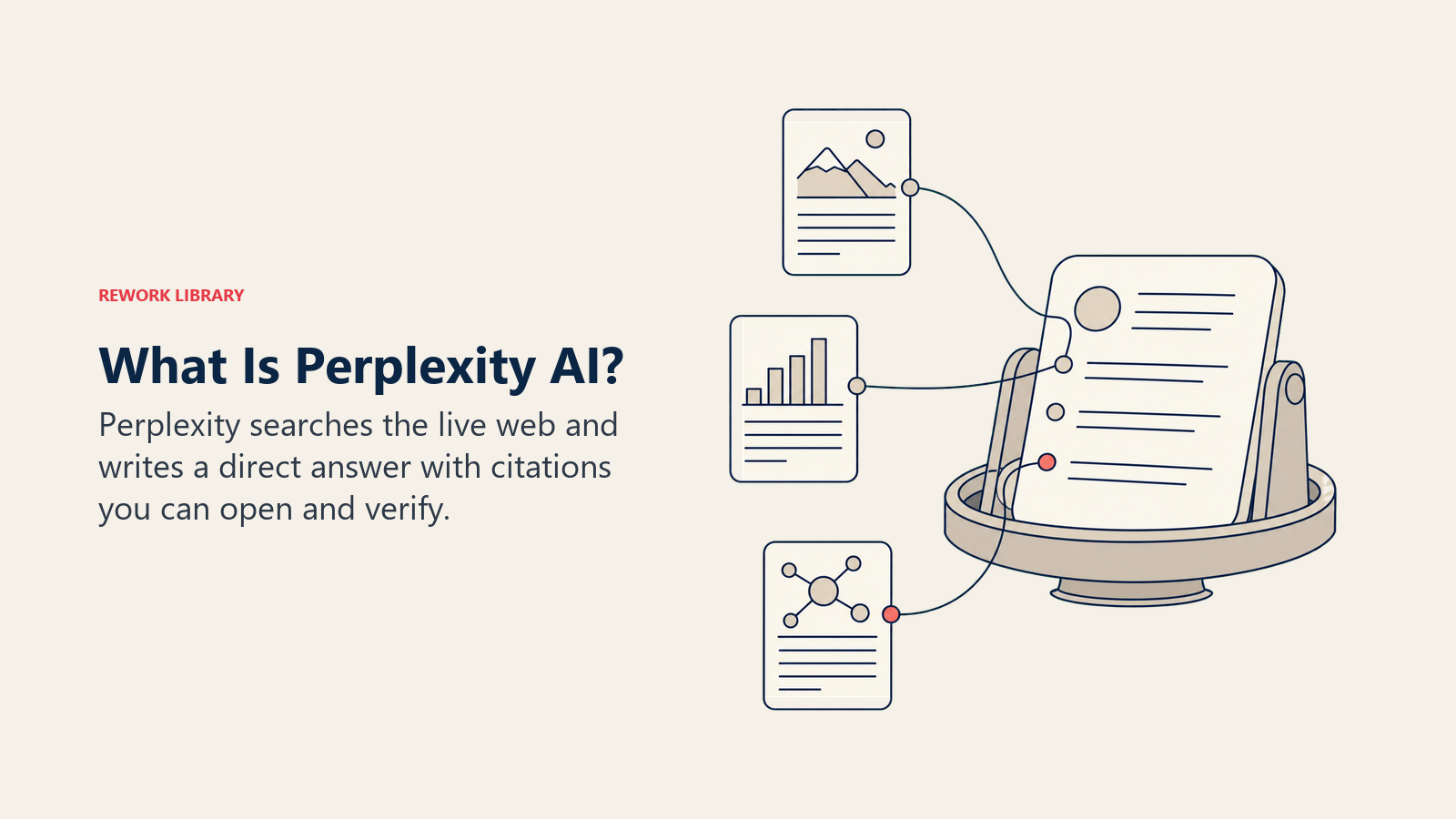
Perplexity AI is an AI-powered answer engine that searches the live web and generates a direct, written answer to a question instead of a list of links, with inline citations pointing back to its sources. It combines a large language model with real-time retrieval, so it can pull current information and show exactly where each claim came from. Think of it as a research assistant that reads the web for you and shows its work.
For business leaders, Perplexity is a faster way to get a sourced answer than digging through search results yourself. Ask it about a competitor's latest funding round, a regulatory change, or a market trend, and it returns a synthesized answer with numbered citations you (or your legal team) can click through and verify. That citation-first design is what separates it from a general chatbot that just generates text from memory.
Company Background
Perplexity AI was founded in August 2022 by Aravind Srinivas, Denis Yarats, Johnny Ho, and Andy Konwinski, and is headquartered in San Francisco. The company launched its core search product on December 7, 2022, positioning itself as an AI-native alternative to traditional search engines rather than another chatbot.
The company has raised more than $1.5 billion since founding. Its most recent widely reported round closed in September 2025 at a $20 billion valuation, according to TechCrunch. Investors reported across various funding rounds include Nvidia, SoftBank Vision Fund 2, IVP, Accel, and Databricks. By March 2026, Perplexity's annualized revenue had passed $450 million, up from roughly $305 million a few months earlier, on a user base the company said exceeded 100 million, according to Financial Times reporting cited by Yahoo Finance.
How Perplexity AI Works
Perplexity's core loop is retrieval, then generation. When you ask a question, the system runs a live web search, pulls the most relevant pages, and feeds that content into a large language model that writes a synthesized answer grounded in what it just found. This is conceptually similar to retrieval-augmented generation (RAG): the model isn't answering purely from what it memorized during training, it's answering from sources it retrieved seconds ago.
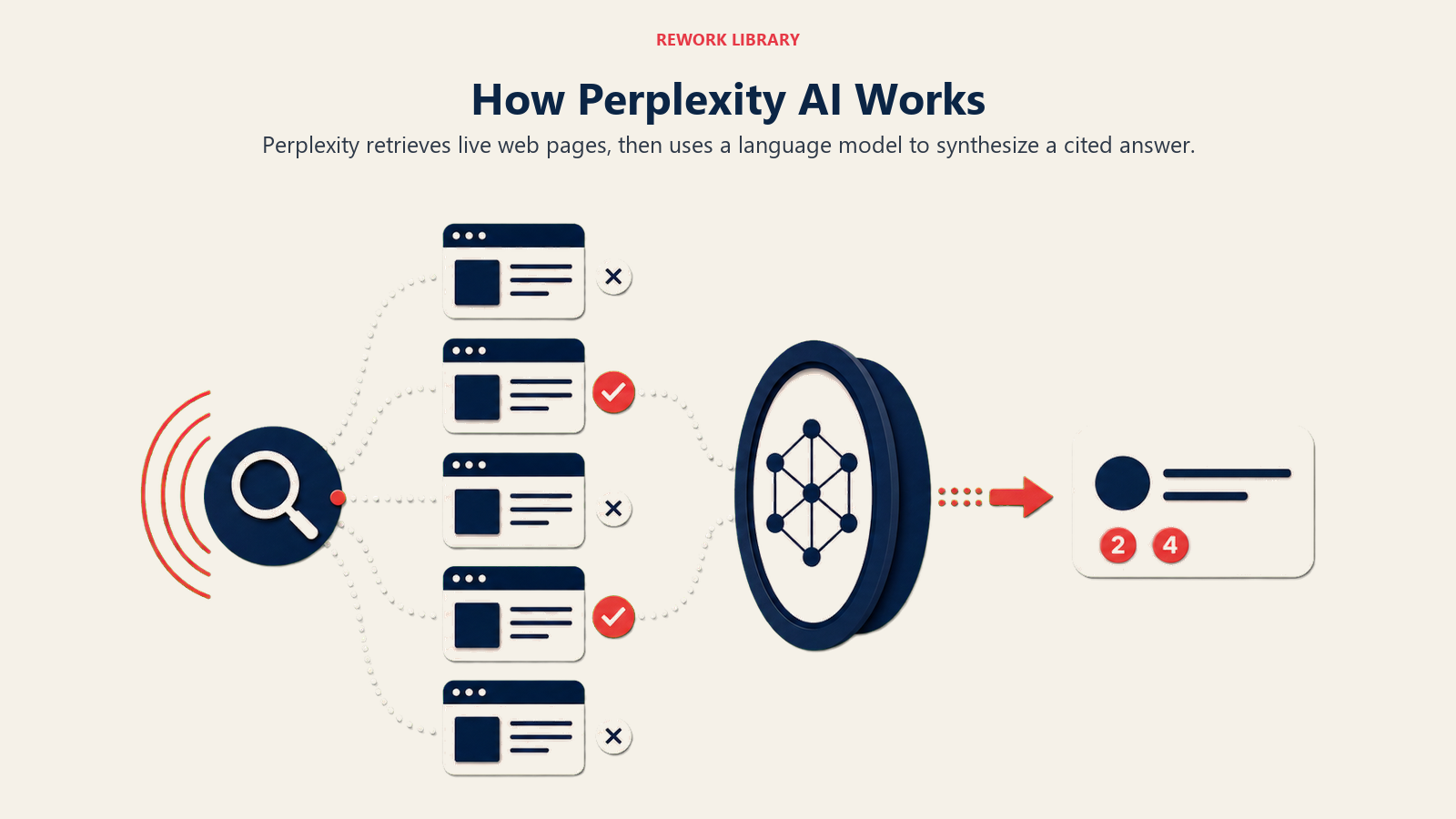
Every answer ships with numbered, clickable citations linking to the original pages, so you can verify a claim without re-running the search yourself. Under the hood, Perplexity built its own family of models, called Sonar, based on open-weight foundation models and tuned specifically for search and citation quality rather than general conversation. The underlying large language model handles the reasoning and writing; the retrieval layer, closer to a specialized form of semantic search than keyword matching, handles finding the right pages to ground the answer in.
Key Facts: Perplexity AI
- Founded in August 2022 by Aravind Srinivas, Denis Yarats, Johnny Ho, and Andy Konwinski, launching its search engine on December 7, 2022, per Wikipedia.
- Raised $200 million in a round that valued the company at $20 billion in September 2025, per TechCrunch.
- Annualized revenue passed $450 million by March 2026, up from about $305 million, with a user base the company said topped 100 million, per Financial Times reporting cited by Yahoo Finance.
- Comet, Perplexity's AI browser, launched in July 2025 priced at $200 a month before the company made it free for all users later that year, per CNBC.
- The Sonar API prices standard queries at $1 per million input and output tokens, and Sonar Pro at $3 per million input tokens and $15 per million output tokens, per Perplexity's official API pricing docs.
- Perplexity Pro costs $20 a month and Enterprise Pro costs roughly $40 per seat per month for teams, a price point consistent across multiple 2026 pricing trackers including eesel AI's Perplexity pricing guide.
Models and Features in 2026
Perplexity's product has expanded well past a simple search box. A few features matter most for business use:
- Pro Search: A deeper mode that runs multiple search steps and reasoning passes before answering, useful for multi-part questions ("compare these three vendors' pricing and support SLAs") instead of a single fact lookup.
- Spaces: Shared, organized workspaces where a team can group related searches, uploaded documents, and instructions for a recurring research project, so a colleague picking up the work later has the full context instead of starting from scratch.
- Comet browser: An AI-native web browser that embeds Perplexity's assistant into everyday browsing. It can summarize the page you're on, answer follow-up questions about it, and take actions like filling forms or navigating multi-step tasks. Comet launched in July 2025 as a paid product and became free for all users later that year, per CNBC.
- Sonar API: The developer-facing version of Perplexity's search-and-cite technology, letting companies build their own applications on top of live web retrieval with source citations, rather than a static model that can't see current information.
- Deep Research: A mode built for longer research tasks, producing a structured report with citations instead of a single paragraph answer, aimed at the kind of work an analyst would otherwise spend hours on.
Pricing and Plans in 2026
Pricing below reflects the tier structure reported across vendor pricing pages and analyst trackers as of July 2026. Confirm exact current pricing directly with Perplexity before budgeting, since AI vendor pricing shifts often.
| Plan | Price | Built for |
|---|---|---|
| Free | $0 | Unlimited basic search with a limited number of Pro Search queries per day |
| Pro | $20/month | Individuals who want higher usage limits, premium models, and file/app search |
| Max | $200/month | Heavy individual users needing high limits on Deep Research and asset generation |
| Enterprise Pro | ~$40/seat/month | Teams needing SSO, admin controls, and shared usage across the organization |
| Enterprise Max | ~$325/seat/month | Large teams needing the highest per-user search and research quotas |
Perplexity also offers the Sonar API on usage-based pricing for developers building on the platform directly, separate from the consumer and team subscription tiers.
Who Perplexity Is For and Business Use Cases
Perplexity fits best for people who ask a lot of fact-based questions and need to move fast without losing the ability to verify what they read. Common business use cases include:
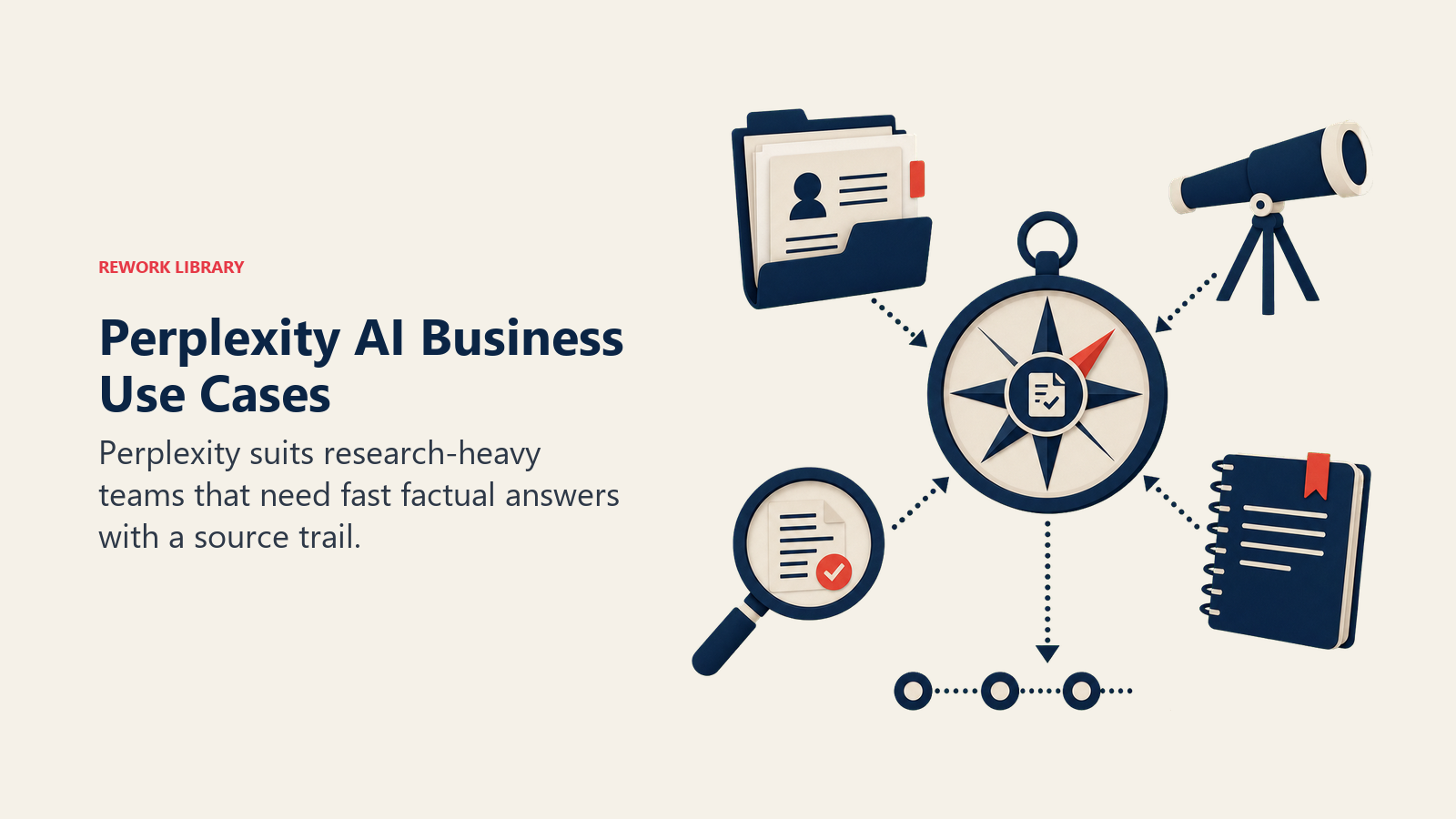
- Competitive intelligence: Quick, cited answers on a competitor's pricing changes, product launches, or leadership moves, with a source trail you can forward to a colleague.
- Market research and trend scanning: Fast desk research on market size, adoption trends, or emerging players in a category, before committing to a deeper study. Perplexity is one of several tools teams use for this kind of scanning; for a broader comparison against dedicated research platforms, see the best AI tools for market research.
- Due diligence prep: Pulling recent, sourced background on a company or executive ahead of a meeting, an investment decision, or a partnership conversation.
- Analyst and strategy teams: Running a high volume of research queries daily, where citation quality matters more than long-form writing or conversational AI style back-and-forth.
Perplexity is a weaker fit for teams whose core need is drafting long documents, working through multi-step reasoning, or building autonomous workflows. Those needs point more toward general-purpose AI agents or a strong conversational model, rather than a search-first answer engine.
Perplexity vs ChatGPT Search vs Google
These three tools all answer questions with some form of web access now, but they were built for different starting points.
| Dimension | Perplexity | ChatGPT Search | Google (AI Overviews / Gemini) |
|---|---|---|---|
| Core identity | Purpose-built AI search with citations | Conversational AI with web browsing added | Search engine with AI answers layered on top |
| Citation style | Inline, numbered, consistent | Present, but varies by query type | Present in AI Overviews, less consistent |
| Best for | Fast, cited factual research | Extended reasoning plus retrieval in one pass | Everyday search with an AI summary on top |
| Team/enterprise option | Enterprise Pro / Enterprise Max | ChatGPT Team / Enterprise | Google Workspace with Gemini |
| Starting price (individual) | Free; Pro $20/month | Free; Plus $20/month | Free with a Google account |
| Browser product | Comet (free) | None dedicated | Chrome (with Gemini features) |
The practical difference: Perplexity is built around the citation-first answer, ChatGPT Search is a strong general reasoner that also browses the web, and Google's AI Overviews sit on top of the search engine most people already default to. For a deeper, role-based breakdown of when each tool wins for executive research work, see Perplexity vs ChatGPT Search vs Gemini.
Limitations
Perplexity's citations reduce the risk of an unverifiable answer, but they don't eliminate it. A few honest limitations to know before relying on it for decisions:
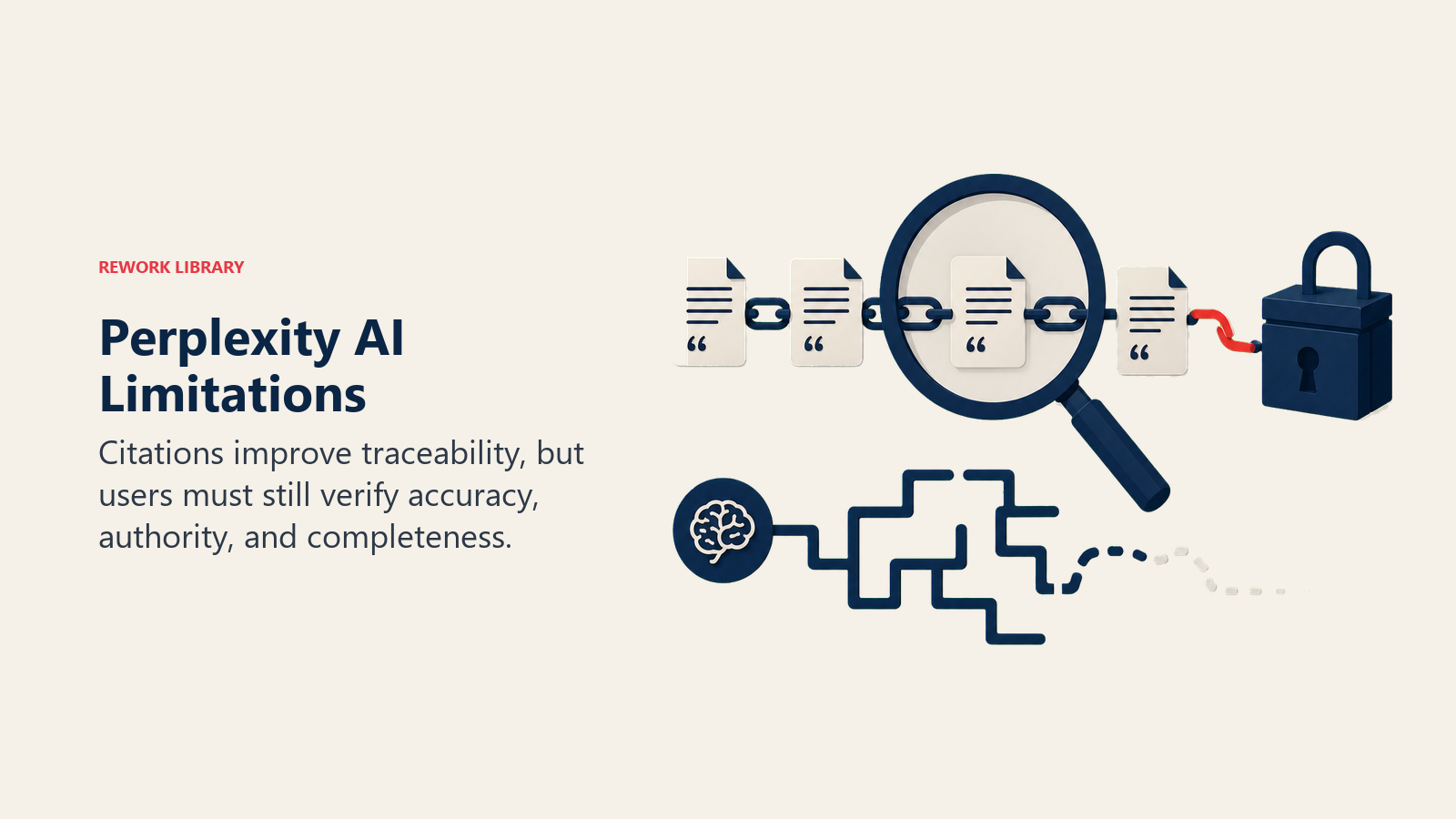
- Accuracy still needs a human check. A citation shows where an answer came from; it doesn't guarantee the source itself is correct or current. Treat every cited claim in a high-stakes decision the same way you'd treat a single search result: worth reading, not worth acting on unverified.
- Source quality varies. Perplexity pulls from whatever the web search surfaces, which can include lower-authority sites alongside primary sources. Compare the domain, not just the number attached to a claim.
- Weaker at extended reasoning. Multi-step strategic analysis, long-form drafting, and open-ended brainstorming are not where Perplexity's design is strongest; it answers questions well and reasons through complex, ambiguous problems less well than a general-purpose model built for that.
- Paywalled and private content stays out of reach. Like any web-search tool, it can't retrieve information behind a login or a paywall, so anything not publicly indexed won't show up in an answer.
Frequently Asked Questions about Perplexity AI
What is Perplexity AI in simple terms?
Perplexity AI is an AI answer engine that searches the live web and writes a direct, cited answer to your question instead of returning a list of links. Every claim links back to the source page it came from.
Is Perplexity AI free to use?
Yes. Perplexity offers a free tier with unlimited basic search and a limited number of Pro Search queries per day. Paid tiers (Pro at $20/month, Max at $200/month) raise those limits and add premium models and features.
How is Perplexity different from ChatGPT?
ChatGPT is a general-purpose conversational AI that added web browsing as a feature. Perplexity was built from the start as a search-and-cite tool, so its citation formatting and retrieval-first design are more consistent for fact-based research queries.
What is Comet, Perplexity's browser?
Comet is Perplexity's AI-native web browser. It embeds the assistant into everyday browsing, so it can summarize pages, answer follow-up questions, and complete simple multi-step tasks on your behalf. It launched as a paid product in 2025 and later became free.
What is the Sonar API used for?
The Sonar API lets developers build their own applications on top of Perplexity's search-and-cite technology, so an app can answer questions with real-time web retrieval and source citations instead of relying on a static model's training data.
Can businesses use Perplexity for market research?
Yes, many teams use Perplexity for fast, cited desk research and competitive scanning. For deeper quantitative or qualitative research methods, most teams pair it with a dedicated research platform rather than relying on it alone.
Does Perplexity AI hallucinate or make mistakes?
Like any AI system, it can. Citations reduce the risk by showing sources, but they don't guarantee the source is accurate or that the AI summarized it correctly, so claims that matter for a decision should still be checked against the original source.
What is Perplexity Enterprise Pro?
Enterprise Pro is Perplexity's team-oriented tier, priced at roughly $40 per seat per month, adding single sign-on, admin controls, and usage analytics on top of the individual Pro features.
Related AI Concepts
- Retrieval-Augmented Generation (RAG) - The retrieval-then-generate pattern behind how Perplexity grounds its answers
- Semantic Search - The meaning-based retrieval approach underlying Perplexity's search layer
- Large Language Models - The reasoning core that writes Perplexity's synthesized answers
- What is Agentic AI? - How autonomous, tool-using AI differs from a search-and-answer tool like Perplexity
- Generative AI - The broader category of AI that produces text, including Perplexity's answer synthesis
External Resources
- TechCrunch: Perplexity reportedly raised $200M at $20B valuation - Funding and valuation reporting
- Perplexity API Pricing Documentation - Official Sonar API pricing
- CNBC: Perplexity AI rolls out Comet browser for free worldwide - Comet browser pricing history
- Wikipedia: Perplexity AI - Company founding and history
Part of the AI Terms Collection. Last updated: July 2026
