What is AI Inference? Running AI Models in Production
Turn this article into takeaways for your work.


Each assistant summarizes the article only for you and suggests best practices for your work.
A retailer trains a demand forecasting model over six months. Data scientists validate it. Leadership approves it. The model is ready. Then it goes into production and has to answer thousands of queries per day, each one in under 200 milliseconds, for months or years. That's inference: the live, continuous process of running a trained model on real data to generate real outputs.
Training gets most of the attention in AI coverage. Inference is where the business value actually lives, and by 2026 it's also where most of the AI budget lives. Inference prices per token have fallen by orders of magnitude since 2022, and usage has grown even faster, so total inference spend keeps climbing even as the unit cost keeps shrinking.
Training vs. Inference: The Core Distinction
Understanding inference requires understanding what it's not. Training is the process of teaching a model by exposing it to large amounts of data and adjusting its parameters until it produces accurate outputs. Training is computationally intensive, expensive, and done relatively infrequently.
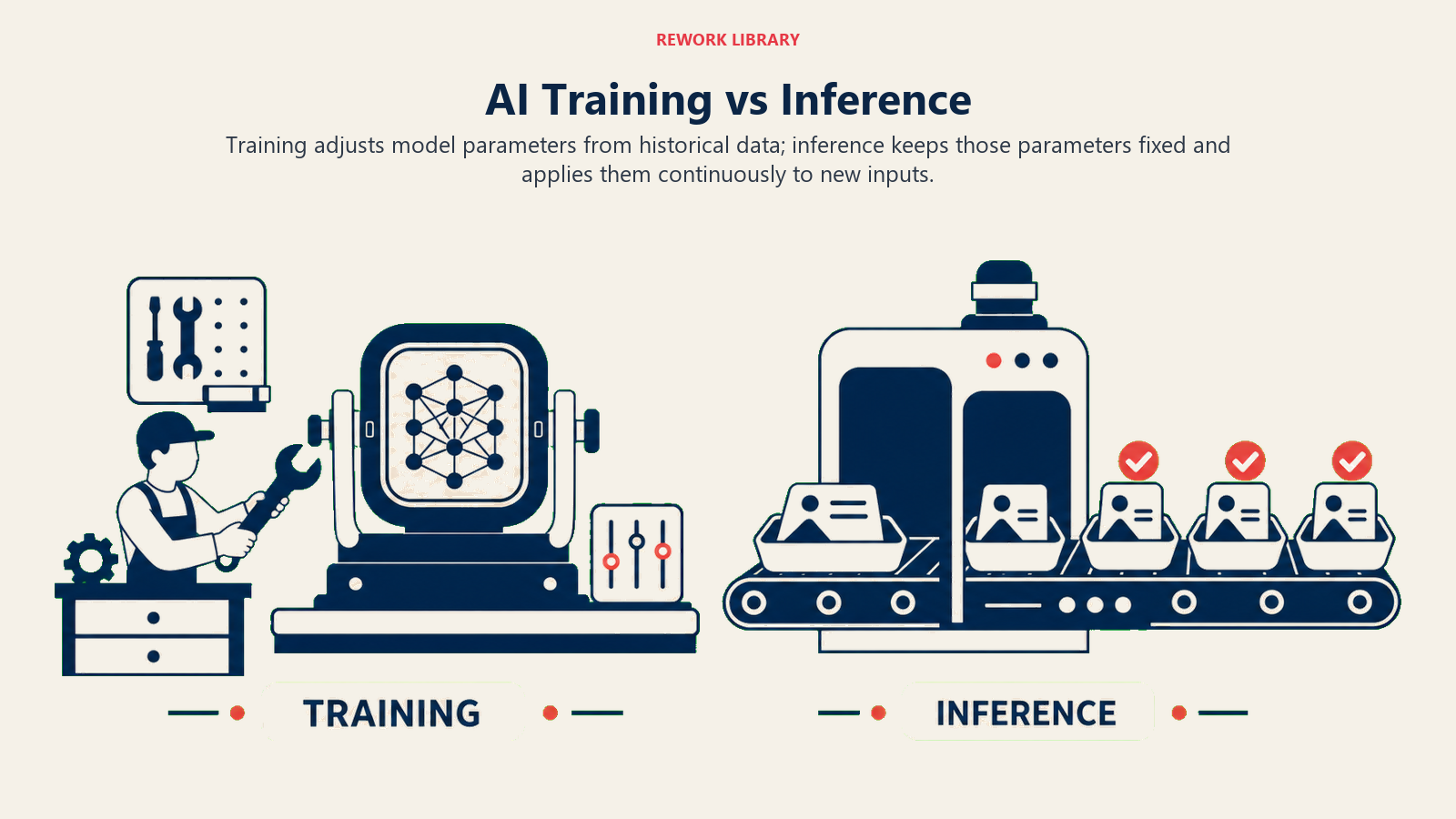
Inference is the opposite of all three. It's the process of taking a model whose parameters are already set and running it on new inputs to generate predictions. Inference is what happens when:
- A customer types a question into a chatbot and gets a response
- A fraud detection system evaluates a transaction in real time
- A document processing pipeline extracts data from an uploaded invoice
- A recommendation engine decides what to show a user next
Training happens once (or periodically). Inference happens continuously, at whatever volume the production system demands. For most businesses, inference is where nearly all the computing cost of AI in production comes from.
| Dimension | Training | Inference |
|---|---|---|
| Purpose | Teach the model by adjusting parameters on historical data | Apply the model's fixed parameters to a new, unseen input |
| Frequency | Happens once, then periodically for retraining or fine-tuning | Happens continuously, every time a user or system queries the model |
| Compute pattern | Sustained, large-scale, parallel compute over days or weeks | Short bursts per request, repeated thousands to billions of times |
| Cost shape | Large, front-loaded, project-style spend | Ongoing, usage-based spend that scales with adoption |
A model that's cheap to train but expensive to run at scale can still be a bad business decision. A model that's expensive to train but cheap to run at high volume can pay for itself many times over. Inference economics, not training benchmarks, usually decide which model actually ships.
How Inference Works
During inference, the trained model receives an input, whether text, an image, structured data, or audio, and runs it through its learned parameters to produce an output. For a large language model, this means the input gets converted to tokens, the model processes those tokens through its transformer architecture using its learned attention mechanisms, and the output tokens are generated sequentially until the response is complete. That's why longer responses take longer to produce: each output token requires another full pass through the model.
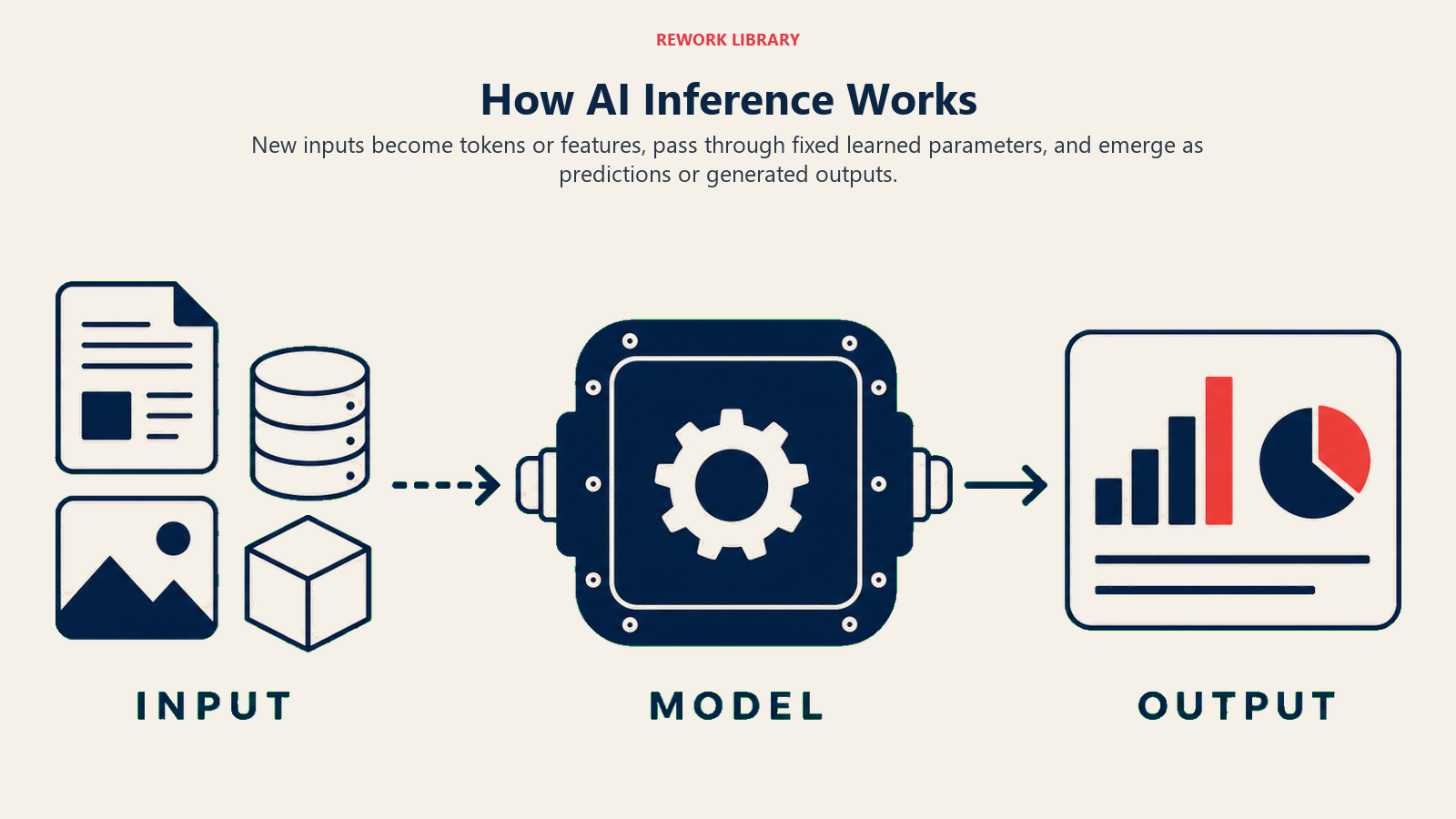
The parameters of the model don't change during inference. The model isn't learning from the query; it's applying what it already learned to the new input. This distinction matters practically: it means the same model can serve thousands of concurrent users without each one affecting the others.
The cost of inference comes from the computation required to process inputs through a model that may have billions or hundreds of billions of parameters. More parameters generally means more capability and more computation per inference call.
The Two Key Performance Dimensions
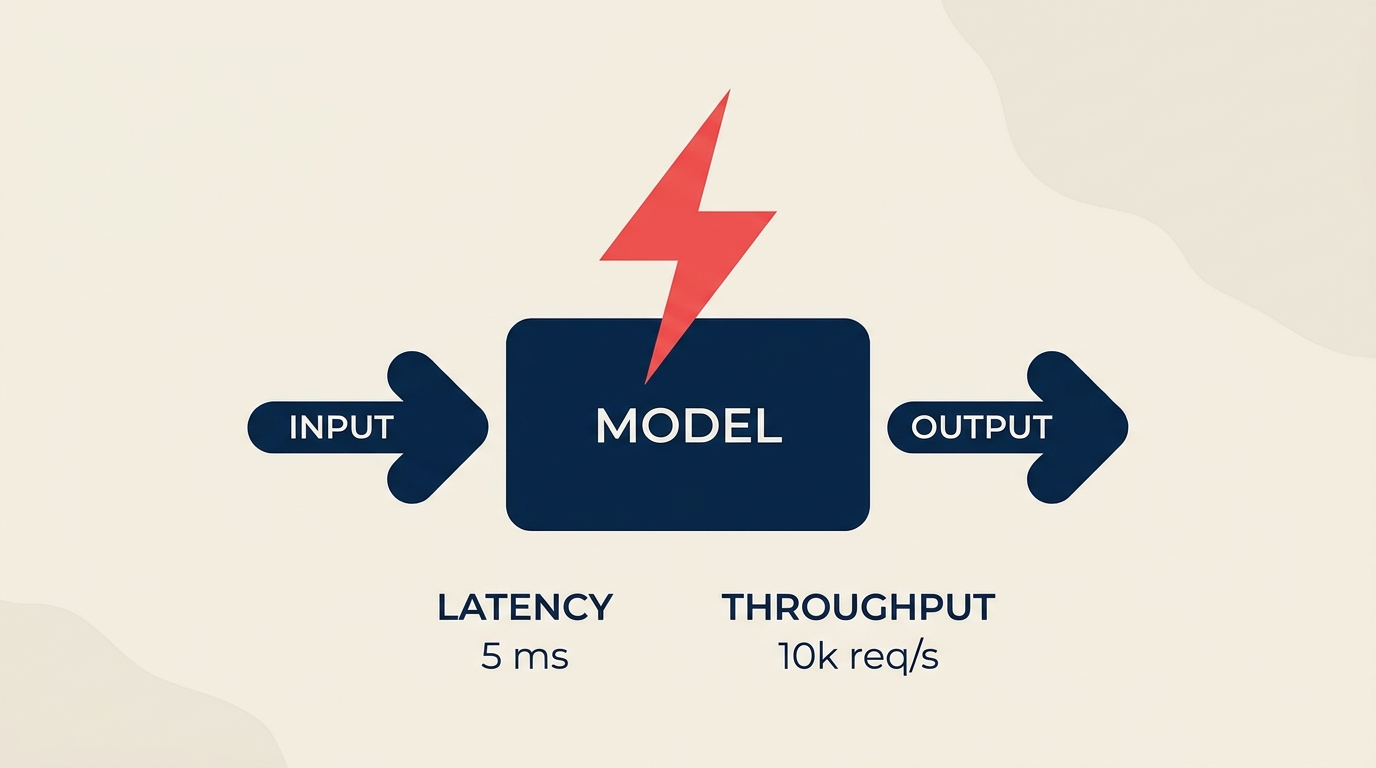
Latency is how long a single inference call takes from input to output, including the time to the first token and the time to generate each token after that. Users waiting for a chatbot response are experiencing latency. Medical imaging AI needs low latency when a radiologist is waiting for a reading. Document processing that happens overnight in a batch can tolerate higher latency.
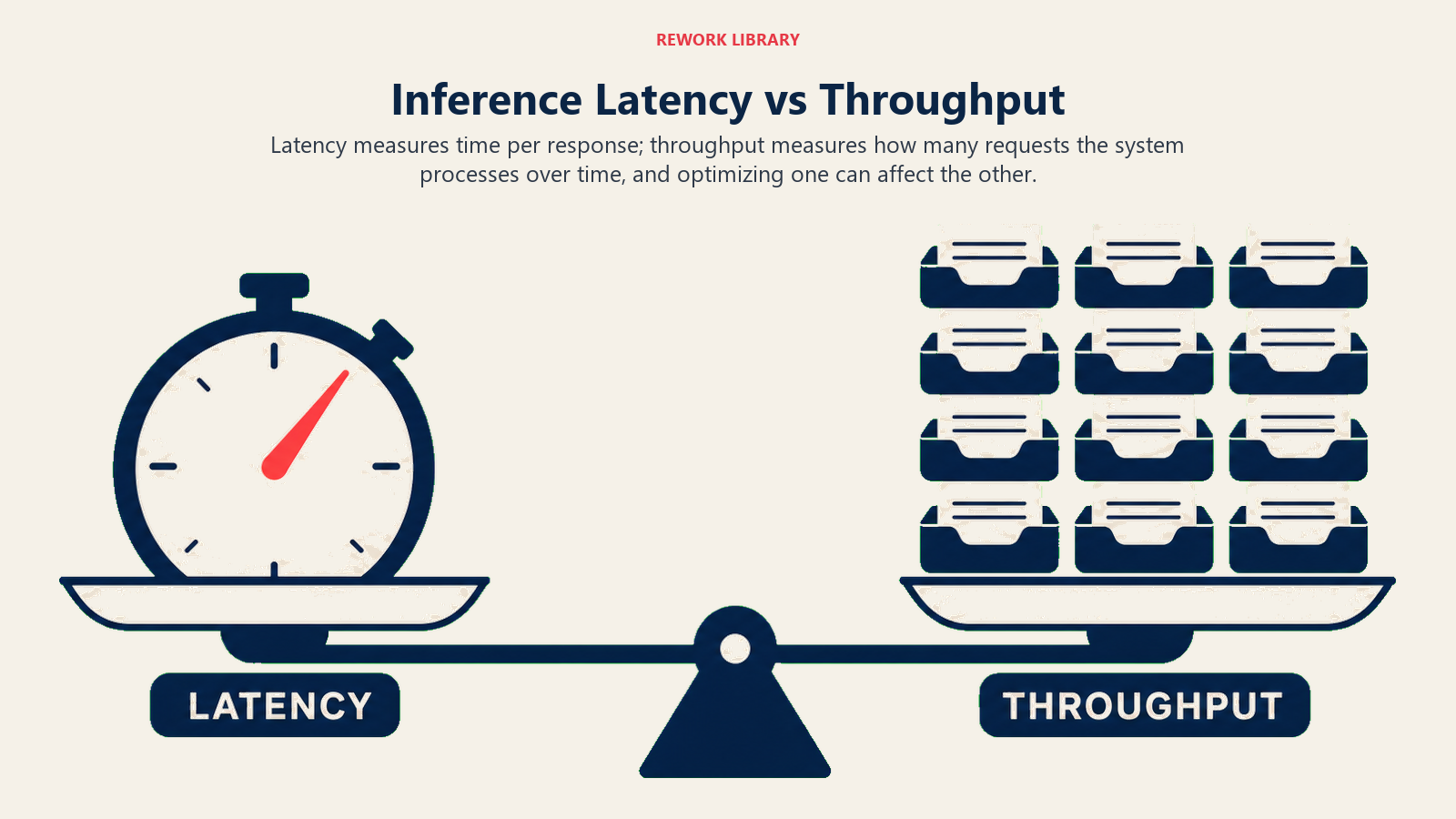
Throughput is how many inference calls a system can handle per unit of time. An e-commerce recommendation engine serving millions of shoppers needs high throughput. A legal document analysis tool used by a team of 20 analysts has much lower throughput requirements.
These two dimensions often trade off against each other. Batching multiple inference requests together, for example, increases throughput, since the hardware processes many inputs in parallel, but increases latency for any individual request since it waits for the batch to fill. The right balance depends on the use case.
Inference optimization is the technical field dedicated to improving both dimensions, making models run faster and cheaper without sacrificing quality.
Where Inference Runs: Cloud, Edge, and On-Device
Inference sits at the top of the AI stack. Foundation models are trained once by AI labs using massive compute clusters. Businesses either call these models via API or deploy models on their own infrastructure, and where that inference actually runs is a real architecture decision, not a detail to leave to the infrastructure team.
Cloud inference. The model runs on a provider's servers, typically accessed through an API. This is the default for most businesses using foundation models from major labs. It's simple to start, scales automatically with demand, and keeps cost tied directly to usage. The tradeoffs are ongoing per-call pricing, dependence on the provider's uptime and pricing decisions, and network latency between the request and the data center.
Self-hosted inference. The business runs the model on its own GPU infrastructure, in a private cloud account or on-premises. This gives more control over data privacy, can be cheaper than API pricing at very high, steady volumes, and allows deeper customization through fine-tuning. It also means owning the operational burden: provisioning GPUs, managing uptime, and handling scale spikes without a provider's elasticity.
Edge and on-device inference. The model runs locally, on a phone, a browser, a retail kiosk, or an industrial sensor, with no network round trip at all. This is the lowest-latency option and keeps data from leaving the device, which matters for privacy-sensitive use cases. The tradeoff is capability: edge devices have limited memory and compute, so edge deployment usually means a smaller, compressed model rather than a frontier-scale one.
None of these is universally correct. A customer support chatbot might use cloud inference for quality. A field inspection app with unreliable connectivity might need edge inference to work at all. A regulated healthcare workflow might require self-hosted inference purely for data residency reasons.
MLOps practices govern how inference is managed in production: how models are versioned and deployed, how performance is monitored, how to roll back when a model behaves unexpectedly, and when to retrain. Model monitoring is the ongoing practice of watching inference outputs and performance metrics to catch degradation before it causes business impact.
What Changed in 2026
For years, the AI conversation was dominated by training: bigger models, bigger training runs, bigger headlines. That's no longer where the money or the risk sits. Inference has become the operational and financial center of gravity for AI in production, for three connected reasons.
Usage keeps growing faster than per-call cost keeps falling. Inference prices have dropped dramatically since late 2022, but adoption has grown even faster, so total inference spend keeps climbing even as unit costs shrink.
Inference is recurring, training is not. A training run is a project with a start and an end. Inference runs for the entire life of a deployed feature, which for a successful product can be years. A cost that looks small per call becomes material once it's multiplied by millions of daily requests running indefinitely.
Infrastructure providers are already rebuilding around it. Analysts now project inference workloads will overtake training as the dominant demand on AI data centers within the next few years, and hyperscalers are shifting how and where they build capacity as a direct result: training clusters go to remote, power-dense sites, while inference capacity increasingly moves closer to where users actually are, to cut network latency.
The practical consequence for any leader sponsoring AI work: the model that wins the training benchmark isn't automatically the model that should ship. The model whose inference economics work at your actual production volume is the one that determines whether an AI feature is a sustainable product or an expensive pilot.
Key Facts
- The cost to query a model performing at GPT-3.5 level fell from $20.00 to $0.07 per million tokens between November 2022 and October 2024, a more than 280-fold drop in about 18 months, per the Stanford AI Index 2025 report.
- LLM inference prices at a fixed performance level have fallen at a median rate of roughly 50x per year, accelerating to about 200x per year for data from January 2024 onward, according to Epoch AI's analysis of inference price trends.
- Inference is projected to overtake training as the dominant AI compute workload by 2030, accounting for more than half of all AI compute and 30 to 40 percent of total data center demand, per McKinsey's analysis of AI workload shifts.
- 49 percent of large enterprises reported that most or nearly all of their compute is inference-driven in 2025, up from 29 percent the year before, per Menlo Ventures' 2025 mid-year LLM market update.
- Anthropic's 2025 spending included roughly $2.7 billion on inference compute and $4.1 billion on R&D (training) compute out of $9.7 billion in total expenses, according to Epoch AI's analysis of AI company spending, based on reporting from The Information.
- The global AI inference market is projected to grow from $106.15 billion in 2025 to $254.98 billion by 2030, overtaking training as the dominant expense category in enterprise AI, per MarketsandMarkets research cited by Forbes.
The Business Cost of Inference
For organizations using AI at scale, inference cost is a material budget line. Cost drivers include:
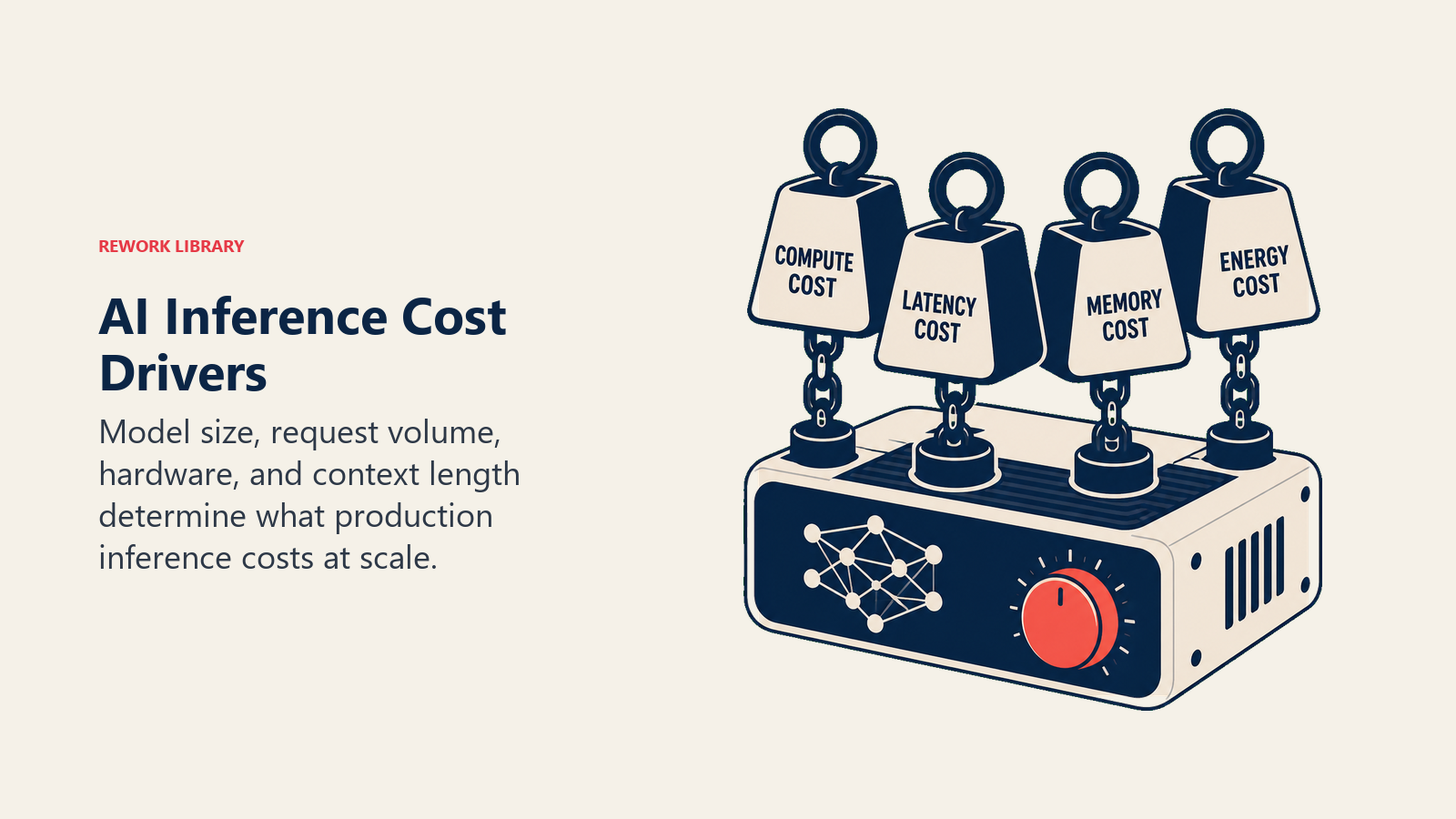
The model size. Larger models require more computation per inference call. A 70-billion parameter model costs roughly 10 times more to run inference on than a 7-billion parameter model, though quality differences may justify the cost for some use cases.
The volume of requests. Inference costs scale with usage. A system handling 10 million daily inference calls costs proportionally more to run than one handling 10,000.
The hardware. GPU inference is faster but more expensive than CPU inference. Specialized inference chips (like Google's TPUs or AWS Inferentia) can improve cost efficiency for specific workloads.
The context window size. For language models, longer inputs cost more to process because inference cost scales with token count. Systems that pass large amounts of context on each call face proportionally higher costs.
Because inference cost scales directly with usage, it's the highest-leverage place to cut AI spend without touching product scope. The core optimization techniques are:
Quantization. Reducing the numerical precision of a model's weights, for example from 32-bit floating point down to 8-bit or 4-bit integers, shrinks the model's memory footprint and speeds up computation, usually with only a small accuracy tradeoff. See Quantization for the mechanics.
Distillation. Training a smaller "student" model to mimic the outputs of a larger "teacher" model. The result runs faster and cheaper while retaining most of the teacher's capability on the tasks it was distilled for.
Batching. Grouping multiple inference requests together so the hardware processes them in parallel instead of one at a time. This raises throughput substantially, at the cost of some added latency for individual requests, since each one waits for the batch to fill.
Caching. Storing the outputs of common or repeated queries so the model doesn't have to reprocess the same input twice. For applications with a lot of repeat traffic, caching can eliminate a large share of inference calls outright.
Speculative decoding. A small, fast "draft" model predicts several tokens ahead, and the larger model verifies them in a single pass rather than generating each token one at a time on its own. When the draft model's guesses are good, this cuts the number of expensive full-model passes needed to produce a response.
Most production systems combine several of these techniques at once. None of them requires switching to a fundamentally different or lower-quality model; they change how efficiently an existing model gets served. Organizations that systematically apply them commonly report cost reductions of 50 to 90 percent compared to an unoptimized deployment.
Real-Time vs. Batch Inference
Not all inference happens in real time. Many valuable AI applications run on a batch schedule rather than responding to live requests.
Real-time inference handles requests as they arrive, with milliseconds to seconds of latency. Chatbots, fraud detection, real-time personalization, and voice assistants all require this mode.
Batch inference processes large datasets on a schedule, often overnight or on demand. CRM enrichment that runs every night to score all leads, document processing that works through a queue of uploaded files, or analytics workloads that generate weekly reports all fit the batch pattern. Batch inference is generally cheaper per inference call because it can take advantage of efficient batching strategies without the constraint of user-facing latency requirements.
The choice between modes is a product and architecture decision, not purely a technical one. Many use cases that initially seem to require real-time inference can be redesigned as near-real-time or batch with no meaningful loss of business value, at significantly lower cost.
What Business Leaders Need to Understand
The AI terms that get the most attention, training data, model architecture, benchmark scores, all relate to a model's potential. Inference is where that potential either translates into business results or doesn't. Three practical consequences follow directly from how inference works, and all three belong on a leader's checklist before approving an AI deployment, not after.
Cost scales with success, which cuts both ways. Training cost is roughly fixed once the project is done. Inference cost rises directly with adoption: the more useful a feature is, the more it gets used, and the more it costs to run. A feature that looks affordable in a pilot with 50 users can become a real budget line at 50,000 users.
Latency determines whether people actually use the feature. Users adapt their behavior to how fast an AI feature responds. Interactive tools that take more than a few seconds routinely see adoption drop off, and once users learn to route around a slow feature, they often don't come back even after it's fixed.
Where inference runs affects who can see your data. Cloud inference through a third-party API means requests, and whatever context they contain, leave your environment. For regulated or sensitive workloads, that's sometimes a non-starter, which is why self-hosted or edge inference exists as an alternative, even at a higher operational cost.
When evaluating AI vendors or build options, ask about inference cost per call at your expected volume, latency under real production load, how inference cost scales with usage, and where your data actually goes when the model runs. These are the numbers that determine whether AI use cases are economically sustainable.
Related AI Concepts
- Inference Optimization - Techniques to make inference faster and cheaper
- MLOps - Managing model deployment and inference pipelines
- Edge AI - Running inference on local hardware instead of the cloud
- Model Monitoring - Tracking inference performance over time
- Latency - Why response time determines whether AI features get adopted in production
- Context Window - Key driver of inference cost for language models
- Transformer Architecture - How most modern models compute inference
- Quantization - Reducing model size to lower inference cost
- Large Language Models - The model category most inference discussion centers on
- Foundation Models - The base models businesses run inference against via API or self-hosting
External Resources
- NVIDIA Inference Platform - Industry standard infrastructure for large-scale model inference
- Hugging Face Inference Endpoints - Guide to production model serving and inference tradeoffs
- Google AI Inference Best Practices - Practical guide to inference architecture and optimization
Frequently Asked Questions about AI Inference
What is AI inference?
AI inference is the process of running a trained machine learning model on new inputs to generate predictions or outputs. It's the production phase of AI, where a model that was trained on historical data is applied to live data to create value, answering customer queries, scoring leads, detecting fraud, or generating documents.
What's the difference between training and inference?
Training is the process of teaching a model by exposing it to large datasets and adjusting its parameters. Inference is running the trained model on new inputs without changing those parameters. Training happens infrequently and requires massive compute. Inference happens continuously and at production volume, which is where most of the ongoing AI infrastructure cost comes from.
Why has inference become more expensive to manage than training for many companies?
Training is a one-time or occasional project cost. Inference is a recurring cost that scales directly with how many people use a feature and how often. As adoption grows, inference spend grows with it, even as the cost per individual call keeps falling. Several 2025 industry reports found that inference now makes up the majority of ongoing AI compute spend at both large enterprises and AI-native startups.
Why does inference latency matter for business?
Latency determines how responsive an AI-powered experience feels to users. Customer-facing applications, like chatbots, real-time recommendations, and voice assistants, need low latency to avoid frustrating users. Internal tools used by employees typically have more tolerance for latency. Getting the latency requirement right is an important part of inference architecture decisions.
Should inference run in the cloud or on-device?
It depends on latency needs, data sensitivity, and volume. Cloud inference is simplest to deploy and scales automatically, which suits most business applications. On-device or edge inference removes network latency entirely and keeps data local, which matters for privacy-sensitive or connectivity-limited use cases, but usually requires a smaller, less capable model.
Is AI inference always real-time?
No. Real-time inference responds to requests as they arrive, which is what chatbots, fraud detection, and live personalization need. Batch inference processes large volumes of data on a schedule, often overnight, and is typically cheaper per call because it doesn't have to meet a live latency requirement. Many workloads that seem to need real-time inference can run as batch or near-real-time with no real loss of business value.
How can organizations reduce inference costs?
The main levers are using smaller models where quality allows, applying quantization to reduce model size, distilling a smaller model from a larger one, batching requests where latency constraints permit, caching common responses, and using speculative decoding for language models. Inference optimization is an entire technical discipline; many organizations see 50-90% cost reductions from systematic optimization without changing the underlying model.

Co-Founder, Rework.com
On this page
- Training vs. Inference: The Core Distinction
- How Inference Works
- The Two Key Performance Dimensions
- Where Inference Runs: Cloud, Edge, and On-Device
- What Changed in 2026
- Key Facts
- The Business Cost of Inference
- Real-Time vs. Batch Inference
- What Business Leaders Need to Understand
- Related AI Concepts
- External Resources