What is an AI Chip?

Turn this article into takeaways for your work.


Each assistant summarizes the article only for you and suggests best practices for your work.
An AI chip is a processor purpose-built to run artificial intelligence workloads: training and running neural networks. Unlike a general-purpose CPU, it's optimized for the massive parallel math AI requires. GPUs, TPUs, NPUs, and custom ASICs are all AI chips, each trading flexibility for speed and efficiency in different ways.
Every AI feature your business touches, a chatbot answering a customer question, a fraud model scoring a transaction, a forecasting tool predicting demand, runs on one of these chips somewhere. You may never buy one directly. But the price, availability, and performance of AI chips shape what your AI tools cost, how fast they respond, and which vendors can even offer certain capabilities. That makes AI chips a business topic, not just an engineering one.
Why Regular CPUs Aren't Built for This
A CPU (central processing unit) is designed to do one thing very well: execute a sequence of complex instructions, one after another, as fast as possible. That's ideal for running an operating system, a spreadsheet, or a web server, tasks that are mostly sequential and branch-heavy.
AI workloads look nothing like that. Training a neural network or running inference on a large language model means performing the same simple operation, mostly matrix multiplication, across millions or billions of data points at once. A CPU has only a handful of powerful cores, so it processes that workload in small batches, one after another. An AI chip has thousands of simpler cores that all run the same operation on different pieces of data simultaneously.
That difference is called parallelism, and it's the entire reason AI chips exist. A modern GPU can have well over 10,000 processing cores compared to a high-end CPU's dozen or so. For AI math specifically, that translates into training runs that take days instead of months, and inference responses that arrive in milliseconds instead of seconds. A CPU can technically run an AI model. It just can't do it at the speed or cost that makes AI commercially useful at scale.
The Main Types of AI Chips
Not all AI chips are built the same way. Each type makes a different tradeoff between raw flexibility and raw speed.
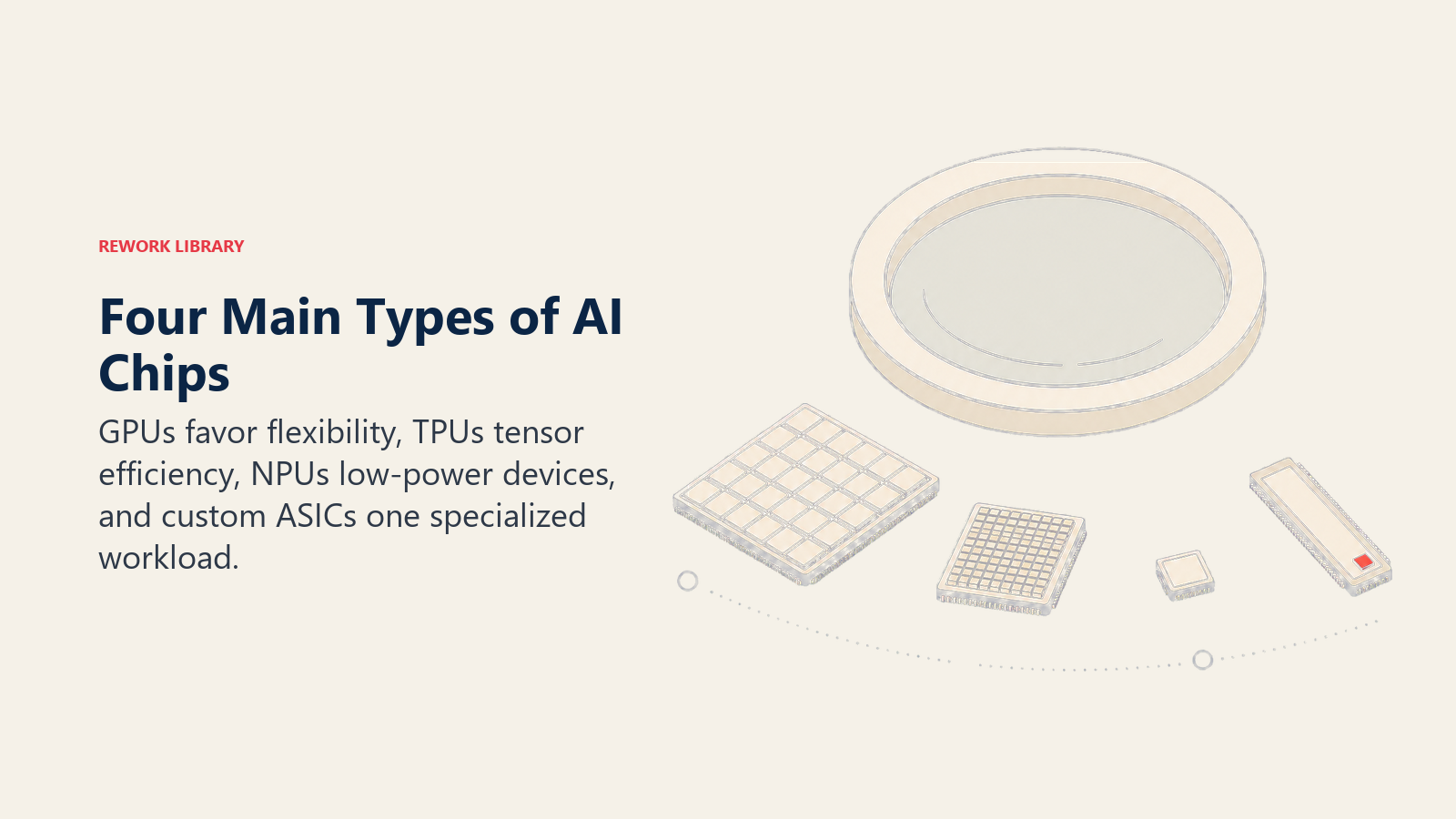
GPU (Graphics Processing Unit). Originally built to render video game graphics, GPUs turned out to be extremely good at the parallel math AI needs. They're the most widely used AI chip today because they're flexible enough to handle almost any AI workload, from computer vision to language models, and they benefit from a mature software ecosystem that most AI tools already support.
TPU (Tensor Processing Unit). A chip Google designed specifically for the "tensor" math that powers deep learning. TPUs are less flexible than GPUs but more efficient for the specific workloads they're built for. Google uses them to run its own AI products and rents them out through Google Cloud.
NPU (Neural Processing Unit). A smaller, low-power chip built into phones, laptops, and other consumer devices to run AI tasks locally instead of sending data to the cloud. NPUs trade raw power for efficiency, which is why they show up in edge AI deployments like on-device voice assistants, camera processing, and real-time translation.
Custom ASIC (Application-Specific Integrated Circuit). A chip designed from scratch for one narrow job, in this case, running one company's specific AI workload as efficiently as possible. ASICs sacrifice flexibility entirely for maximum performance-per-dollar on a known task. Google's TPU is technically an ASIC; so are the custom chips Amazon, Microsoft, and Meta have each built for their own data centers.
| Chip type | Built for | Flexibility | Typical use | Example maker |
|---|---|---|---|---|
| GPU | General-purpose parallel math | High | Training and running most AI models | Nvidia, AMD |
| TPU | Tensor/matrix math for deep learning | Medium | Google's own AI products, Google Cloud rentals | |
| NPU | Low-power, on-device AI | Low | Phones, laptops, cameras, offline AI | Apple, Qualcomm, Intel |
| Custom ASIC | One company's specific workload | Lowest | Hyperscaler data centers, one purpose | Amazon, Microsoft, Meta, OpenAI |
Training Chips vs. Inference Chips
AI chips also split along a second line: what stage of the AI lifecycle they're built for.
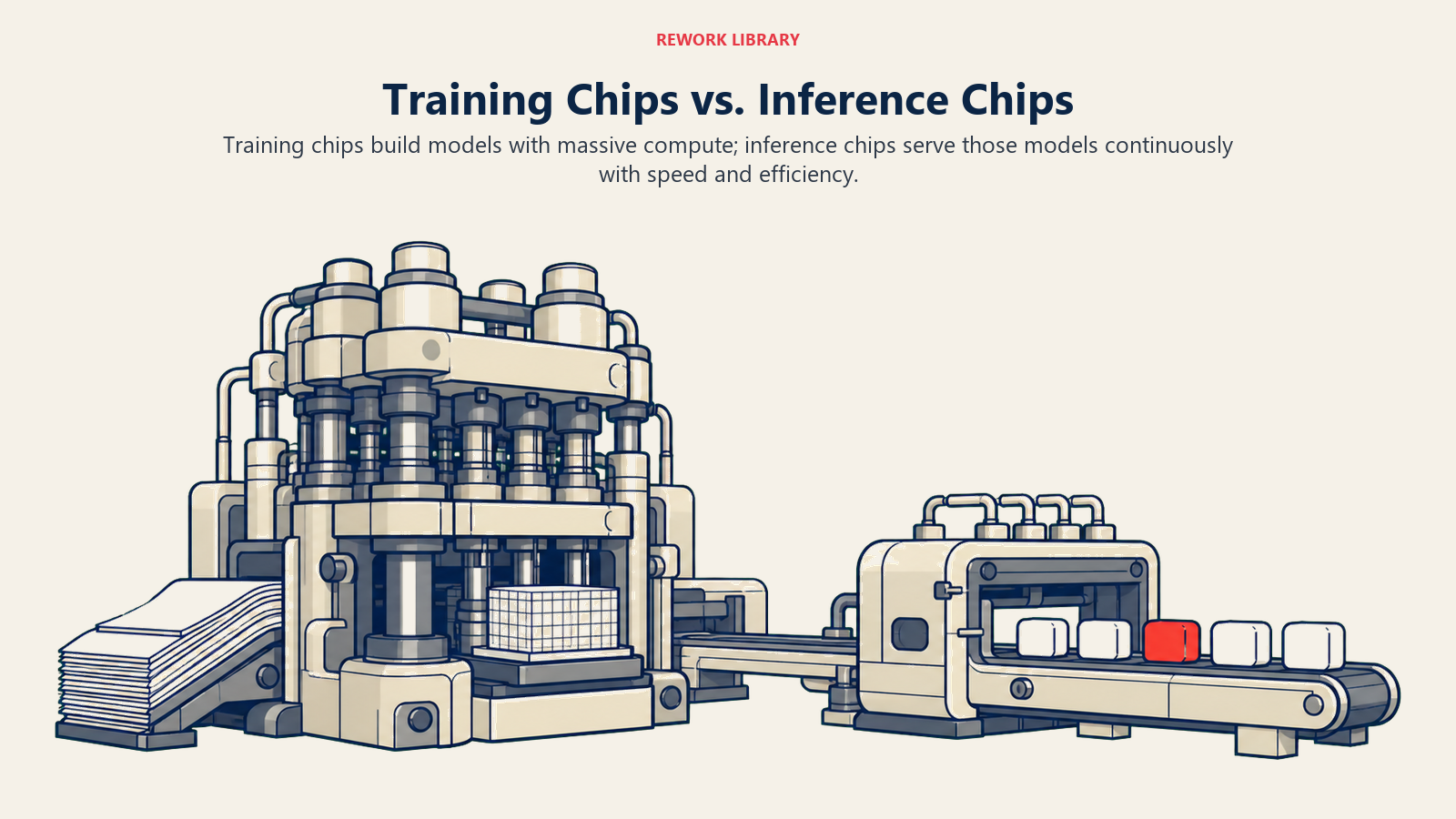
Training chips do the heavy lifting of teaching a model, adjusting billions of parameters across huge datasets over days or weeks. This work is extremely compute-intensive and tolerates some latency, since it's a one-time or periodic project rather than a live, user-facing task. High-end GPUs and TPUs dominate here because they can be networked together by the thousands into training clusters.
Inference chips run the trained model against new, real-world inputs, the step where a chatbot actually answers a question or a fraud model actually scores a transaction. See AI inference for the full mechanics. Because inference happens continuously and often needs to respond in real time, inference chips are frequently optimized differently than training chips: smaller, cheaper, more power-efficient, sometimes even purpose-built ASICs rather than general-purpose GPUs. Inference optimization techniques like quantization and model compression exist specifically to make models cheaper to run on inference hardware without sacrificing much accuracy.
A useful way to think about it: training chips are the factory that builds the model. Inference chips are the assembly line that runs it, every single day, for as long as the product exists. Most organizations building on top of foundation models never touch a training chip directly. Almost everyone touches inference cost.
Who Makes AI Chips: The Key Players
Nvidia is the dominant GPU maker for AI training and data-center inference, and the closest thing the industry has to a default choice. Its data center segment, driven almost entirely by AI chip sales, generated $62.3 billion in a single record quarter in early 2026, with full-year data center revenue for fiscal 2025 reaching $115.2 billion, up 142 percent year over year.
AMD is Nvidia's main GPU competitor, offering an alternative architecture that some hyperscalers and cloud providers use to diversify supply and negotiate on price.
Google builds its own TPUs rather than relying on merchant GPUs for much of its internal AI workload, then rents that capacity out through Google Cloud.
Hyperscaler custom silicon is a fast-growing category. Amazon, Microsoft, Meta, and increasingly OpenAI and Anthropic have each invested in purpose-built ASICs designed for their own AI infrastructure, often working with chip design partners like Broadcom or Marvell rather than building fabrication capability themselves.
Edge NPU makers, including Apple, Qualcomm, and Intel, build the low-power chips that put AI directly into phones, laptops, and consumer devices, an increasingly important category as more AI shifts to run locally instead of in the cloud.
TSMC, the Taiwanese foundry, physically manufactures the vast majority of these chips for nearly every company listed above. Almost none of the companies designing AI chips actually fabricate them; TSMC's advanced manufacturing and packaging capacity is one of the industry's tightest bottlenecks.
The 2026 AI Chip Market and Export Controls
The AI chip market has become the center of gravity for the entire semiconductor industry. Generative AI chips are projected to approach $500 billion in revenue in 2026, roughly half of the $975 billion global semiconductor industry, according to Deloitte's 2026 semiconductor industry outlook. AMD's CEO has raised her own estimate for the total addressable market of AI accelerator chips for data centers to $1 trillion by 2030.

That growth is starting to reshape who supplies the chips, not just how many get sold. Custom ASICs, once a niche alternative to Nvidia's GPUs, are forecast to account for 27.8 percent of AI server shipments in 2026, against 69.7 percent for GPU-based systems, according to TrendForce's January 2026 server forecast. Every major hyperscaler now has its own chip program underway, a direct response to GPU cost and supply constraints.
Export controls add another layer of complexity. The US government restricts which AI chips can be sold to China, a policy that has shifted repeatedly. Nvidia's Blackwell-generation GPUs remain banned from the Chinese market, while its H200 chip, roughly six times more powerful than the previously permitted H20, became eligible for export under a Commerce Department rule that took effect in stages through late 2025 and early 2026. On June 1, 2026, Commerce clarified that the licensing requirement also applies to Chinese-headquartered companies' overseas subsidiaries, not just entities physically inside China. For any business relying on global AI vendors or supply chains, these rules directly affect which chips, and therefore which AI capabilities, are available in which markets.
Key Facts
- Nvidia's data center segment posted record revenue of $62.3 billion in a single quarter in early 2026, up 75 percent year over year, according to NVIDIA's SEC-filed earnings release.
- For full fiscal year 2025, NVIDIA's data center revenue totaled $115.2 billion, up 142 percent from the prior year, per the company's SEC-filed Q4 FY2025 results.
- Generative AI chips are projected to approach $500 billion in revenue in 2026, close to half of the $975 billion global semiconductor industry, according to Deloitte's 2026 Semiconductor Industry Outlook.
- AMD CEO Lisa Su has raised her projection for the total addressable market of AI accelerator chips for data centers to $1 trillion by 2030, as cited in Deloitte's 2026 Semiconductor Industry Outlook.
- Custom ASIC systems are forecast to make up 27.8 percent of AI server shipments in 2026, versus 69.7 percent for GPU-based systems, per TrendForce's January 2026 AI server shipment forecast.
- Nvidia's H200 chip, about six times more powerful than the previously permitted H20, became eligible for export to China under a Commerce Department rule clarified on June 1, 2026, while Blackwell-generation GPUs remain banned from that market, per Al Jazeera's reporting on the Commerce Department guidance.
Why AI Chips Matter for Business Leaders
Most executives will never buy a chip directly. They'll buy a cloud AI subscription, a SaaS tool with AI features built in, or an API from a foundation model provider. But the chip layer still shows up on the bill in three concrete ways.
Cost. Chip scarcity and demand drive what AI vendors charge you. When training and inference capacity is tight, API pricing and cloud AI costs rise with it. Understanding this layer helps explain why some AI features are expensive and others aren't, and it's a key input into any AI total cost of ownership analysis.
Availability. Export controls, foundry capacity limits, and hyperscaler chip shortages can determine which AI vendors can actually deliver at the scale and reliability you need, particularly for regulated industries or global operations spanning restricted markets.
Performance and latency. The chip a vendor runs inference on affects how fast your AI feature responds. A slow, oversubscribed GPU cluster behind a chatbot produces the same frustrating lag a customer feels regardless of how good the underlying model is.
You don't need to become a semiconductor expert to run AI initiatives well. But when a vendor's pricing changes, a rollout slips, or a new feature suddenly becomes available, the chip layer, and the companies that make, manufacture, and export those chips, is very often the reason why.
Related AI Concepts
- AI Inference - The production phase where AI chips actually generate business value
- Edge AI - Running AI locally on NPUs instead of cloud GPUs
- Inference Optimization - Techniques that make AI chips run models faster and cheaper
- Quantization - Shrinking a model so it runs efficiently on smaller chips
- Model Compression - Reducing model size for cheaper, faster chip performance
- Large Language Models - The models that AI chips are most often built to train and run
- Foundation Models - The base models most businesses access through chip-powered APIs
- Deep Learning - The neural network techniques that created the demand for specialized AI chips
- Neural Networks - The underlying architecture that AI chips are optimized to compute
- MLOps - Managing the model deployments that run on AI chip infrastructure
External Resources
- NVIDIA Investor Relations - Official quarterly data center and AI chip revenue disclosures
- TrendForce - Semiconductor and AI server market research and forecasts
- Deloitte 2026 Semiconductor Industry Outlook - Annual analysis of AI chip demand and semiconductor market sizing
Frequently Asked Questions about AI Chips
What is an AI chip in simple terms?
An AI chip is a processor built specifically to run artificial intelligence workloads efficiently. Instead of executing instructions one at a time like a CPU, it performs thousands of simple calculations in parallel, which is what training and running AI models actually require.
What's the difference between a GPU, TPU, NPU, and ASIC?
A GPU is a flexible, widely used AI chip originally built for graphics. A TPU is Google's chip, purpose-built for deep learning math. An NPU is a small, low-power chip built into phones and laptops for on-device AI. A custom ASIC is designed from scratch for one company's specific workload, trading flexibility for maximum efficiency. All four are AI chips; they just make different tradeoffs.
Why can't a regular computer processor run AI as well as an AI chip?
A CPU has a small number of powerful cores built for sequential tasks. AI workloads need the same simple math repeated across millions of data points simultaneously, which is what an AI chip's thousands of parallel cores are built for. A CPU can run AI models, just far slower and at much higher cost per task.
Who are the biggest AI chip makers?
Nvidia leads the GPU market for AI training and inference. AMD is its main GPU competitor. Google builds TPUs for its own AI products and Google Cloud. Amazon, Microsoft, Meta, and other hyperscalers increasingly design custom ASICs for their own data centers. TSMC manufactures the physical chips for nearly all of these companies.
What's the difference between training chips and inference chips?
Training chips do the intensive, one-time work of teaching a model on massive datasets, tolerating higher latency in exchange for raw compute power. Inference chips run the already-trained model on live, real-world inputs, usually optimized for speed, cost, and power efficiency since inference happens continuously at production scale.
Why do AI chip export controls matter for businesses?
Export controls determine which AI chips can be sold into which countries, which affects what AI infrastructure and cloud capacity is actually available in different markets. For businesses operating globally or relying on vendors with international data centers, these rules can directly affect service availability, pricing, and which AI capabilities are accessible where.
Does every business need to understand AI chips to use AI?
No. Most businesses interact with AI chips indirectly, through cloud subscriptions, SaaS tools, or API-based AI features. But chip cost, availability, and performance drive vendor pricing, feature rollout timing, and response speed, so a basic understanding helps leaders interpret AI vendor decisions and budget changes.
Is Nvidia the only company that makes AI chips?
No, though it's the market leader for GPUs used in AI training and data-center inference. Google, AMD, Amazon, Microsoft, Meta, Apple, and Qualcomm all design their own AI chips for different purposes, from cloud-scale training to on-device inference in phones and laptops.

Co-Founder, Rework.com