What is Vibe Coding?
Turn this article into takeaways for your work.


Each assistant summarizes the article only for you and suggests best practices for your work.
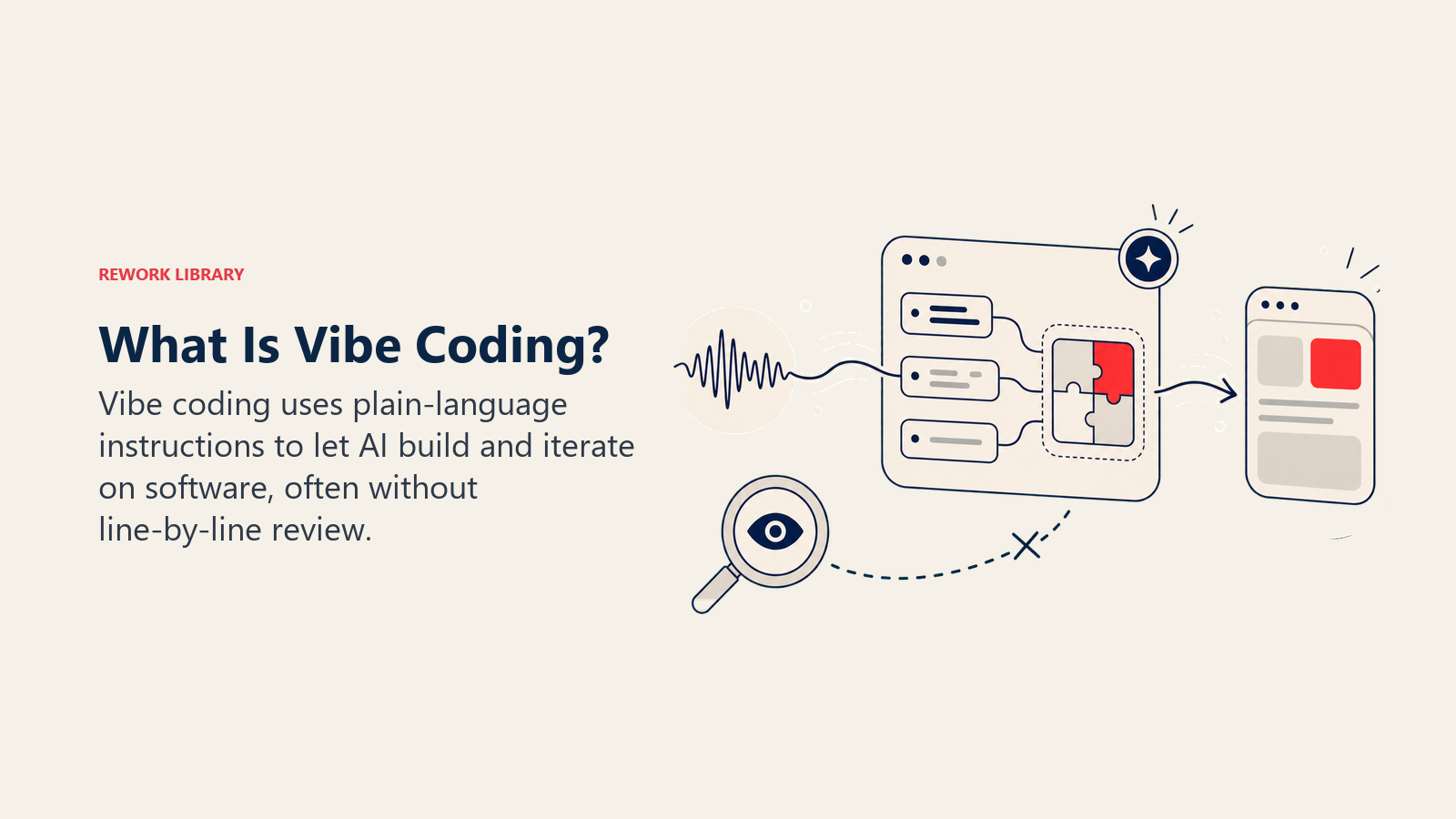
Vibe coding is a way of building software where you describe what you want in plain English and let an AI coding tool, like Cursor, Claude Code, or Replit, generate, run, and iterate on the code, largely without reading or writing it yourself. Andrej Karpathy coined the term in February 2025.
For business leaders, vibe coding means a founder or a product manager with no formal engineering background can now describe an app and watch a working version appear within minutes. That's a real shift in who can build software, and it comes with real tradeoffs. The same speed that lets a non-technical operator ship an internal tool over a weekend can also ship a customer-facing product with security holes nobody checked for. Understanding where vibe coding fits, and where it doesn't, matters for anyone deciding how their team should actually use these tools.
The Origin of Vibe Coding: Karpathy's February 2025 Tweet
Andrej Karpathy, a former OpenAI founding member and Tesla's former AI director, posted the tweet that gave the practice its name on February 2, 2025. He described a workflow where he "fully gives in to the vibes," accepts AI suggestions without reading them line by line, and talks to the tool by voice instead of typing. His own words: "I just see stuff, say stuff, run stuff, and copy-paste stuff, and it mostly works."
The post spread fast because it named something thousands of developers were already doing quietly with tools like Cursor Composer, but hadn't had a word for. Within weeks, "vibe coding" showed up in product launches, job postings, and eventually Y Combinator's own startup data. It's worth separating the term from the practice: developers have been generating code from natural-language prompts since early versions of GitHub Copilot. What Karpathy captured was a specific mindset: trusting the output enough to stop reading it.
How Vibe Coding Works
The mechanics are simple, which is exactly why the practice spread so quickly.
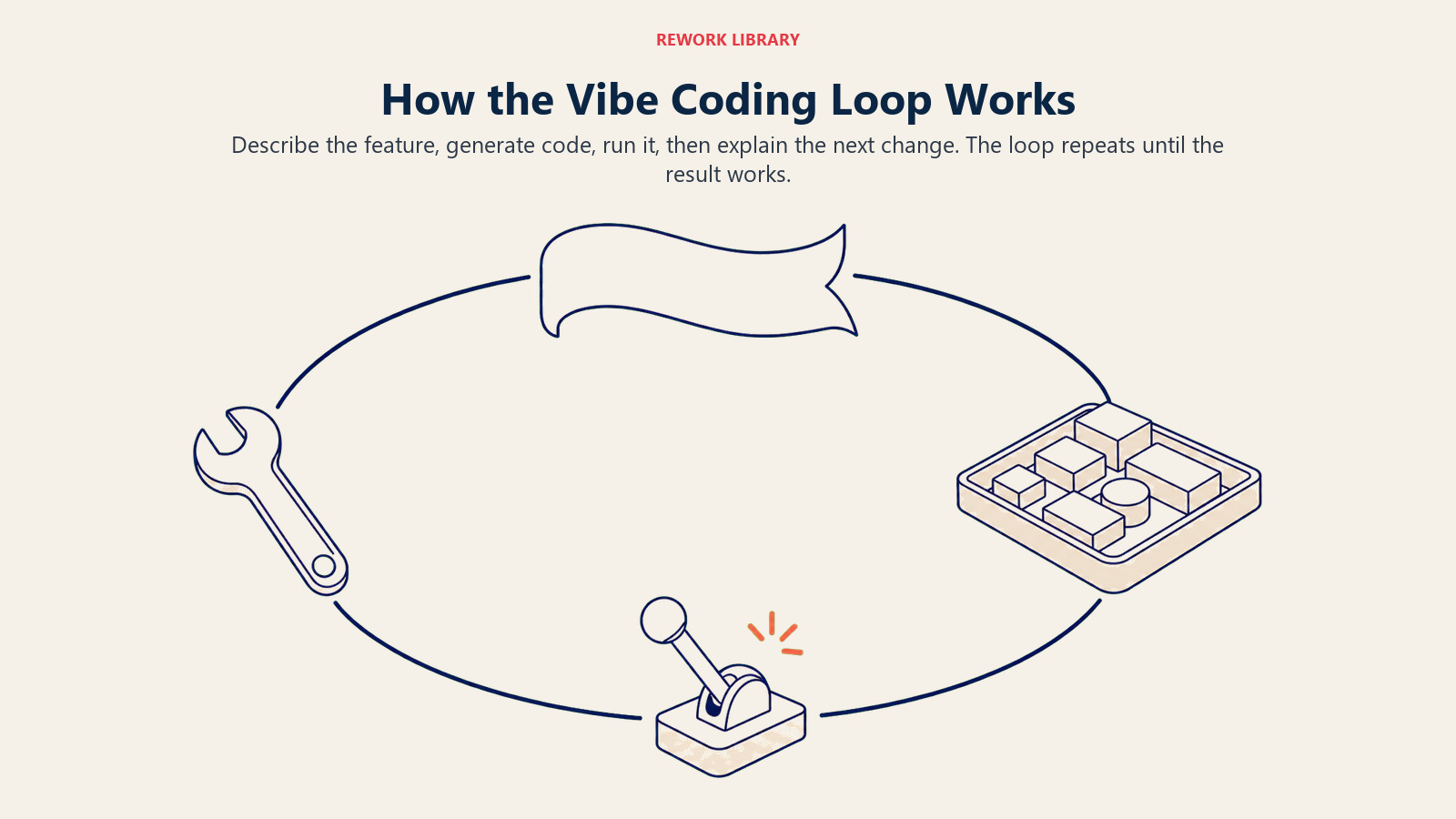
- Prompt: You describe the feature, page, or fix you want in natural language, the same way you'd explain it to a teammate.
- Generate: The AI tool, built on a large language model, writes the code, often across multiple files at once, and frequently proposes the change as a complete diff rather than a single snippet.
- Run: The tool executes the code, or you do, to see if it actually works. Many modern tools run tests or start a local server automatically as part of this step.
- Iterate: You describe what's wrong or what to change next, in plain language again, and the loop repeats. Over a session this can mean dozens of small prompts stacking into a working application.
The quality of that loop depends heavily on prompt engineering: vague requests produce vague code, while specific, well-scoped prompts (what the screen should show, what happens on error, what data it touches) produce far more usable results. The practice also leans on the same reasoning and tool-calling abilities that power broader AI agents, just narrowed to a single domain: writing and running code.
Tools Used for Vibe Coding
A handful of tools built specifically for this workflow drove most of the 2025 to 2026 adoption curve:
- Cursor: An AI-native code editor, forked from VS Code, built around a chat and "Composer" mode that can edit multiple files in one pass.
- Claude Code: A command-line and IDE-integrated coding agent that can plan a multi-step task, edit files, run tests, and report back, aimed at developers who want more autonomy in the loop.
- Lovable: A browser-based tool that generates a full working web app, front end and back end, from a text description, aimed at non-engineers building products fast.
- Bolt: A browser-based builder from StackBlitz that generates, runs, and deploys full-stack apps in-browser from a prompt, with live preview as you iterate.
- Replit: A cloud IDE with an "Agent" mode that can scaffold, build, and deploy an application from a description, without the user setting up a local dev environment.
These tools differ mainly in audience: Cursor and Claude Code assume a developer is still in the loop reviewing changes, while Lovable, Bolt, and Replit's Agent mode are built so a non-developer can go from description to deployed product with almost no code review at all. For a full side-by-side on pricing, strengths, and team fit across these and other options, see Best AI Coding Tools in 2026.
Where Vibe Coding Works Well vs Where It Fails
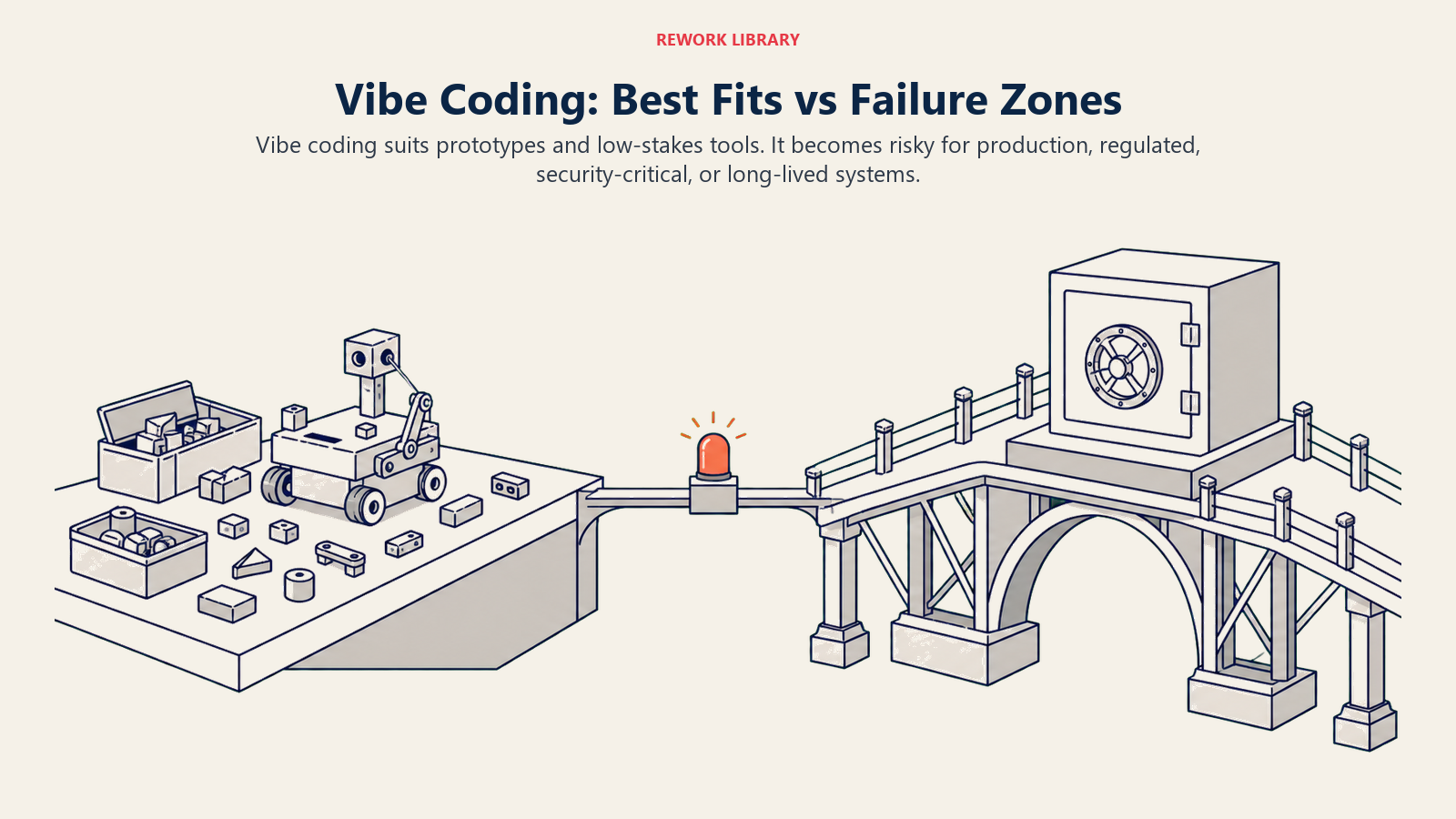
Vibe coding is a fit for some situations and a liability in others, and the difference usually comes down to what happens if the output is wrong.
Where it works well:
- Prototypes and proof-of-concept demos where the goal is to test an idea, not ship it
- Internal tools and one-off scripts where the audience is a handful of coworkers, not customers
- Hackathons and weekend projects where speed matters more than long-term maintainability
- Early-stage MVPs where founders need to validate a product before investing in a full engineering team
- Learning and exploration, where a non-developer wants to understand what's technically possible before scoping a real project
Where it fails:
- Production systems handling customer data, payments, or authentication, where a missed edge case has real consequences
- Regulated industries (healthcare, finance, insurance) where audit trails and compliance requirements assume a human understood and approved the logic
- Large, complex codebases where an AI tool lacks the full context of how a change ripples through other systems
- Security-critical code, where the risks below are highest
- Long-term products a team will maintain for years, where nobody on the team can explain how a given feature actually works
Business Implications and Risks of Vibe Coding
The upside is real: a non-technical founder can validate an idea in an afternoon instead of hiring a contractor for a month. The risk is that speed hides the parts of software engineering that exist precisely to catch what a fast prototype skips.
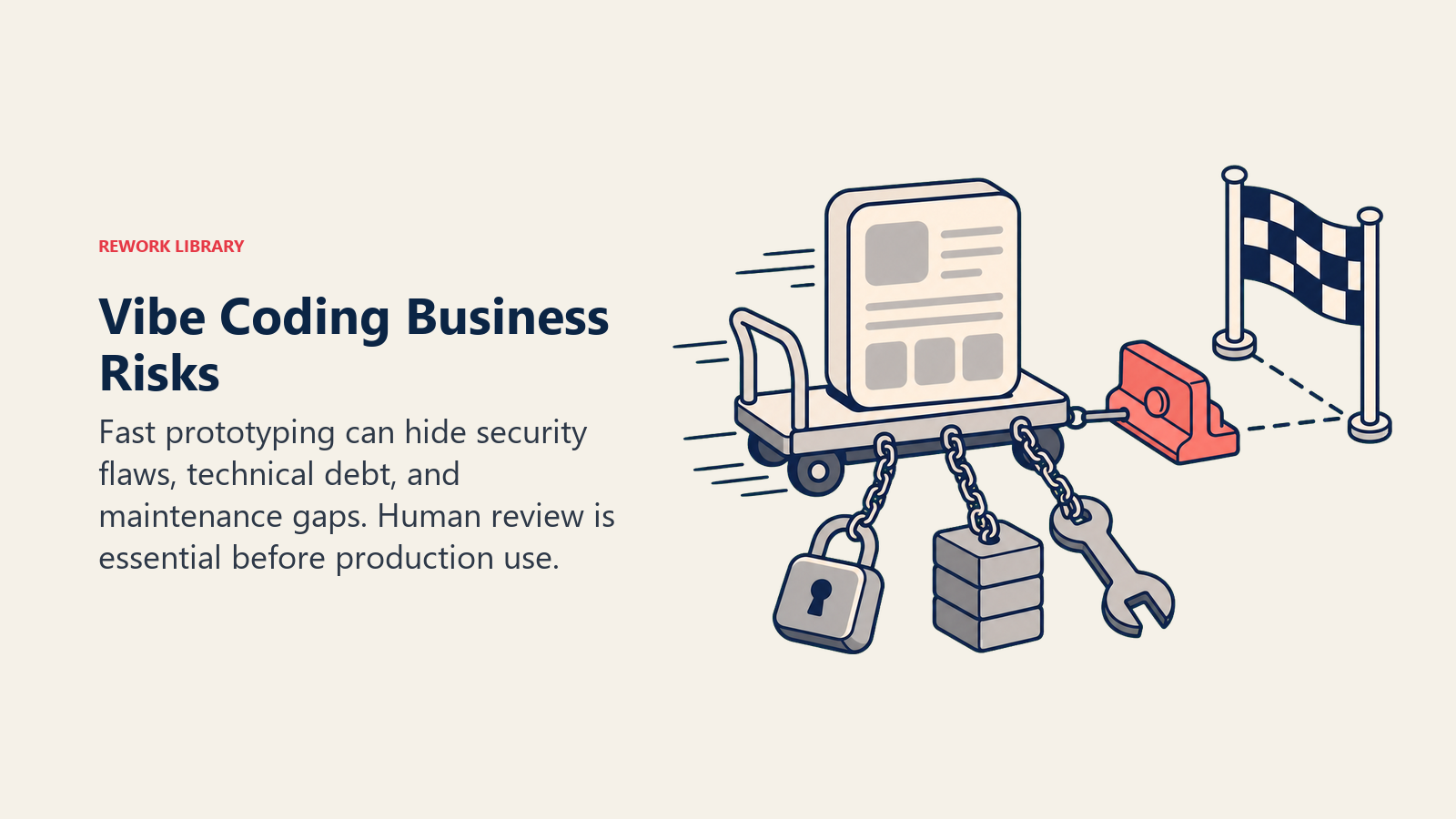
Security. Independent research on AI-generated code security has found consistent, material gaps. AI-generated code introduced OWASP Top 10 security vulnerabilities in 45% of tests across more than 100 large language models, and contained roughly 2.74 times more vulnerabilities than comparable human-written code, according to Veracode's 2025 GenAI Code Security Report (see Key Facts below). If nobody on the team is reviewing what the AI wrote, those flaws ship straight to production. Treat API security and basic security review as non-negotiable, not optional polish, for anything customer-facing.
Technical debt. Code generated quickly, without a consistent architecture or naming convention, tends to accumulate the kind of technical debt that's expensive to unwind later. A vibe-coded MVP that becomes the actual product, without ever being refactored by someone who understands the whole system, is a common and costly pattern.
Maintainability. If the person who "wrote" the code can't explain how it works, because they never read it, the team has no institutional knowledge to fall back on when something breaks. That's a real operational risk, not a hypothetical one, especially once the original prompt-writer moves to a different project or leaves the company.
How to use it without creating a mess:
- Keep a human-in-the-loop for anything that will touch real customers or real data, even if the initial build was vibe-coded
- Set clear guardrails on what an AI coding tool is allowed to touch unsupervised (never production credentials, never customer databases directly)
- Budget time for a proper review and refactor pass before a vibe-coded prototype becomes a shipped product, not after something breaks
- Apply the same AI vendor evaluation rigor to coding tools that you would to any other software touching sensitive data
Vibe Coding vs Traditional Coding vs AI-Assisted Coding
These three approaches sit on a spectrum from full manual control to full delegation. The table below is the fastest way to see where each one actually differs.
| Aspect | Traditional Coding | AI-Assisted Coding (autocomplete/copilots) | Vibe Coding |
|---|---|---|---|
| Who writes the logic | The developer, line by line | The developer, with AI suggesting completions they review | The AI tool, from a natural-language prompt |
| Developer's role | Author and reviewer of every line | Author and reviewer, faster typing | Prompt writer and outcome-checker, not line-by-line reviewer |
| Code review habit | Standard, expected at every stage | Standard, AI suggestions still get reviewed like any commit | Often skipped, that's the defining trait of the practice |
| Speed to first working version | Slowest, built incrementally | Faster than manual, still incremental | Fastest, often minutes for a working prototype |
| Required skill level | Formal programming knowledge | Formal programming knowledge, boosted by AI | Clear communication and product judgment, coding knowledge optional |
| Best fit | Production systems, complex logic, regulated work | Everyday professional development work | Prototypes, MVPs, internal tools, non-developer builders |
| Primary risk | Slower delivery | Low, review process is unchanged | Security gaps, technical debt, and code nobody understands |
Key Facts
- 25% of Y Combinator's Winter 2025 startup batch have codebases that are almost entirely AI-generated, with YC managing partner Jared Friedman reporting those companies' code is roughly 95% AI-written. TechCrunch
- Only 11.9% of developers said vibe coding is part of their professional workflow, while 72.2% said no and another 5.3% said "no, emphatically," per Stack Overflow's 2025 Developer Survey. Stack Overflow
- 84% of developers are using or plan to use AI tools in their development process, up from 76% the year before, yet only 32.7% say they trust the accuracy of that output, versus 45.7% who actively distrust it. Stack Overflow
- AI-generated code introduced OWASP Top 10 security vulnerabilities in 45% of tests and contained roughly 2.74x more vulnerabilities than human-written code, across more than 100 large language models tested. Veracode 2025 GenAI Code Security Report
- 80% of new developers on GitHub used Copilot in their first week on the platform, and GitHub's Copilot coding agent authored more than 1 million pull requests between May and September 2025 alone. GitHub Octoverse 2025
- Performance on SWE-bench Verified, a benchmark of real-world GitHub coding issues, rose from about 60% to near 100% in a single year, and companies that deployed AI coding assistants in 2025 reported productivity gains of 39%. Stanford HAI AI Index 2026
Frequently Asked Questions about Vibe Coding
What is vibe coding in simple terms?
Vibe coding is describing what you want a piece of software to do in plain English and letting an AI tool write, run, and adjust the code, largely without you reading or editing it yourself. The term was coined by Andrej Karpathy in February 2025.
Who coined the term vibe coding?
Andrej Karpathy, a former OpenAI founding member and Tesla's former AI director, introduced the term in a tweet on February 2, 2025, describing his own workflow of accepting AI-generated code without reviewing it line by line.
What tools are used for vibe coding?
The most common tools are Cursor, Claude Code, Lovable, Bolt, and Replit's Agent mode. Cursor and Claude Code tend to keep a developer in the review loop, while Lovable, Bolt, and Replit are built so non-developers can go from a text prompt to a deployed app.
Is vibe coding the same as AI-assisted coding?
No. AI-assisted coding, like autocomplete or Copilot suggestions, still has a developer reviewing and approving each change. Vibe coding is defined by skipping that review step and trusting the output based on whether it runs, not whether the code itself was checked.
Is vibe coding safe to use for a real business product?
It's safe for prototypes, internal tools, and MVPs meant to validate an idea. It's risky for anything handling customer data, payments, or regulated information without a proper security and code review pass before launch, since AI-generated code has been shown to carry more security vulnerabilities than human-written code.
Do you need to know how to code to vibe code?
No, that's the point of tools like Lovable and Bolt: someone with no formal programming background can describe a product and get a working version. That said, judging whether the output is actually good, and catching subtle errors, still benefits from technical knowledge or a developer's review.
What's the biggest risk of vibe coding for a company?
Security gaps and technical debt that go unnoticed because nobody reviewed the code. A prototype that quietly becomes the real product, without a refactor or security pass, is one of the most common and costly patterns companies run into.
How many developers actually use vibe coding at work?
Adoption is much lower than the hype suggests. Only about 12% of developers in Stack Overflow's 2025 survey said vibe coding is part of their professional workflow, even though roughly 84% use some form of AI coding tool.
How is vibe coding different from traditional software development?
Traditional development has a developer write and review every line, with testing and code review built into the process. Vibe coding replaces most of that manual authorship and review with a prompt, a generated result, and a quick check of whether it runs.
Related AI Concepts
- AI Agents - The broader autonomous systems that power tools like Claude Code
- Prompt Engineering - The skill that determines how good a vibe-coded result actually is
- AI Copilots - The review-in-the-loop counterpart to full vibe coding
- AI Technical Debt - What accumulates when vibe-coded prototypes go unreviewed
- Guardrails - How to scope what an AI coding tool can touch unsupervised
External Resources
- Andrej Karpathy's original vibe coding tweet - The February 2025 post that coined the term
- TechCrunch: A quarter of YC's current cohort have codebases that are almost entirely AI-generated - Y Combinator's own adoption data
- Stack Overflow 2025 Developer Survey: AI section - Vibe coding adoption and AI trust figures
- Veracode 2025 GenAI Code Security Report - Security vulnerability rates in AI-generated code
- GitHub Octoverse 2025 - Copilot adoption and coding agent activity
- Stanford HAI AI Index 2026 - Benchmark performance and productivity data for AI coding assistants
Part of the AI Terms Collection. Last updated: 2026-07-16

Co-Founder, Rework.com