What is Prompt Chaining? Definition, How It Works, and Examples
Turn this article into takeaways for your work.


Each assistant summarizes the article only for you and suggests best practices for your work.
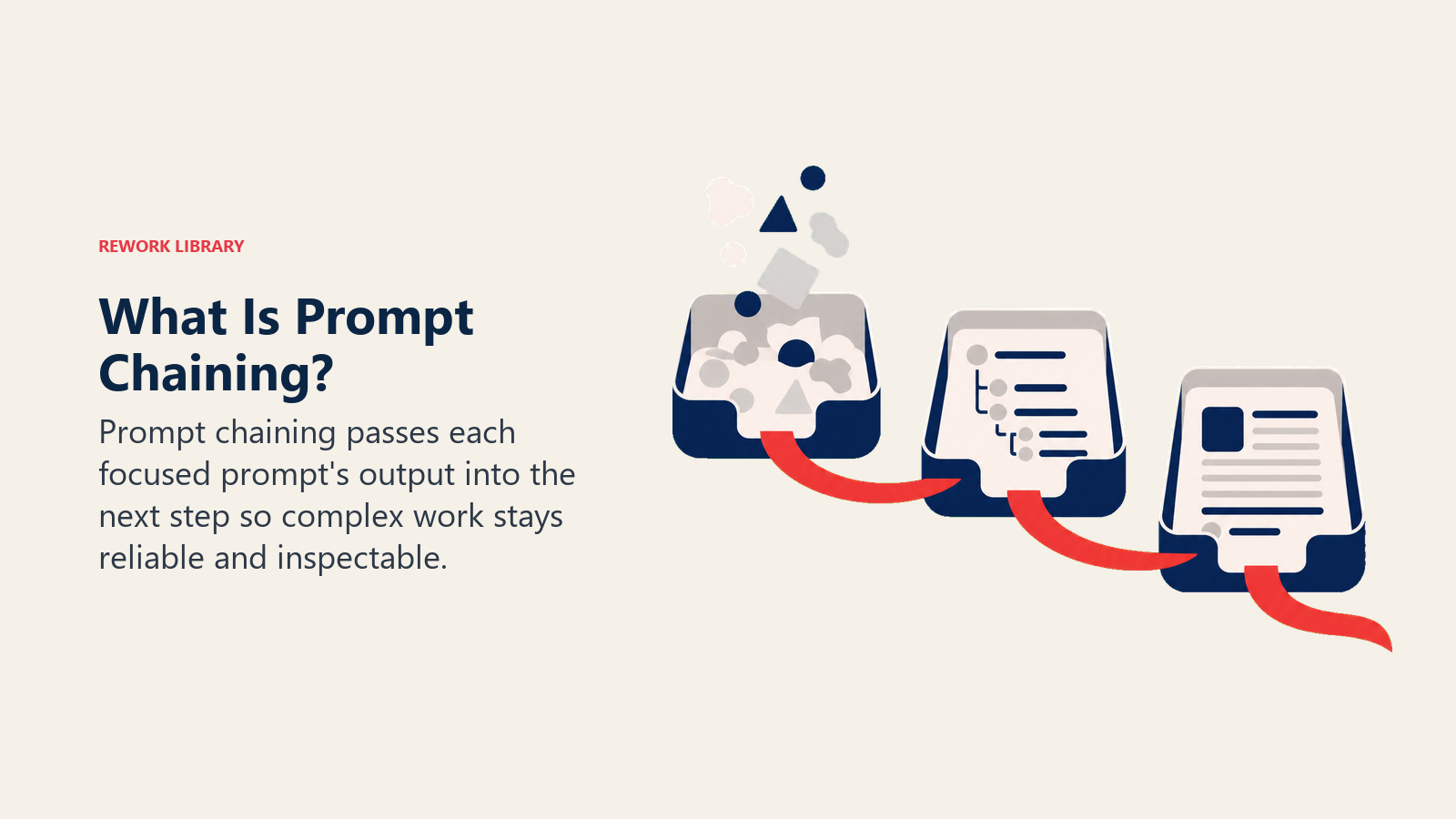
Prompt chaining is a technique that breaks a complex task into a sequence of smaller prompts, where the output of one prompt becomes the input to the next. Instead of asking an AI model to do everything in a single instruction, you guide it through a series of focused steps, each one building on the result of the last.
For business leaders, prompt chaining means the difference between an AI workflow that quietly fails halfway through and one you can actually trust with real work. Ask a model to "research this company, write a pitch, and draft a follow-up email" in one prompt, and it often rushes or skips a step. Chain those same three tasks, research then pitch then email, and each step gets the model's full attention, with a clean handoff you can inspect along the way.
How Prompt Chaining Works
The mechanics are simple, even when the workflow they power is not.
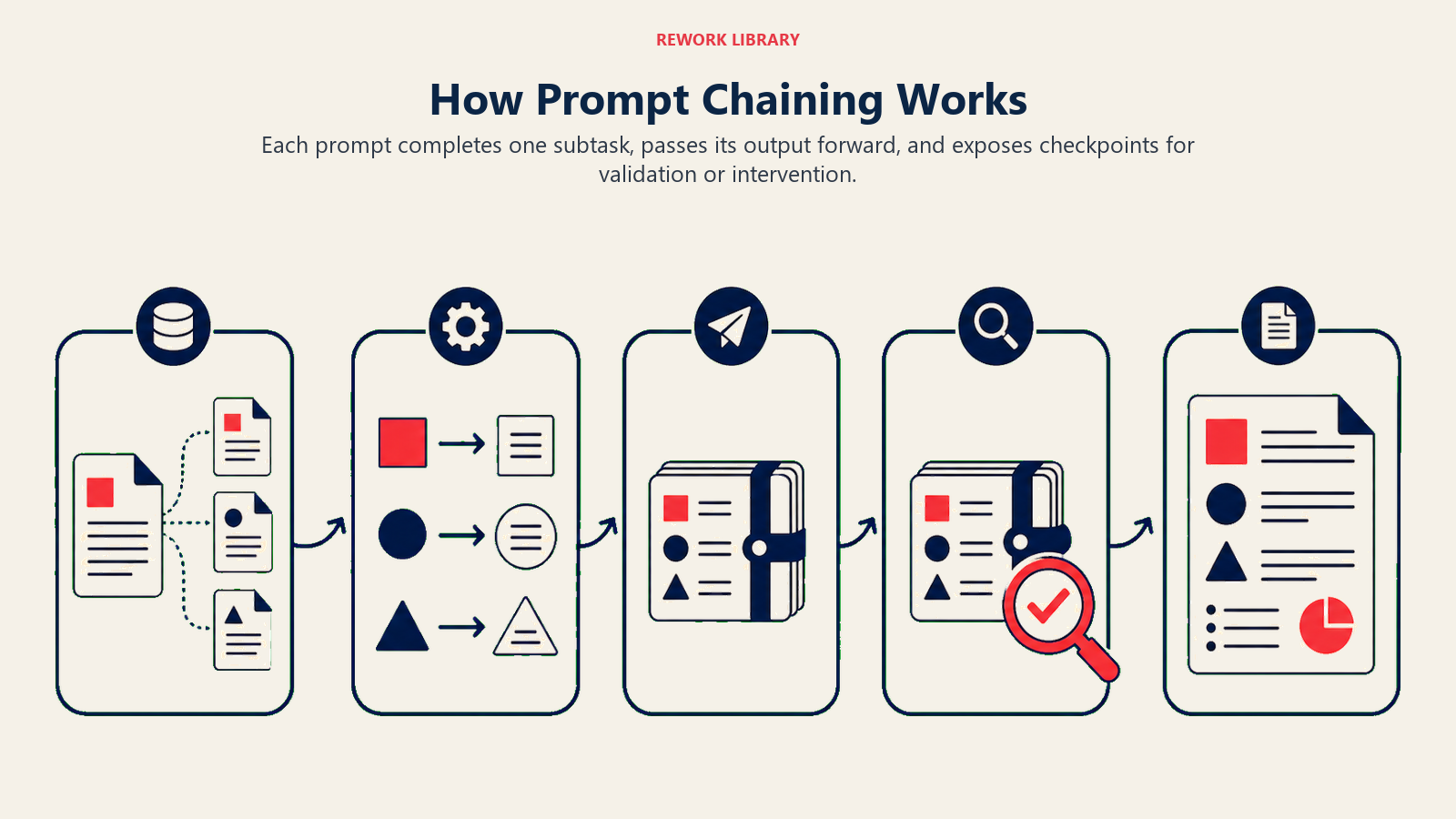
- Break the task into subtasks. A complex job, drafting a market analysis, qualifying a lead, generating a report, gets split into a sequence of smaller, well-defined steps.
- Run the first prompt. The model completes the first subtask on its own, with no dependency on later steps.
- Pass the output forward. The response from step one becomes part of the input for step two, either as raw text, a structured field, or a summary.
- Repeat through the chain. Each subsequent prompt builds on everything that came before it, until the final step produces the finished output.
- Inspect or intervene at any link. Because each step is a discrete unit, you can log it, validate it, or insert a human check before the chain continues.
A basic content workflow illustrates this well: prompt one extracts key facts from a source document, prompt two turns those facts into an outline, prompt three expands the outline into a draft, and prompt four edits the draft for tone. Each prompt does one job and does it with the model's undivided attention, similar to how chain-of-thought forces a model to reason step by step within a single response, except chaining splits the steps across separate calls instead of one long one.
Why Chain Prompts Instead of Writing One Mega-Prompt
A single, giant prompt asking for research, analysis, and a final recommendation all at once seems efficient. In practice, it's often the less reliable option.
Reliability. Models tend to lose focus across long, multi-part instructions, skipping requirements buried in the middle or blending steps together. A chain forces the model to fully complete one job before moving to the next, which is the same principle behind good prompt engineering: narrow, well-scoped instructions outperform vague, all-in-one ones.
Debugging. When a single mega-prompt produces a bad result, you're left guessing which part of the instruction the model misread. When a chain produces a bad result, you know exactly which link failed, because each step's output is a visible, checkable artifact.
Consistency. Each prompt in a chain can be tuned, tested, and reused independently. A prompt that reliably extracts data from invoices can plug into ten different downstream chains without being rewritten each time.
Control. Chains let you insert validation, formatting rules, or a human approval gate between any two steps, something a single opaque prompt cannot offer.
The research backs this up. Least-to-most prompting, a chaining approach that decomposes a problem into subproblems and solves them in sequence, reached 99% accuracy on the SCAN compositional generalization benchmark with only 14 examples, compared to 16% accuracy for standard chain-of-thought prompting on the same benchmark (see Key Facts below). That's not a marginal improvement, it's the difference between a technique that works and one that mostly doesn't on hard, multi-step problems.
Common Prompt Chaining Patterns
Most production chains follow one of three shapes.
Sequential chains run steps in a fixed order, one after another. Research, then outline, then draft, then edit is a sequential chain. This is the most common pattern because most real tasks naturally break into ordered stages.
Conditional chains branch based on the output of an earlier step. A support ticket chain might classify the ticket first, then route to a "billing" prompt, a "technical" prompt, or an "escalate to human" step depending on the classification. The chain isn't a straight line, it's a decision tree with prompts at each node.
Looping chains repeat a step until a condition is met. A chain might generate a draft, then run a "does this meet our style guide?" check, and loop back to revise until the check passes or a maximum number of attempts is reached. This pattern underpins self-correction workflows, where a model reviews and improves its own earlier output.
Real workflows frequently combine all three: a sequential backbone with a conditional branch partway through and a looping revision step near the end.
Tools and Frameworks for Building Prompt Chains
Prompt chaining ranges from a few lines of code to a fully visual, no-code workflow builder.
| Tool | Best for | Approach |
|---|---|---|
| LangChain | Developers building custom AI applications | Code-first framework with chain, agent, and memory abstractions |
| LangGraph | Developers building stateful, branching chains | Graph-based orchestration for conditional and looping chains |
| n8n | Technical teams that want visual workflows with code fallback | Node-based canvas, self-hosted or cloud, native AI step nodes |
| Zapier | Business teams automating chains across existing SaaS tools | No-code "Zap" builder connecting AI steps to thousands of apps |
| Make (formerly Integromat) | Visual builders who need complex branching logic | Drag-and-drop scenario builder with detailed conditional routing |
| Custom agent builders | Teams building autonomous, self-directing chains | Frameworks like AutoGen or CrewAI that let a model plan its own chain |
LangChain remains the most widely adopted developer framework for chaining, with 142,000 GitHub stars and 23,600 forks as of July 2026 (see Key Facts below). For teams that want chaining without writing code, n8n and Zapier both now ship native AI steps that can be linked into a chain alongside traditional app-to-app automation, so a chain might extract data with one AI step, transform it with a code node, and hand it to a CRM update, all in the same workflow.
Prompt Chaining vs Single Prompt vs AI Agents
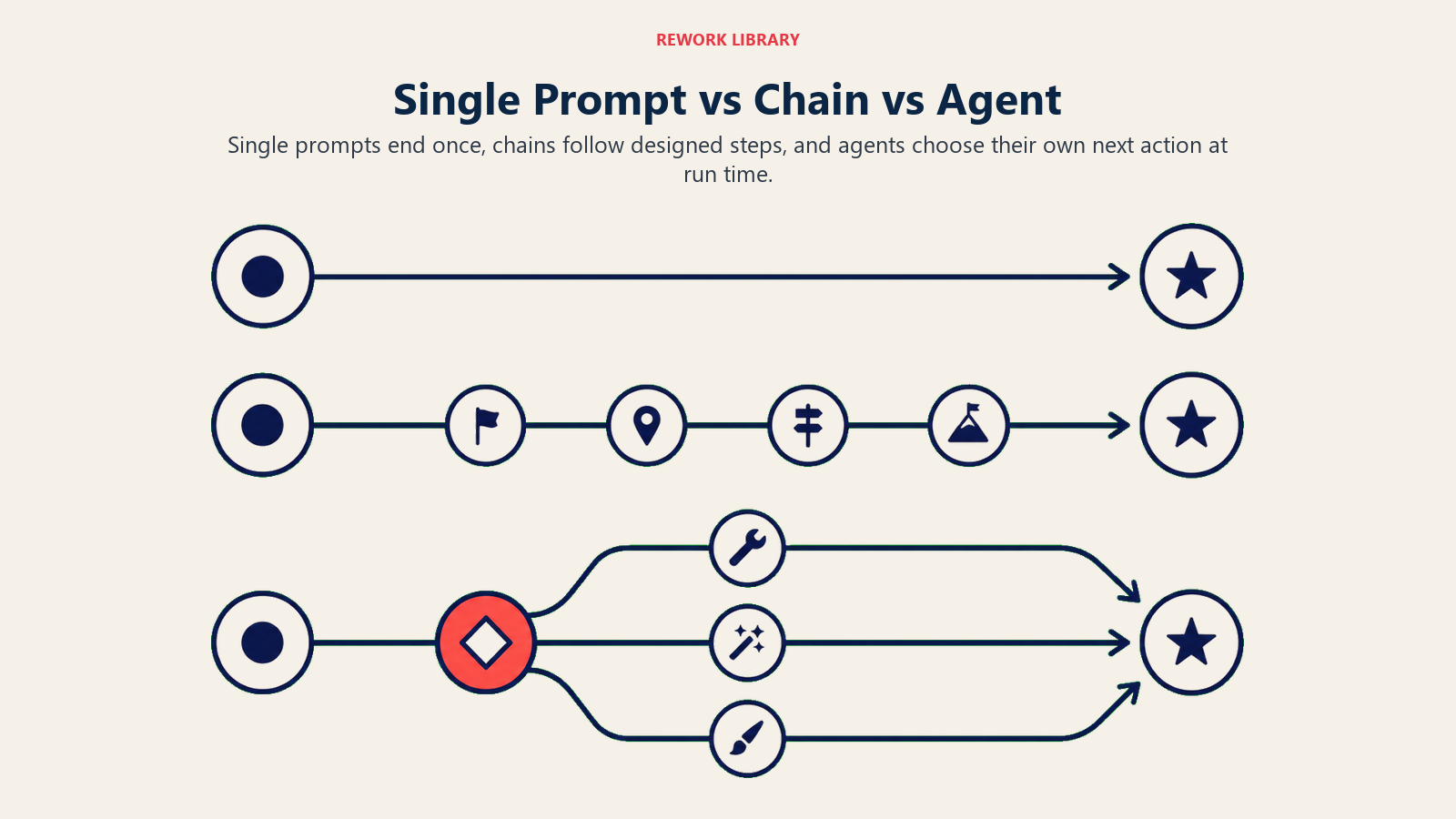
These three approaches get confused because they all involve "AI does multiple things," but they differ in how much autonomy the system has over its own next step.
| Aspect | Single Prompt | Prompt Chaining | AI Agents |
|---|---|---|---|
| Structure | One instruction, one response | Fixed, predefined sequence of prompts | Dynamic, self-directed sequence of steps |
| Who decides the next step | Not applicable, task ends after one response | The developer, at design time | The model itself, at run time |
| Best fit | Simple, single-step tasks | Complex but predictable, well-understood workflows | Open-ended goals where the path isn't known in advance |
| Debuggability | Hard to isolate what went wrong in a long request | Easy, each link is a visible checkpoint | Harder, the model's own reasoning path can vary run to run |
| Flexibility | None | Limited to the branches you've built in | High, can improvise new steps within its tool set |
| Failure mode | The whole response is off | One link is off; usually easy to locate and fix | Errors can compound across self-chosen steps |
The practical takeaway: a single prompt is fine for a quick summary or a one-off question. Prompt chaining is the right tool when you know the steps a task requires and want predictable, inspectable execution. AI agents go a step further, using a reasoning model to decide its own sequence of actions rather than following a chain you designed in advance, the approach covered in agentic workflows and what is agentic AI. Many production systems actually combine all three: a chain handles the predictable backbone of a task, while an agent step handles the one part of the job that genuinely requires judgment.
Real Use Cases for Prompt Chaining
Content production. A chain extracts key points from a source, drafts an outline, writes a full draft, then runs a tone and style check, mirroring an editorial process a human team would follow.
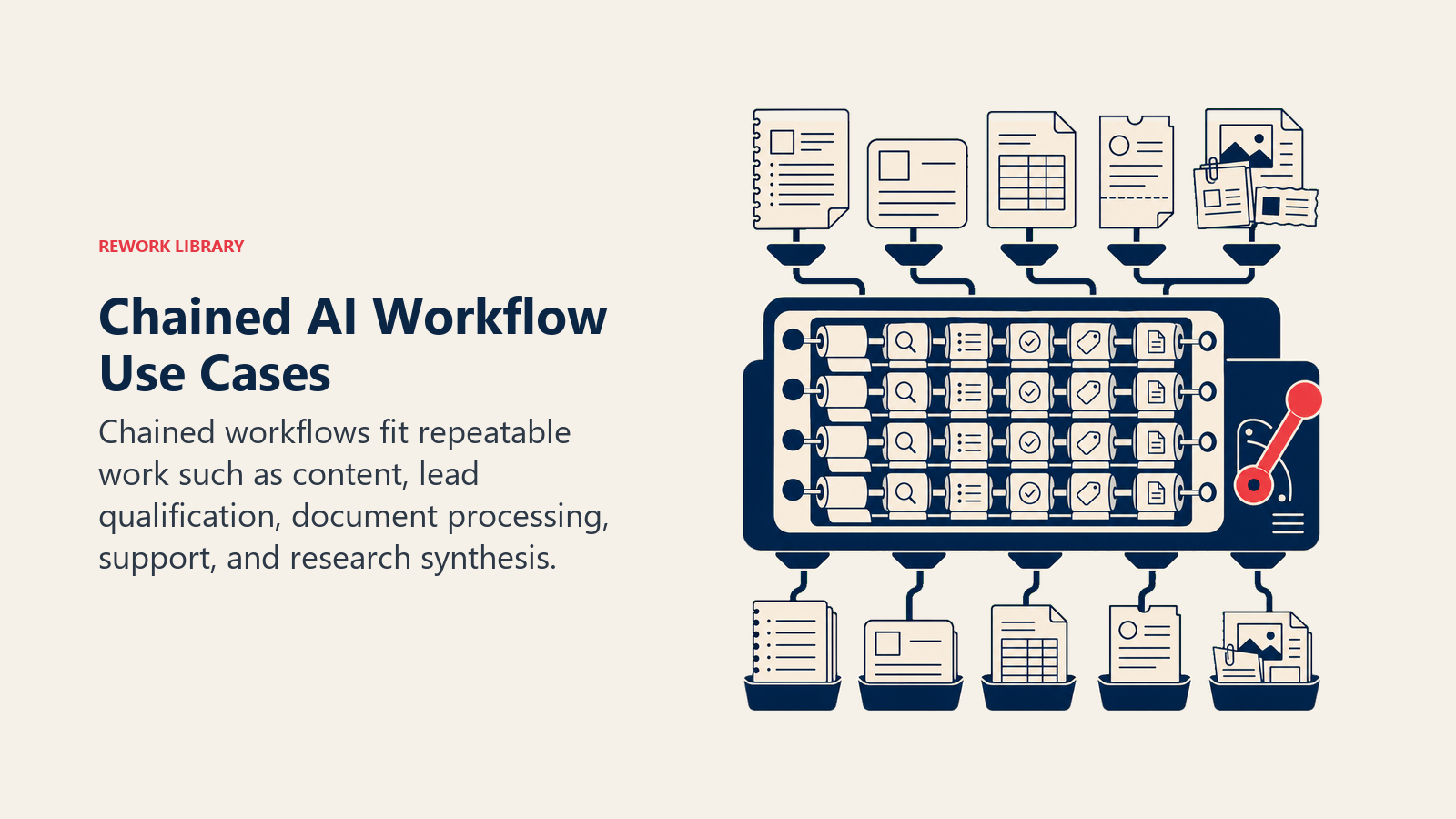
Lead qualification. One prompt scores a lead against your ideal customer profile, a second drafts a personalized outreach message if the score clears a threshold, and a third schedules a follow-up task if no reply arrives within a set window.
Document processing. A chain extracts structured data from an invoice or contract, validates the data against business rules, flags anomalies for human review, and writes the clean record to a database, each step small enough to verify independently.
Customer support. A ticket gets classified, routed to a category-specific prompt for a draft response, checked against policy constraints, and escalated to a human agent if the confidence score falls below a threshold, a conditional chain pattern in practice.
Research synthesis. A chain pulls information from multiple sources, summarizes each one separately, then combines the summaries into a single synthesized brief, avoiding the accuracy loss that comes from asking a model to read and summarize everything at once.
Key Facts
- Least-to-most prompting, a chaining technique that decomposes a task into subproblems solved in sequence, reached 99% accuracy on the SCAN benchmark using just 14 examples, versus 16% accuracy for standard chain-of-thought prompting on the same benchmark. arXiv: Zhou et al., 2022
- LangChain, the most widely used developer framework for building prompt chains, has 142,000 GitHub stars and 23,600 forks as of July 2026. GitHub: langchain-ai/langchain
- n8n, a visual workflow tool commonly used to build chained AI automations, has 196,642 GitHub stars and 200,000-plus community members. n8n.io
- Zapier's developer platform connects 9,000-plus app integrations with 66,000-plus triggers and actions, the ecosystem that no-code prompt chains route through. Zapier Developer Platform
- Zapier customers now automate over 2 billion AI-related tasks per month across 3.7 million companies. Zapier Engineering Blog
- Zapier's platform has automated more than 81 billion tasks in total since launch. Zapier Engineering Blog
Frequently Asked Questions about Prompt Chaining
What is prompt chaining in simple terms?
Prompt chaining is a technique where you split a complex task into smaller steps and feed the output of each step into the next prompt. Instead of one giant instruction, the AI works through a sequence of focused subtasks that build on each other.
How is prompt chaining different from a single, longer prompt?
A single prompt asks the model to do everything at once, which often causes it to skip or blend steps in a long instruction. Prompt chaining forces the model to fully complete one step before starting the next, which is more reliable and easier to debug when something goes wrong.
How is prompt chaining different from AI agents?
In prompt chaining, a developer designs the sequence of steps in advance and the chain follows that fixed path. In an AI agent, the model decides its own next step at run time based on its reasoning, without a predefined sequence. Chains are predictable; agents are flexible but less predictable.
What are the main types of prompt chains?
Sequential chains run steps in a fixed order, conditional chains branch based on an earlier output, and looping chains repeat a step until a condition is met. Most real workflows combine two or three of these patterns.
What tools can I use to build a prompt chain?
Developers commonly use LangChain or LangGraph in code. Teams that prefer visual, no-code tools use n8n, Zapier, or Make to build chains that combine AI steps with other app automations.
Do I need to code to build a prompt chain?
No. No-code platforms like Zapier and n8n let you build multi-step AI chains through a visual interface, connecting AI prompts to other apps and logic steps without writing code. Custom or highly technical chains still typically use a code framework like LangChain.
When should I use prompt chaining instead of a single prompt?
Use chaining when a task has multiple distinct stages, when you need to inspect or validate intermediate results, or when a single prompt has been producing inconsistent or incomplete output. Simple, one-step requests rarely need a chain.
What's a common mistake when building prompt chains?
Making chains too long or too granular, which adds latency and cost without improving quality. A good rule of thumb is to split a task only where a genuine judgment or format change happens between steps, not at every possible sentence boundary.
Related AI Concepts
- Prompt Engineering - The broader discipline of crafting effective instructions that prompt chaining builds on
- Chain-of-Thought - A related technique that chains reasoning steps within a single prompt instead of across separate calls
- What is Agentic AI? - How autonomous agents decide their own steps instead of following a predefined chain
- Agentic Workflows - Multi-step AI systems that often combine fixed chains with agent-driven decisions
- AI Agents - The autonomous systems that represent the next step up from a fixed chain
- AI Orchestration - Coordinating multiple chains, agents, and tools across a larger system
- Tool Use - How individual links in a chain can call external tools and APIs
- Model Context Protocol - The open standard many chaining and agent frameworks use to connect to external tools
- Best AI Automation Tools 2026 - A roundup of the no-code and low-code platforms used to build prompt chains in production
External Resources
- Least-to-Most Prompting Enables Complex Reasoning in Large Language Models (arXiv) - The research paper behind the SCAN benchmark accuracy figures cited above
- Anthropic: Prompt Engineering Overview - Official guidance on chaining prompts for complex tasks
- LangChain on GitHub - The most widely used open-source framework for building prompt chains
- n8n.io - Visual workflow platform used to build no-code prompt chains
- Zapier Developer Platform - App integration ecosystem that no-code chains connect through
Part of the AI Terms Collection. Last updated: 2026-07-16

Co-Founder, Rework.com