What are World Models in AI? A Business Guide to AI That Simulates Reality
Turn this article into takeaways for your work.


Each assistant summarizes the article only for you and suggests best practices for your work.
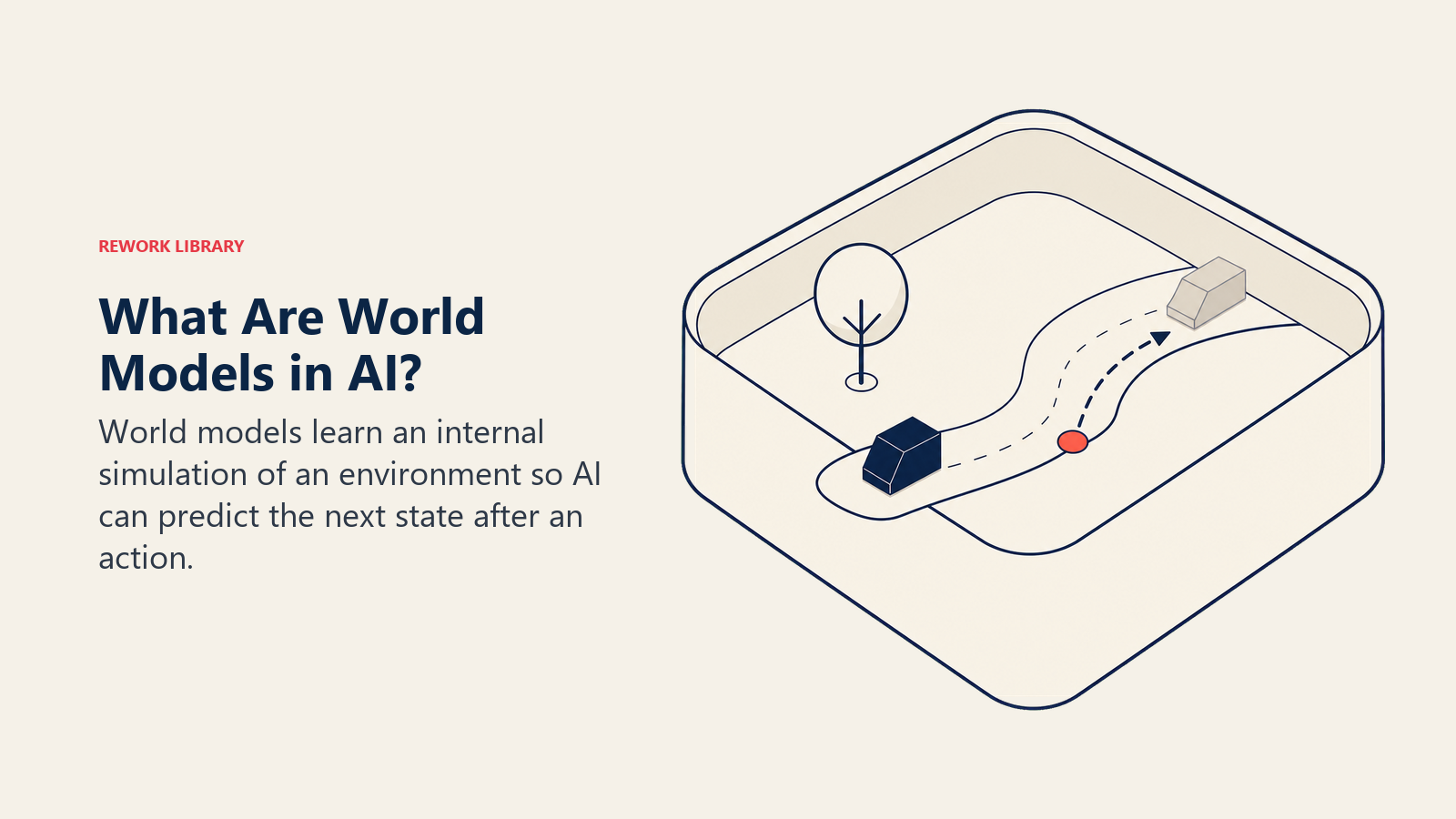
A world model is an AI system trained to build an internal, predictive simulation of an environment: what a scene looks like, how objects and people move through it, and what happens next after an action. Instead of predicting the next word like a language model does, a world model predicts the next state of a world.
That distinction sounds small. It isn't. It's the difference between an AI that talks about the physical world and an AI that understands it well enough to act in it, or to build a version of it you can walk through, test a robot in, or generate an entire game level from.
How World Models Learn an Internal Simulation
A world model doesn't memorize facts about the world the way an encyclopedia does. It learns physics and cause-and-effect by watching enormous amounts of video, interaction data, and (increasingly) robot sensor logs, then compressing what it sees into a compact internal representation of "state": where objects are, how they're moving, what's likely to happen a moment from now.
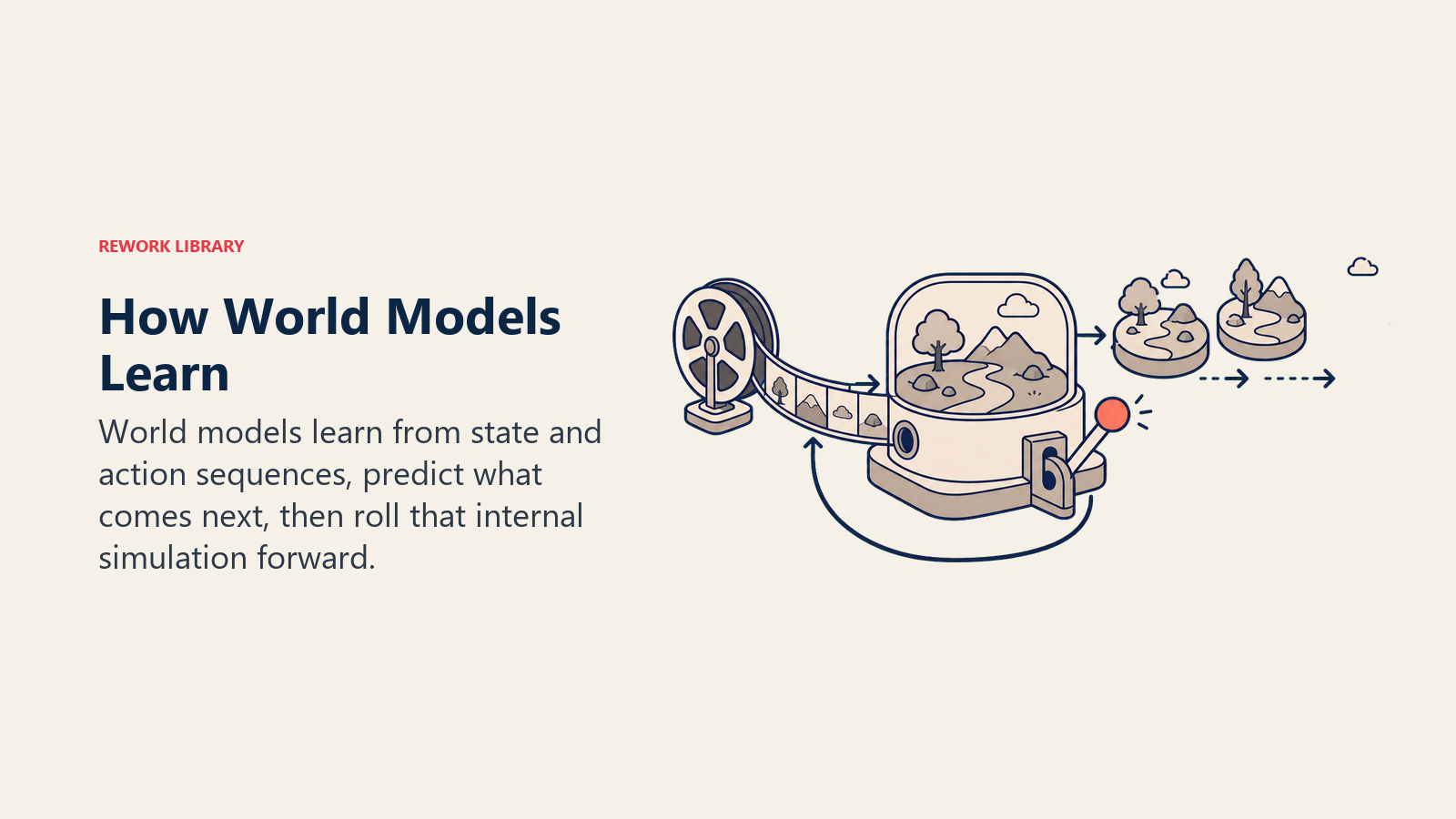
Training generally follows three stages:
- Ingest raw sequences. The model watches millions of hours of video, gameplay footage, or robot demonstrations, each frame paired with whatever action (a camera move, a robot arm motion, a keypress) caused the next frame to happen.
- Learn to predict the next state. Given the current state and an action, the model learns to predict what comes next, over and over, until its internal simulation stops drifting away from how the real world actually behaves.
- Roll the simulation forward. Once trained, the model can generate new states indefinitely, in effect "imagining" what would happen if a person, robot, or camera took a given action, without that action ever occurring in reality.
Google DeepMind's Genie 3 is a useful concrete example. It's an 11-billion-parameter autoregressive transformer that takes a text prompt and generates a navigable world in real time at 720p and 24 frames per second, with visual memory reaching back about a minute so the environment stays consistent as you move through it (Google DeepMind, 2026). That's the core loop: describe a world, get back a place you can move through, where the model is continuously predicting what should appear next based on where you just went.
This is also what separates world models from ordinary video generators. A video generator produces a fixed clip. A world model keeps a persistent internal state and responds to input, closer to a simulation than a movie.
Why World Models Matter
Robotics. Real-world robot training is slow and expensive: every failed grasp or collision costs time, hardware, and sometimes safety. World models let engineers generate huge volumes of realistic, physically plausible training scenarios in simulation first, then transfer what the robot learned into the real machine. Nvidia calls this "physical AI," and it's the entire premise behind Cosmos: train the policy in a simulated world before it ever touches a real one.
Video and content generation. Traditional AI video tools generate a clip and stop. A world model can be steered, revisited, and extended, which is why video-generation companies like Runway are explicitly repositioning around world models instead of one-shot clips. Longer, controllable, physically coherent generation is the next step past "type a prompt, get 5 seconds of video."
Planning and agentic AI. An AI agent that can simulate the likely outcome of an action before taking it can plan several steps ahead instead of reacting one step at a time. This is a meaningful upgrade over agents that only reason in text: a world model gives an agent something closer to imagination, a way to test a plan mentally before committing resources to it.
A possible path toward more general AI. Large language models are extraordinarily good at manipulating text, but text is a description of the world, not the world itself. Researchers including Fei-Fei Li have argued that spatial intelligence, an understanding of how objects, space, and time actually behave, is a separate capability that language alone doesn't teach a model. World models are one of the more concrete bets in the industry on closing that gap.
Key Players and Projects in 2026
Google DeepMind, Genie 3. DeepMind's world model generates real-time, playable, text-prompted environments. It rolled out to Google AI Ultra subscribers on January 29, 2026, after debuting in 2025, and represents the clearest public demonstration yet of real-time, interactive world generation (Google DeepMind, 2026; 9to5Google, 2026).
World Labs, founded by Fei-Fei Li. World Labs builds Marble, a world model that turns text prompts, photos, video clips, or rough 3D layouts into persistent, editable, navigable 3D environments, aimed squarely at spatial industries like architecture, gaming, and design (World Labs, via TechCrunch, 2026).
Nvidia Cosmos. Cosmos is Nvidia's world foundation model platform for what it calls "physical AI," generating synthetic training data and action trajectories to accelerate robotics and autonomous vehicle development. Cosmos 3, launched in 2026, was trained on roughly 20 trillion tokens of multimodal data, including close to a billion images and 400 million real and synthetic videos (Nvidia Newsroom, 2026).
Runway. Best known for AI video generation, Runway has pivoted its roadmap toward world models, raising $315 million in a Series E round in February 2026 explicitly to "pre-train the next generation of world models," on top of a first world model it shipped in December 2025 (TechCrunch, 2026).
These four organizations don't compete on identical products. DeepMind and Runway lean toward generative, video-style world models you explore in real time. World Labs leans toward persistent, editable 3D scenes. Nvidia leans toward physical accuracy for robots and vehicles. Together they define the current shape of the category.
World Models vs LLMs
| World Models | Large Language Models | |
|---|---|---|
| Learns from | Video, simulation, robot interaction data, paired with actions | Text, code, and other written language |
| Predicts | The next state of an environment (visual, spatial, physical) | The next token in a sequence of text |
| Output | Navigable environments, video, or action trajectories | Text, code, structured data |
| Core strength | Spatial and physical reasoning, "what happens if" simulation | Language reasoning, knowledge synthesis, conversation |
| Interactivity | Responds to actions in real time (in leading models) | Responds to prompts, not to physical actions |
| Typical use today | Robotics training, game/world generation, spatial design | Chatbots, coding assistants, document analysis, search |
| Maturity in 2026 | Early: minutes of consistency, narrow deployment | Mature: broadly deployed in production products |
Limitations of World Models
World models are advancing fast, but they're not close to a finished technology.
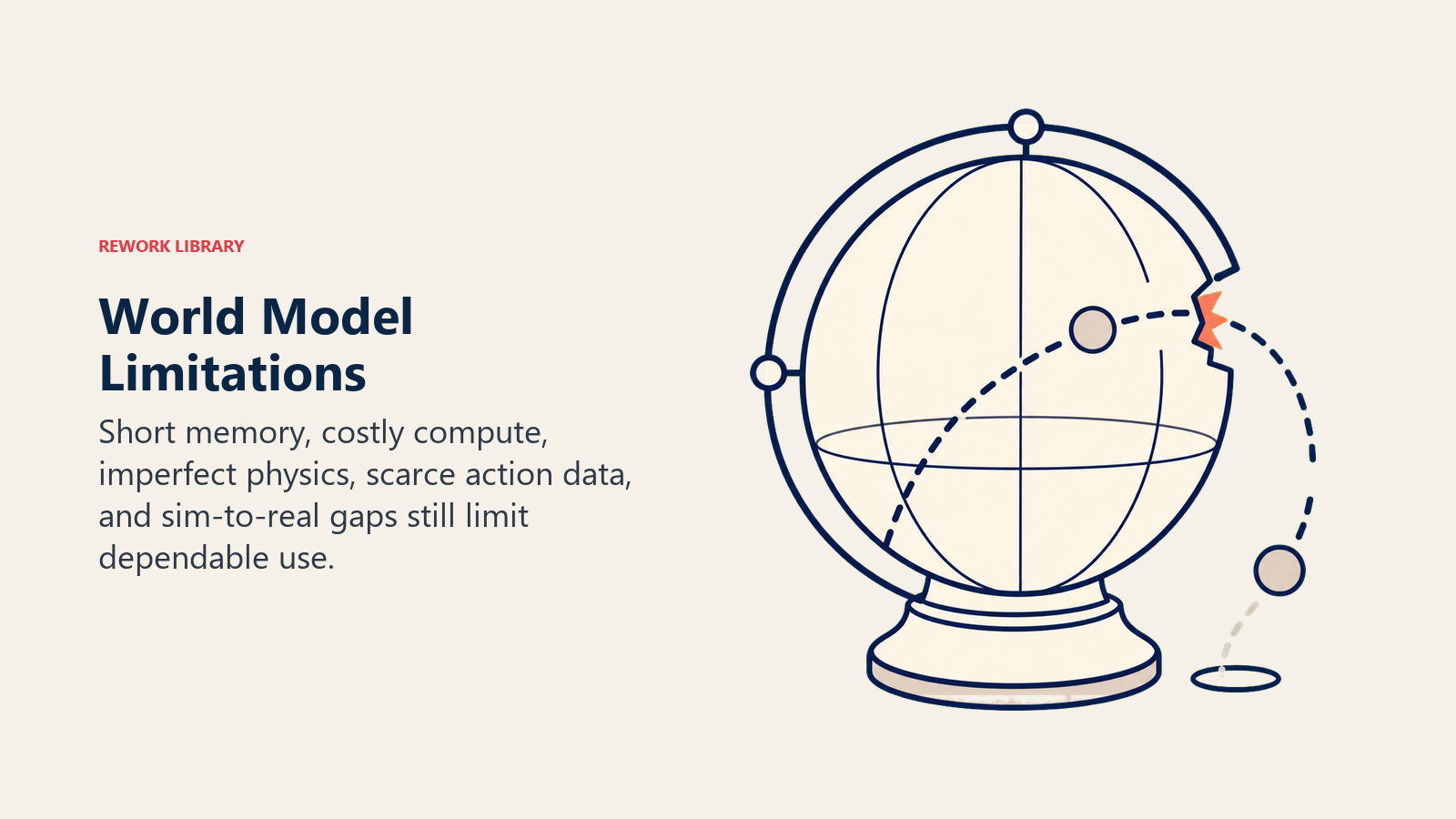
- Short consistency windows. Genie 3 sustains a coherent world for a few minutes, not hours. Long-running simulations still drift or lose coherence.
- Heavy compute cost. Training on tens of trillions of tokens of video and simulation data, and running real-time generation at usable frame rates, requires substantially more compute than training a text model of comparable ambition.
- Imperfect physics. These models learn physics statistically, from examples, not from first principles. They can still generate scenes where objects behave in ways that don't match real-world mechanics.
- Sparse real-world interaction data. Text is abundant online. High-quality video paired with precise action data (especially from real robots) is comparatively scarce and expensive to collect.
- No shared benchmark yet. Unlike language models, which have dozens of standardized evaluations, world models don't yet have an agreed-upon way to measure "how good" a simulation is, which makes vendor comparisons harder for buyers.
- Sim-to-real gap. A robot policy that works flawlessly in a simulated world can still fail on the factory floor if the simulation missed some real-world variable, so simulation training still needs real-world validation.
Key Facts: World Models by the Numbers
- Google DeepMind's Genie 3 generates real-time, navigable worlds at 720p and 24 frames per second, with roughly a minute of visual memory to keep the world consistent as you move through it. Source: Google DeepMind
- Nvidia's Cosmos 3 world foundation model was trained on about 20 trillion tokens of multimodal data, including nearly a billion images and 400 million real and synthetic videos. Source: Nvidia Newsroom
- World Labs, founded by Fei-Fei Li, raised roughly $1 billion in February 2026, including $200 million from Autodesk, bringing its total funding to about $1.23 billion. Source: TechCrunch
- World Labs' valuation reportedly rose from $1 billion at its 2024 launch to roughly $5 billion by January 2026, in about sixteen months. Source: Bloomberg
- Runway raised $315 million in a Series E round in February 2026 at a $5.3 billion valuation, earmarked in part to pre-train its next generation of world models. Source: TechCrunch
- Generative AI, the broader category world models sit inside, grew more than 200% in private investment in 2025 and captured nearly half of all private AI funding globally. Source: Stanford HAI, 2026 AI Index Report
Business and Industry Implications
For most companies, world models aren't a near-term line item, but they're worth tracking for a few reasons.
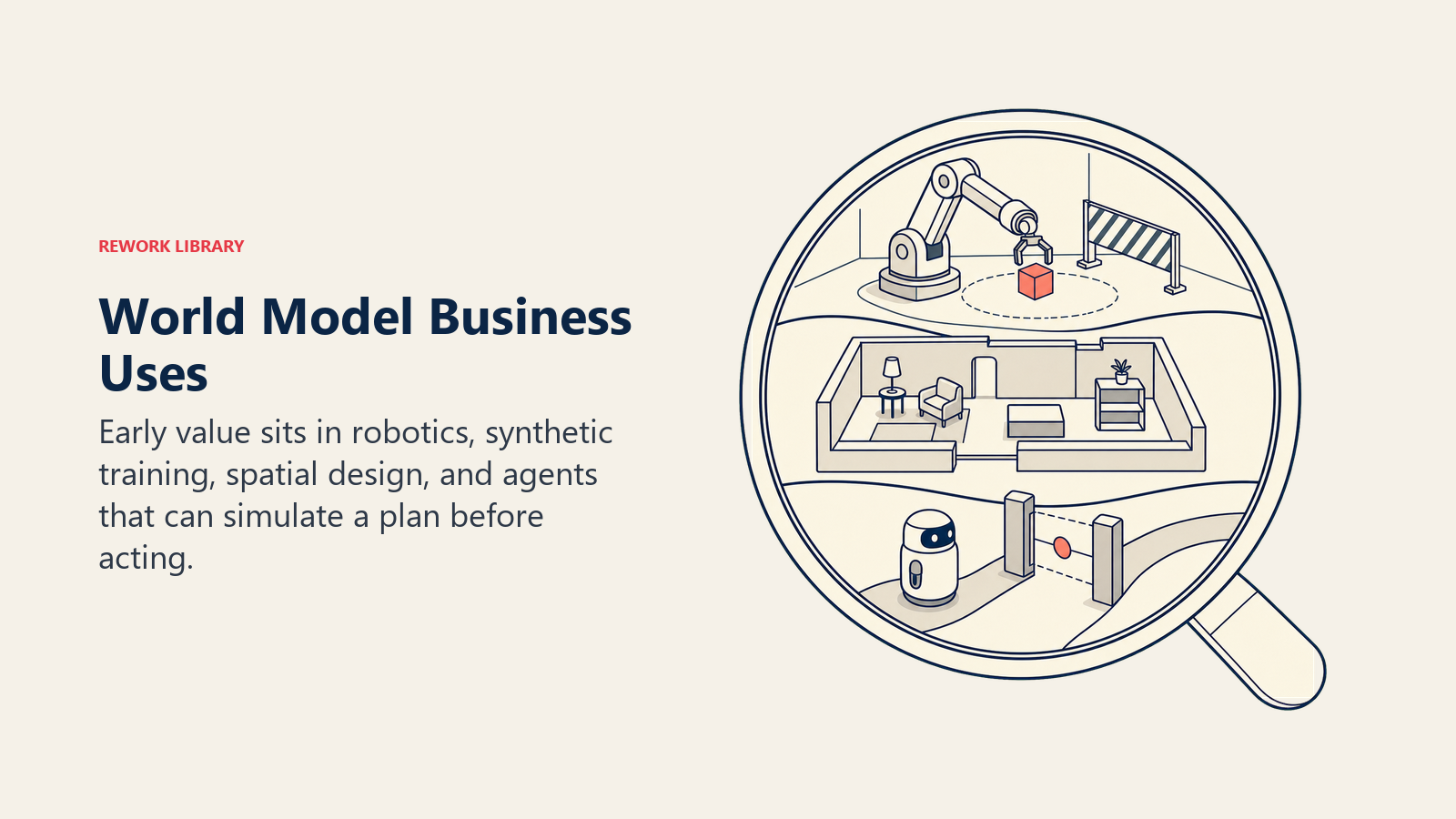
Robotics and manufacturing are the clearest early beneficiaries. If your business depends on physical automation, warehouse robotics, or autonomous vehicles, world models are quietly becoming the standard way vendors generate the synthetic training data those systems need, which should show up as faster deployment cycles and fewer costly real-world training failures over the next few years.
Spatial and creative industries (architecture, real estate, gaming, industrial design, film) get a more immediate tool: turning a photo, sketch, or text prompt into an explorable 3D space, which is exactly the pitch behind World Labs' Marble. That shortens the loop between "idea" and "walkthrough you can actually evaluate."
Everyone building or buying agentic AI should watch this space even if they never touch a robot. If agents eventually get access to internal "imagination," the ability to simulate a plan's outcome before executing it, that changes what businesses can reasonably delegate to an agent versus what still needs a human check first.
Budget-wise, treat world models the way you'd treat any pre-production technology: promising, well-funded, and not yet something to build a critical workflow around. The compute and data requirements are steep, the consistency windows are still measured in minutes, and there's no standardized way yet to evaluate one vendor's world model against another's. Watch the space, pilot narrowly if it's directly relevant to your industry, and don't bet a core process on it in 2026.
Frequently Asked Questions about World Models in AI
What is a world model in AI?
A world model is an AI system trained to build an internal simulation of an environment, learning how objects, agents, and space behave so it can predict what happens next after a given action. It's the technology behind tools like Google DeepMind's Genie 3 and World Labs' Marble.
How is a world model different from a large language model?
A large language model predicts the next word in text. A world model predicts the next state of an environment, visual, spatial, or physical, based on the current state and an action. LLMs reason about language; world models reason about space and time.
Is Sora a world model?
Sora and similar text-to-video tools share some underlying techniques with world models, since both learn to predict coherent future frames. The distinction most researchers draw is interactivity: a world model responds to ongoing user actions in something close to real time, while a standard video generator produces a fixed clip from a single prompt.
Why are Google, Nvidia, and Runway all investing in world models right now?
Each is targeting a different application. Google DeepMind is building general-purpose interactive worlds with Genie 3. Nvidia's Cosmos platform targets synthetic training data for robots and autonomous vehicles. Runway is extending its video generation business into persistent, controllable simulated environments. All three see world models as the next major capability layer after language and image generation.
What are world models used for in robotics?
World models generate large volumes of realistic, physically plausible training scenarios in simulation, letting engineers train and test robot behavior without the cost, time, and risk of thousands of real-world trial-and-error attempts. Nvidia's Cosmos platform is built specifically around this use case.
How long can a world model sustain a consistent environment?
As of 2026, leading models like Genie 3 sustain a coherent, navigable world for a few minutes at a time, not hours. Extending that consistency window is one of the main open technical challenges in the field.
Are world models related to AGI?
Some researchers, including Fei-Fei Li, argue that grounded spatial and physical understanding is a missing piece on the path to more general AI, since language alone doesn't teach a model how the physical world actually behaves. World models are one of the more concrete industry bets on closing that gap, though they remain an early-stage, unproven step toward that goal rather than a settled answer.
What is World Labs' Marble?
Marble is World Labs' world model, founded by Fei-Fei Li, that converts text prompts, photos, video clips, or rough 3D layouts into persistent, editable, navigable 3D environments, aimed at industries like architecture, gaming, and design.
Should my business invest in world model technology now?
For most businesses, world models are worth monitoring rather than adopting today. They're relevant now mainly to robotics, autonomous vehicles, and spatial design work. For most other functions, the technology is still early: short consistency windows, high compute costs, and no standardized benchmarks yet make it a "watch closely" category rather than a "build on it now" one.
Related Resources
Explore these related concepts to deepen your understanding of world models:
- Large Language Models (LLMs) - How text-based AI differs from world models
- AI Agents - How agentic systems could use world models to plan ahead
- Multimodal AI - AI that processes multiple data types, a foundation many world models build on
- Diffusion Models - The image and video generation technique underlying many world model architectures
- Reinforcement Learning - How agents learn from simulated environments, closely tied to world model training
- Generative AI - The broader category of AI that creates new content, including simulated worlds
- Transformer Architecture - The technical backbone behind models like Genie 3
- Foundation Models - The large, general-purpose models that world models and LLMs are both built on
- Computer Vision - How AI interprets the visual data world models are trained on
External Resources
- Google DeepMind - Genie 3: A New Frontier for World Models - Official announcement and technical details
- Nvidia Newsroom - Nvidia Launches Cosmos 3 - Nvidia's world foundation model for physical AI
- TechCrunch - World Labs Lands $200M From Autodesk - World Labs' funding and Marble product details
- Stanford HAI - 2026 AI Index Report, Economy Chapter - Generative AI investment data cited above
Part of the AI Terms Collection. Last updated: 2026-07-16

Co-Founder, Rework.com