What is Narrow AI?
Turn this article into takeaways for your work.


Each assistant summarizes the article only for you and suggests best practices for your work.
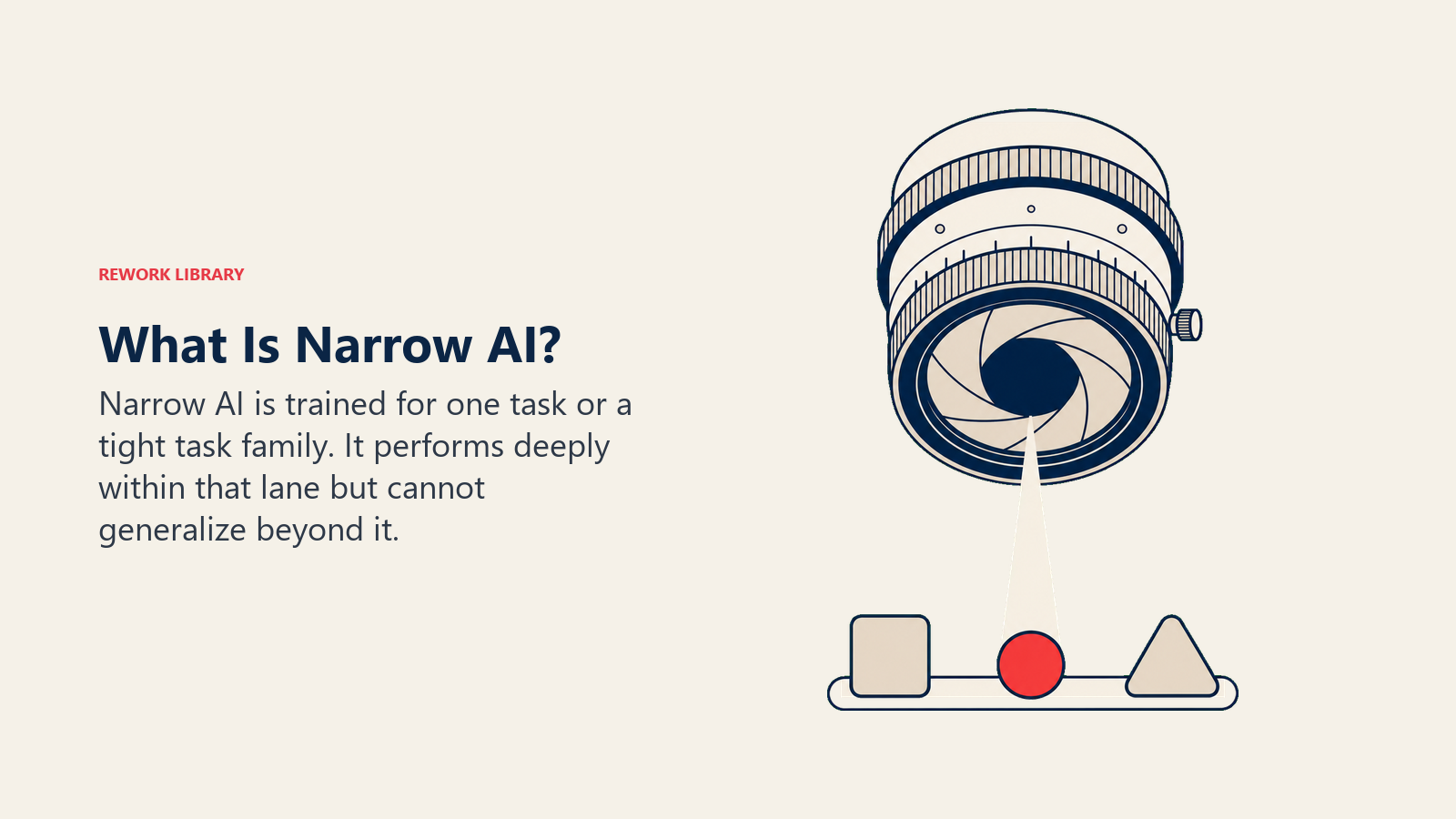
Narrow AI, also called weak AI or ANI (artificial narrow intelligence), is AI built and trained to do one task or a tightly related set of tasks well, like translating text, flagging fraud, or recommending products. It cannot transfer that skill to an unrelated problem. Every AI system running in production today, including the most advanced models, is narrow AI.
That last part surprises people. Frontier models write code, draft contracts, and hold fluent conversations, so they feel general. They aren't. A model that writes flawless Python can't drive a car, diagnose a medical scan, or run a warehouse robot without being retrained or wired into a completely different system. General AI, usually shortened to AGI, is the still-hypothetical alternative: a system that generalizes across most cognitive tasks the way a person does. It doesn't exist yet, and understanding why the gap matters is more useful for a business leader than the AGI hype cycle itself.
Narrow AI vs General AI vs Super AI
| Aspect | Narrow AI (ANI) | General AI (AGI) | Super AI (ASI) |
|---|---|---|---|
| Scope | One task or a tight cluster of related tasks | Most cognitive tasks a human can do | Every cognitive task, beyond the best humans |
| Status today | Deployed at scale, in production now | Not yet demonstrated | Not yet demonstrated |
| Generalization | Fails outside its trained domain | Transfers skills across unrelated domains | Transfers and exceeds human skill everywhere |
| Examples | Large language models, spam filters, computer vision systems, recommendation engines, reasoning models | None yet, the subject of active lab research | A theoretical extension of AGI, discussed mainly in safety research |
| Business relevance | Already automating specific workflows | Would change what work needs a human at all | Raises planning questions almost no organization is ready for |
The row that trips people up is "examples." Every product a vendor sells you this year, from a machine learning churn model to a full agentic AI workflow, sits in the narrow AI column. See what is AGI for the fuller breakdown of general AI and superintelligence.
Narrow AI Examples Across Business
Narrow AI is not a future technology. It's already running quietly inside most of the software a company touches:
- Sales and marketing: lead scoring models that rank prospects by likelihood to convert, email subject line optimizers, ad bid automation
- Customer support: chatbots that resolve common tickets, sentiment analysis that flags an angry customer before escalation, call transcription and summarization
- Finance: fraud detection systems that flag anomalous transactions in milliseconds, invoice processing, cash flow forecasting
- Operations: demand forecasting for inventory, route optimization for delivery fleets, predictive maintenance on manufacturing equipment
- HR: resume screening and candidate ranking, interview scheduling assistants, employee attrition prediction
- Engineering: coding assistants that autocomplete and review code, bug triage, automated test generation
Each of these is excellent at its one job and useless outside it. A fraud detection model trained on transaction data can't screen resumes, and a coding assistant can't forecast demand. That's the defining trait of narrow AI: depth in a lane, not breadth across lanes.
Why the Narrow vs General Distinction Matters
This isn't an academic label. It changes three decisions leaders actually make.
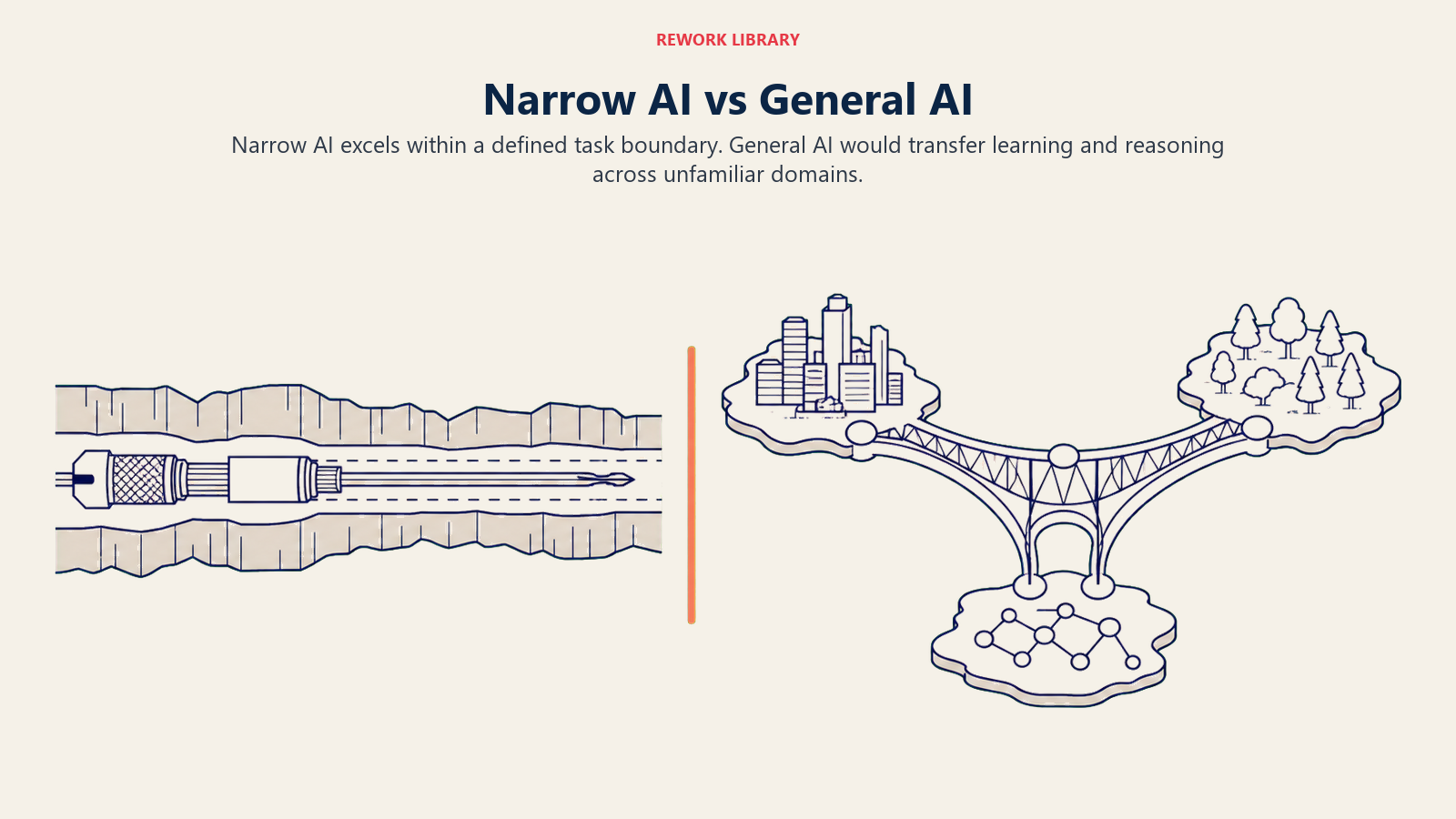
Budgeting and vendor evaluation. When a vendor pitches an "AI platform," ask what task it's narrow to. A tool that's exceptional at one workflow (say, sales email drafting) will disappoint if you buy it expecting it to also handle scheduling or reporting. Narrow AI systems are point solutions, not universal ones, and evaluating them that way avoids the most common enterprise AI procurement mistake.
Workforce and process planning. Narrow AI automates specific tasks inside a role, not the whole role. A support agent's ticket-triage work might get automated this year while the judgment calls on an angry enterprise customer still need a human. Planning around task-level automation, rather than waiting for a general system to replace whole jobs, is the realistic near-term move.
Risk and governance. A narrow system trained on last year's fraud patterns will confidently misfire on a pattern it has never seen, because it cannot reason its way to a novel situation the way a general system in theory could. That's why AI safety practices like monitoring, human review on edge cases, and clear scope boundaries matter more for narrow systems in production today than debates about far-off general AI risk.
Is Today's Frontier AI Still Narrow?
Yes, and this is the part that confuses even experienced buyers. The best foundation models in 2026 handle text, code, images, and audio inside one conversation, plan multi-step work, call external tools, and check their own output before responding. That's a huge leap from the narrow AI of a decade ago, a single model trained to do exactly one thing.
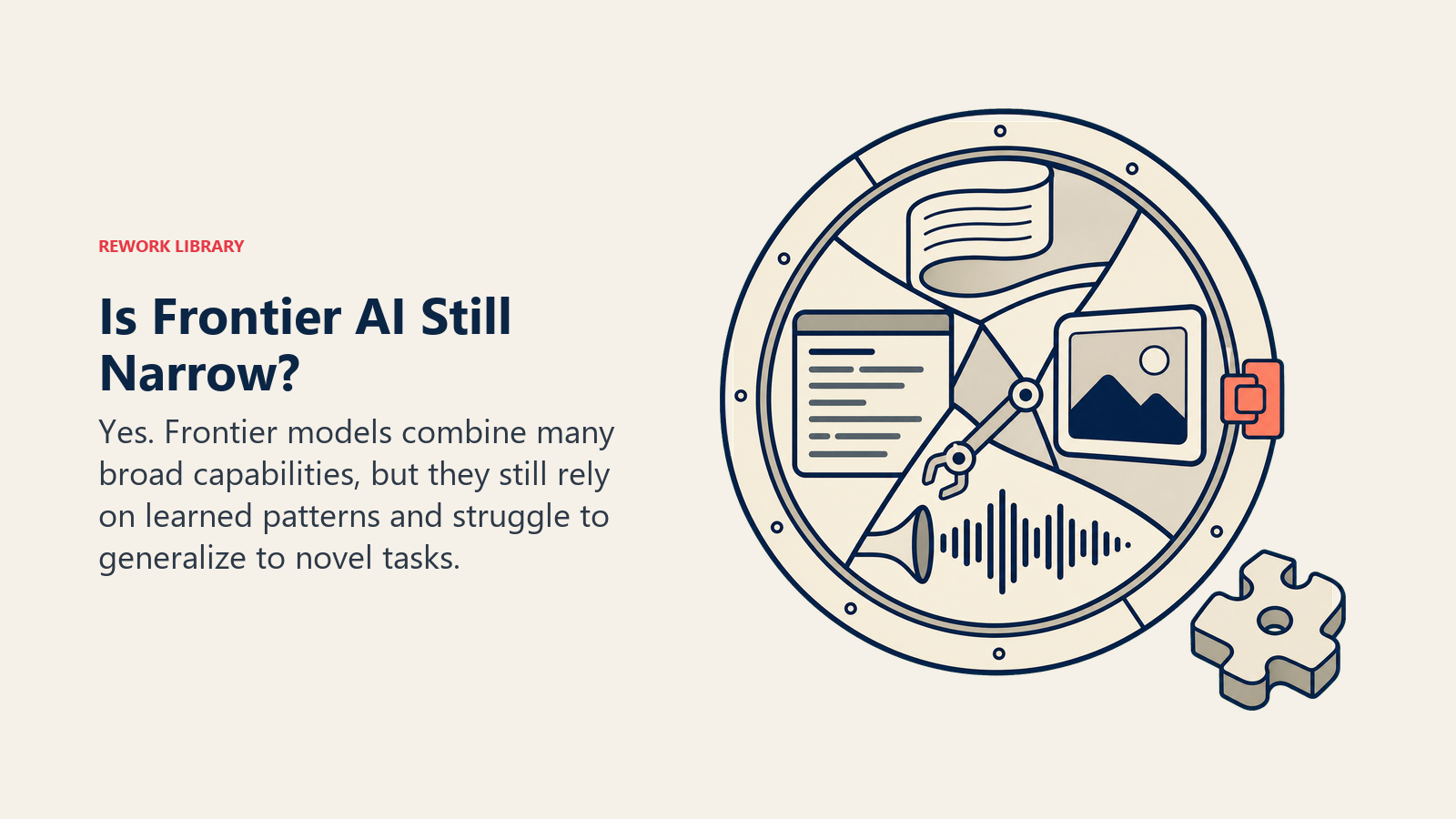
But breadth of tasks is not the same as general intelligence. A model that's fluent across dozens of domains is still narrow in the technical sense: it was trained on patterns in existing data and struggles on problems built specifically to resist pattern matching. ARC-AGI-2, a benchmark designed for exactly that purpose, shows the gap clearly. Human testers solve nearly all of its tasks within two attempts. The top verified commercial model in the 2025 ARC Prize competition scored 37.6%. Wide narrow AI, sometimes called "broad AI" informally, is real and improving fast. It is still a very large collection of narrow capabilities stitched together, not a single generalizing intelligence.
Agentic AI adds another layer of confusion. An agent that plans, uses tools, and completes multi-step projects looks general because it handles varied inputs. It's still narrow underneath: each tool call, each planning step, and each piece of natural language processing it does is a trained capability operating inside known bounds, not a mind reasoning freely about an unfamiliar domain.
Key Facts
- McKinsey's 2025 State of AI survey found 88% of organizations use AI in at least one business function, and virtually all of that AI is narrow, task-specific software, not general-purpose intelligence. McKinsey, State of AI
- Gartner projects 40% of enterprise applications will ship with task-specific AI agents built in by the end of 2026, up from under 5% in 2025, each one a narrow system scoped to a single job. Gartner
- On ARC-AGI-2, a benchmark built to resist memorization and reward genuine reasoning, the top verified commercial model in the 2025 ARC Prize competition scored 37.6%, while human testers solved essentially all tasks within two attempts. ARC Prize 2025 Results
- The AI Impacts 2023 Expert Survey on Progress in AI, based on 2,778 published AI researchers, put the aggregate 50% probability of "high-level machine intelligence," a working definition of general AI, at 2047, with only a 10% chance by 2027. AI Impacts / arXiv
- Stanford's 2026 AI Index reports that scores on SWE-bench Verified, a narrow coding benchmark, rose from around 60% to near 100% within a single year, a clear example of fast progress inside one narrow domain rather than general capability. Stanford HAI, 2026 AI Index Report
- Global corporate AI investment hit $581.7 billion in 2025, up 130% from the year before, funding that went almost entirely to narrow, task-specific systems since no general AI product exists to buy. Stanford HAI, 2026 AI Index Report
- Menlo Ventures found enterprise AI application spending tripled to $37 billion in 2025, the fastest single-year expansion the firm has tracked for any enterprise software category, aimed squarely at narrow tools built for specific workflows. Menlo Ventures
Related AI Concepts
- What is AGI (Artificial General Intelligence)? - The full breakdown of general AI and superintelligence
- Artificial Intelligence - The foundational technology narrow AI is one category of
- Machine Learning - The core technique most narrow AI systems are trained with
- AI Agents - Narrow, task-specific systems that act autonomously within a defined scope
- What is Agentic AI? - Why goal-directed, tool-using AI still counts as narrow
- Reasoning Models - A narrow AI technique that improved sharply in the past two years
- Foundation Models - The broad, still-narrow models frontier AI products are built on
- AI Safety - Why scope and monitoring matter for narrow systems in production today
External Resources
- Stanford HAI: 2026 AI Index Report - Annual benchmark, adoption, and investment data on AI progress
- McKinsey: The State of AI - Survey data on how organizations are adopting AI in production
- ARC Prize: ARC-AGI-2 - The benchmark built to test genuine reasoning over pattern memorization
- AI Impacts: Thousands of AI Authors on the Future of AI - The 2023 survey of 2,778 published AI researchers on general AI timelines
Part of the AI Terms Collection. Updated July 2026.
