What is Lovable?
Turn this article into takeaways for your work.


Each assistant summarizes the article only for you and suggests best practices for your work.
Lovable is a Swedish AI app-builder platform, often called a "vibe coding" tool, that turns plain-English prompts into complete, deployable full-stack web applications. It generates working React frontend code connected to a Supabase backend, letting founders, product managers, and other non-developers build and ship a working product without writing code themselves.
For business leaders, Lovable is the fastest path from an idea on a whiteboard to a clickable product a customer can actually use. Describe a landing page, a booking flow, or an internal dashboard in a chat window, and Lovable scaffolds the frontend, wires up a database, and gives you a live URL within minutes. That speed is exactly why it became one of the fastest-growing software companies in history, and exactly why the same speed has caused real security problems for some of the apps it produced. Both facts matter for anyone deciding whether to build on it.
Company Background
Lovable was founded in Stockholm, Sweden in 2023 by Anton Osika (CEO) and Fabian Hedin (CTO). The product grew out of GPT Engineer, an open-source tool Osika built for generating code with large language models, which the pair commercialized and then rebranded as Lovable in December 2024, according to Wikipedia.
What happened next is one of the fastest revenue climbs software has ever seen. Lovable crossed $100 million in annual recurring revenue just eight months after its December 2024 launch, then doubled that to $200 million ARR four months later, and by March 2026 the company said it had added $100 million in revenue in a single month, running on a team of just 146 people (see Key Facts below). Investors noticed just as fast: a $200 million Series A led by Accel valued the company at $1.8 billion in July 2025, and a $330 million Series B led by CapitalG and Menlo Ventures pushed that valuation to $6.6 billion by December 2025.
How Lovable Works
Lovable's workflow follows the same core loop as other vibe coding tools, just aimed specifically at shipping a complete, hosted application rather than a snippet of code.
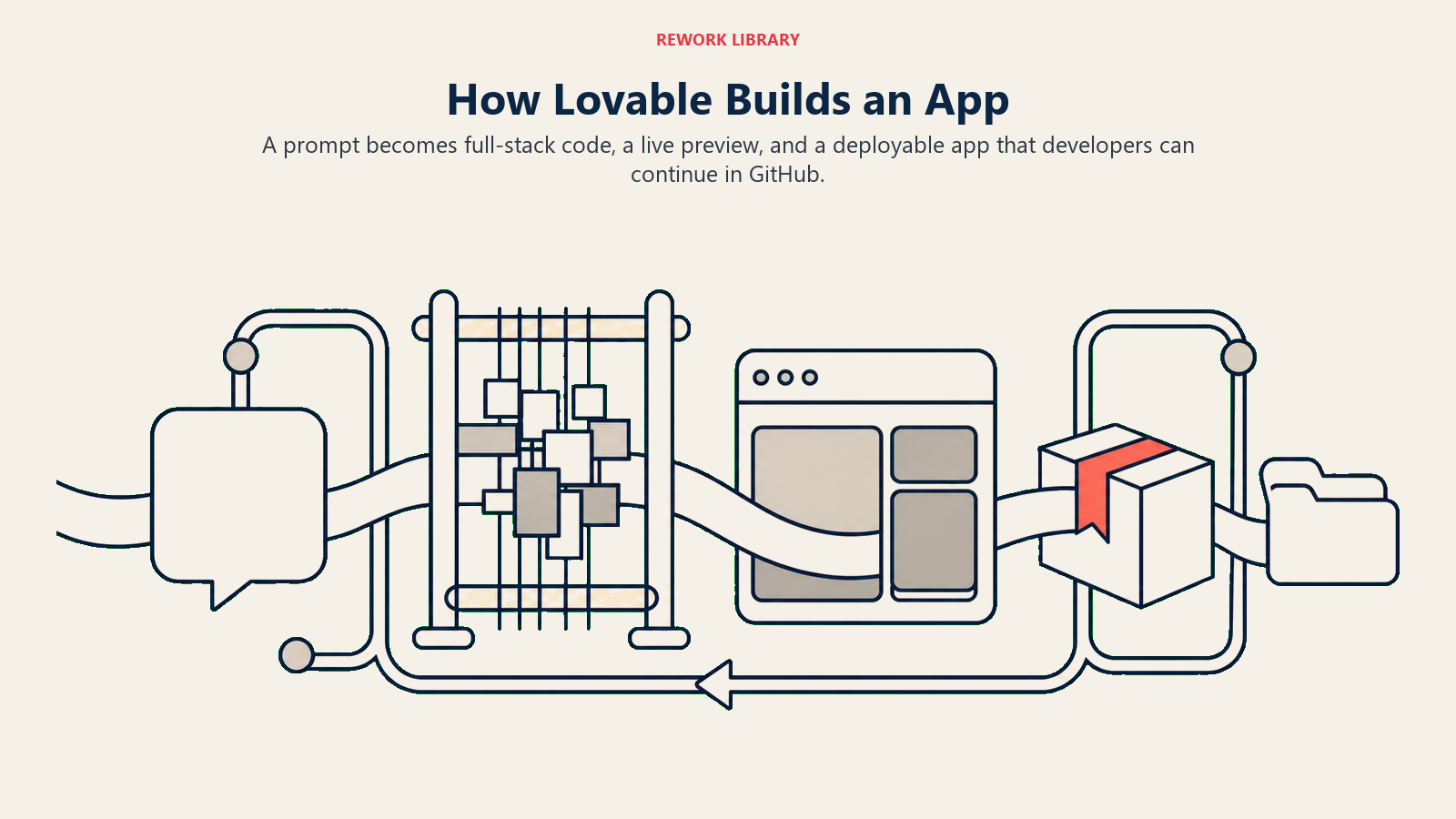
- Describe: You type what you want in a chat interface, a customer portal, a waitlist page, an internal tool, the same way you'd brief a contractor.
- Generate: Lovable's system, built on top of underlying large language models, writes real React and TypeScript code for the frontend and provisions a Supabase backend for authentication, database, and storage.
- Preview and iterate: You see a live, working preview immediately and describe changes in plain language, the app updates in place rather than making you dig through files.
- Deploy and export: A finished project publishes to a Lovable-hosted URL or a custom domain on paid plans, and GitHub sync lets a real engineering team pull the underlying code and keep building on it by hand.
That last point is part of what separates Lovable from tools built as thin wrappers: the output is ordinary, readable React code you can hand to a developer, not a proprietary format locked inside the platform. For more on that distinction, see what an AI wrapper actually is.
Key Facts: Lovable
- Lovable's $200 million Series A, led by Accel, valued the company at $1.8 billion just eight months after its December 2024 launch, per TechCrunch.
- The company crossed $100 million in annual recurring revenue in July 2025, eight months after launch, per TechCrunch.
- ARR doubled to $200 million by November 2025, a milestone CEO Anton Osika announced onstage at Slush in Helsinki, per TechCrunch.
- A $330 million Series B, led by CapitalG and Menlo Ventures, valued Lovable at $6.6 billion in December 2025, per TechCrunch.
- By March 2026, Lovable said it had added $100 million in revenue in a single month, running on a team of just 146 employees, per TechCrunch.
- Lovable was nearing 8 million users as of November 2025, per TechCrunch.
- A researcher disclosed a Broken Object Level Authorization flaw, tracked as CVE-2025-48757, caused by missing Row Level Security policies that left source code, database credentials, and customer data in some Lovable-built apps readable by other accounts, affecting projects created before November 2025, per The Register.
Who Lovable Is For
Lovable is built for people who need a working product before they need a formal engineering process. Common users include:
- Founders and solo operators validating a business idea with a real, usable product instead of a slide deck or a static mockup.
- Product managers who want to test a feature idea or build an internal prototype without filing a ticket and waiting on an engineering sprint.
- Agencies and freelancers building lightweight client sites, booking tools, or dashboards faster than a from-scratch build would allow.
- Non-technical founders and small teams who need a customer-facing MVP fast enough to start getting real user feedback within days, not months.
It's a weaker fit for teams building complex, regulated, or highly custom backend systems, where Supabase's managed database and auth model won't cover the business logic a mature product actually needs.
Pricing and Plans in 2026
Lovable runs on a credit-based system rather than flat feature tiers: every plan can buy more credits to scale usage, and the credits themselves are what pay for AI generation and app hosting. Pricing below reflects the tier structure reported across pricing trackers as of July 2026; confirm exact current pricing directly with Lovable before budgeting.
| Plan | Price | Credits | Built for |
|---|---|---|---|
| Free | $0/month | 5 credits/day (up to 30/month), plus 20 monthly Cloud credits | Trying the product and small, low-stakes experiments |
| Pro | $25 to $480/month | 100 to 10,000 credits/month | Individual builders and small teams shipping real projects, with custom domains and GitHub sync |
| Business | $50 to $4,300/month | 100 to 10,000 credits/month (roughly 2x Pro's price for the same credits) | Teams needing SSO, data-training opt-out, and per-user credit limits |
| Enterprise | Custom | Volume-based | Large organizations needing SCIM provisioning, audit logs, and dedicated support |
Annual billing on Pro and Business plans runs roughly 16% cheaper than paying monthly, per eesel AI's Lovable pricing guide. Unused monthly credits expire two months after they're issued, so heavy, uneven usage months can burn through a plan's allotment faster than the sticker price suggests.
Strengths and Limits
Strengths. Lovable produces clean, idiomatic React and TypeScript code rather than a proprietary format, and GitHub sync on paid plans lets an actual engineering team take over a project once it graduates past prototype. The Supabase integration bundles auth, database, and file storage into the build automatically, so a non-developer doesn't have to separately configure a backend. And the speed is real: a working, deployed app from a plain-English description in one sitting.
Limits. The same speed that makes Lovable useful for prototypes creates the risks common to all vibe-coded software. The CVE-2025-48757 disclosure above is a concrete example: a missing Row Level Security check in Lovable-generated projects left some apps' database credentials and customer data readable by other accounts. Complex, multi-system logic still runs into the same ceiling every vibe coding tool hits, an AI generating code fast doesn't replace someone who understands how the whole system fits together. Treat API security and a proper review pass as mandatory before a Lovable-built app touches real customer data, not optional polish for later. Set clear guardrails on what gets built unsupervised, and budget time to catch AI technical debt before a prototype quietly becomes the shipped product.
Lovable vs v0 vs Bolt vs Replit
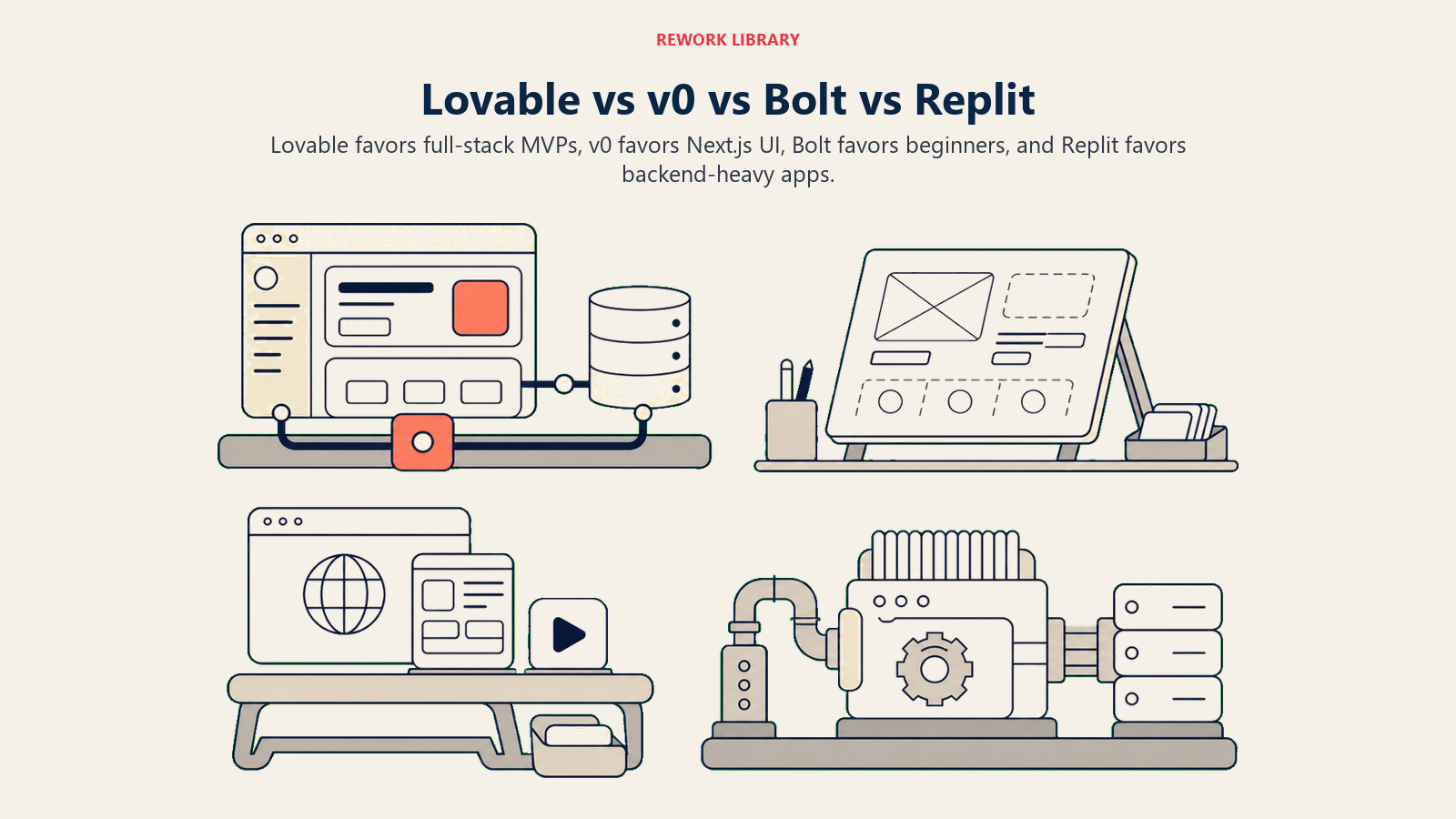
These four tools all turn a prompt into working code, but they were built around different defaults and different users.
| Dimension | Lovable | v0 (Vercel) | Bolt (StackBlitz) | Replit Agent |
|---|---|---|---|---|
| Core identity | Full-stack app builder aimed at non-developers | Next.js UI and app generator for developers | Browser-based full-stack builder, runs in-browser | Cloud IDE with an autonomous build-and-deploy agent |
| Default stack | React + TypeScript frontend, Supabase backend | Next.js, tightly tied to Vercel's hosting and database options | Framework-flexible (React, Vue, Svelte, and more) | Framework-flexible, with strong support for persistent backend processes |
| Code ownership | Real, exportable code via GitHub sync on paid plans | Real Next.js code | Real code, runs via in-browser WebContainers | Real code in a persistent cloud workspace |
| Best fit | Non-developers shipping a customer-facing MVP fast | Developers who want a polished Next.js UI quickly | Lowest barrier to entry for a first-time builder | Backend-heavy apps: bots, webhooks, persistent server processes |
| Team/enterprise option | Business plan (SSO, data opt-out) and custom Enterprise | Team and Enterprise plans available | Team plans available | Team and Enterprise plans available |
| Primary tradeoff | Fast and clean output, but inherits vibe coding's security risk if unreviewed | Best for Next.js specifically, less flexible for other stacks | Most accessible for total beginners, less polished output | Most autonomous and capable for backend logic, steeper learning curve |
The honest takeaway: Lovable's edge is producing the cleanest React output of the group and handing off real, usable code once a project is ready for an engineering team. For a broader ranking across all of these plus command-line tools like Cursor and Claude Code, see Best AI Coding Tools in 2026.
Frequently Asked Questions about Lovable
What is Lovable in simple terms?
Lovable is an AI app-builder platform that turns a plain-English description into a complete, working web application, generating both the frontend and a connected backend, so someone without coding experience can build and deploy a real product.
Is Lovable free to use?
Yes, Lovable offers a free tier with 5 credits a day (up to 30 a month) plus monthly Cloud credits. Paid plans start at $25/month for Pro and $50/month for Business, both scaling with more credits as usage grows.
What programming language and backend does Lovable use?
Lovable generates React and TypeScript for the frontend and connects it to a Supabase backend for authentication, database, and file storage, all provisioned automatically as part of the build.
Is Lovable the same thing as vibe coding?
Lovable is one specific tool built for vibe coding, the broader practice of describing software in natural language and letting an AI tool generate and run the code with minimal manual review. Lovable focuses that practice specifically on full-stack, deployable web apps.
Who founded Lovable and where is it based?
Lovable was founded in Stockholm, Sweden in 2023 by Anton Osika and Fabian Hedin. It grew out of an earlier open-source project called GPT Engineer and was rebranded to Lovable in December 2024.
Is Lovable safe to use for a product handling customer data?
It's safe for prototypes and internal tools, but a security review is essential before production use. A disclosed vulnerability (CVE-2025-48757) showed that missing Row Level Security checks in some Lovable-generated projects exposed customer data to other accounts, which is a strong argument for a proper security pass before launch.
How does Lovable compare to v0, Bolt, and Replit?
Lovable tends to produce the cleanest, most exportable React code of the group and is built for non-developers. v0 is strongest for Next.js-specific UI work, Bolt has the lowest barrier to entry for total beginners, and Replit's Agent mode is the most capable for apps needing real backend server logic.
Do you need to know how to code to use Lovable?
No. Lovable is built so someone with no programming background can describe a product and get a working version. Understanding the output well enough to judge whether it's actually secure and correct still benefits from a developer's review before anything customer-facing ships.
Related AI Concepts
- What is Vibe Coding? - The broader practice Lovable is built around
- What is an AI Wrapper? - The debate over products built on top of foundation models, and why Lovable's exportable code sets it apart
- Large Language Models - The underlying models that power Lovable's code generation
- AI Agents - The broader autonomous-systems category Lovable's build-and-iterate loop belongs to
- Human-in-the-Loop - Why a review step still matters before a Lovable-built app touches real customer data
- AI Technical Debt - What accumulates when a Lovable prototype ships without a refactor pass
- API Security - The review discipline that catches issues like Lovable's disclosed CVE-2025-48757
- Guardrails - How to scope what an AI builder like Lovable is allowed to touch unsupervised
External Resources
- TechCrunch: Lovable becomes a unicorn with $200M Series A just 8 months after launch - Series A funding and valuation
- TechCrunch: Eight months in, Swedish unicorn Lovable crosses the $100M ARR milestone - First ARR milestone
- TechCrunch: As Lovable hits $200M ARR, its CEO credits staying in Europe for its success - Second ARR milestone
- TechCrunch: Vibe-coding startup Lovable raises $330M at a $6.6B valuation - Series B funding and valuation
- TechCrunch: Lovable says it added $100M in revenue last month alone, with just 146 employees - Latest revenue and headcount data
- The Register: AI-built app on Lovable exposed 18K users, researcher claims - Security vulnerability disclosure
- Wikipedia: Lovable (company) - Company founding and history
- eesel AI: A complete guide to Lovable pricing in 2026 - Detailed 2026 pricing tiers
Part of the AI Terms Collection. Last updated: July 2026
