What is AI's Environmental Impact?
Turn this article into takeaways for your work.


Each assistant summarizes the article only for you and suggests best practices for your work.
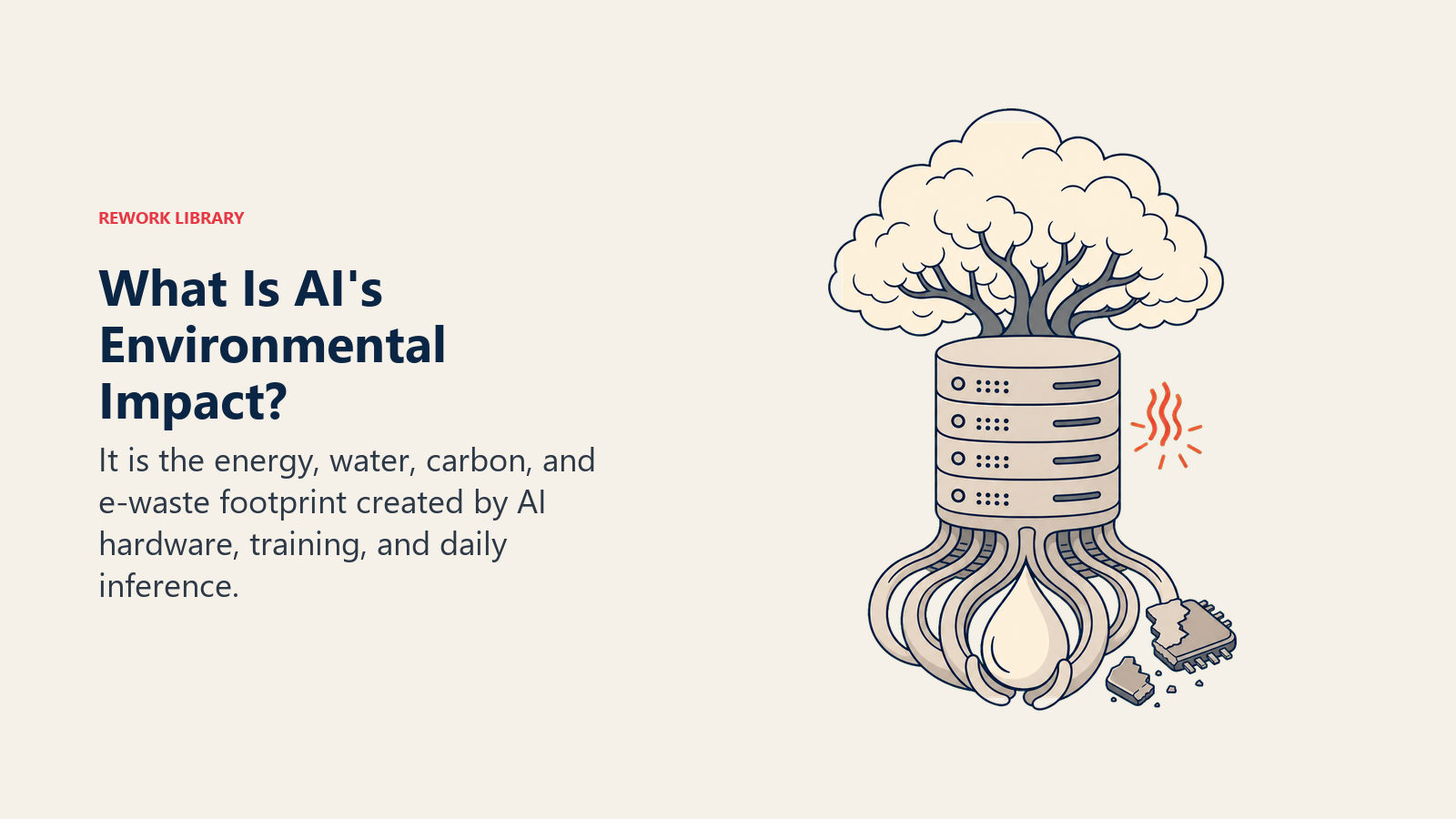
AI's environmental impact is the energy, water, carbon emissions, and electronic waste generated by training and running AI models, primarily through the data centers, chips, and cooling systems behind them. It covers the full AI lifecycle, from manufacturing hardware to everyday inference, and it's growing faster than most companies' sustainability plans accounted for.
For business leaders, the question "what is AI doing to the environment" isn't academic anymore. It shows up in vendor ESG questionnaires, in procurement due diligence, and in the sustainability reports companies now have to explain to boards and regulators. Google's and Microsoft's own numbers below show why: both companies' emissions jumped double digits in a single year, almost entirely because of AI infrastructure growth. If your company buys, builds, or resells AI tools, this is a line item you'll eventually have to account for, not just an interesting statistic.
The Four Pillars of AI's Environmental Footprint
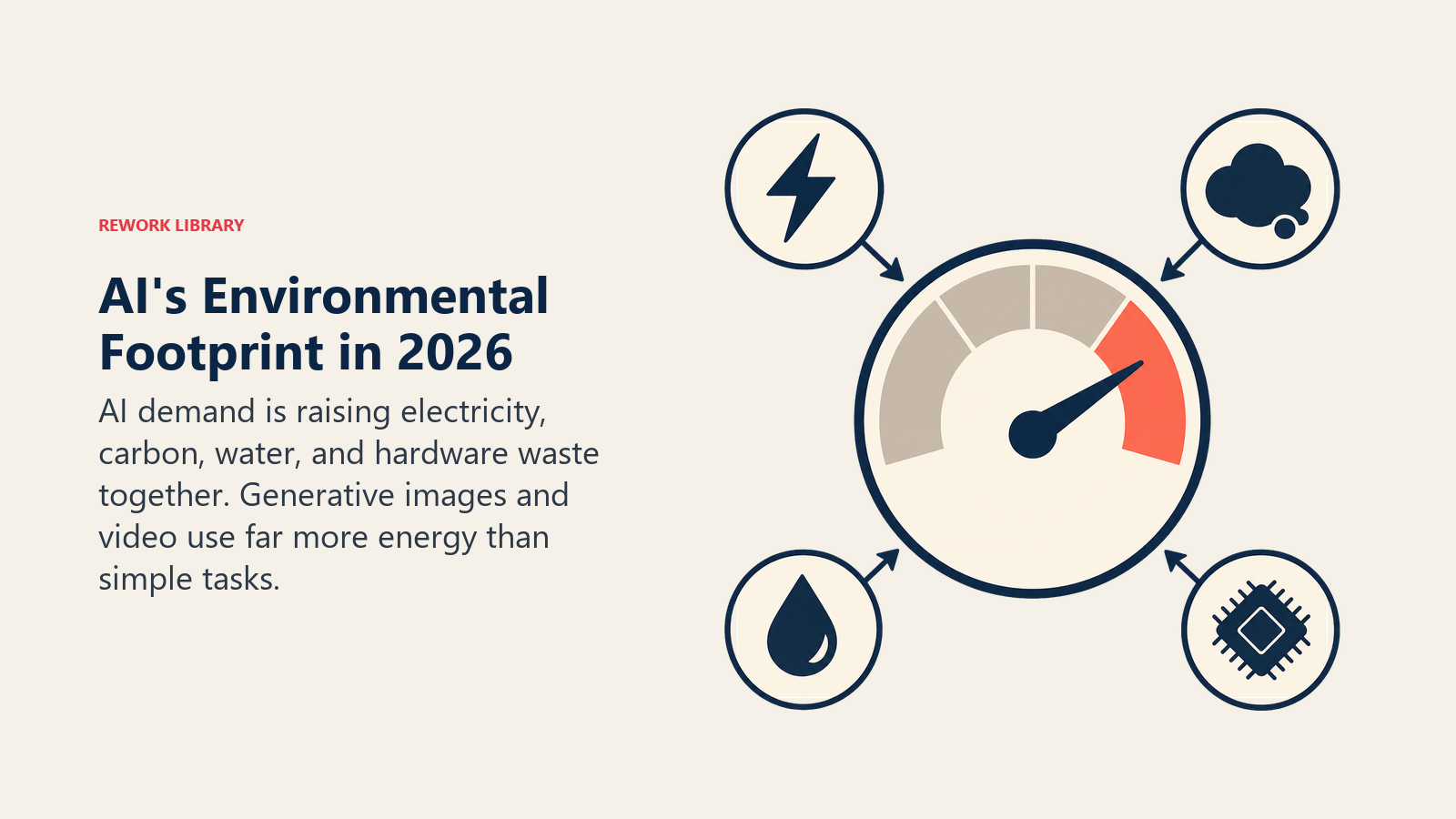
AI's environmental impact isn't one thing. It's four separate resource problems that happen to be caused by the same infrastructure.
| Pillar | What It Measures | Primary Driver |
|---|---|---|
| Energy | Electricity consumed to train and run models | GPU-heavy compute in data centers, running around the clock |
| Water | Water used to cool that compute | Direct-to-chip liquid cooling and evaporative cooling towers |
| Carbon | Greenhouse gases released generating that electricity | The local grid's fuel mix, fossil-heavy grids emit far more per kilowatt-hour |
| E-waste | Discarded hardware, chips, servers, cooling gear | Fast GPU refresh cycles and a short useful life for AI-era hardware |
These four pillars don't always move together. A data center running on clean electricity can still strain a local water supply. A facility with efficient cooling can still sit on a carbon-heavy grid. Treating "AI's environmental impact" as a single number hides which specific resource is actually under pressure in a given location, and that distinction matters more than any headline percentage.
Training vs. Inference: Where the Footprint Actually Comes From
Most coverage of AI's environmental impact focuses on training, the eye-catching one-time event where a lab spends weeks running thousands of GPUs to build a new model. That's real, but it's not where most of the footprint sits anymore.
| Dimension | Training | Inference |
|---|---|---|
| When it happens | Once, then occasionally for updates or fine-tuning | Continuously, every time someone sends a query |
| Share of total AI energy use | Roughly 10 to 20% | Roughly 80 to 90% |
| Footprint shape | Large, front-loaded, project-style spend | Smaller per request, but compounds at massive volume |
| Real example | Training a GPT-3-scale model used about 1,287 megawatt-hours of electricity and produced roughly 552 tons of carbon dioxide | ChatGPT alone handles an estimated 2.5 billion prompts a day |
The practical implication: a model that looks efficient in a training benchmark can still have a large environmental footprint once it's deployed at scale, because inference happens continuously for the entire life of a product. A chatbot feature that trains once and serves millions of users for years does more cumulative environmental damage through inference than through the training run that created it. That's the same shift business leaders need to understand when budgeting AI infrastructure costs: the ongoing bill, in dollars and in resources, is inference, not training.
The Real Numbers: How Big Is AI's Footprint Right Now
The scale is easiest to grasp through direct comparisons rather than raw terawatt-hours.
Global data center electricity use is projected to nearly double from about 415 terawatt-hours in 2024 to roughly 945 terawatt-hours by 2030, close to 3% of total global electricity consumption. At current growth, global data centers already used about 448 terawatt-hours of electricity in a recent year, more electricity than all but about 10 countries in the world. That electricity use produced an estimated 189 million tonnes of carbon dioxide, roughly the same as Argentina's entire national footprint, and consumed about 4.5 trillion liters of water for cooling.
ChatGPT specifically is estimated to use around 383 gigawatt-hours of electricity a year, with a water footprint comparable to the annual domestic water needs of roughly 500,000 people in Sub-Saharan Africa. Task type matters a lot here: a routine chat query is estimated to be around 200 times more energy-intensive than a basic text-classification task, generating a single AI image can use up to 1,450 times that baseline, and producing a short AI video can consume energy on the order of 200,000 basic classification tasks. That variance is why "AI" as a category is hard to put one number on: a quick customer-support chat and a batch of AI-generated video ads are not remotely the same environmental event.
Hardware disposal is the least-discussed piece of the four pillars. Researchers publishing in Nature Computational Science estimate generative AI hardware could generate between 1.2 million and 5 million metric tons of electronic waste annually by 2030, driven by data centers cycling through GPUs faster than typical enterprise IT hardware. Circular-economy approaches, refurbishing components and extending hardware life, could cut that volume by an estimated 16 to 86%, but only if data center operators actually adopt them at scale.
What's Being Done About It
None of this is static. Efficiency gains and clean-energy investment are both moving fast, even as total demand grows faster still.
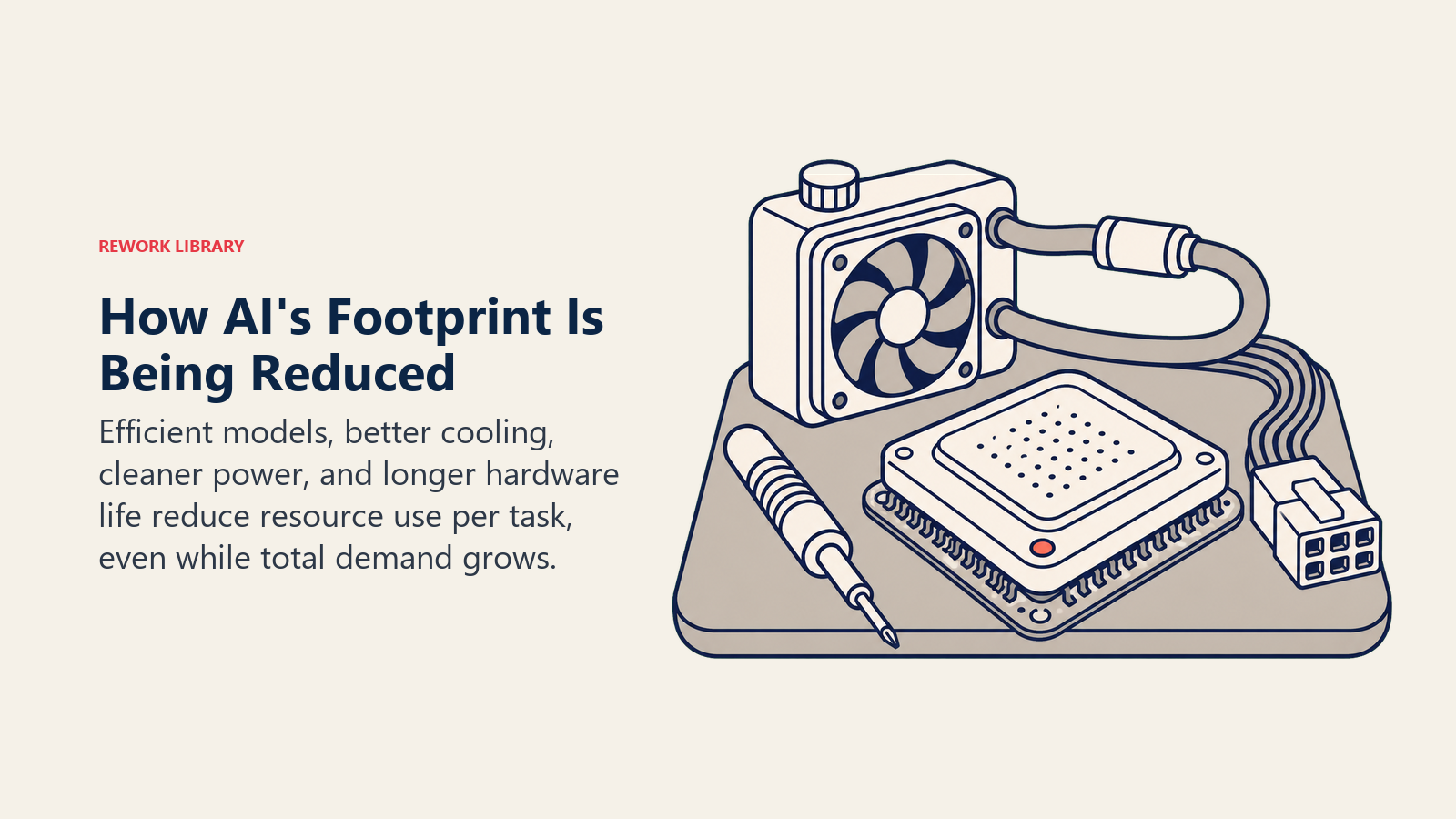
- Chip and model efficiency. Newer GPU generations deliver more computation per watt than their predecessors, and techniques like quantization and model compression shrink how much compute a given task actually needs. Small language models and inference optimization work toward the same goal from a different angle: getting comparable output from meaningfully less compute.
- Cooling technology. Direct-to-chip liquid cooling and closed-loop systems that recycle water instead of consuming it are replacing older evaporative designs, cutting water draw per unit of compute even as rack power density keeps climbing.
- Clean energy procurement. Hyperscalers are signing large renewable-energy agreements to offset data center demand. Google signed agreements for more than 12 gigawatts of new clean energy in 2025 alone, and Microsoft expanded its renewable portfolio to 40 gigawatts, up from 34 gigawatts the year before. Neither fully offsets their AI-driven emissions growth yet, but both are moving in that direction.
- Water-positive and net-zero commitments. Several major providers have pledged to replenish more water than their data centers consume and to reach net-zero or carbon-negative status by 2030, though both companies' own reports acknowledge AI buildout is currently outpacing those goals.
- Circular hardware strategies. Refurbishing GPUs and extending server life instead of replacing them on a fixed cycle is the most direct lever against the e-waste problem, and it's still the least mature of the strategies above.
Why This Matters for Business Leaders and ESG Reporting
If your company reports on ESG metrics, uses AI vendors at any scale, or answers procurement questionnaires from customers who do, AI's environmental footprint is no longer someone else's problem to track.
- Vendor emissions are increasingly your Scope 3 emissions. If a supplier's AI infrastructure emissions climb the way Google's and Microsoft's did, and you rely on that vendor for AI-powered tools, that growth can show up in your own supply-chain emissions reporting depending on how your ESG framework scopes it.
- "Our AI vendor is carbon neutral" claims deserve scrutiny. Ask specifically whether that claim covers Scope 1 and 2 (the vendor's direct operations) or extends to Scope 3 (everything upstream and downstream, including chip manufacturing and end-of-life hardware). Most public commitments still fall short of full lifecycle coverage.
- Inference volume is a controllable variable. Because inference drives the large majority of ongoing AI energy use, product decisions like which model tier you default to, how aggressively you cache repeat queries, and whether a task needs real-time or batch processing directly affect your AI footprint, not just your AI bill.
- Regulatory disclosure requirements are expanding. More jurisdictions are adding energy and emissions disclosure requirements that touch data center operators and, increasingly, large AI users. Treating this as a compliance question now is cheaper than retrofitting reporting later.
A Balanced View
It's easy to read the numbers above and conclude AI is an unambiguous environmental negative. That's not quite right, and it's not quite wrong either.
The footprint is real, growing, and currently outpacing the clean-energy buildout meant to offset it, that part isn't in dispute. At the same time, AI is also being applied to climate modeling, grid optimization, materials discovery for better batteries and solar cells, and industrial efficiency work that has its own environmental upside. Neither side cancels the other out. The honest position for a business leader is that AI's environmental cost is a real, quantifiable, and currently growing expense, one that deserves the same scrutiny as any other resource-intensive part of the business, rather than either a moral panic or a free pass because "AI helps the climate too." Both claims can be true in different parts of the same technology at the same time.
Key Facts
- Global data center electricity consumption is projected to roughly double to 945 terawatt-hours by 2030, about 3% of total global electricity use, up from roughly 415 terawatt-hours in 2024. IEA
- Global data centers are projected to emit about 399 million tonnes of carbon dioxide from electricity use by 2030 and consume roughly 9.3 trillion liters of water, equal to the basic annual domestic water needs of 1.3 billion people in Sub-Saharan Africa. United Nations University, UNU-INWEH
- ChatGPT alone is estimated to use about 383 gigawatt-hours of electricity a year across roughly 2.5 billion daily prompts, with a water footprint comparable to the annual needs of about 500,000 people in Sub-Saharan Africa; a single AI-generated image can use up to 1,450 times the energy of a basic text-classification task. United Nations University, UNU-INWEH
- Training a GPT-3-scale model consumed roughly 1,287 megawatt-hours of electricity and produced about 552 tons of carbon dioxide; cooling a data center takes roughly 2 liters of water for every kilowatt-hour of energy it uses. MIT News
- Generative AI hardware could generate between 1.2 million and 5 million metric tons of electronic waste a year by 2030, though circular-economy strategies like refurbishing and reuse could cut that volume by 16 to 86%. Nature Computational Science
- Google's 2025 operational carbon footprint rose 18% year over year and is now 81% above its 2019 baseline, a jump the company attributes largely to AI data-center growth outpacing grid decarbonization. Google 2026 Environmental Report
- Microsoft's fiscal year 2025 emissions rose 25% year over year to about 20 million metric tons of carbon dioxide equivalent, up from 16 million tons the year before, driven mainly by new AI data-center construction. Microsoft
Frequently Asked Questions about AI's Environmental Impact
What is AI's environmental impact, in simple terms?
It's the energy, water, carbon emissions, and electronic waste generated by building and running AI models, mostly through the data centers, GPUs, and cooling systems that power them. It covers the full lifecycle: manufacturing hardware, training models, running everyday inference, and eventually disposing of aging equipment.
What is AI actually doing to the environment right now?
It's driving a fast increase in electricity demand, water use for cooling, and carbon emissions at the companies that operate large data centers. Google's and Microsoft's own 2026 sustainability reports both showed double-digit emissions increases in a single year, attributed mainly to AI infrastructure growth outpacing their clean-energy buildout.
Does training or running AI models use more energy?
Running trained models, called inference, accounts for roughly 80 to 90% of total AI energy use, far more than training. Training is a large but one-time or occasional cost; inference happens continuously for every query, for as long as a product stays in use, which is why it dominates the footprint over time.
How much water does AI actually use?
Data centers use water mainly for cooling, roughly 2 liters per kilowatt-hour of energy consumed according to MIT research. At a global level, data centers are projected to consume about 9.3 trillion liters of water annually by 2030. ChatGPT's water footprint alone is estimated to be comparable to the annual needs of around 500,000 people.
Is AI's carbon footprint actually going down as chips get more efficient?
Per-task efficiency is improving: newer chips, quantization, and model compression all reduce the energy needed for a given amount of AI work. But total demand is growing faster than those efficiency gains, which is why total emissions from major AI providers are still rising rather than falling.
What is being done to reduce AI's environmental impact?
Major providers are investing in more efficient chips, liquid and closed-loop cooling, and large renewable-energy agreements, Google signed over 12 gigawatts of new clean energy in 2025 alone. Companies are also pursuing water-positive and net-zero commitments, though most acknowledge AI buildout is currently outpacing those targets.
How much e-waste does AI create?
Researchers estimate generative AI hardware could generate between 1.2 million and 5 million metric tons of electronic waste annually by 2030, driven by GPUs and servers cycling out faster than typical enterprise hardware. Refurbishing and reuse strategies could cut that volume significantly, but adoption is still limited.
Should businesses factor AI's environmental impact into vendor decisions?
Yes, especially if you report on ESG metrics or answer sustainability questionnaires from your own customers. Ask vendors whether their emissions claims cover their full supply chain (Scope 1, 2, and 3) or only their direct operations, and understand that your inference volume, not just your vendor choice, is a real lever on your own AI footprint.
Is AI's environmental impact only a big-tech problem?
The infrastructure buildout is concentrated among a small number of hyperscalers and chipmakers, but any business using AI tools at meaningful volume contributes to inference demand, which is the largest driver of AI's ongoing footprint. Smaller companies typically have more control over their share through model choice, caching, and batch versus real-time processing decisions.
Related AI Concepts
- What is an AI Data Center? - The physical facilities behind most of AI's energy, water, and carbon footprint
- What is AI Infrastructure? - The full stack, compute through observability, that generates this environmental footprint
- What is AI Inference? - The ongoing production workload responsible for 80 to 90% of AI's total energy use
- Inference Optimization - Techniques that cut the energy and cost of running AI models in production
- Quantization - A key technique for shrinking model size and the compute needed to run it
- Small Language Models - Lower-compute alternatives to frontier models for many production use cases
- AI Total Cost of Ownership - How infrastructure and inference costs, financial and environmental, add up over time
- Model Serving - The deployment layer where inference, and most of AI's ongoing footprint, actually happens
- Foundation Models - The large pre-trained models most training-related environmental cost comes from
- AI Governance - The oversight frameworks increasingly expected to cover environmental and ESG claims
External Resources
- IEA: Energy and AI, Executive Summary - Global data center electricity demand projections through 2030
- MIT News: Explained, Generative AI's Environmental Impact - Energy, water, and carbon costs of training and running generative AI
- United Nations University, UNU-INWEH: Environmental Cost of AI's Energy Use - Carbon, water, and land footprint projections for global data centers through 2030
- Nature Computational Science: E-waste Challenges of Generative Artificial Intelligence - Projected electronic waste from generative AI hardware through 2030
- Google 2026 Environmental Report - Google's operational emissions, water replenishment, and clean-energy commitments
- Microsoft: Responsibly Building the AI Future - Microsoft's fiscal year 2025 emissions and sustainability progress
Part of the AI Terms Collection. Last updated: 2026-07-20

Co-Founder, Rework.com
On this page
- The Four Pillars of AI's Environmental Footprint
- Training vs. Inference: Where the Footprint Actually Comes From
- The Real Numbers: How Big Is AI's Footprint Right Now
- What's Being Done About It
- Why This Matters for Business Leaders and ESG Reporting
- A Balanced View
- Key Facts
- Related AI Concepts
- External Resources