What is AGI (Artificial General Intelligence)?
Turn this article into takeaways for your work.


Each assistant summarizes the article only for you and suggests best practices for your work.
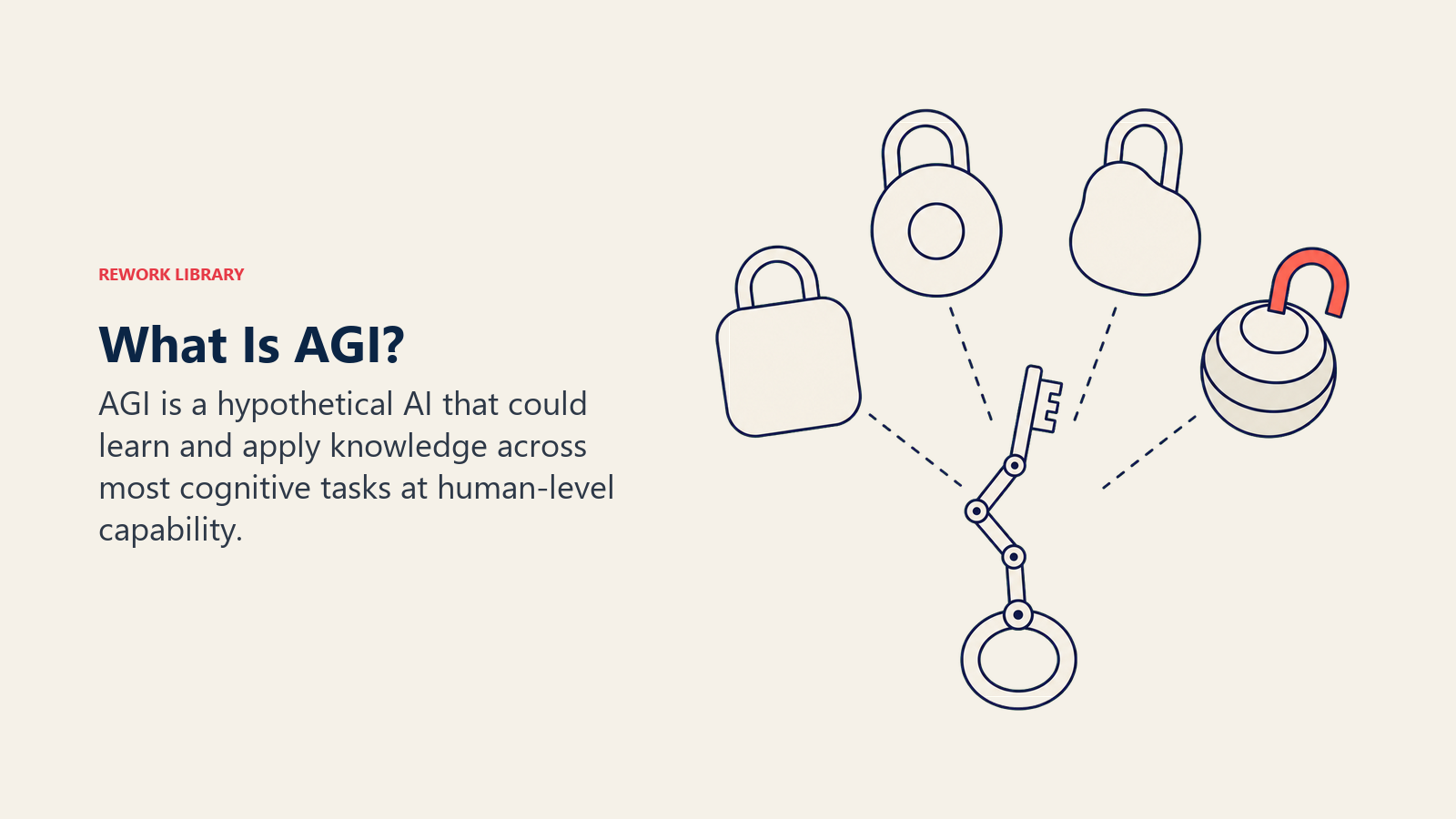
Artificial general intelligence, or AGI, is a hypothetical AI system that can understand, learn, and apply knowledge across most cognitive tasks at a level matching or exceeding human ability, without needing task-specific retraining. Unlike today's narrow AI tools, which excel at one job, AGI would generalize the way a person does, moving fluidly between problems.
That single-sentence definition hides a lot of disagreement. Ask ten AI researchers what would actually count as AGI and you'll get ten different thresholds, which is exactly why it's one of the most argued-about terms in the industry right now.
AGI vs Narrow AI vs ASI
Most confusion about AGI comes from mixing it up with the AI already in daily use, or with the far more speculative idea of superintelligence. The three sit on a spectrum, not on a single line you cross.
| Aspect | Narrow AI (ANI) | AGI | ASI (Superintelligence) |
|---|---|---|---|
| Scope | One task or a tight cluster of related tasks | Most cognitive tasks a human can do | Every cognitive task, at a level beyond the best humans |
| Examples today | Large language models, image recognition, recommendation engines, reasoning models | Not yet demonstrated | Not yet demonstrated |
| Generalization | Fails outside its trained domain | Transfers skills across unrelated domains like a person would | Transfers and exceeds human skill across every domain |
| Status in 2026 | Deployed at scale across business functions | The subject of active lab research and public debate | A theoretical extension of AGI, discussed mainly in safety research |
| Business relevance | Already automating specific workflows today | Would change what work needs a human at all | Raises questions few organizations are equipped to plan for yet |
The practical takeaway: everything you use at work today, from a chatbot to a coding assistant to an AI agent that qualifies leads, is narrow AI. It's very good at what it does and useless at almost everything else. AGI is the idea of collapsing that gap, one system with the general-purpose competence of a capable adult across nearly any domain.
How Close Are We? The 2026 Debate
This is where the argument gets loud, because the people building the technology and the people studying it broadly disagree.
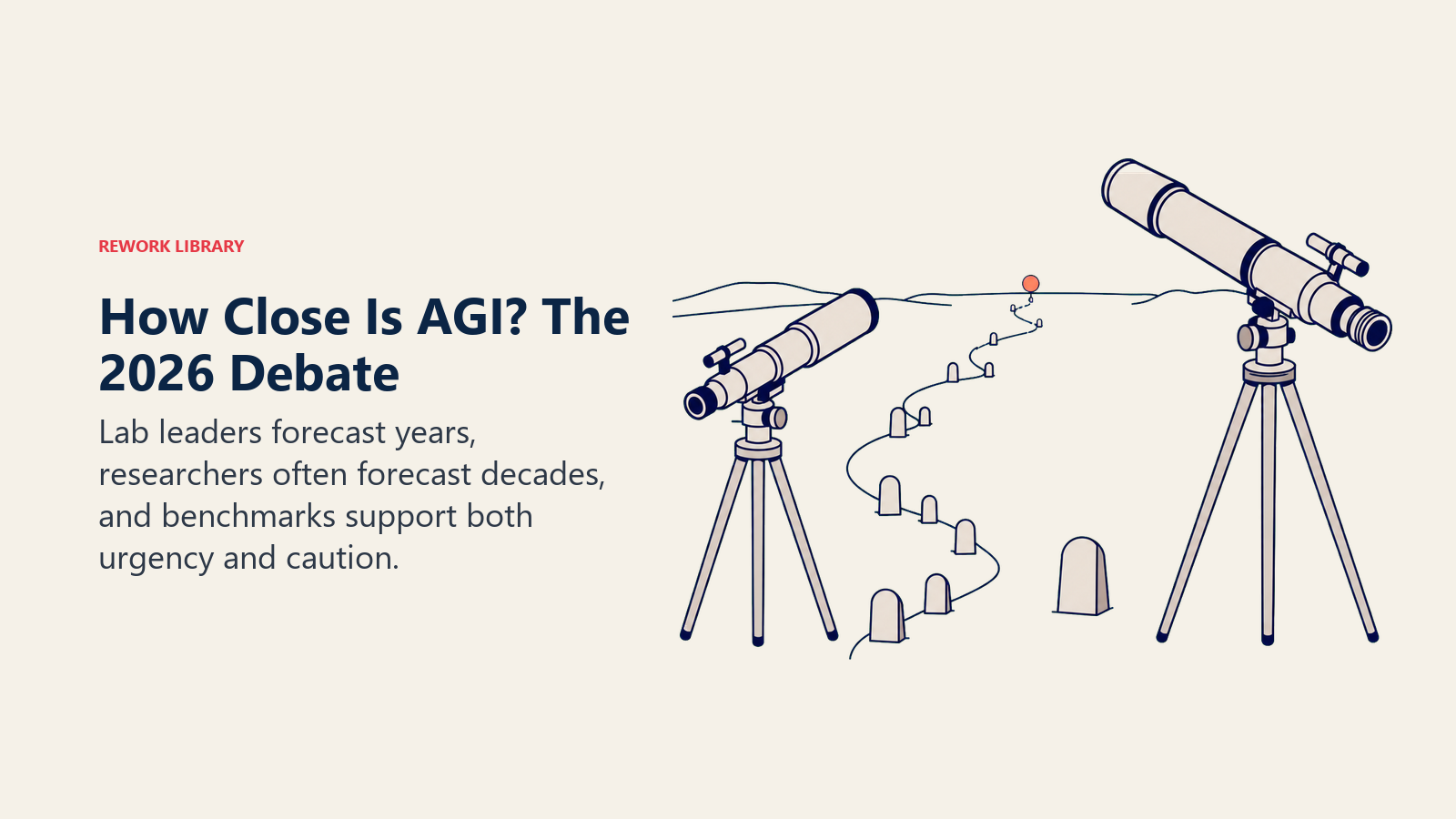
Lab leaders are aggressive on timelines. Anthropic CEO Dario Amodei has said "powerful AI," his term for a system smarter than a Nobel Prize winner across most relevant fields, could arrive as early as 2026 or 2027. Google DeepMind CEO Demis Hassabis has been more measured but still put human-level AI at five to ten years away as of March 2025, and has publicly pushed back on Amodei's shorter timeline, saying his own estimate runs longer. OpenAI's Sam Altman has suggested AGI will probably be developed within the current U.S. presidential term, while at the same time calling AGI "not a super useful term" because the goalposts keep moving every time a model clears the last bar people set for it.
The broader research community is more conservative. The AI Impacts 2023 Expert Survey on Progress in AI, based on responses from 2,778 AI researchers who had published at top venues, put the aggregate 50% probability of "high-level machine intelligence" (systems that can do every task better and more cheaply than humans) at 2047, with only a 10% chance by 2027. That's a meaningfully longer horizon than what several lab CEOs describe in interviews, and it shows how much the debate depends on who you ask and how the question is framed.
Benchmarks tell a mixed story. ARC-AGI-2, a test built specifically to resist memorization and reward genuine reasoning over pattern matching, illustrates the gap well. Human testers solved essentially all of its tasks within two attempts during controlled testing. In the 2025 ARC Prize competition, the top verified commercial model (Claude Opus 4.5, extended thinking) scored 37.6%, while the best refinement-based approach, built on Gemini 3 Pro, reached 54%. AI is closing the gap fast, but a real gap remains on tasks designed to probe generalization rather than recall.
On the other hand, progress on narrower technical benchmarks has been genuinely fast. Stanford's 2026 AI Index reports that scores on SWE-bench Verified, a coding benchmark, rose from around 60% to near 100% in a single year. That kind of jump is real and it's exactly why timelines keep getting revised, in both directions, as new results land.
The honest summary: AGI hasn't arrived, the people closest to frontier models disagree by years to decades on when it might, and both the optimistic and skeptical camps can point to real evidence for their view.
Paths and Obstacles
Researchers pursuing AGI are mostly working from a handful of overlapping bets on what will get there.
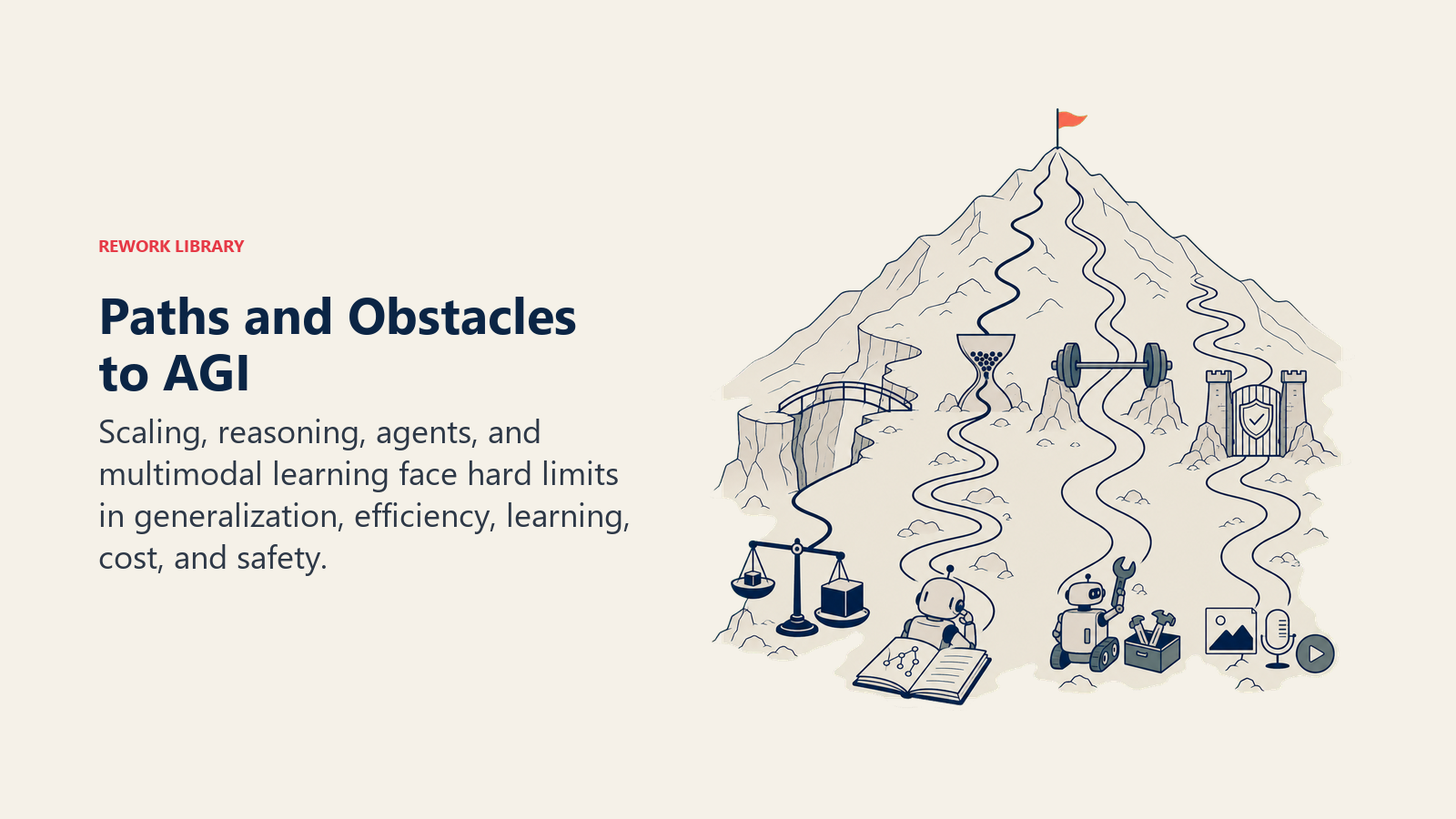
Likely paths:
- Scaling: Bigger models, more training data, and more compute have driven most of the progress from GPT-3 to today's frontier systems, and scaling advocates argue this trend has more room to run.
- Reasoning and test-time compute: Instead of just scaling training, reasoning models spend more computation at inference time to think through problems step by step, a technique that has produced some of the sharpest capability jumps of the past two years.
- Agentic systems and tool use: Rather than one model doing everything internally, agentic AI chains reasoning with real-world tool calls, memory, and multi-step planning, which some researchers see as a more practical route to general capability than a single monolithic model.
- Multimodal grounding: Training on text, images, video, and audio together, instead of text alone, is seen as a way to build more robust, human-like world understanding.
Persistent obstacles:
- Generalization is still shallow. Today's foundation models are excellent at interpolating within their training distribution and much weaker at genuinely novel problems, exactly what ARC-AGI-2 is designed to expose.
- Sample efficiency. A child learns a new concept from a handful of examples. Frontier models still need enormous datasets to learn comparably well, which points to a real architectural gap, not just a scale gap.
- Continual learning. Most deployed models don't update their own weights from experience after training ends, so they can't accumulate new skills the way a human employee does on the job.
- Embodiment and real-world feedback. Some researchers argue general intelligence requires acting in and learning from a physical or richly interactive environment, not just processing text, which current systems mostly don't do.
- Compute and energy cost. Each capability jump has come with a steep rise in training and inference cost, raising real questions about how far pure scaling can go economically.
- Safety and alignment. Building a system that reliably pursues the goals its operators intend, especially as capability grows, is an unsolved research problem in its own right, not an afterthought bolted on once capability arrives. See AI safety and AI alignment for the fuller picture.
Why AGI Matters for Business, the Economy, and Policy
You don't need AGI to arrive tomorrow for this debate to matter to your organization today.
For business leaders, the AGI conversation is a useful proxy for how fast general-purpose AI capability is compounding. The same benchmarks and lab statements that fuel AGI debate are leading indicators of what today's narrower AI agents and copilots will be able to handle next year. Treating AGI purely as a distant, binary event misses the point: capability is arriving in increments, and each increment is already reshaping which tasks need a human and which don't.
For the economy, the range of outcomes under discussion is genuinely wide. Some lab leaders describe transformative effects on medicine, scientific research, and productivity within years, not decades, if their more aggressive timelines hold. Economists and labor researchers are far more divided on how fast and how broadly those effects would actually diffuse through real organizations, given how slowly most companies adopt and operationalize new technology even when it's available.
For policy, the debate matters regardless of when AGI actually arrives, because governance frameworks take years to build and can't be assembled after the fact. Regulatory efforts already underway, from sector-specific AI rules to broader frameworks, are being shaped in part by how seriously policymakers take near-term AGI timelines. Waiting for certainty before building AI governance muscle is a bet that the slower timelines are correct, which is exactly the bet a meaningful share of frontier researchers say is wrong.
Criticisms of the Term "AGI"
Not everyone thinks AGI is even a useful concept to argue about, and the criticism comes from serious people on both sides of the capability debate.
The goalposts keep moving. Critics, including cognitive scientist Gary Marcus, point out that nearly every past claim of approaching AGI has been followed by a quiet redefinition of the term once the system in question turned out to have clear limits. A benchmark that once seemed like strong evidence of general intelligence gets reclassified as "just pattern matching" the moment a model clears it, which makes the term hard to falsify in either direction.
Even AGI's biggest proponents admit it's fuzzy. Sam Altman himself has called AGI "not a super useful term" precisely because there's no single agreed technical definition, no universally accepted test, and no consensus threshold that separates a very capable narrow system from a genuinely general one.
It's a useful marketing word. Because AGI carries so much cultural weight, from science fiction to genuine existential-risk research, labs and vendors have an incentive to imply proximity to it even when the underlying claim is narrower than it sounds. That dynamic mirrors a broader pattern of overstated AI claims, similar to what happens with AI slop and vendor "agentic" rebrands.
Human intelligence itself resists a clean definition. Some researchers argue AGI can't be rigorously defined until cognitive science better understands general intelligence in humans, since AGI is usually defined by comparison to a benchmark, human cognitive ability, that isn't itself precisely measured.
None of this means the underlying research questions don't matter. It means the label is doing a lot of rhetorical work that the current science can't fully back up yet, which is worth remembering every time a headline announces we're "close."
Key Facts
- The AI Impacts 2023 Expert Survey on Progress in AI, based on 2,778 published AI researchers, found an aggregate 50% probability of "high-level machine intelligence" by 2047, with only a 10% chance by 2027. AI Impacts / arXiv
- Anthropic CEO Dario Amodei has said "powerful AI," a system smarter than a Nobel Prize winner across most fields, could arrive as early as 2026 or 2027. Dario Amodei, "Machines of Loving Grace"
- Google DeepMind CEO Demis Hassabis put human-level AI at five to ten years away as of March 2025, a more conservative estimate than several peers. CNBC
- On ARC-AGI-2, a benchmark designed to resist memorization, the top verified commercial model in the 2025 ARC Prize competition scored 37.6% and the best refinement-based approach reached 54%, while human testers solved essentially all tasks within two attempts. ARC Prize 2025 Results
- Stanford's 2026 AI Index reports that scores on the SWE-bench Verified coding benchmark rose from around 60% to near 100% within a single year. Stanford HAI, 2026 AI Index Report
- The same Stanford report found 73% of AI experts expect a positive impact on how people do their jobs, compared with just 23% of the general public, a 50-point gap in outlook. Stanford HAI, 2026 AI Index Report
Related AI Concepts
- Artificial Intelligence - The foundational technology AGI is a hypothetical extension of
- Machine Learning - The core learning approach behind today's AI progress
- Reasoning Models - The technique behind some of the sharpest recent capability gains
- What is Agentic AI? - How goal-directed, tool-using AI systems work today
- AI Safety - Why reliability matters more as capability grows
- AI Alignment - Making sure powerful AI pursues the goals it's given
- AI Governance - Building oversight before, not after, capability jumps
External Resources
- AI Impacts: Thousands of AI Authors on the Future of AI - The 2023 survey of 2,778 published AI researchers on AGI timelines
- Dario Amodei: Machines of Loving Grace - Anthropic's CEO on what "powerful AI" could mean and when
- ARC Prize: ARC-AGI-2 - The benchmark built to test genuine reasoning over pattern memorization
- Stanford HAI: 2026 AI Index Report - Annual benchmark, adoption, and public opinion data on AI progress
Part of the AI Terms Collection. Updated July 2026.
