What is Quantum AI? Definition, Reality vs. Hype, and the Scam to Avoid
Turn this article into takeaways for your work.


Each assistant summarizes the article only for you and suggests best practices for your work.
Quantum AI is the intersection of quantum computing and machine learning: using quantum computers, which process information as qubits capable of superposition and entanglement, to potentially speed up specific AI tasks like optimization, pattern matching, and complex simulation. In 2026, it's still a research frontier, not something you can buy or deploy in a typical business stack.
That plain definition matters because the term has been stretched in two very different directions. Serious researchers at Google, IBM, and a handful of well-funded startups use it to describe a genuine, if early, scientific effort. At the same time, fraudsters have hijacked the exact same phrase to sell a fake trading bot with no connection to quantum computing at all. This article covers both: what quantum AI actually is today, where the real research stands, and how to recognize the scam wearing its name.
How Quantum Computing Could Accelerate Machine Learning
Classical computers store information as bits: a 0 or a 1. Quantum computers use qubits, which can hold a combination of both states at once (superposition) and can be linked together so that the state of one instantly affects another (entanglement). For certain narrow problem types, that lets a quantum computer explore a huge number of possibilities in parallel instead of checking them one at a time.
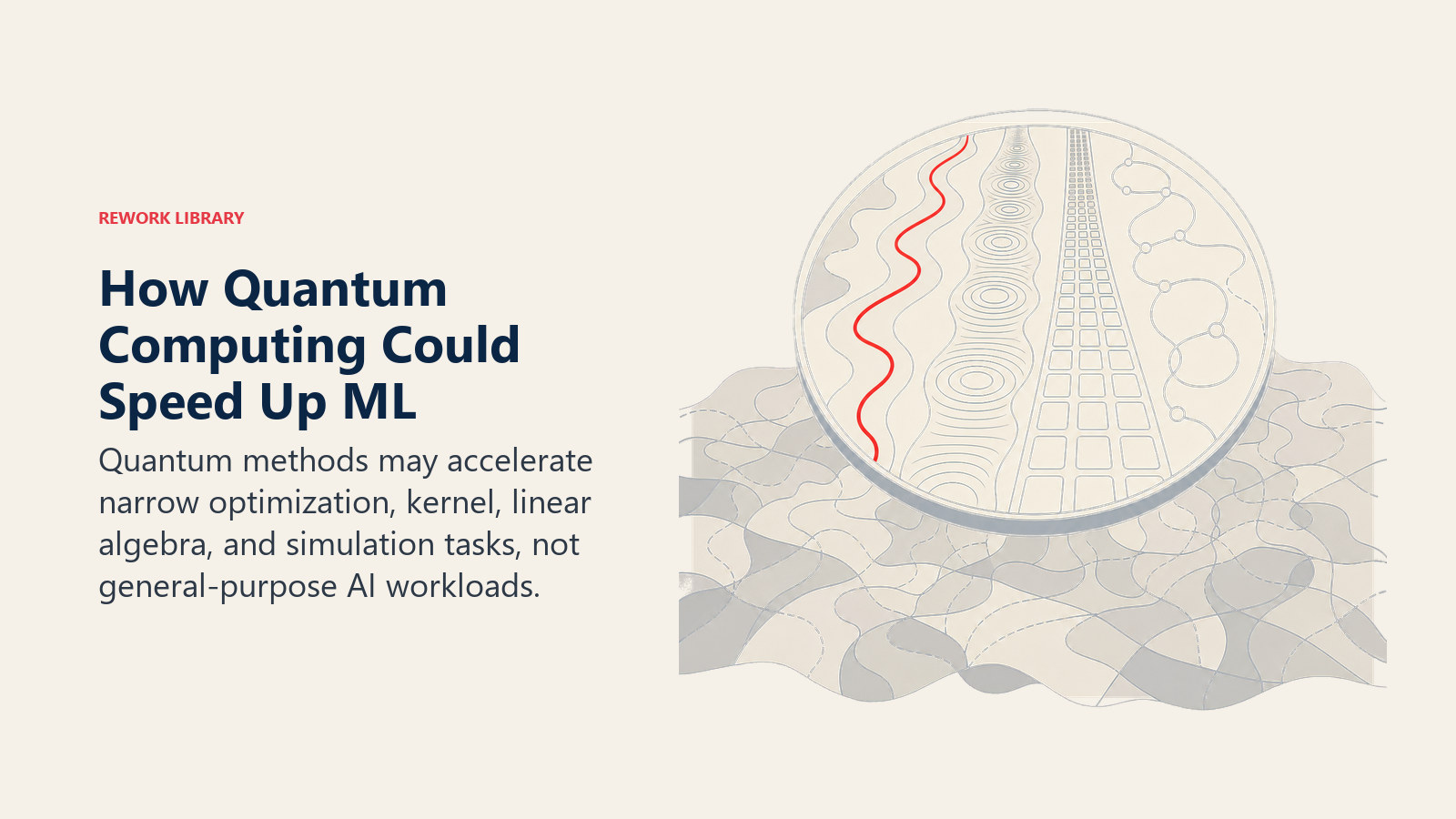
A handful of research directions explain why anyone connects this to machine learning at all:
- Optimization problems. Many ML tasks reduce to finding the best combination out of an enormous number of options, tuning a model's parameters, routing a supply chain, or allocating a portfolio. Quantum annealers and gate-based algorithms are designed for exactly this kind of search space.
- Quantum kernel methods. Some researchers are testing whether mapping data into a quantum state can reveal patterns that are computationally expensive to find with classical neural networks, though this only helps for specific, carefully chosen data structures.
- Linear algebra speedups. Training and running ML models is, underneath the abstractions, mostly matrix math. Algorithms like HHL (Harrow-Hassidim-Lloyd) theoretically solve certain linear systems exponentially faster on a quantum computer, though the practical version of that speedup, with real-world data loading and error correction included, hasn't been demonstrated yet.
- Simulation. Quantum computers are naturally good at simulating quantum systems, which matters for drug discovery, materials science, and chemistry, fields that already lean on deep learning models to predict molecular behavior.
None of this means a quantum computer runs today's chatbots or recommendation engines faster. The theoretical speedups are narrow, problem-specific, and, in most cases, still unproven outside a lab.
Current Reality vs. the Hype: Where Quantum AI Actually Stands in 2026
Here's the honest gap between the marketing and the lab notebook.
| Claim you'll hear | Reality in 2026 |
|---|---|
| "Quantum AI is already outperforming classical AI" | True only for narrow, artificial benchmark problems designed to favor quantum hardware, not for real-world ML tasks like language or vision |
| "Quantum computers will make today's AI models faster" | Almost all of the efficiency gains reshaping AI right now come from classical techniques like quantization and inference optimization, not quantum hardware |
| "Quantum advantage has been proven for machine learning" | Quantum advantage has been demonstrated for specific mathematical benchmarks (random circuit sampling), not for a practical ML workload a business would run |
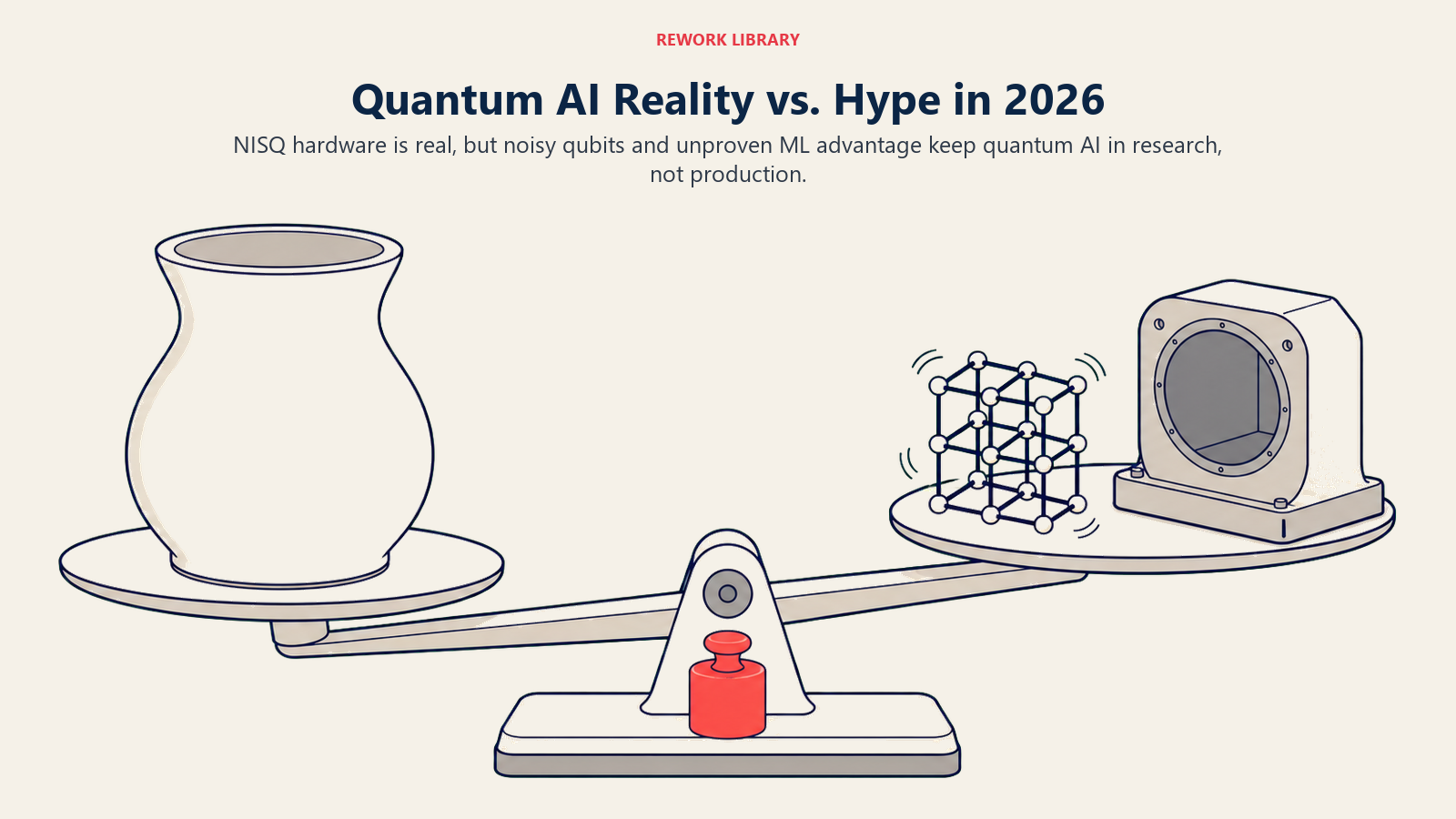
| "This is production-ready technology" | Current systems are noisy, error-prone, and limited in qubit count, this era even has its own name |
That last row points to a term worth knowing: NISQ, short for Noisy Intermediate-Scale Quantum, coined by physicist John Preskill in 2018. It describes exactly where the field sits: real hardware exists, with tens to a few hundred qubits, but errors accumulate fast enough that most calculations stay small and unreliable. Google's Willow chip made a genuine dent in that problem in late 2024, showing that error rates can drop as qubit grids get bigger instead of the usual pattern of getting worse (see Key Facts below). That's a meaningful science milestone. It is not the same as a quantum computer being ready to train or run production machine learning models.
The practical takeaway for 2026: quantum AI is a legitimate, well-funded research category. It is not a shortcut to better AI you can adopt this year, and any vendor pitching it as one deserves the same scrutiny you'd apply during AI vendor evaluation for any other unproven technology claim.
Who's Building Toward Quantum AI: The Key Players
| Company | Quantum approach | Where it stands in 2026 |
|---|---|---|
| Google Quantum AI | Superconducting qubits | Willow chip reached 105 qubits and demonstrated error rates that improve as the qubit grid scales up, a long-sought error-correction milestone |
| IBM Quantum | Superconducting qubits | Targeting Starling, a fault-tolerant system with 200 logical qubits able to run circuits with 100 million quantum gates, by 2029 |
| IonQ | Trapped-ion qubits | Reported 99.99% two-qubit gate fidelity in late 2025 and is deploying systems supporting 100 to 256+ physical qubits through 2026 |
| Microsoft Azure Quantum | Multiple hardware partners, topological research | Provides cloud access to third-party quantum hardware and pursues its own topological qubit research for more stable error correction |
| Amazon Braket | Cloud aggregator | Offers pay-as-you-go access to IonQ, Rigetti, and other hardware providers for experimentation, no in-house quantum chip |
| D-Wave | Quantum annealing | Focused specifically on optimization problems rather than general-purpose computing, with commercial customers in logistics and scheduling |
The pattern across all of them: heavy investment, real hardware progress, and a shared roadmap that points to broad usefulness later this decade at the earliest, not now.
Realistic Timeline: When Might Quantum AI Actually Matter for Business
The most credible roadmaps separate today's research access from fault-tolerant hardware and later specialized applications.
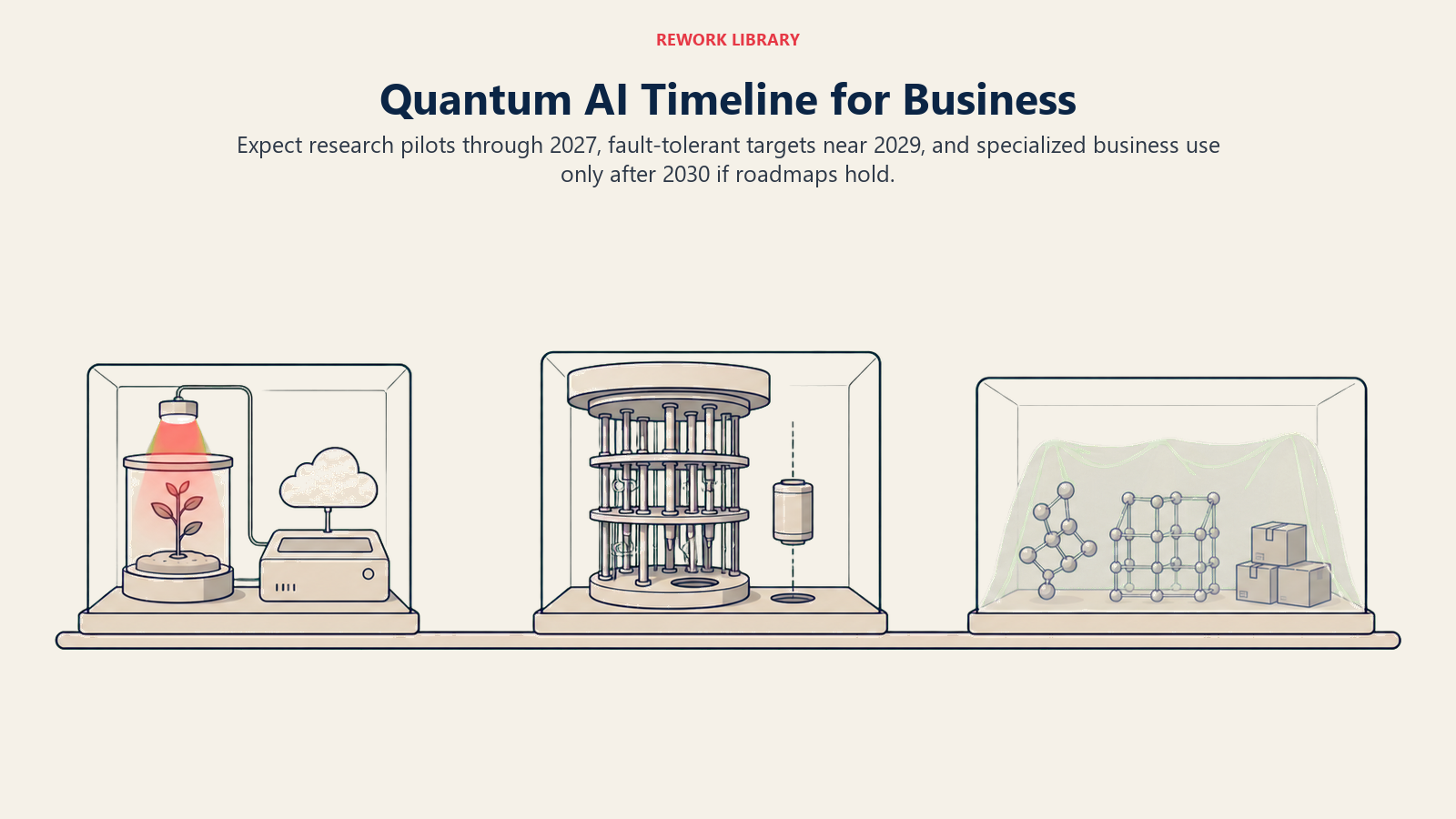
- Now through 2027: Narrow research pilots inside pharma, materials science, finance, and logistics companies that can afford dedicated quantum teams. Cloud access (Azure Quantum, Amazon Braket) makes experimentation possible without owning hardware, but results stay in R&D, not production ML pipelines.
- 2028 to 2029: IBM's own roadmap targets Starling, its first large-scale fault-tolerant system, for 2029. This is the point most serious industry roadmaps treat as the earliest plausible date for quantum computers to reliably outperform classical machines on problems beyond narrow benchmarks.
- 2030 and beyond: If fault-tolerant systems scale as planned, this is the window where quantum-assisted machine learning could start showing up in specialized business applications, drug discovery pipelines, materials design, complex financial modeling, rather than general-purpose AI tools.
Every date above is a target from a company roadmap, not a guarantee. The field has a well-documented history of ambitious timelines slipping, and the honest, current position of most serious researchers is that quantum advantage for a real machine learning workload has not yet been proven, only theorized.
Business Relevance and a Word of Caution
For the overwhelming majority of companies, quantum AI is not a near-term decision. The AI competitive advantage available to most businesses right now still comes from classical, deployable technology: better data, better foundation models, better integration, better governance. Quantum computing does not change any of that math today.
A few situations where it's worth actual attention:
- You're in pharma, materials science, chemistry, or advanced logistics, where quantum simulation has a plausible, near-term research payoff.
- You have a dedicated R&D or advanced analytics function that can run a bounded pilot without disrupting core operations.
- A cloud provider you already use (Azure, AWS) makes quantum hardware access essentially free to experiment with at small scale.
For everyone else, the practical move is to monitor the field, not act on it. Be skeptical of any vendor, consultant, or sales deck that implies "quantum AI" is a product you can buy today to improve your existing AI systems. It generally isn't. Watch for the term being used loosely to describe classical AI running on quantum-inspired algorithms (a legitimate but different thing, since those run on ordinary hardware) versus AI that genuinely requires quantum computers. None of this is financial or investment guidance, it's a technology-adoption caution: the research is real, the near-term business case for most companies is not.
Watch Out: The "Quantum AI" Investment Scam
There is a second, unrelated use of the phrase "Quantum AI" that every reader should know about, because it has nothing to do with the research above: fake automated trading platforms that borrow the name to sound credible.
These scams typically:
- Advertise a bot that supposedly uses "quantum computing" and "AI" to guarantee high trading returns with little or no risk
- Run ads on Facebook, Instagram, and YouTube featuring deepfake videos of celebrities or business figures appearing to endorse the platform
- Show a fake account dashboard with rising balances that isn't connected to any real trading activity
- Ask for repeated additional deposits or "fees" before allowing a withdrawal, and then stop responding once a user tries to cash out
- Are not licensed or registered with any real financial regulator
Regulators have taken formal notice. The UK's Financial Conduct Authority lists "Quantum AI" as an unauthorised firm, warning consumers directly to avoid dealing with it and to beware of scams, with no access to the Financial Ombudsman Service or compensation protection if it takes your money (see Key Facts below). Similar warnings have circulated from other national regulators and consumer-protection agencies.
The reason this scam works is precisely because real quantum AI research is a legitimate, newsworthy field. It's easy to mistake "sounds technical and cutting-edge" for "sounds financially trustworthy." They are not the same thing. If you or someone you know encounters a "Quantum AI" trading app, treat it the same as any unlicensed investment pitch: don't deposit money, and report it to your country's financial regulator or fraud authority.
Key Facts
- Google's Willow chip performed a benchmark computation in under five minutes that would take one of today's fastest supercomputers 10 septillion (10^25) years, using a 105-qubit processor. Google Quantum AI
- IBM is targeting 2029 to deliver Starling, a large-scale, fault-tolerant quantum computer capable of running circuits with 100 million quantum gates on 200 logical qubits. IBM Quantum
- Quantum computing companies generated more than $1 billion in revenue worldwide in 2025, a figure McKinsey projects could reach $4.4 billion by 2028. McKinsey Quantum Technology Monitor 2026
- Investment in quantum technology startups reached $12.6 billion in 2025, a 6.3-fold jump from the prior year, with roughly 90% of it flowing specifically to quantum computing companies. McKinsey Quantum Technology Monitor 2026
- McKinsey projects quantum computing could create up to $2.7 trillion in economic value worldwide by 2035. McKinsey Quantum Technology Monitor 2026
- IonQ reported 99.99% two-qubit gate fidelity in October 2025 using its Electronic Qubit Control technology, a key accuracy milestone for trapped-ion quantum hardware. The Quantum Insider
- The UK's Financial Conduct Authority lists "Quantum AI" as a firm that is not authorised or registered, warning consumers to avoid dealing with it and beware of scams. FCA Warning: Quantum AI
Related AI Concepts
- Machine Learning - The broader discipline quantum AI is trying to accelerate
- Deep Learning - The classical technique still driving nearly all production AI gains today
- Neural Networks - The models some quantum kernel methods are trying to complement
- AI Vendor Evaluation - How to scrutinize any "quantum AI" claim in a vendor pitch
- AI Security - Why quantum computing's real near-term business risk is cryptography, not machine learning speed
External Resources
- Google: Meet Willow, our state-of-the-art quantum chip - Google's own account of the Willow error-correction milestone
- IBM: A large-scale, fault-tolerant quantum computer - IBM's roadmap to the Starling system
- McKinsey: Quantum Technology Monitor 2026 - Market revenue, investment, and economic value forecasts
- The Quantum Insider: IonQ Achieves 99.99% Two-Qubit Gate Performance - IonQ's trapped-ion accuracy milestone
- FCA Warning: Quantum AI - Official UK regulator warning about the unauthorised "Quantum AI" trading firm
Part of the AI Terms Collection. Last updated: 2026-07-20

Co-Founder, Rework.com
On this page
- How Quantum Computing Could Accelerate Machine Learning
- Current Reality vs. the Hype: Where Quantum AI Actually Stands in 2026
- Who's Building Toward Quantum AI: The Key Players
- Realistic Timeline: When Might Quantum AI Actually Matter for Business
- Business Relevance and a Word of Caution
- Watch Out: The "Quantum AI" Investment Scam
- Key Facts
- Related AI Concepts
- External Resources