What is an AI Data Center?
Turn this article into takeaways for your work.


Each assistant summarizes the article only for you and suggests best practices for your work.
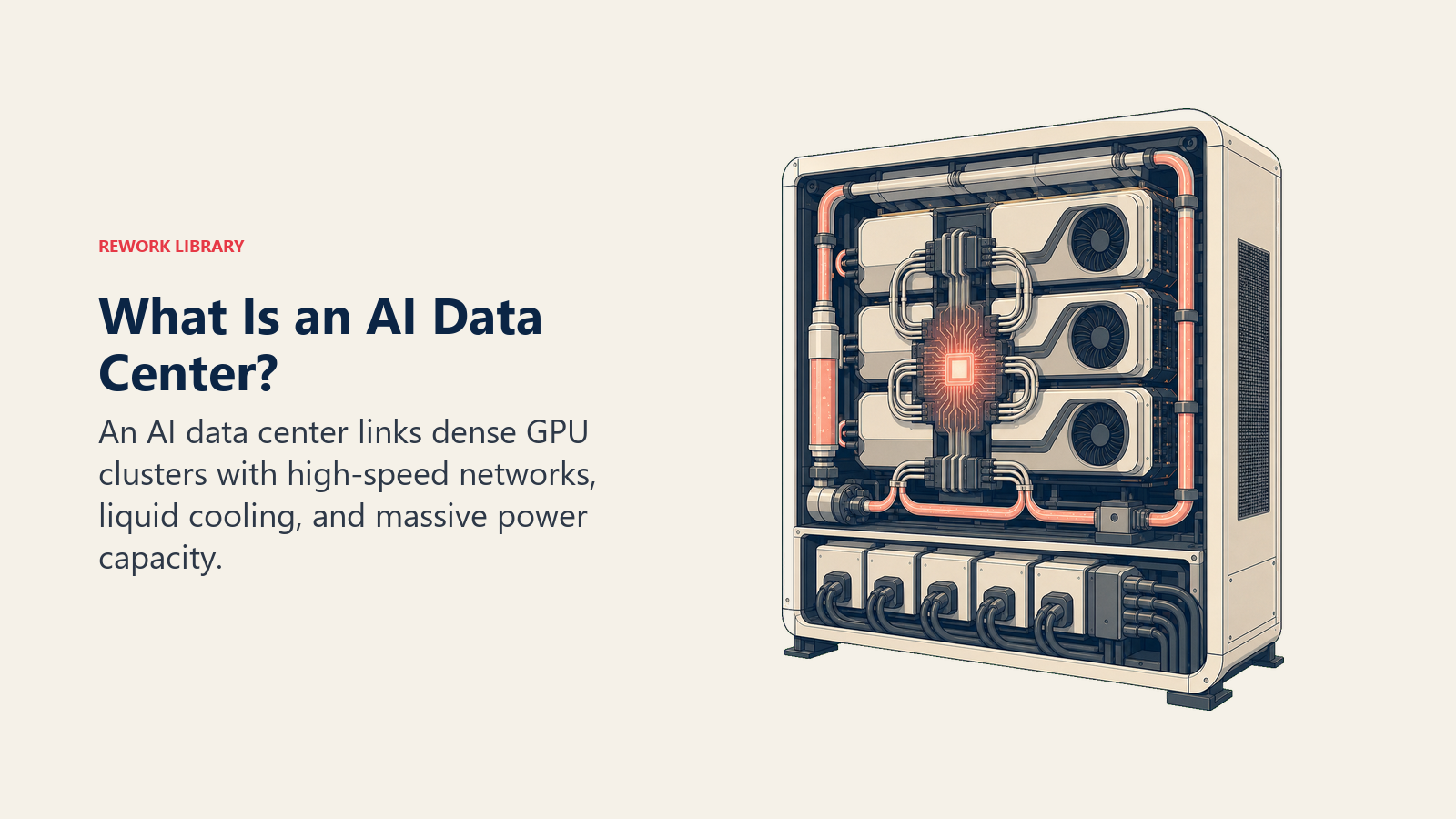
An AI data center is a specialized facility packed with GPUs and other AI accelerators, built specifically to train and run AI models at massive scale. Unlike a general-purpose data center, it's engineered around extreme power density, high-speed chip-to-chip networking, and heavy-duty cooling, the things a traditional facility running email servers and websites was never designed to handle.
For business leaders, the distinction matters because it explains why AI is expensive and why capacity is tight. Every chatbot response, every AI-generated forecast, every model your team fine-tunes runs on infrastructure that costs more to build, more to power, and more to cool than the data centers that ran the internet for the last two decades. Understanding what's actually inside an AI data center makes it much easier to read a vendor's pricing, a cloud provider's capacity waitlist, or a headline about a new $10 billion campus, and know what's actually driving the number.
How an AI Data Center Differs From a Traditional Data Center
A traditional data center was built for a different job: hosting websites, running databases, storing files, and serving applications where a single server chip did most of the work on its own. An AI data center exists to move enormous amounts of data between thousands of chips at once, so almost every design choice changes.
| Aspect | Traditional Data Center | AI Data Center |
|---|---|---|
| Power density per rack | Roughly 5 to 10 kilowatts | Often 40 to 130+ kilowatts, with the newest GPU racks pushing past 120 kilowatts |
| Cooling method | Air cooling through raised floors and CRAC units | Direct-to-chip liquid cooling or immersion cooling, because air alone can't remove the heat fast enough |
| Networking | Standard Ethernet, tuned for many independent requests | High-bandwidth, low-latency fabrics like NVLink and InfiniBand, tuned so thousands of GPUs can act as one machine |
| Compute hardware | General-purpose CPUs | GPUs and other accelerators, often thousands per cluster, working in parallel on one job |
| Primary workload | Serving many small, independent requests | Training and running large models that need every chip talking to every other chip constantly |
| Build cost per megawatt | Lower, standard construction | Substantially higher, due to power infrastructure, liquid cooling plant, and specialized networking |
The practical takeaway: a traditional data center is optimized to serve lots of small, separate jobs cheaply. An AI data center is optimized to make thousands of expensive chips work together on one enormous job, and that difference in purpose is what drives every difference in design.
Key Components Inside an AI Data Center
Strip away the marketing and every AI data center is built from a handful of core pieces.
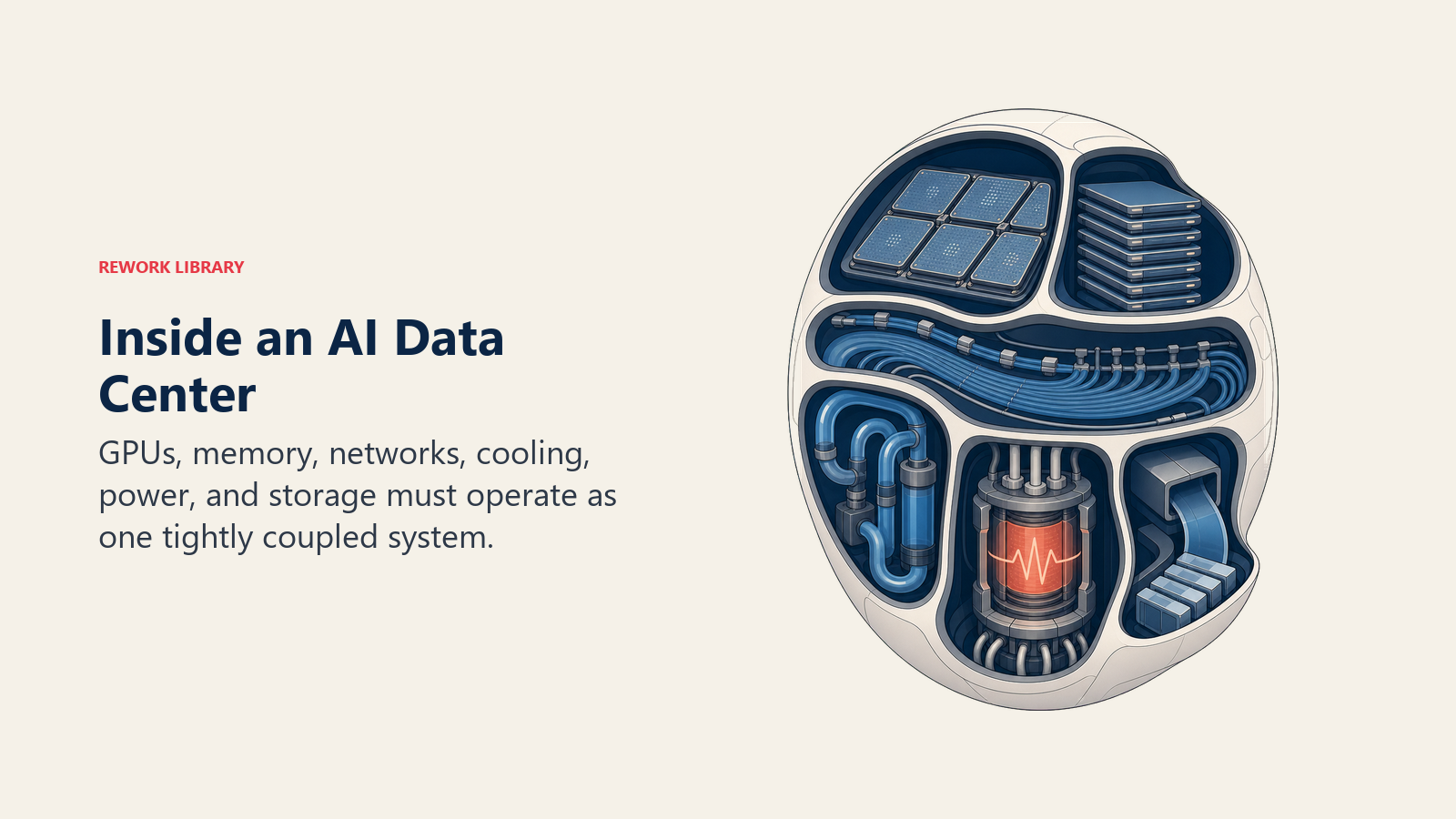
- GPUs and AI accelerators: The compute engines doing the actual math, chips like Nvidia's H100, H200, and Blackwell-generation GPUs, AMD's MI-series accelerators, Google's TPUs, and a growing wave of custom silicon built by hyperscalers themselves. This is where large language models and other foundation models actually get trained and run.
- High-bandwidth memory (HBM): Memory stacked directly next to the GPU die so it can feed data to the chip fast enough to keep it busy. Model size and speed are often limited by how much HBM a chip has, not just how fast it can compute.
- Interconnect and networking fabric: The chip-to-chip and rack-to-rack connections (NVLink inside a server, InfiniBand or high-speed Ethernet between servers) that let thousands of GPUs function as one giant computer instead of thousands of separate ones. This is the piece most people underestimate: a cluster is only as fast as its slowest connection.
- Liquid cooling systems: Direct-to-chip cold plates or full immersion tanks that pull heat away from racks running far hotter than anything a traditional facility was built for.
- Power infrastructure: Dedicated substations, on-site backup generation, and increasingly battery storage, because a single AI campus can draw as much power as a small city.
- Storage and data pipeline: Fast storage systems that keep training data flowing into the GPUs without becoming the bottleneck, plus the systems that manage model serving once a model is trained and ready for production traffic.
The 2025-2026 AI Data Center Buildout
The scale of construction happening right now is the fastest infrastructure buildout in tech history. The four largest US hyperscalers, Amazon, Alphabet (Google), Microsoft, and Meta, guided a combined roughly $725 billion in capital expenditure for 2026, up about 77% from 2025's already-record $410 billion, according to reporting on their earnings guidance. Individually, that breaks down to roughly $200 billion at Amazon, $185 to $190 billion at Alphabet, $125 to $145 billion at Meta, and around $120 billion at Microsoft, the overwhelming majority of it AI infrastructure.
Three forces are driving that spending. Training costs for frontier models keep scaling with available compute, so whoever has the most GPUs can build the most capable model. Inference demand, the compute needed to actually run AI products once they're live, is growing faster than most providers can add capacity, since every user query, every AI agent task, and every test-time compute reasoning step consumes GPU time. And each hyperscaler is racing to build proprietary chips to cut its dependence on Nvidia and lower the cost per unit of AI output, alongside techniques like quantization that squeeze more performance out of the hardware already in the ground.
The result shows up in the physical world as multi-gigawatt campuses under construction across Texas, Louisiana, Wisconsin, and a dozen other states, plus a parallel wave of sovereign buildouts in the Gulf states, Europe, and Asia (see sovereign AI), as governments decide they don't want their AI capacity dependent on someone else's data center.
Power, Water, and Grid Impact
The buildout's biggest constraint isn't chips, it's electricity. The IEA projects that global data center electricity consumption will roughly double to about 945 terawatt-hours by 2030, close to 3% of total global electricity consumption, with electricity use in AI-optimized "accelerated" servers growing around 30% a year in its base case, versus roughly 9% a year for conventional servers. In the United States specifically, data centers are expected to account for nearly half of all electricity demand growth between now and 2030.
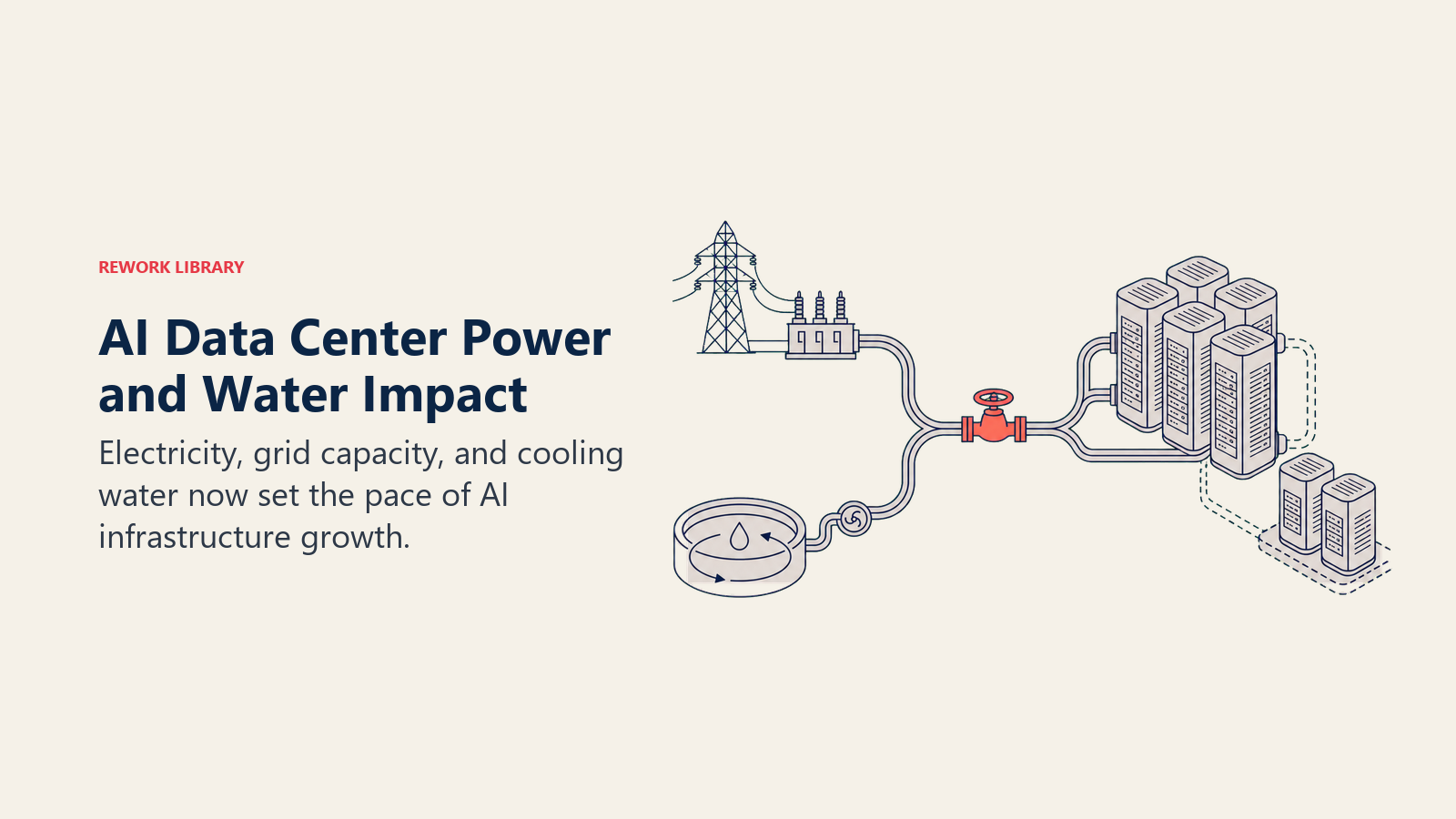
Goldman Sachs Research puts a similar shape on the numbers: global data center power demand is projected to rise about 165% by 2030 versus 2023 levels, with data centers going from 1 to 2% of world power use today to 3 to 4% by 2030. In the US, that share could hit 8% of national power consumption by 2030, up from about 3% in 2022. Goldman estimates roughly $720 billion in grid spending will be needed through 2030 just to keep the electricity system able to deliver that power.
McKinsey frames the capital side even more starkly: it projects data centers will require about $6.7 trillion in capital expenditure worldwide by 2030 to keep pace with compute demand, with $5.2 trillion of that going toward AI-capable facilities specifically. Total data center capacity demand could nearly triple to 219 gigawatts by 2030, with roughly 70% of that new demand coming directly from AI workloads.
Cooling adds a second resource constraint on top of power. Liquid and evaporative cooling systems that keep dense GPU racks from overheating can draw significant water, which is why new AI campuses increasingly face local pushback in drought-prone regions and why hyperscalers are investing in closed-loop cooling designs that recycle water instead of consuming it. Expect utility rate negotiations, water rights, and grid interconnection queues to remain the practical bottleneck on how fast new AI capacity can actually come online, regardless of how much capital is available to build it.
Why This Matters for Business Leaders
None of this is abstract if your company buys or builds on AI. Data center economics flow directly into what you pay for AI tools, how quickly you can get GPU capacity for a custom project, and which vendors can actually deliver on their roadmap versus which ones are capacity-constrained. A few practical implications worth tracking:
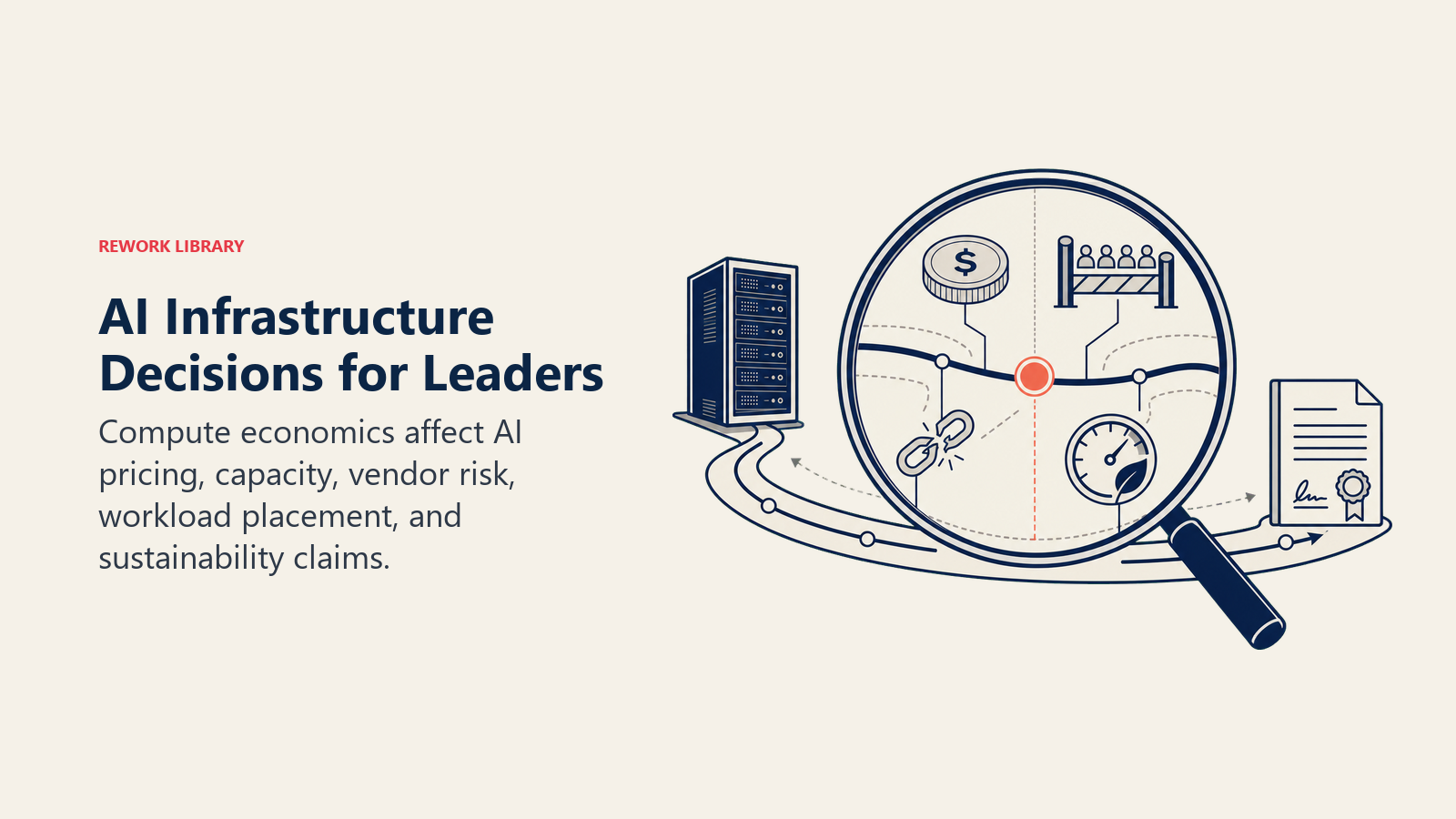
- Pricing pressure works both ways. GPU scarcity keeps compute expensive in the near term, but the capex race is also driving efficiency gains (better chips, better cooling, better utilization) that bring the cost per unit of AI output down over time. Model your AI total cost of ownership with both trends in mind, not just today's sticker price.
- Where your workload runs matters more than it used to. Latency-sensitive applications increasingly push compute closer to the user via edge AI, while heavy training and batch inference work stays centralized in hyperscale campuses. Knowing the difference helps you evaluate vendor architecture claims instead of taking "we run on AI infrastructure" at face value.
- Capacity constraints are a real vendor-risk factor. If a provider's roadmap depends on GPU or power availability it doesn't control, that's worth asking about directly, the same way you'd ask about any other single point of failure in a critical vendor relationship.
- Sustainability commitments are colliding with growth targets. Several major providers have publicly walked back or softened net-zero timelines as data center power demand outpaced their renewable buildout, a tension worth factoring into any vendor ESG claims you're relying on for your own reporting.
Key Facts
- Global data center electricity consumption is projected to roughly double to 945 terawatt-hours by 2030, about 3% of total global electricity consumption, with AI-optimized server electricity use growing around 30% a year. IEA
- In the United States, data centers are expected to account for nearly half of all electricity demand growth between now and 2030. IEA
- AI is projected to drive a 165% increase in global data center power demand by 2030 versus 2023, pushing data centers from 1 to 2% of world power use today to 3 to 4% by 2030, and to about 8% of US power consumption by 2030 (up from roughly 3% in 2022). Goldman Sachs
- Roughly $720 billion in grid spending is estimated to be needed through 2030 to support AI-driven data center power demand. Goldman Sachs
- Data centers worldwide are projected to require about $6.7 trillion in capital expenditure by 2030 to keep pace with compute demand, with $5.2 trillion of that for AI-capable facilities specifically. McKinsey
- Global data center capacity demand could nearly triple to 219 gigawatts by 2030, with about 70% of new demand coming from AI workloads. McKinsey
- Amazon, Alphabet, Microsoft, and Meta guided a combined roughly $725 billion in capital expenditure for 2026, up about 77% from 2025's record $410 billion, the large majority earmarked for AI infrastructure. CNBC
Frequently Asked Questions about AI Data Centers
What is an AI data center in simple terms?
An AI data center is a facility built around large clusters of GPUs and other AI accelerators, designed specifically to train and run AI models at scale. It differs from a regular data center mainly in power density, cooling, and the networking that lets thousands of chips work together on one job.
How is an AI data center different from a regular data center?
A regular data center is built to serve many small, independent requests using standard servers and air cooling. An AI data center concentrates far more power per rack, uses liquid or immersion cooling to manage the heat, and relies on high-speed interconnects so GPUs can operate as one large system instead of separate machines.
Why do AI data centers need so much power?
Training and running large AI models requires thousands of GPUs running at full load simultaneously, and each GPU draws far more power than a traditional server chip. The IEA projects global data center electricity demand will roughly double by 2030, driven mainly by this kind of AI-optimized compute.
What hardware is inside an AI data center?
The core pieces are GPUs or other AI accelerators, high-bandwidth memory stacked next to those chips, high-speed interconnects like NVLink and InfiniBand connecting them, liquid cooling systems to manage heat, dedicated power infrastructure, and fast storage that keeps data flowing to the chips without becoming a bottleneck.
Who is building the most AI data centers right now?
Amazon, Alphabet (Google), Microsoft, and Meta are the largest builders, together guiding roughly $725 billion in 2026 capital expenditure, most of it for AI infrastructure. Independent cloud and colocation providers, along with sovereign national initiatives in regions like the Gulf states and Europe, are also expanding capacity.
What are the environmental concerns around AI data centers?
The two biggest concerns are electricity demand, since AI-optimized data centers are the fastest-growing driver of global power consumption, and water use for cooling, since liquid and evaporative cooling systems can draw significant water in facilities located in water-stressed regions.
How does an AI data center affect the cost of AI tools?
Data center construction, power, and cooling costs are a major input into what cloud providers charge for AI compute. Scarcity of GPU capacity keeps near-term prices elevated, while efficiency gains in chips and cooling gradually bring the cost per unit of AI output down over time.
What is the difference between training and inference in an AI data center?
Training is the process of building a model from scratch, an extremely compute-intensive job usually run in large hyperscale campuses. Inference is running that trained model to answer real user requests, which happens continuously and, at scale, can consume more total compute than training did.
Should a business ever build its own AI data center?
For almost all companies, no. Building and operating AI-grade infrastructure requires capital, power access, and technical expertise on a scale only hyperscalers and specialized providers can justify. Most businesses are better served renting capacity from a cloud provider and focusing their own investment on the AI applications built on top of it.
Related AI Concepts
- What is AI Inference? - The production workload that keeps AI data centers running around the clock
- Large Language Models - What actually gets trained inside these facilities
- Foundation Models - The pre-trained models that make hyperscale training runs worthwhile
- Model Serving - How trained models get deployed at scale once training is done
- Edge AI - The alternative to centralized data centers for latency-sensitive workloads
- Quantization - A key technique for squeezing more performance out of existing data center hardware
- Sovereign AI - Why nations are building their own AI data center capacity
- AI Total Cost of Ownership - How data center economics flow into what businesses actually pay for AI
External Resources
- IEA: Energy and AI, Executive Summary - Global data center electricity demand projections through 2030
- IEA: AI is set to drive surging electricity demand from data centres - Regional breakdown of demand growth
- Goldman Sachs: AI to Drive 165% Increase in Data Center Power Demand by 2030 - Power demand, grid spending, and US share projections
- McKinsey: The Cost of Compute, a $7 Trillion Race to Scale Data Centers - Capital expenditure and capacity demand forecasts
- CNBC: Tech AI spending approaches $700 billion in 2026 - Hyperscaler 2026 capex guidance
Part of the AI Terms Collection. Last updated: 2026-07-20
