What is Scale AI?
Turn this article into takeaways for your work.


Each assistant summarizes the article only for you and suggests best practices for your work.
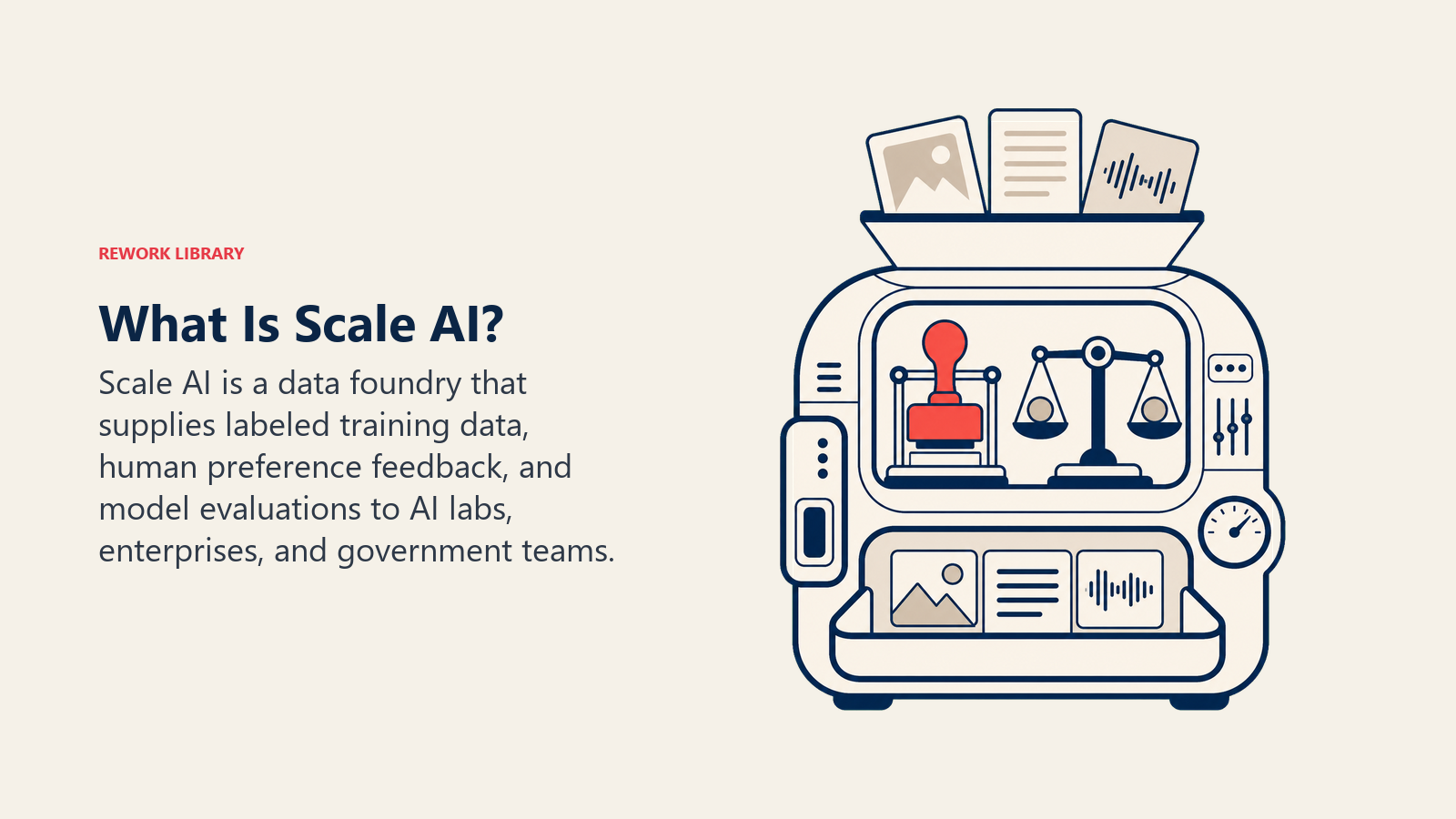
Scale AI is a San Francisco data-foundry company that supplies the labeled training data, human feedback, and evaluation pipelines that AI labs use to build and improve foundation models. Founded in 2016, it grew into one of the AI industry's most important, and most scrutinized, infrastructure suppliers after Meta bought a 49% stake in the company in June 2025.
For business leaders, Scale AI is the company that quietly sits behind the scenes of the AI boom. It hires and manages large networks of human contributors, through subsidiaries like Remotasks and Outlier, who label images, rank chatbot answers, and grade model outputs so that labs like OpenAI, Google, and Meta can train and fine-tune the models your team eventually uses. It's a specialized data-production layer for the AI industry, not a chatbot, an app, or a tool you'd sign up for directly.
Where Scale AI Came From
Scale AI was founded in 2016 by Alexandr Wang and Lucy Guo, two former Quora engineers who built the company through Y Combinator. The original pitch was narrow: hire and manage human workers to draw bounding boxes and label images for self-driving car companies, a tedious but essential step in training computer vision systems. Guo left the company in 2018 after a falling out with Wang, though she has kept a small equity stake.
The business scaled fast from there. A $100 million investment from Peter Thiel's Founders Fund pushed Scale past a $1 billion valuation in August 2019. As the AI industry shifted from computer vision toward large language models, Scale followed the demand: by 2024 it had grown into a roughly $870 million revenue business, reaching a $1.5 billion annualized run rate by year's end, with 2025 revenue projected to roughly double to around $2 billion.
What Scale AI Actually Does
Scale's core business is producing the raw material that large language models and other AI systems are trained on. That work breaks down into a few distinct product lines.
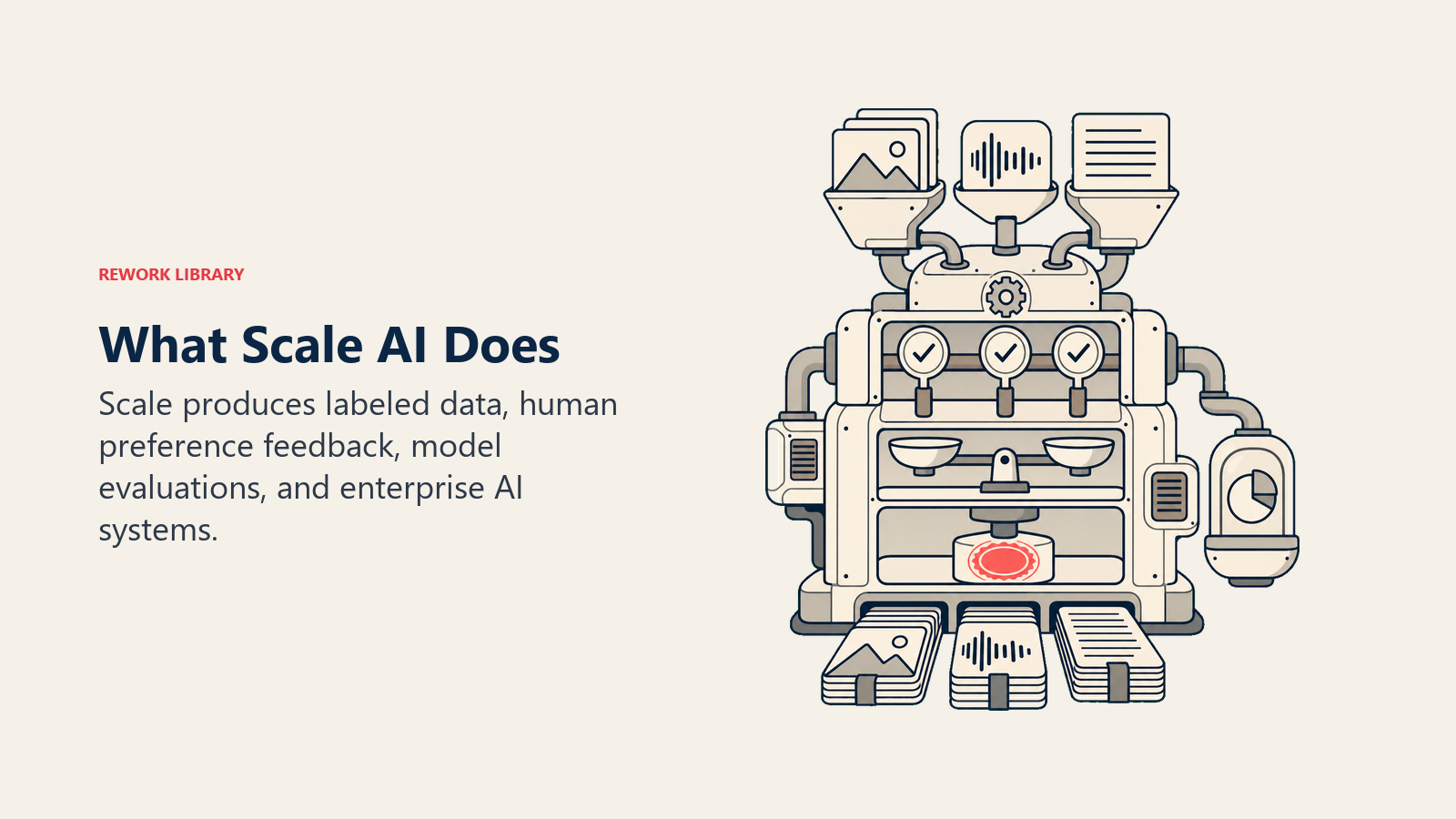
Data annotation and labeling. This is the original business: humans (supported by AI-assisted tooling) label images, transcribe audio, tag text, and structure raw data so it's usable for training. Remotasks, Scale's original crowdsourced labeling arm, still handles high-volume work like computer vision and autonomous-vehicle data. A separate brand, Outlier, recruits domain experts (developers, lawyers, doctors, and other specialists) to produce the kind of high-skill training data that frontier language models increasingly need.
RLHF and preference data. Scale runs large-scale RLHF programs, where human reviewers compare and rank AI-generated responses so a model can learn which outputs people actually prefer. This kind of human-in-the-loop feedback is a big part of what makes modern chatbots feel helpful rather than just technically correct, and it depends on careful data curation to keep the feedback consistent and unbiased.
Model evaluation. Beyond producing training data, Scale builds and runs benchmarks that let AI labs test how well a model performs against competitors, a service that has become more valuable as labs need independent, credible ways to measure progress.
GenAI platform and enterprise software. Scale also sells enterprise software for companies building and deploying their own generative AI applications, packaging its data expertise into tools rather than pure services.
Donovan, for defense and government. Scale Donovan is a generative AI decision-support platform built specifically for defense and intelligence customers. It turns large volumes of unstructured battlefield and intelligence data into usable analysis for military operators, and it has been deployed on classified U.S. Army networks. The Pentagon's Chief Digital and AI Office has steadily expanded its relationship with Scale, growing its enterprise agreement from $100 million to $500 million.
The Meta Investment That Changed Everything (June 2025)
In June 2025, Meta invested $14.3 billion in Scale AI for a 49% non-voting stake, valuing the company at approximately $29 billion, roughly double its prior valuation. As part of the deal, founder and CEO Alexandr Wang left Scale to lead Meta's newly formed Superintelligence Labs as chief AI officer. Jason Droege, Scale's former chief strategy officer, took over as CEO. Scale maintains that it continues to operate as an independent company, and Meta's stake carries no voting power.
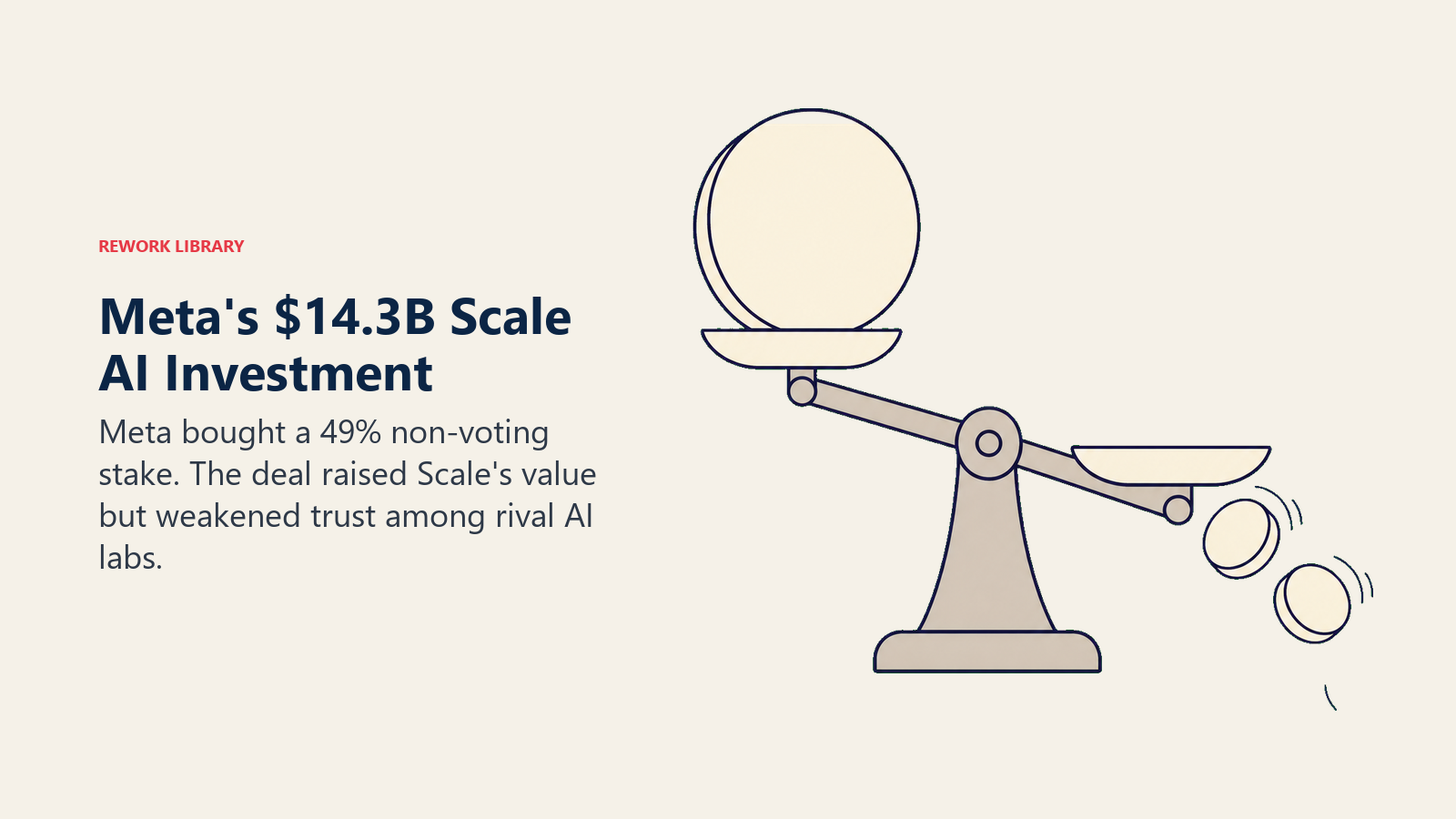
The fallout was immediate and, for Scale, painful. Google, reportedly Scale's largest customer at around $150 million spent in 2024 with $200 million planned for 2025, moved to cut ties within days. OpenAI, which had already been winding down its work with Scale over the prior six to 12 months, formally dropped the company as a data provider. Microsoft reportedly pulled back as well. The logic was straightforward: none of Meta's direct competitors in the race to build frontier AI wanted a company partly owned by Meta, and led in part by a Meta executive, handling their sensitive training data and getting a window into their model roadmaps.
Why Business Leaders Should Care About Scale AI
Scale AI isn't a tool most companies buy directly. It sits further up the AI supply chain, selling primarily to the foundation-model labs, large enterprises building custom AI systems, and government agencies that need labeled data and human feedback at scale. So why does it matter if you're not one of those buyers?
Two reasons. First, Scale AI is a useful lens for understanding how the AI industry actually works: the polished chatbot your team uses didn't learn to be helpful on its own, it learned from a supply chain of human labelers and reviewers, and Scale is the largest company built around managing that supply chain. Second, the Meta deal is a live case study in vendor concentration risk. When a critical infrastructure supplier gets partly absorbed by one of your competitors, your options narrow fast, which is exactly the kind of dependency worth mapping during any AI vendor evaluation or broader AI governance review of who touches your data and how.
Scale AI vs Alternatives
| Company | Primary Focus | Known For | Ownership Note |
|---|---|---|---|
| Scale AI | Data annotation, RLHF, evaluation, GenAI platform, defense (Donovan) | The original at-scale data-labeling company for frontier AI labs | 49% owned by Meta (non-voting) since June 2025 |
| Surge AI | High-quality RLHF and labeling for frontier labs | Reputation for reviewer quality on complex, technical tasks | Independent, reportedly bootstrapped and profitable |
| Appen | Crowdsourced data annotation and linguistic data | Long track record serving search engines and enterprise AI teams | Publicly traded, independent |
| Labelbox | Software-first data labeling and ML data platform | Self-serve tooling rather than a managed labeling service | Independent |
| Mercor | Talent marketplace for expert data-labeling and RLHF work | Recruiting domain experts (engineers, doctors, lawyers) for training data | Independent |
| Invisible Technologies | AI training data plus broader process operations | Blends data-labeling work with wider business-process outsourcing | Independent |
The common thread among the independents is that they market themselves, implicitly or explicitly, as not tied to any single frontier AI lab, a positioning that became a lot more valuable to prospective customers after Scale's ownership changed.
Key Facts
- Meta invested $14.3 billion for a 49% non-voting stake in Scale AI in June 2025, valuing the company at approximately $29 billion. CNBC
- Scale AI generated approximately $870 million in revenue in 2024, reaching a $1.5 billion annualized run rate by year's end, before projecting roughly $2 billion in 2025 revenue. Bloomberg
- Google, reportedly Scale AI's largest customer at around $150 million spent in 2024, moved to cut ties with the company within days of the Meta deal closing. CNBC
- OpenAI had been winding down its work with Scale AI for six to 12 months before formally dropping the company as a data provider after the Meta investment. CNBC
- The Pentagon's Chief Digital and AI Office expanded its enterprise agreement with Scale AI from $100 million to $500 million, a five-fold increase, covering the Donovan platform and broader AI capabilities. Bloomberg
- Scale AI was founded in 2016 by Alexandr Wang and Lucy Guo, two former Quora engineers who built the company through Y Combinator. Wikipedia
- Scale AI first crossed a $1 billion valuation in August 2019 after a $100 million investment from Peter Thiel's Founders Fund. Forbes
Frequently Asked Questions about Scale AI
What is Scale AI in simple terms?
Scale AI is a company that provides the labeled training data, human feedback, and model evaluation services that AI labs use to build and improve large language models and other AI systems. It's infrastructure for the AI industry, not a consumer-facing product.
Who owns Scale AI?
Scale AI is largely owned by its founders, employees, and early investors, but Meta holds a 49% non-voting stake as of June 2025, following a $14.3 billion investment. Scale states it continues to operate as an independent company.
Is Alexandr Wang still the CEO of Scale AI?
No. Wang left Scale AI in June 2025 to lead Meta's Superintelligence Labs as chief AI officer. Jason Droege, Scale's former chief strategy officer, took over as CEO.
What is Scale Donovan?
Donovan is Scale AI's generative AI platform for defense and intelligence customers. It turns large volumes of unstructured data into decision support for military operators and has been deployed on classified U.S. Army networks.
Why did Google and OpenAI stop working with Scale AI?
Both companies compete directly with Meta in building frontier AI models. After Meta took a 49% stake in Scale AI and installed its former CEO in a senior Meta AI role, Google, OpenAI, and Microsoft grew concerned that continuing to share data and research priorities with Scale could expose competitive information to a rival.
What does Scale AI actually do day to day?
It manages large networks of human contributors and AI-assisted tools to label data (images, text, audio, video), collect human feedback for RLHF, and evaluate model outputs, plus it sells enterprise software for building and deploying AI applications.
Is Scale AI a competitor to OpenAI or Google?
No. Scale AI is a supplier to AI labs like OpenAI and Google, not a model developer competing with them. It provides the training data and evaluation pipelines those labs use to build their own models.
How much is Scale AI worth?
Meta's June 2025 investment valued Scale AI at approximately $29 billion, roughly double its prior valuation.
Related AI Concepts
- RLHF - The human-feedback training technique at the core of Scale's preference-data business
- Foundation Models - The large-scale models Scale's training data helps build
- Human-in-the-Loop - The review pattern behind Scale's labeling and RLHF workforce
- Data Curation - How labeled data gets cleaned and structured before training
- Synthetic Data - A machine-generated alternative to Scale's human-labeled approach
- Fine-Tuning - What labs do with the labeled and preference data Scale produces
- Computer Vision - Scale's original labeling use case, before its shift toward language models
- AI Vendor Evaluation - A framework for assessing data and infrastructure suppliers like Scale
External Resources
- CNBC: Scale AI founder Wang confirms departure for Meta as part of $14.3 billion deal - Deal terms and leadership change
- Bloomberg: Scale AI expects to more than double sales to $2 billion in 2025 - Revenue and growth figures
- CNBC: Google, Scale AI's largest customer, plans split after Meta deal - Customer fallout following the investment
- Bloomberg: Meta-backed Scale AI wins $500 million Defense Department deal - Pentagon contract expansion
- Wikipedia: Scale AI - Company history, founders, and background
Part of the AI Terms Collection. Last updated: 2026-07-20
