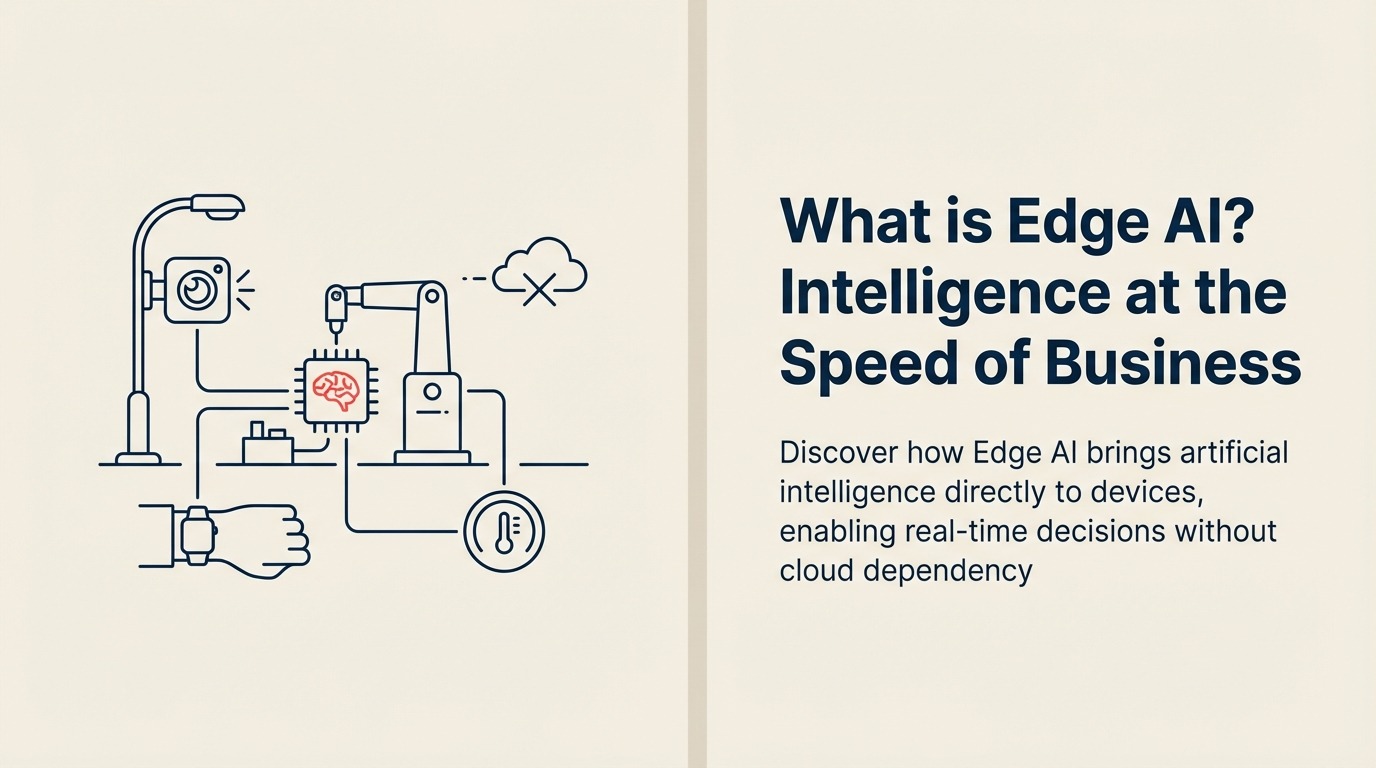
What is Edge AI? When Intelligence Lives Where You Need It
Turn this article into takeaways for your work.


Each assistant summarizes the article only for you and suggests best practices for your work.
Your security camera shouldn't need the cloud to recognize an intruder. Your factory robot shouldn't wait for server responses to avoid collisions. Edge AI puts intelligence directly where decisions happen, delivering instant responses without internet delays or privacy concerns.
Technical Definition
Edge AI refers to artificial intelligence algorithms processed locally on hardware devices at the "edge" of the network, rather than in centralized cloud servers. This includes running AI models on smartphones, IoT devices, autonomous vehicles, industrial equipment, or dedicated edge servers.
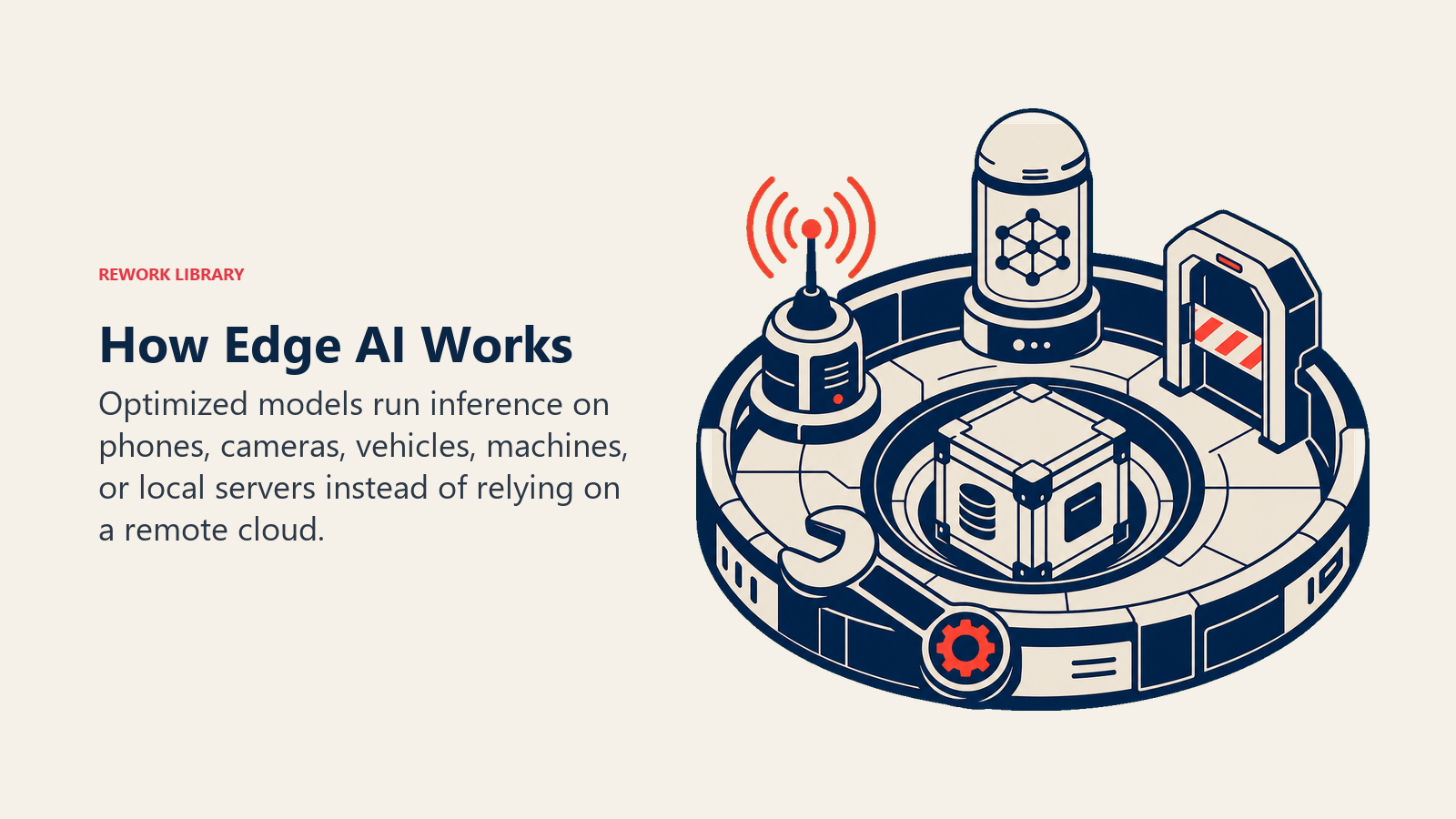
According to Gartner, "Edge AI will be embedded in more than 50% of new industrial IoT solutions by 2026." The technology combines optimized AI models with specialized hardware like neural processing units (NPUs) to enable real-time inference without network connectivity.
Edge AI emerged from the convergence of more powerful edge devices, model compression techniques, and the need for low-latency, privacy-preserving AI applications.
Business Perspective
For business leaders, Edge AI means instant intelligence wherever you operate – from retail stores to remote oil rigs – without depending on internet connectivity, cloud costs, or risking data privacy.
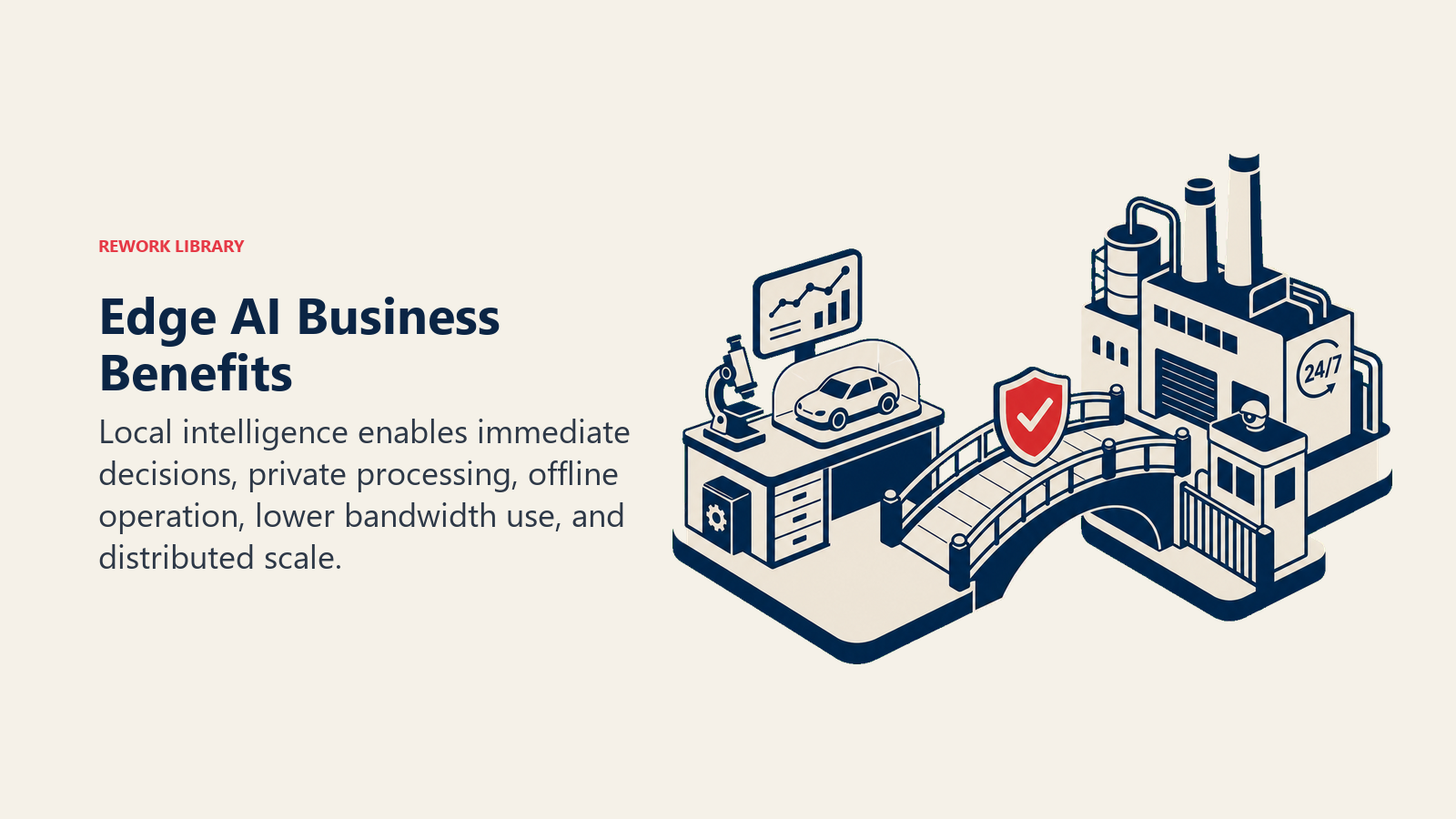
Think of Edge AI as having expert consultants embedded in every device, vehicle, and sensor across your operations. They make smart decisions instantly based on local conditions, only escalating to headquarters when necessary.
In practical terms, this enables real-time quality control on production lines, instant fraud detection at ATMs, personalized retail experiences in-store, and autonomous operations in remote locations. These capabilities often leverage computer vision for visual inspection and anomaly detection for identifying issues in real-time.
Core Capabilities
Edge AI delivers these advantages:
• Ultra-Low Latency: Decisions in milliseconds, not seconds, critical for safety systems, autonomous vehicles, and real-time control
• Privacy Protection: Sensitive data never leaves the device, ensuring compliance with regulations and customer trust
• Offline Operation: Full AI capabilities without internet connectivity, enabling deployment in remote or secure locations
• Bandwidth Efficiency: Process data locally instead of streaming to cloud, reducing network costs by 90%+
• Scalable Intelligence: Deploy AI across thousands of devices without proportional cloud infrastructure costs
How Edge AI Works
The Edge AI architecture follows this pattern:
Model Optimization: Full AI models compressed and optimized for edge hardware using techniques like quantization and pruning. Learn more about model optimization techniques.
Local Processing: Specialized chips (NPUs, TPUs) run neural network inference directly on device, processing sensor data in real-time
Smart Orchestration: Edge devices handle routine decisions locally while selectively sending complex cases or aggregated insights to cloud
This creates a distributed intelligence network that combines edge speed with cloud sophistication when needed.
Edge AI Deployment Models
Different architectures for different needs:
Model 1: On-Device AI Location: Smartphone, camera, sensor Best for: Personal devices, privacy-critical Example: Face ID on iPhone, Google Translate offline
Model 2: Gateway Edge Location: Local server or gateway device Best for: Multiple IoT devices, facility management Example: Smart building systems, retail analytics
Model 3: Network Edge Location: Telecom infrastructure, 5G towers Best for: Low-latency services, AR/VR Example: Cloud gaming, autonomous vehicles
Model 4: Hybrid Edge-Cloud Location: Coordinated edge and cloud Best for: Complex systems, learning loops Example: Industrial IoT AI with continuous improvement
Real-World Edge AI
Companies deploying intelligence at the edge:
Manufacturing Example: BMW's factories use Edge AI for real-time quality inspection, detecting paint defects in milliseconds on the production line. This prevents defective products from progressing, saving $1.2M annually per plant.
Retail Example: Amazon Go stores process hundreds of AI decisions per second locally to track what customers take, enabling checkout-free shopping while ensuring privacy by not sending video to cloud.
Healthcare Example: Philips' portable ultrasound devices use Edge AI to guide non-experts through scans, providing instant analysis in remote clinics without internet connectivity, expanding care to underserved areas.
When to Deploy Edge AI
Edge AI excels in scenarios requiring:
• Instant Response: Autonomous vehicles, safety systems, industrial control where milliseconds matter • Privacy Requirements: Healthcare, financial services, government where data cannot leave premises - see AI governance for compliance considerations • Intermittent Connectivity: Ships, mines, rural deployments with unreliable internet • High-Volume Processing: Video analytics, sensor networks where cloud bandwidth would be prohibitive • Distributed Operations: Retail chains, logistics networks needing consistent local intelligence
Implementation Considerations
Key factors for Edge AI success:
Hardware Selection:
- Processing power vs. energy consumption
- Environmental conditions (temperature, vibration)
- Form factor constraints
- Cost at scale
Model Optimization:
- Accuracy vs. size tradeoffs
- Quantization and pruning strategies
- Update mechanisms
- Fallback options
System Architecture:
- Edge-cloud coordination
- Data synchronization
- Security at the edge
- Management at scale
Learn More
Ready to distribute intelligence across your operations? Explore these related concepts:
- Model Optimization - Techniques for compressing AI models for edge deployment
- IoT AI - Integration of AI with Internet of Things devices
- Deep Learning - The neural network architectures powering edge intelligence
- MLOps - Managing AI model lifecycles across edge deployments
- Model Serving - How models are deployed as production services, both in cloud and at the edge
External Resources
- Google Edge TPU - Purpose-built edge AI accelerators
- Papers With Code: Edge AI - Latest research in on-device AI
Frequently Asked Questions about Edge AI
What is Edge AI?
Edge AI refers to artificial intelligence algorithms processed locally on hardware devices at the "edge" of the network, rather than in centralized cloud servers, enabling instant decisions without internet dependency.
What's the difference between Edge AI and Cloud AI?
Cloud AI processes data on remote servers requiring internet connectivity. Edge AI runs directly on local devices, providing instant responses, offline operation, better privacy, and reduced bandwidth usage.
What are the key benefits of Edge AI?
Ultra-Low Latency (millisecond decisions), Privacy Protection (data never leaves device), Offline Operation (no internet required), Bandwidth Efficiency (90%+ network cost reduction), and Scalable Intelligence (deploy across thousands of devices).
What are the four Edge AI deployment models?
On-Device AI (smartphones, cameras), Gateway Edge (local servers for multiple devices), Network Edge (telecom infrastructure), and Hybrid Edge-Cloud (coordinated edge and cloud processing).
When should businesses use Edge AI?
For instant response needs (autonomous vehicles, safety systems), privacy requirements (healthcare, finance), intermittent connectivity (remote locations), high-volume processing (video analytics), and distributed operations (retail chains).
Part of the AI Terms Collection. Last updated: 2026-01-11
