What is AI Red Teaming? Finding AI Vulnerabilities Before Hackers Do
Turn this article into takeaways for your work.


Each assistant summarizes the article only for you and suggests best practices for your work.
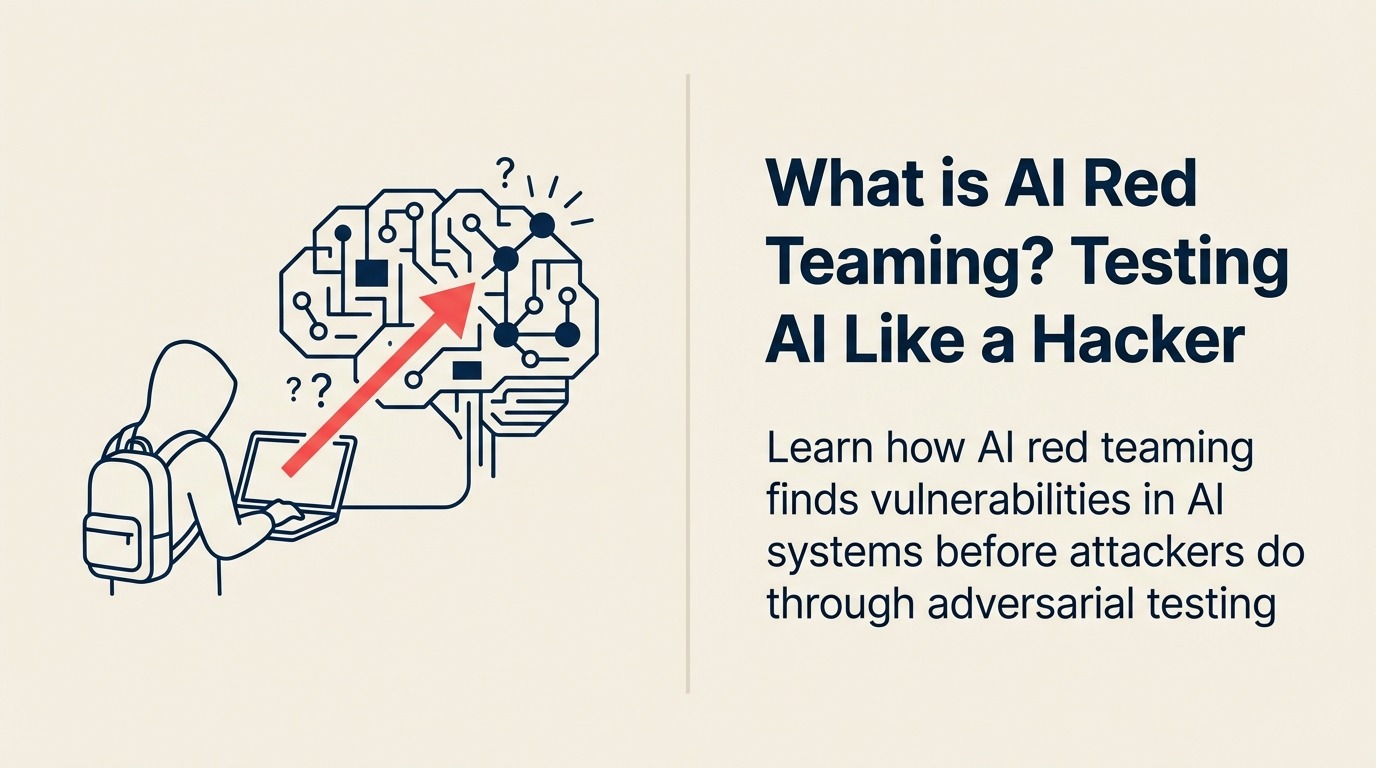
Your AI passes all internal tests. It handles typical user queries perfectly. Then someone discovers a simple prompt that makes it reveal confidential data, ignore safety rules, or generate harmful content. Red teaming finds these vulnerabilities before attackers do, and before they damage your business.
The Security Imperative
AI red teaming emerged from cybersecurity practices when organizations realized traditional testing couldn't catch AI-specific vulnerabilities. Anthropic's Constitutional AI paper in 2022 and OpenAI's red teaming program in 2023 established the practice as essential for responsible AI deployment.
According to Microsoft Security, AI red teaming is "systematic adversarial testing of AI systems using techniques that simulate malicious actors, aiming to discover vulnerabilities, safety failures, and unintended behaviors before production deployment."
The practice became critical after high-profile failures: chatbots manipulated to ignore safety constraints, models tricked into generating harmful content, and AI systems revealing training data through clever prompting.
Red Teaming in Business Terms
For business leaders, AI red teaming means hiring experts to attack your AI systems the way malicious users would, finding security holes, safety failures, and policy violations before they become real problems.
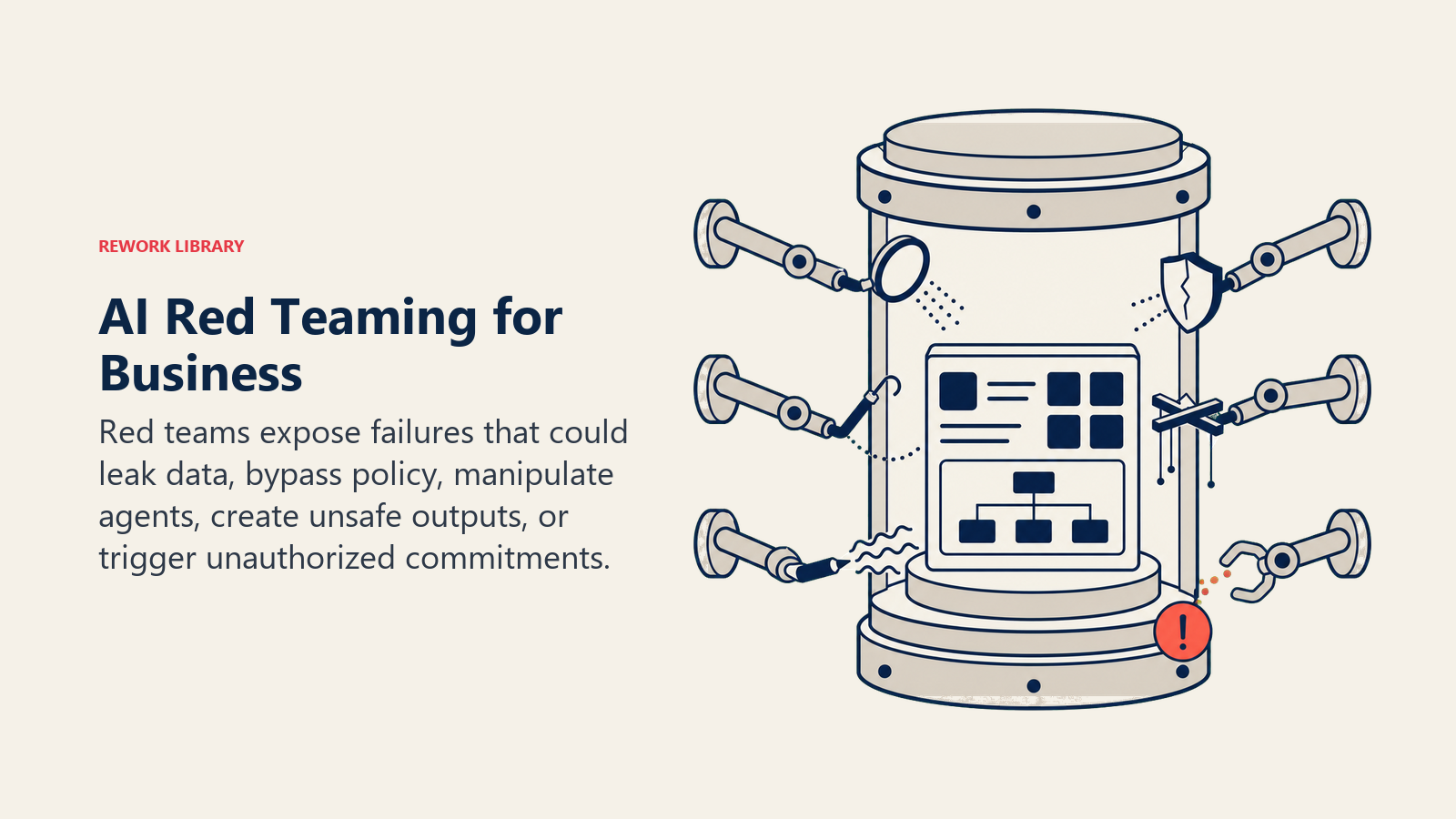
Think of it as penetration testing for AI. Just as security teams try to hack your network before criminals do, red teams try every trick to break your AI's safety measures, extract private information, or manipulate it into unintended behaviors.
In practical terms, this reveals that your customer service bot can be tricked into making unauthorized commitments, your document AI can leak confidential information through clever prompting, or your AI agents can be manipulated into taking harmful actions.
Red Teaming Components
AI red teaming involves these essential elements:
• Adversarial Prompting: Crafting inputs designed to bypass guardrails, manipulate behavior, or trigger safety failures, testing the boundaries of acceptable use
• Attack Scenarios: Systematic testing of known vulnerability patterns including prompt injection, jailbreaking, data extraction, and goal hijacking
• Safety Evaluation: Assessment of outputs for harmful content, bias, privacy violations, and policy breaches across diverse scenarios
• Documentation: Detailed recording of successful attacks, failure modes, and recommended mitigations for engineering teams
• Iterative Testing: Continuous validation as systems evolve, ensuring new features don't introduce vulnerabilities
How Red Teaming Works
Red teaming follows these systematic steps:
Threat Modeling: Identify what could go wrong based on your AI's capabilities and context, from privacy breaches to safety failures to unauthorized actions
Attack Execution: Red team members attempt various attacks using prompt engineering techniques, social engineering, and known exploit patterns
Vulnerability Assessment: Document successful attacks, analyze failure patterns, and recommend fixes ranging from improved guardrails to architectural changes
This process typically runs for weeks before launch and continues throughout the AI system's lifecycle, adapting as new attack techniques emerge.
Red Teaming Approaches
Different approaches suit different AI systems:
Type 1: Manual Red Teaming Best for: Complex conversational AI Key feature: Human experts craft creative attacks Example: Testing customer service chatbots
Type 2: Automated Red Teaming Best for: Scale and consistency Key feature: AI-generated attack prompts Example: Testing thousands of edge cases
Type 3: Domain-Specific Red Teaming Best for: Specialized applications Key feature: Expert knowledge of domain risks Example: Healthcare or financial AI systems
Type 4: Continuous Red Teaming Best for: Production systems Key feature: Ongoing monitoring and testing Example: User-facing AI with regular updates
Red Teaming Success Stories
Here's how organizations use red teaming to strengthen AI:
OpenAI Example: Before GPT-4 release, 50+ expert red teamers spent six months attacking the system, discovering over 100 safety issues that were fixed, resulting in GPT-4 being 82% less likely to respond to disallowed content.
Anthropic Example: Continuous red teaming of Claude discovered sophisticated jailbreak attempts that led to improved Constitutional AI training, reducing successful manipulations by 90%.
Meta Example: LLaMA 2 underwent extensive red teaming for bias, safety, and security issues across 2,000+ test scenarios, identifying and fixing critical vulnerabilities before open-source release.
Building Red Team Programs
Ready to test your AI systems?
- Understand Large Language Models vulnerabilities
- Learn Prompt Engineering attack techniques
- Implement Guardrails to defend against attacks
- Study AI Orchestration for complex systems
Learn More
Expand your understanding of AI security and safety:
- Guardrails - Implementing defenses against attacks
- AI Hallucination - Understanding output reliability issues
- Responsible AI - Broader framework for safe deployment
External Resources
- NIST AI Risk Management - Government standards
Frequently Asked Questions about AI Red Teaming
What is AI Red Teaming?
AI red teaming is systematic adversarial testing of AI systems using techniques that simulate malicious actors, aiming to discover vulnerabilities, safety failures, and unintended behaviors before production deployment.
What's the difference between AI red teaming and traditional testing?
Traditional testing validates intended functionality. Red teaming actively tries to break the system, manipulate it into unintended behaviors, bypass safety measures, and extract confidential information like a real attacker would.
What are the main AI red teaming approaches?
Manual Red Teaming (human experts crafting attacks), Automated Red Teaming (AI-generated test cases), Domain-Specific Red Teaming (specialized risk knowledge), and Continuous Red Teaming (ongoing monitoring).
What components are involved in red teaming?
Adversarial prompting (crafting attack inputs), attack scenarios (systematic vulnerability testing), safety evaluation (assessing outputs), documentation (recording findings), and iterative testing (continuous validation).
Part of the AI Terms Collection. Last updated: 2026-02-09
