What is AI Slop?
Turn this article into takeaways for your work.


Each assistant summarizes the article only for you and suggests best practices for your work.
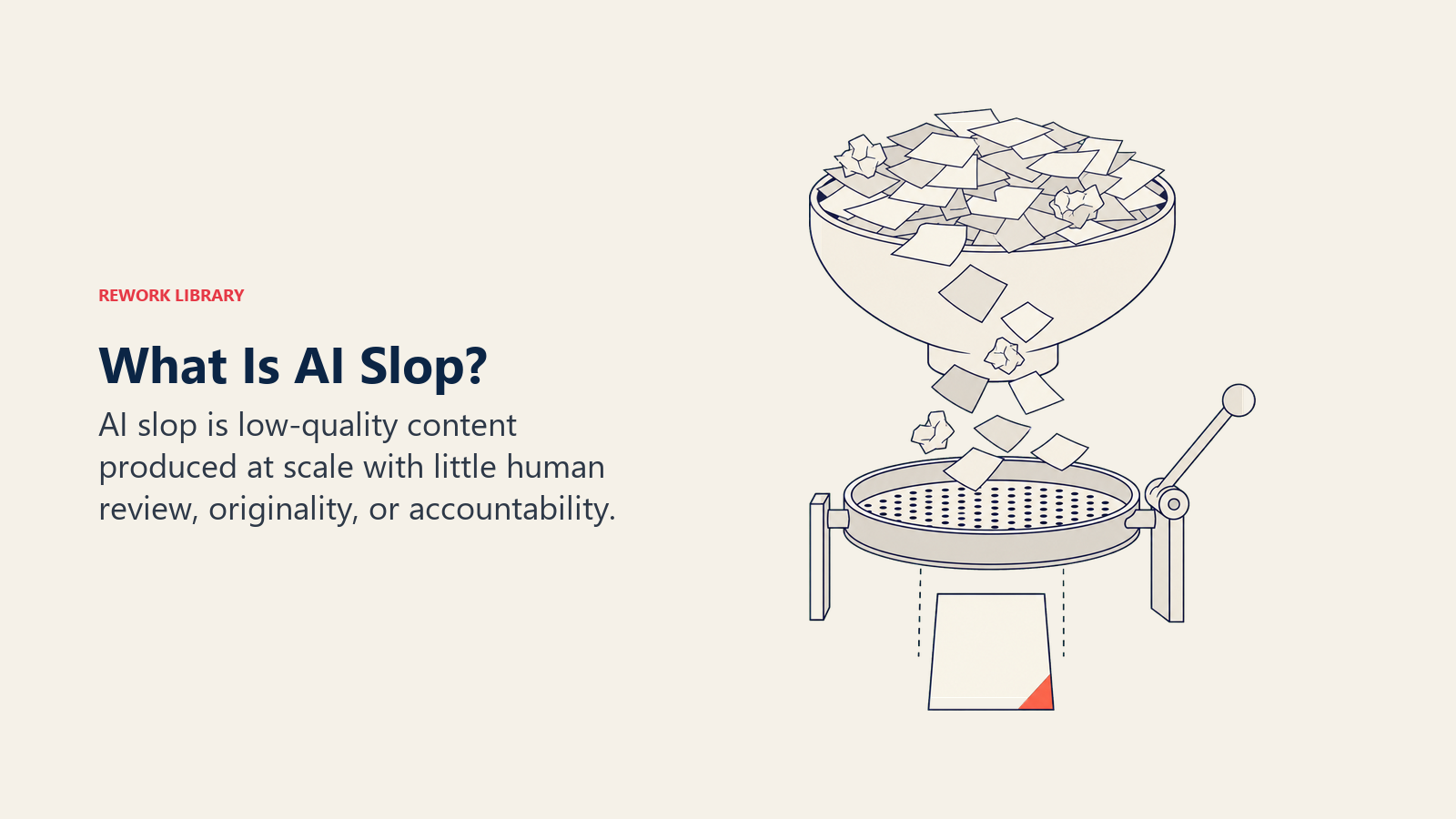
AI slop is low quality, mass produced content, text, images, video, or code, generated cheaply by AI with little to no human oversight. Merriam-Webster, which named it the 2025 Word of the Year, defines it as digital content of low quality that is produced usually in quantity by means of artificial intelligence. The term targets the junk, not AI itself.
Where the Term "AI Slop" Came From
The word "slop" has meant garbage or waste for centuries. Someone posting online under the name "deepfates" used it for unwanted AI-generated content as early as 2022, but the label stayed niche. It broke into the mainstream on May 8, 2024, when programmer Simon Willison published a blog post arguing that "slop" should become the internet's go-to term for junk AI output, the same way "spam" became the word for unwanted email. His post, titled "Slop is the new name for unwanted AI-generated content," gave journalists and critics a sharp, one-syllable word for a problem they'd been struggling to describe.
The term spread through the back half of 2024 as generative AI tools made it trivial to flood search results, social feeds, and app stores with auto-generated junk. By late 2025, it had moved from internet slang into the dictionary. Merriam-Webster crowned "slop" its 2025 Word of the Year, pointing to a year of "absurd videos, off-kilter advertising images, cheesy propaganda, fake news that looks pretty real, junky AI-written books... and lots of talking cats." That recognition mattered because it confirmed slop wasn't a niche complaint from AI skeptics. It had become mainstream shorthand for a specific, recognizable failure mode: quantity without quality, automation without accountability.
Where AI Slop Shows Up
AI slop isn't confined to one channel. It shows up wherever content can be generated faster than it can be reviewed.
Search results and SEO content. Publishers use large language models to mass-produce blog posts aimed at ranking for long-tail keywords, often with minimal editing. Ahrefs' analysis of 900,000 newly created web pages found that nearly three-quarters carried some AI-generated content, and about 12 percent were dominated by it.
Social feeds. Facebook, Instagram, and X are full of AI-generated images built purely to farm engagement, from surreal "Shrimp Jesus" style images to fabricated before-and-after stories. Stanford and Georgetown researchers found a cluster of pages built almost entirely on this tactic pulling in hundreds of millions of views, often from creators paid through platform monetization programs.
News and publishing. Outlets that publish under a masthead but run almost entirely on AI output, with little or no real reporting or editorial review, are now common enough that NewsGuard maintains a dedicated tracker for them.
Email and outreach. Sales and marketing teams increasingly use AI to draft messages at volume. Without a human pass, this produces generic, repetitive copy that reads as slop to the recipient, hurting reply rates and brand perception rather than helping them.
Code. Developers report a rise in AI-generated code submitted with little review: plausible-looking but broken logic, security gaps, and references to dependencies that don't exist, a coding equivalent of AI hallucination.
Why AI Slop Keeps Piling Up
The core driver is cost. Writing a competent 1,500-word article, designing an original image, or building a customer outreach sequence used to take hours of skilled human time. A large language model can produce a rough version of any of these in seconds, for a fraction of a cent. When the cost of producing content collapses toward zero, the incentive to produce huge volumes of it, regardless of quality, goes up.
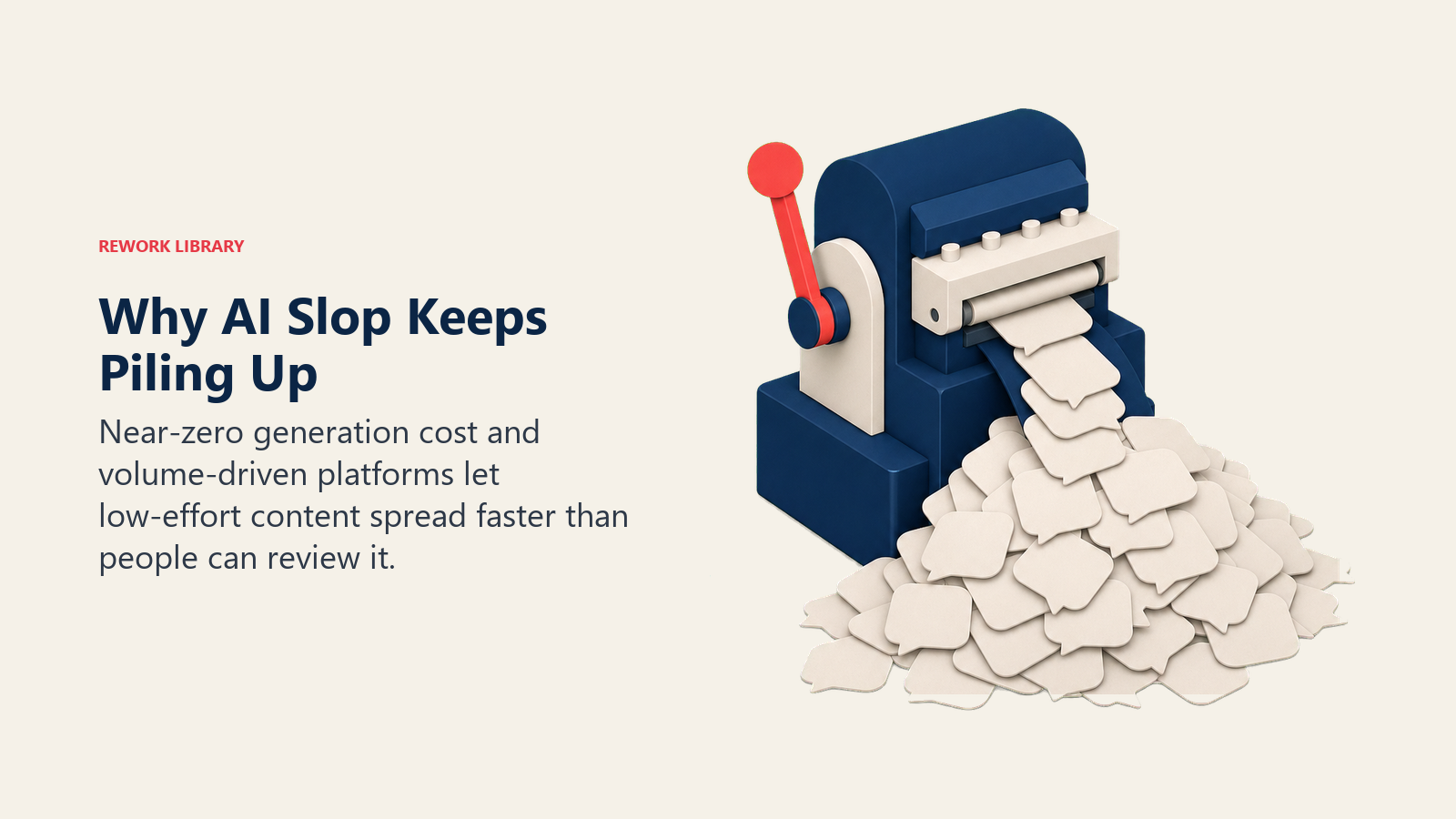
That economic pressure meets platforms built to reward volume. Search engines have historically rewarded fresh, keyword-matched pages. Social platforms reward whatever keeps people scrolling, whether or not the content is real. Programs that pay creators for engagement, like Facebook's Creator Bonus program, give people a direct financial reason to publish as much AI-generated material as possible, quality aside.
The result compounds. An analysis of Common Crawl web data found that by November 2024, AI-generated articles had overtaken human-written ones in raw publishing volume online, barely two years after ChatGPT's public launch. Once generation is nearly free and distribution is automated, slop doesn't trickle in. It floods.
Key Facts: AI Slop
- Merriam-Webster named "slop" its 2025 Word of the Year, defining it as digital content of low quality produced usually in quantity by AI. (Merriam-Webster)
- Ahrefs analyzed 900,000 newly created web pages in April 2025 and found 74.2 percent contained some AI-generated content, though only 2.5 percent were pure AI with no human editing. (Ahrefs)
- AI-generated articles overtook human-written articles in raw publishing volume on the open web in November 2024, based on an AI-detection analysis of Common Crawl data. (Graphite)
- NewsGuard's AI Tracking Center has identified 3,749 "Unreliable AI-Generated News" sites publishing with little to no human oversight, spanning 16 languages. (NewsGuard)
- More than 26 percent of G2 software reviews posted since ChatGPT's launch are likely AI-generated, a 92.8 percent jump over the pre-ChatGPT baseline. (Originality.ai)
- A 2024 Nature study found that AI models trained repeatedly on AI-generated data suffer "model collapse," progressively losing touch with the real-world data distribution. (Nature)
- Stanford Internet Observatory and Georgetown researchers tracked 120 Facebook Pages posting AI-generated images that collectively drew hundreds of millions of engagements. (CSET Georgetown)
The Business and Brand Risks
Slop isn't just an aesthetic annoyance. It carries three concrete risks for any business that touches AI-generated content.
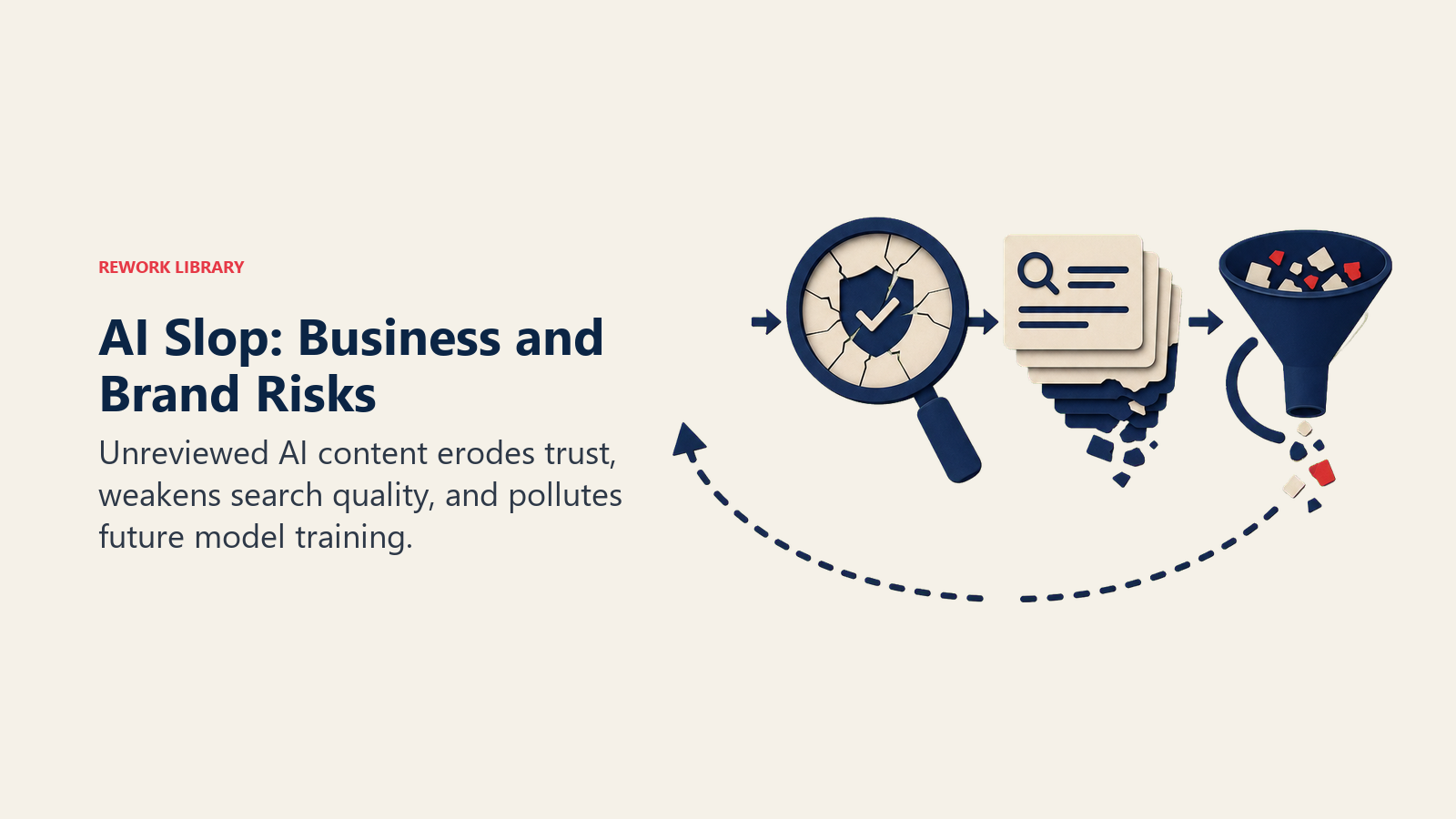
Trust erodes fast, and it's hard to win back. Readers, customers, and prospects are getting better at spotting generic, over-produced AI content, and they punish it. A brand that ships obviously unreviewed AI copy, images, or support replies signals that it doesn't value the audience's time enough to check its own output. That's a credibility problem long before it becomes a legal or technical one, and it compounds every time it happens again.
SEO gets murkier, not simpler. Ahrefs' own research found close to zero correlation between how much AI content a page contains and where it ranks in Google, meaning AI use by itself isn't automatically penalized. But that finding is about ranking position, not quality. Search engines still down-rank thin, unoriginal, unhelpful content under policies like Google's helpful content guidance, and slop is disproportionately likely to be exactly that. Chasing rankings with volume instead of substance is a bet against where search quality signals are heading, not a shortcut around them.
Model collapse threatens the tools themselves. As slop accumulates across the open web, it increasingly becomes training data for the next generation of AI models, since most large models are trained on scraped internet text. The Nature study cited above found that models trained repeatedly on AI-generated content progressively lose the rare, high-quality patterns found in real human data and drift toward generic, degraded output. Left unchecked, a web full of slop risks making every AI model trained on it a little worse, including the ones your business relies on. It's part of why data teams increasingly separate deliberately verified synthetic data used for training from unreviewed AI output scraped indiscriminately from the open web.
How to Avoid Producing AI Slop
The fix isn't avoiding AI. It's refusing to skip the review step that turns AI output into something worth publishing.

Set a quality bar before you generate anything. Decide what "good enough to publish" means for your business, in specifics: accuracy, originality, a real point of view, correct facts, working code, before a single AI draft gets written. Publishing decisions should never default to "the AI produced something."
Keep a human in the loop on anything customer-facing. Human-in-the-loop review, someone checking facts, tone, and accuracy before publication, is the single most effective slop prevention step available. It's also the cheapest insurance against the trust and SEO risks above.
Write for E-E-A-T, not just for the algorithm. Google's quality guidelines score content on Experience, Expertise, Authoritativeness, and Trustworthiness. AI can draft a section, but it can't supply your team's first-hand experience, named expertise, or original data. Add those elements yourself before anything ships.
Use tools built for quality, not just speed. Some AI writing tools are designed around drafting assistance and editing workflows rather than one-click mass publishing. Choosing from a list like the best AI writing tools built for editorial use, rather than pure automation, changes the default output you start from.
Treat AI content policy as an AI governance question, not just a style question. Decide who reviews AI output, what (if anything) gets published without review, and how errors get corrected once they're live.
Learn More
Explore related AI concepts to deepen your understanding:
- Responsible AI - Principles for deploying AI systems accountably
- AI Ethics - Explore responsible AI development practices
- AI Hallucination - The related risk of AI confidently generating false information
Part of the AI Terms Collection. Updated July 2026.
