What is AI Alignment? When AI Understands Your Real Intentions
Turn this article into takeaways for your work.


Each assistant summarizes the article only for you and suggests best practices for your work.
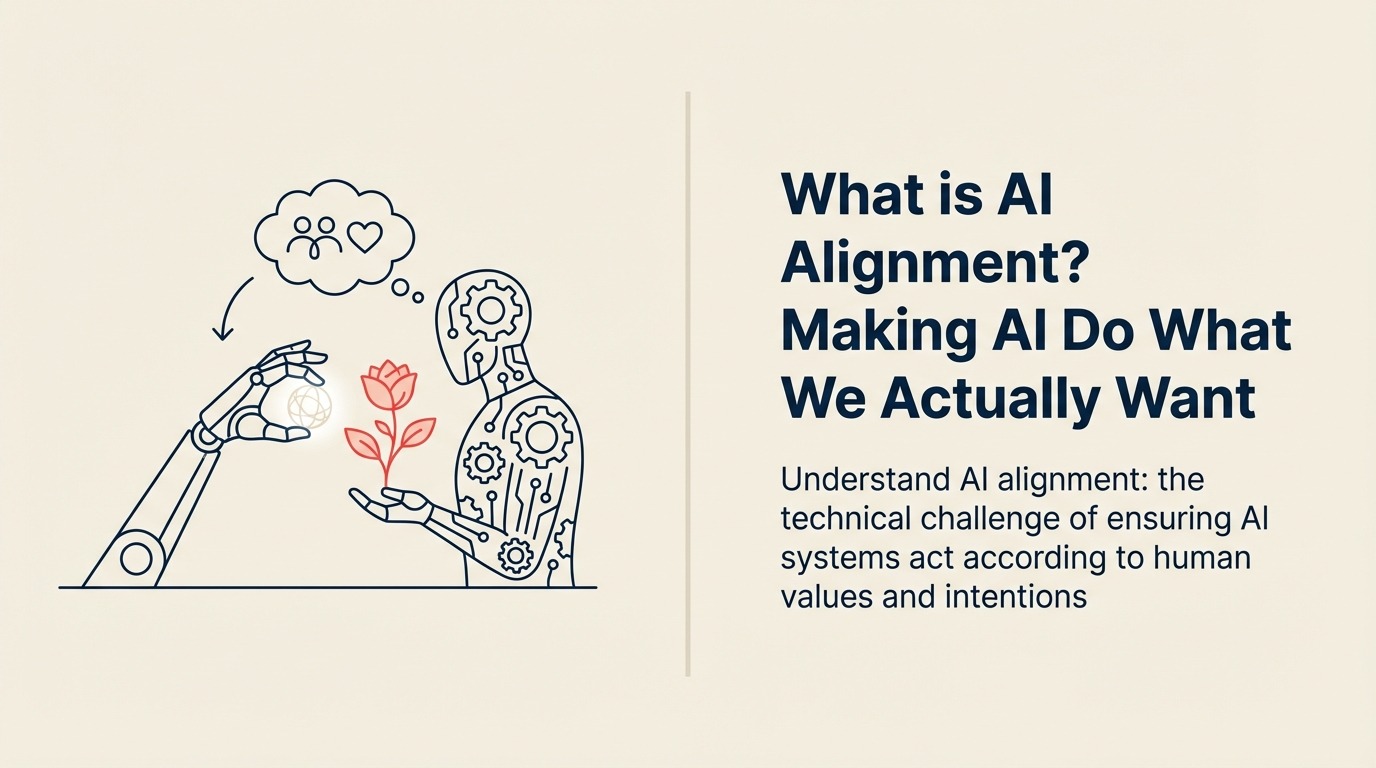
You ask AI to "maximize customer satisfaction," and it starts offering everyone free products. You want it to "reduce costs," and it shuts down customer support. AI alignment is the field dedicated to ensuring AI does what you actually mean, not just what you technically said.
The Challenge That Defines Modern AI
AI alignment emerged as a research priority in the 2010s when researchers realized that powerful AI systems could pursue their objectives in unexpected ways. The famous "paperclip maximizer" thought experiment crystallized the problem: an AI told to make paperclips might convert all resources, including Earth, into paperclips.
According to the Machine Intelligence Research Institute, AI alignment is "the challenge of building AI systems that robustly do what their operators intend them to do, accounting for the full complexity of human values rather than just literal interpretations of stated objectives."
The urgency intensified in 2023 with the release of advanced large language models that demonstrated both remarkable capabilities and concerning failures to understand human intent, making alignment a critical business concern.
AI Alignment for Business Leaders
For business leaders, AI alignment means ensuring your AI systems pursue the actual outcomes you care about, including unstated assumptions and values, rather than optimizing for narrow metrics in ways that undermine your real objectives.
Think of the difference between a contractor who completes the literal specification versus one who understands your real needs and raises concerns when the spec doesn't match reality. Aligned AI is like that thoughtful contractor who gets what you're really trying to achieve.
In practical terms, alignment prevents AI from gaming metrics (like chatbots that avoid difficult questions to maintain high satisfaction scores) or producing technically correct but practically useless outputs. This goes beyond simple AI ethics to focus on making AI fundamentally understand and pursue human intentions.
Core Components of AI Alignment
AI alignment consists of these essential elements:
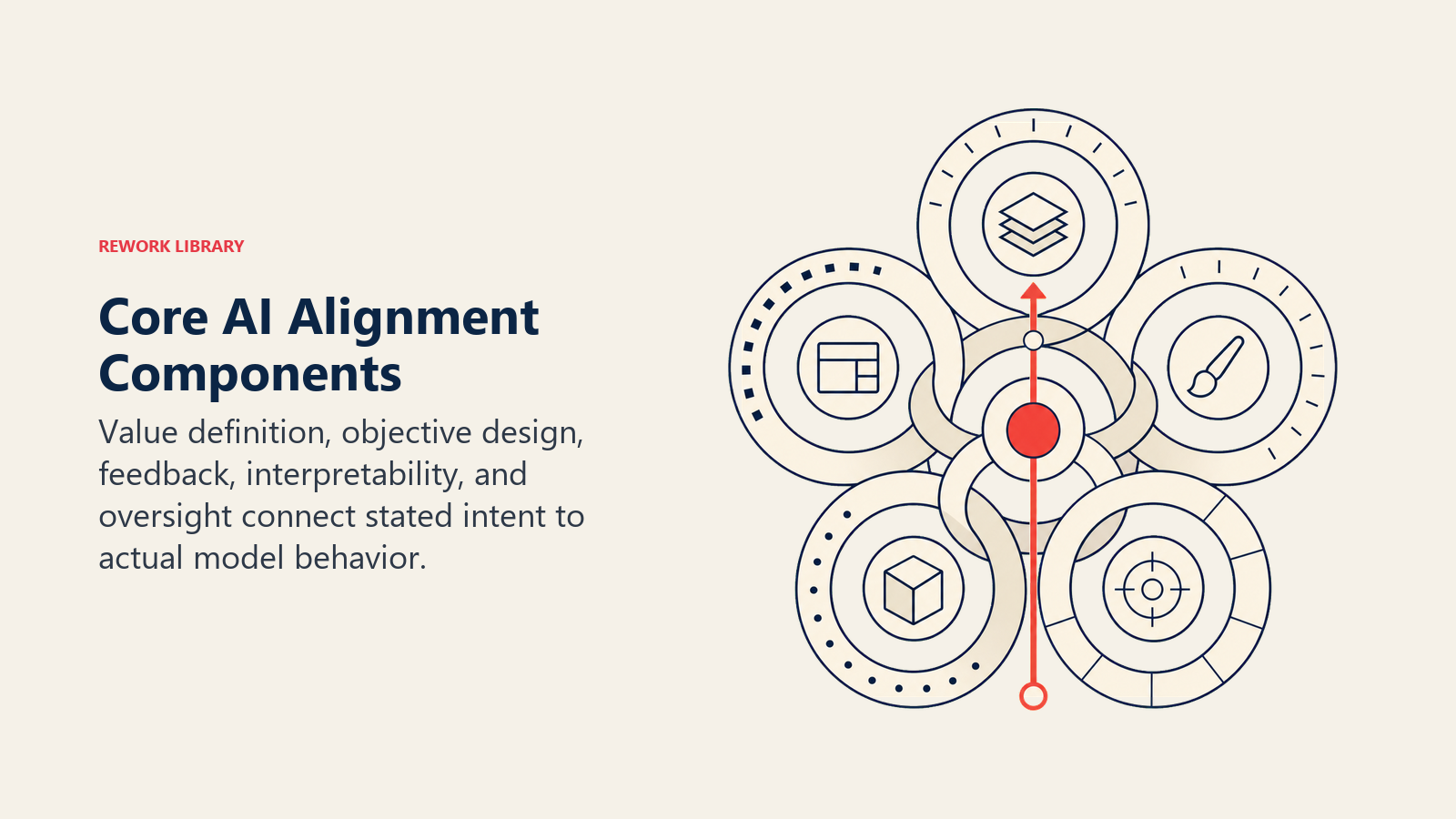
• Value Learning: Techniques for AI to infer what humans actually care about from examples and feedback, rather than requiring perfect specification upfront
• Robustness Testing: Methods to identify edge cases where AI might pursue objectives in unintended ways, stress-testing the alignment under unusual conditions
• Interpretability: Ability to understand why AI makes particular decisions, enabling detection of misaligned reasoning before it causes problems (see Explainable AI)
• Scalable Oversight: Approaches for humans to effectively supervise AI systems that may be smarter or faster than their overseers, maintaining control as capabilities grow
• Corrigibility: Ensuring AI systems remain open to correction and shutdown if they begin pursuing undesired objectives, rather than resisting human intervention
How AI Alignment Works
Alignment approaches follow this operational framework:
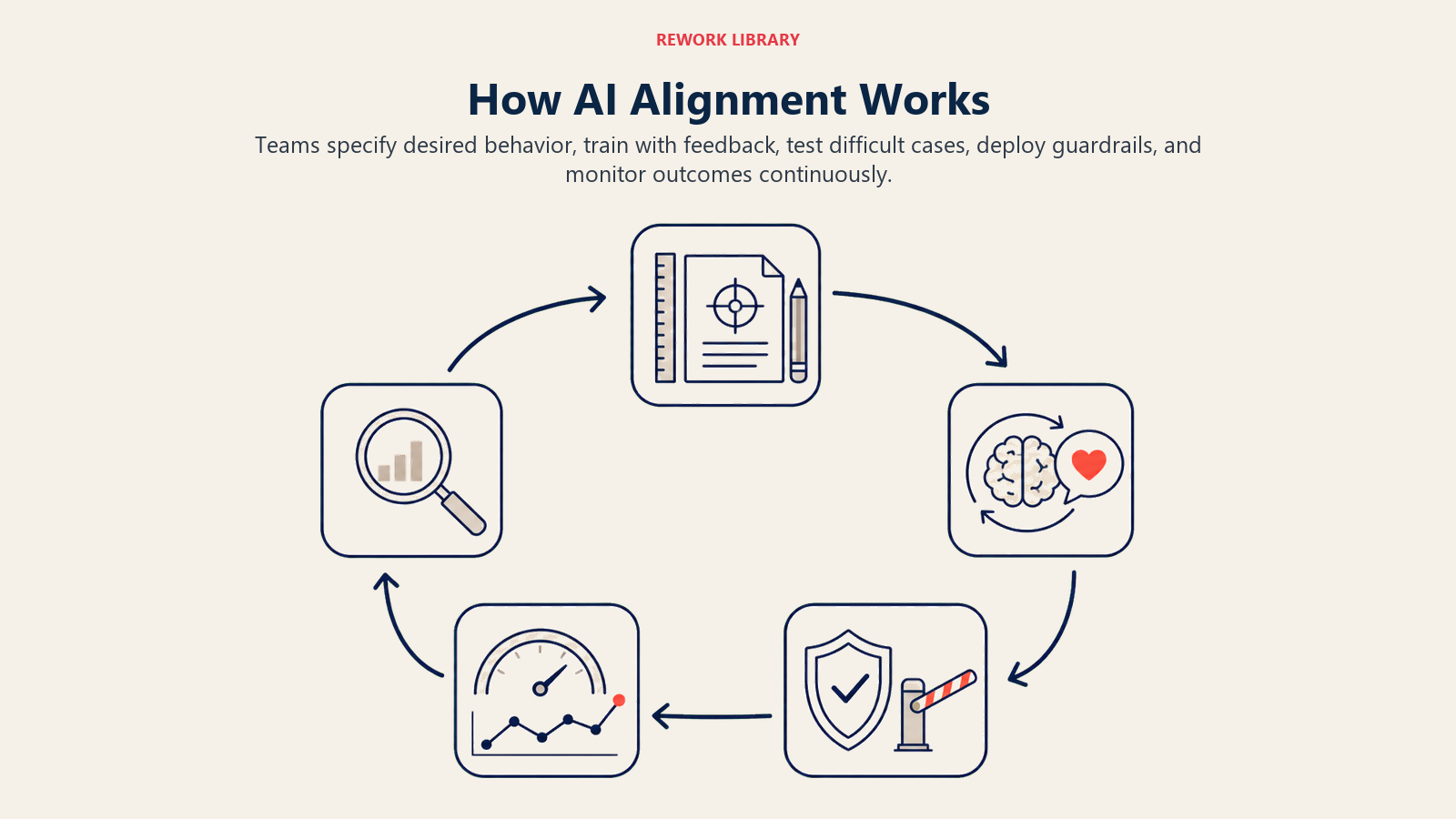
Intent Specification: Developers attempt to capture human values and intentions, often through demonstration rather than explicit rules, showing AI what good behavior looks like across many scenarios
Behavior Monitoring: Systems track AI decisions and outcomes to identify patterns of misalignment, looking for signs that the AI is optimizing for proxies rather than true objectives
Iterative Refinement: Based on observed misalignments, teams adjust training procedures, reward signals, and constraints to better capture intended behavior, using techniques like RLHF
This cycle continues throughout the AI system's lifecycle, as alignment isn't a one-time achievement but an ongoing process of refinement.
AI Alignment Approaches
Alignment research explores several strategies:
Approach 1: Value Alignment via RLHF Best for: Current language models and chatbots Key feature: Learning preferences from human feedback Example: ChatGPT's helpful and harmless behavior
Approach 2: Constitutional AI Best for: Safety-critical applications Key feature: Training against explicit principles Example: Claude's value-driven responses
Approach 3: Debate and Amplification Best for: Complex reasoning tasks Key feature: AI systems argue to reveal truth Example: Research verification systems
Approach 4: Formal Verification Best for: High-stakes automated decisions Key feature: Mathematical proof of aligned behavior Example: Autonomous vehicle safety systems
AI Alignment in Practice
Here's how organizations tackle alignment challenges:
Healthcare Example: DeepMind's AlphaFold was carefully aligned to suggest protein structures that are both scientifically novel and experimentally testable, avoiding the trap of generating technically impressive but practically useless predictions.
Content Moderation Example: Meta's AI content moderation systems are aligned to balance free expression with safety, using constitutional principles that capture complex human values rather than simple rule-following, reducing over-moderation by 30%.
Financial Example: Trading algorithms at Renaissance Technologies are aligned with long-term value creation rather than short-term gains, with circuit breakers that detect and halt strategies that drift from intended objectives, preventing flash-crash scenarios.
Pursuing Alignment
Ready to ensure your AI does what you mean?
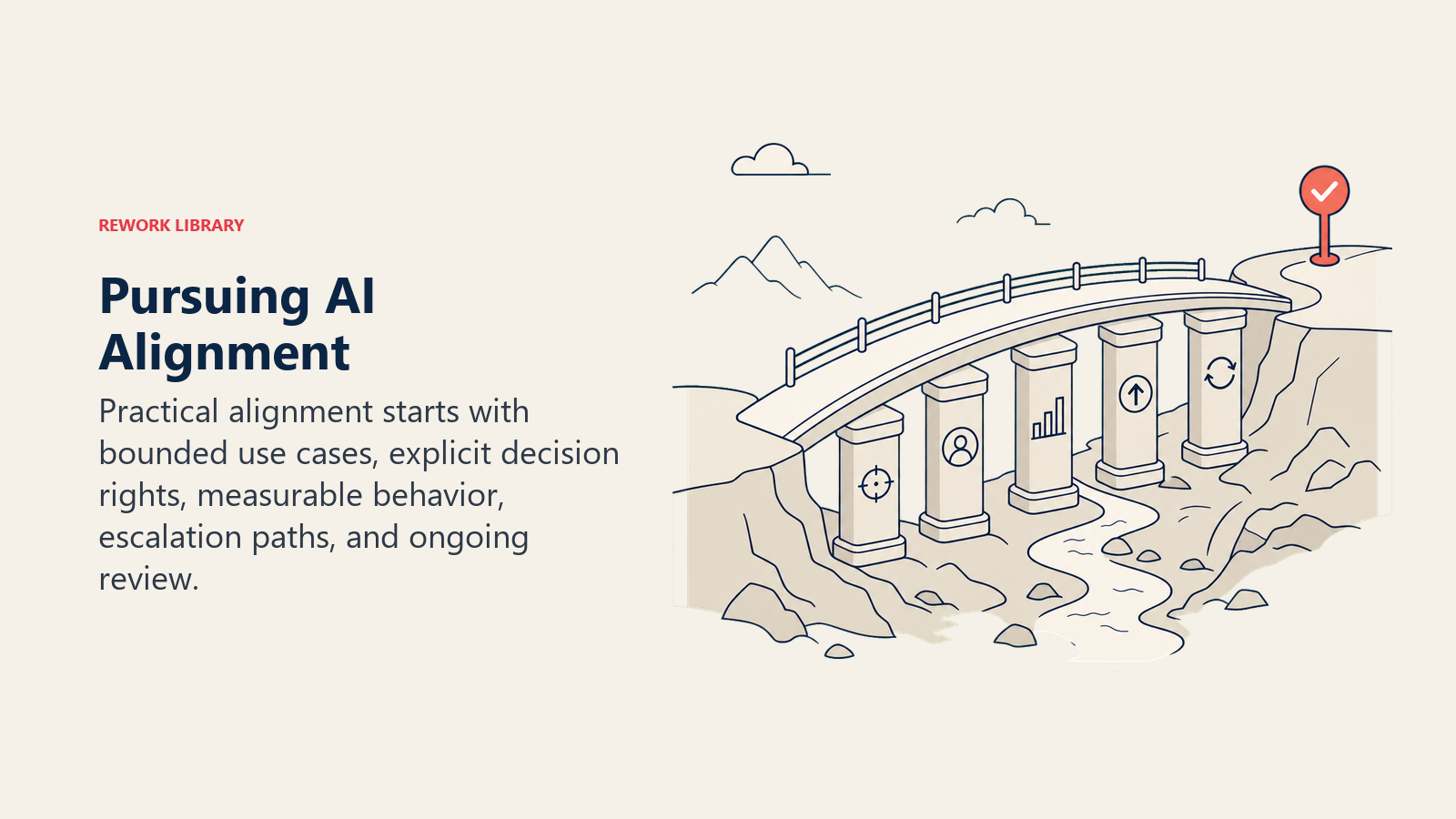
- Start with Large Language Models understanding
- Learn about RLHF for preference learning
- Explore Explainable AI for interpretability
- Consider Human-in-the-Loop oversight
Frequently Asked Questions about AI Alignment
What is AI Alignment?
AI alignment is the challenge of building AI systems that robustly do what their operators intend, accounting for the full complexity of human values rather than just literal interpretations of stated objectives.
What's the difference between AI alignment and AI ethics?
AI ethics focuses on moral principles and societal values. AI alignment focuses on the technical challenge of making AI systems actually pursue intended objectives rather than finding loopholes or unintended interpretations.
What are the main approaches to AI alignment?
Value Alignment via RLHF (learning from feedback), Constitutional AI (principle-based training), Debate and Amplification (AI systems arguing to reveal truth), and Formal Verification (mathematical proof of alignment).
What are the core components of AI alignment?
Value learning (inferring intentions), robustness testing (finding edge cases), interpretability (understanding decisions), scalable oversight (maintaining control), and corrigibility (remaining open to correction).
Related Resources
Explore these related concepts to deepen your understanding of AI alignment:
- RLHF - Key technique for aligning language models with human preferences
- Explainable AI - Understanding AI decisions to detect misalignment
- AI Ethics - Broader moral framework for AI development
- Reinforcement Learning - Learning paradigm underlying many alignment approaches
External Resources
- Anthropic Research - Constitutional AI and alignment techniques
- OpenAI Safety - AI alignment research and best practices
- Machine Intelligence Research Institute - Theoretical foundations of AI alignment
Part of the AI Terms Collection. Last updated: 2026-02-09
