What are Agentic Workflows? When AI Becomes Your Digital Workforce
Turn this article into takeaways for your work.


Each assistant summarizes the article only for you and suggests best practices for your work.
A customer requests a refund at 2 AM. By the time your team arrives at 9 AM, the AI has already verified the purchase, checked return policy eligibility, processed the refund, updated inventory, notified the warehouse, and sent the customer a personalized email with tracking information. No human touched it. This is an agentic workflow: AI that doesn't just answer questions but completes entire processes autonomously.
The Academic Foundation
The term "agentic workflows" emerged from research in autonomous agents and multi-agent systems, formally defined as "goal-directed computational processes where AI systems independently plan, execute, and monitor multi-step tasks across interconnected systems" (OpenAI Research, 2024).
Unlike traditional robotic process automation that follows rigid scripts, agentic workflows leverage large language models for reasoning and decision-making. The architecture builds on research in planning algorithms, reinforcement learning, and tool use, creating systems that can adapt to unexpected situations.
The shift from reactive chatbots to proactive agents represents a fundamental evolution. Where early AI responded to queries, agentic systems initiate actions, make decisions, and handle exceptions, moving from assistant to autonomous worker.
What This Means for Business
For business leaders, agentic workflows mean AI systems that complete entire business processes end-to-end, operating independently within defined guardrails to handle tasks from start to finish without human intervention.
Think of agentic workflows as digital employees who work 24/7, never forget a step, and handle high-volume repetitive processes with perfect consistency. Unlike AI copilots that assist humans, agents work independently, only escalating when they encounter situations outside their authority.
In practical terms, this means lead qualification happens instantly, expense reports get processed without delays, customer onboarding completes in minutes instead of days, and compliance checks run continuously rather than quarterly.
Essential Components
Agentic workflows consist of these essential elements:
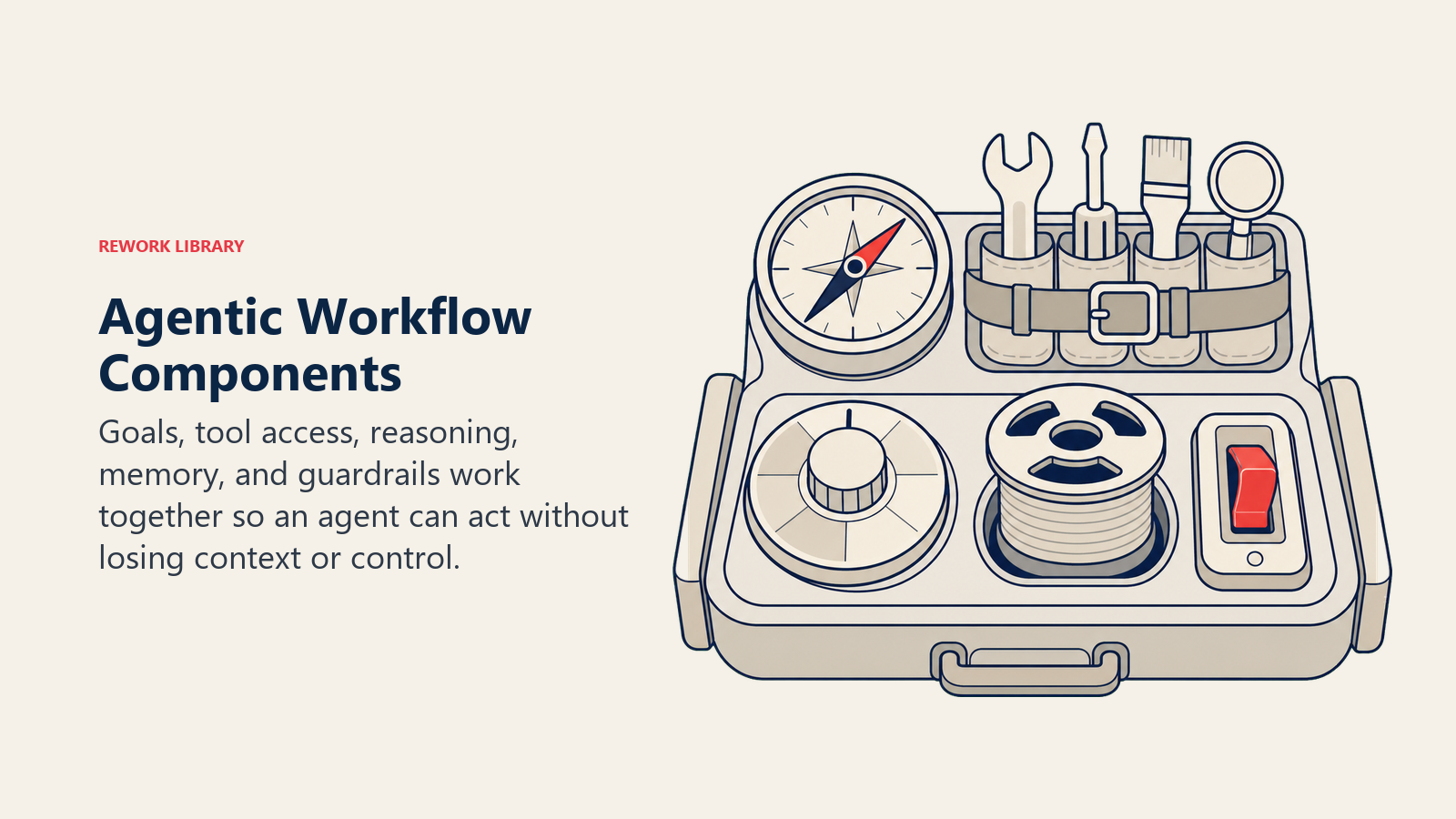
• Goal Definition & Planning: The system's understanding of desired outcomes and ability to break complex objectives into executable steps, dynamically adjusting plans based on intermediate results
• Tool Access Layer: Integration with business systems, databases, and APIs that enable the agent to read data, trigger actions, and update records across your enterprise stack
• Decision Engine: The reasoning capability that evaluates options, assesses trade-offs, and makes judgment calls based on learned patterns and defined policies, powered by generative AI
• Memory & Context: Short-term memory of the current task state and long-term memory of past executions, learning from outcomes to improve future performance
• Guardrails & Oversight: Rules, approval thresholds, and monitoring systems that ensure agents operate within acceptable parameters, escalating edge cases to humans
The Working Process
Agentic workflows follow these steps:
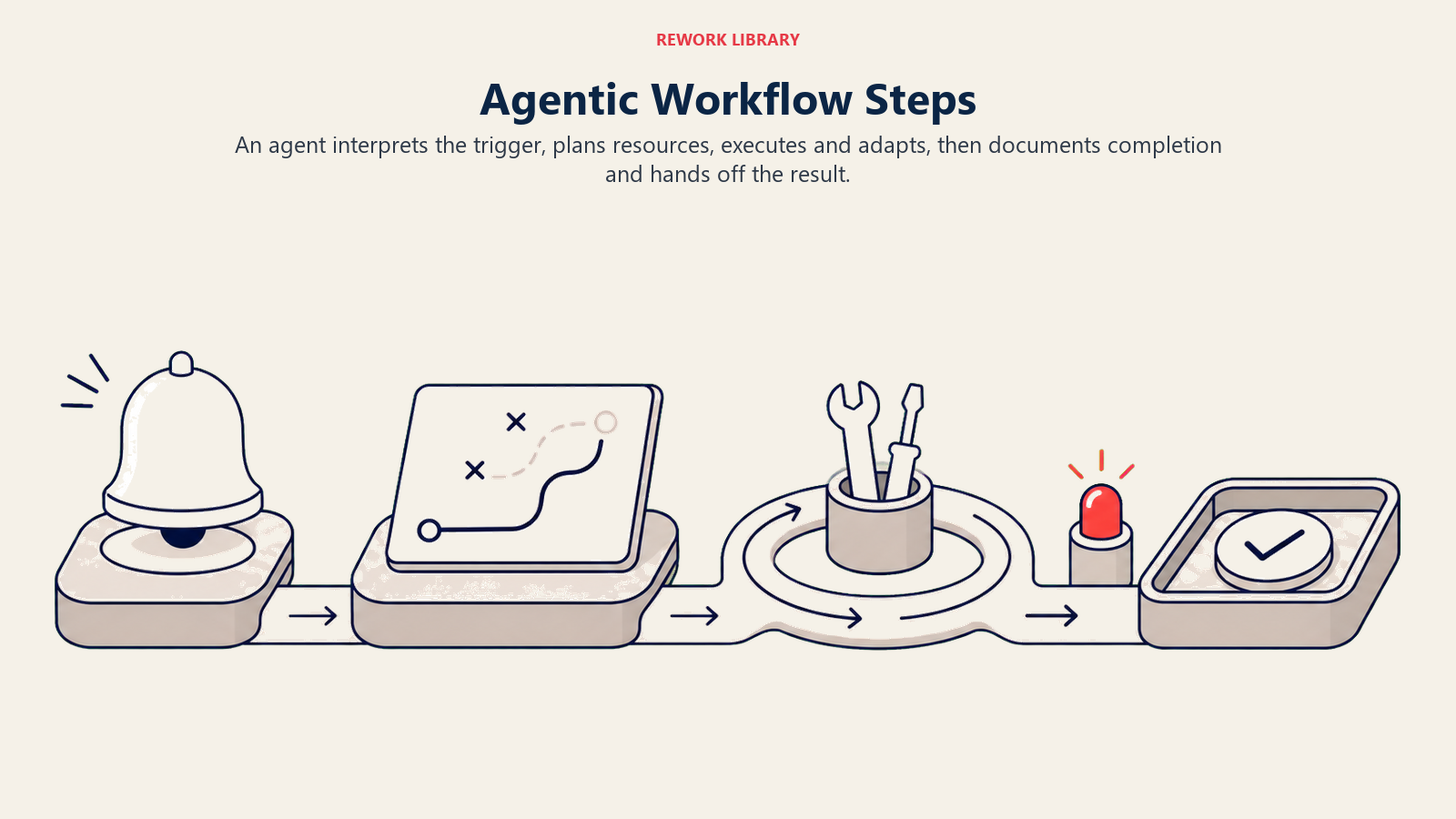
Trigger & Goal Interpretation: An event initiates the workflow like a customer email, form submission, or system alert. The agent interprets the goal, understanding both explicit instructions and implicit requirements
Planning & Resource Assessment: The agent breaks the goal into sub-tasks, identifies required data and tools, and creates an execution plan, accounting for dependencies and potential failure points
Autonomous Execution & Adaptation: The agent executes each step, monitoring outcomes and adjusting the plan as needed. If a payment method fails, it tries alternatives; if data is missing, it requests it from appropriate sources
Completion & Handoff: Upon successful completion, the agent documents actions taken, updates relevant systems, notifies stakeholders, and archives the workflow for future learning
This creates a self-improving automation layer where agents get better at handling edge cases with each execution.
Four Workflow Patterns
Agentic workflows generally fall into four main categories:
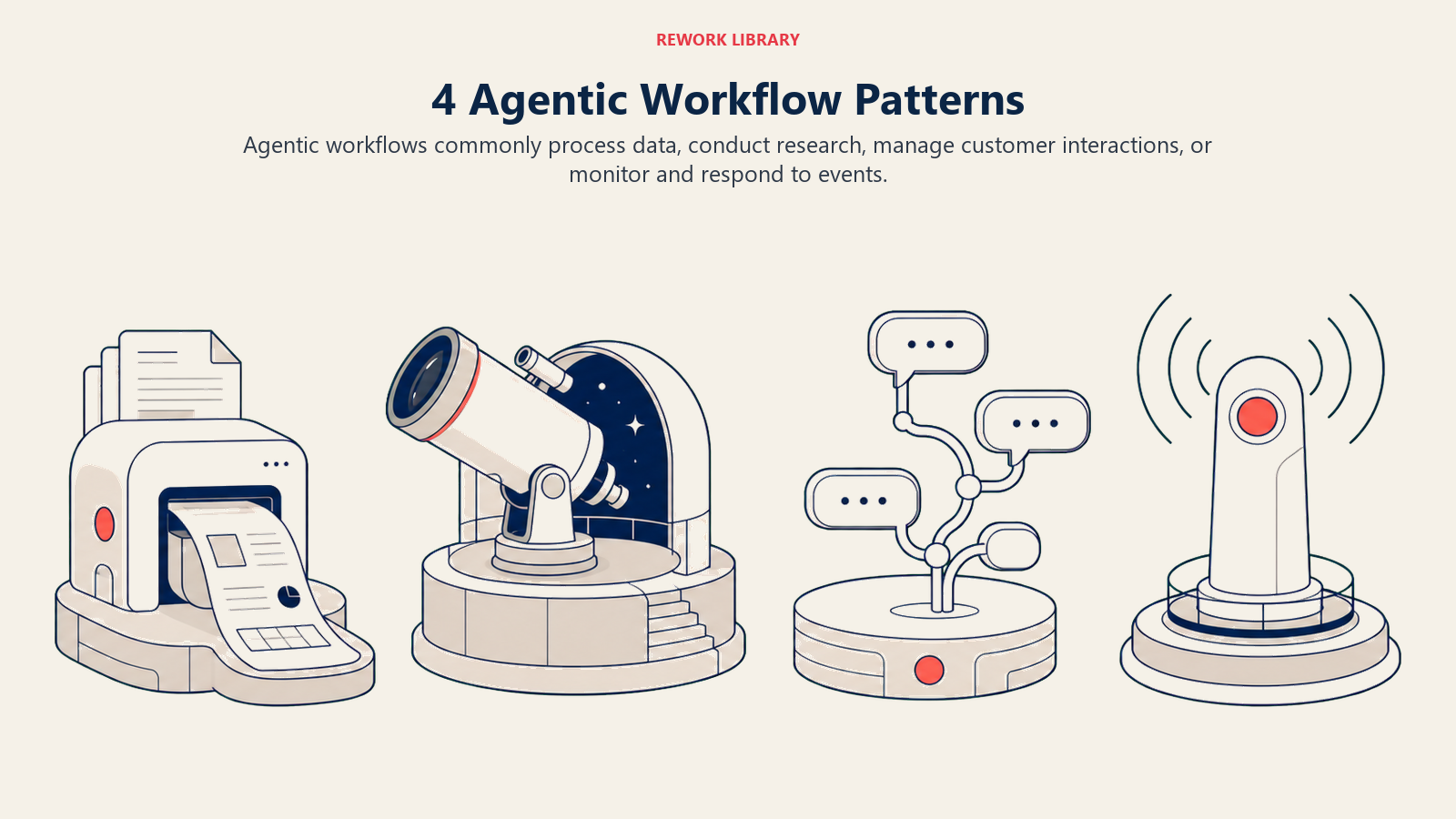
Type 1: Data Processing Workflows Best for: Invoice processing, contract review, data entry Key feature: Transform unstructured inputs into structured outputs Examples: Extracting terms from vendor contracts, categorizing support tickets
Type 2: Research & Analysis Workflows Best for: Competitive intelligence, due diligence, market research Key feature: Gather information from multiple sources and synthesize insights Examples: Compiling prospect company profiles, analyzing industry trends
Type 3: Customer Interaction Workflows Best for: Onboarding, support, account management Key feature: Multi-turn interactions with decision branching Examples: Qualifying leads, troubleshooting technical issues, processing returns
Type 4: Monitoring & Response Workflows Best for: Compliance, security, quality assurance Key feature: Continuous system monitoring with automated remediation Examples: Detecting anomalies and initiating incident response, enforcing policy violations
Agentic Workflows in Action
Here's how businesses actually use agentic workflows:
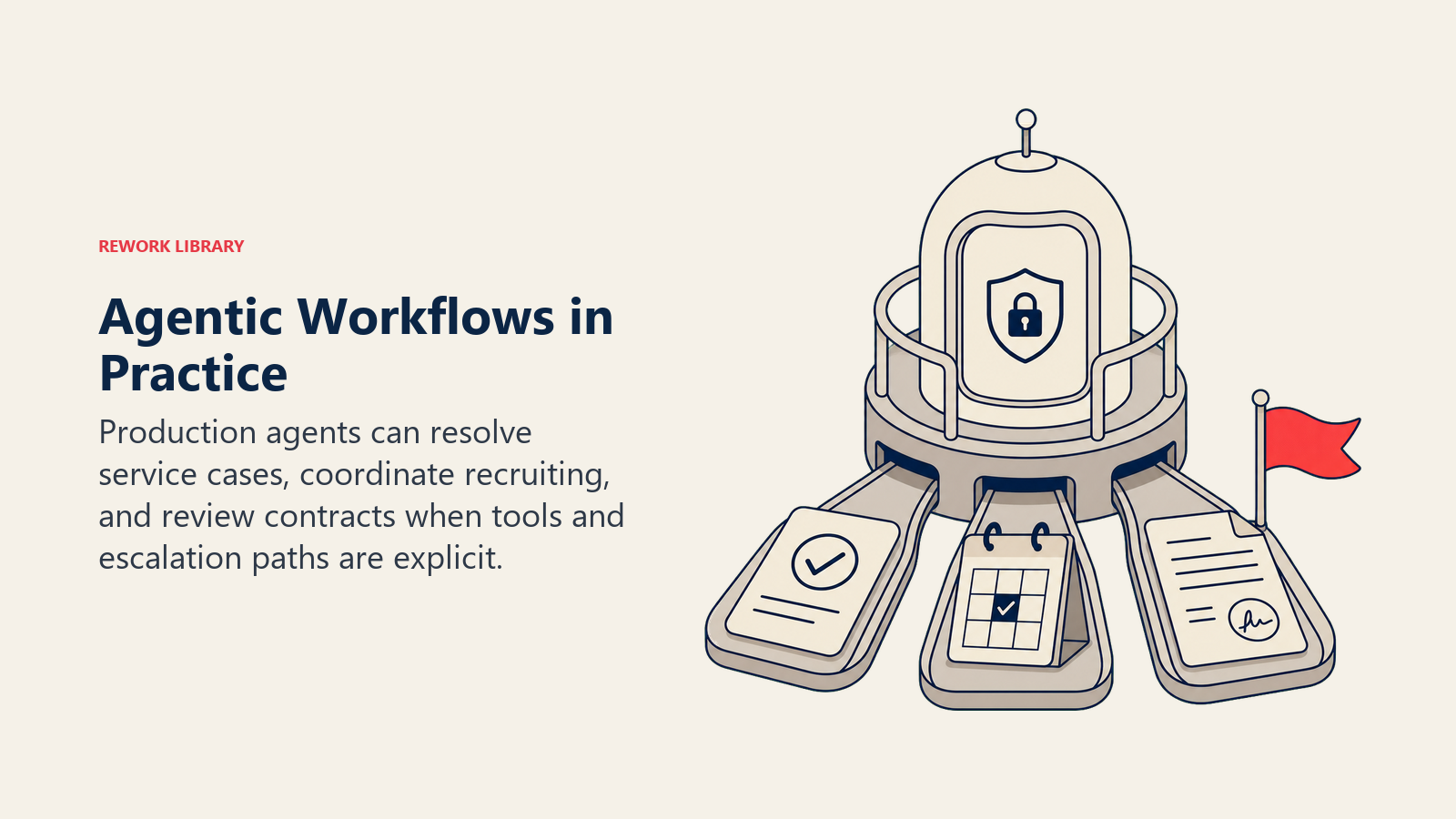
Financial Services Example: Klarna deployed AI agents that handle 2.3 million customer service conversations monthly, resolving 70% of inquiries end-to-end with average satisfaction scores matching human agents. The agents check account status, process disputes, and update billing autonomously.
Recruiting Example: Paradox's AI agent Olivia screens candidates, schedules interviews, and sends reminders, processing 100,000+ candidate interactions daily. Companies using Olivia reduce time-to-hire by 40% while improving candidate experience scores.
Legal Example: Harvey AI agents review contracts, identify non-standard clauses, and flag risks, processing due diligence workflows that previously required 50+ attorney hours in under 2 hours with 95% accuracy on risk identification.
Implementation Strategy
Ready to deploy agentic workflows in your organization?
- Start with AI Agents fundamentals to understand agent capabilities
- Design guardrails using AI Governance frameworks
- Integrate systems through AI Integration architectures
- Monitor performance with AI Observability tools
Related AI Concepts
Explore these topics to build comprehensive agentic strategies:
- AI Orchestration - Coordinate multiple AI agents working together
- Tool Use - Enable agents to access external systems
- AI Safety - Prevent unintended agent behaviors
- Human-in-the-Loop - Balance autonomy with oversight
External Resources
- OpenAI Research - Latest developments in autonomous AI systems
- Stanford HAI - Human-centered AI research on agent safety
- Anthropic Research - Constitutional AI for reliable agents
Frequently Asked Questions about Agentic Workflows
What are Agentic Workflows?
Agentic workflows are autonomous AI systems that complete multi-step business processes end-to-end without human intervention, making decisions, taking actions across systems, and handling exceptions within defined parameters.
What's the difference between agentic workflows and RPA?
Traditional RPA follows rigid scripts and breaks when anything changes. Agentic workflows use AI reasoning to adapt to variations, make judgment calls, and handle unexpected situations, making them suitable for processes with high variability.
What are the main types of agentic workflows?
Four types: Data processing workflows (transform inputs to outputs), research & analysis workflows (gather and synthesize information), customer interaction workflows (multi-turn engagements), and monitoring & response workflows (continuous oversight with automated actions).
What are the risks of autonomous AI agents?
Key risks include unintended actions outside defined parameters, bias amplification at scale, security vulnerabilities from system access, and loss of human judgment on nuanced decisions. Mitigate through comprehensive guardrails, monitoring, and human escalation paths.
How do we measure ROI on agentic workflows?
Track process completion time (typically 60-90% reduction), throughput volume (often 10x increase), error rates (generally 50-80% lower), and labor reallocation to higher-value work. Most implementations show positive ROI within 3-6 months.
Part of the AI Terms Collection. Last updated: 2026-02-09
