What are AI Voice Agents? When AI Answers Your Phone Calls
Turn this article into takeaways for your work.


Each assistant summarizes the article only for you and suggests best practices for your work.
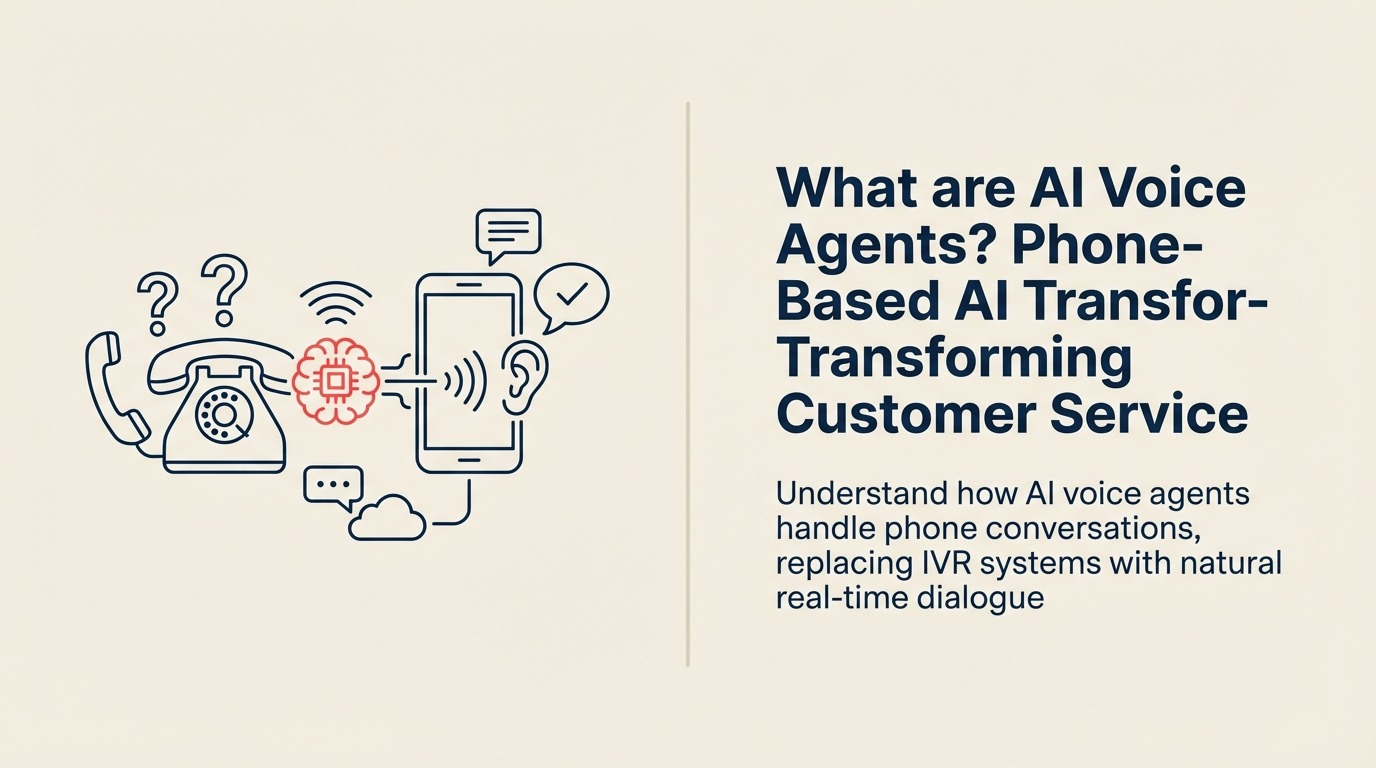
Your customers hate IVR menus. "Press 1 for sales, press 2 for support, press 3 to speak to a representative." They want to just explain their problem and get help. AI voice agents make this possible: natural phone conversations with AI that understands context, accesses your systems, and resolves issues in real-time, no menu trees required.
The Academic Foundation
AI voice agents represent the convergence of multiple AI disciplines, defined as "autonomous conversational systems that conduct real-time spoken dialogue over telephony infrastructure, integrating speech recognition, natural language understanding, dialogue management, and text-to-speech synthesis" (Stanford AI Lab, 2024).
The technology builds on decades of research in speech processing and natural language processing, but recent breakthroughs in large language models and low-latency speech synthesis enabled truly conversational experiences. Earlier systems like Siri and Alexa handled simple commands; modern voice agents conduct nuanced multi-turn conversations with interruptions, clarifications, and emotional awareness.
The architecture evolved from rigid dialogue trees in the 1990s to today's generative systems that dynamically construct responses based on conversation context, similar to how humans naturally communicate.
What This Means for Business
For business leaders, AI voice agents mean scalable phone-based customer service that handles routine inquiries with human-like conversation, reducing wait times and costs while freeing human agents for complex, high-value interactions.
Think of voice agents as your best phone rep who works 24/7, never gets tired, handles unlimited concurrent calls, and maintains perfect consistency. Unlike traditional IVR that frustrates customers with menu navigation, voice agents let customers speak naturally: "I need to reschedule my Friday appointment" instead of "Press 4, then 2, then enter your account number."
In practical terms, this translates to appointment scheduling, order tracking, basic troubleshooting, payment processing, and information lookup handled by AI, while human agents focus on sales, complex issues, and relationship building.
Essential Components
AI voice agents consist of these essential elements:
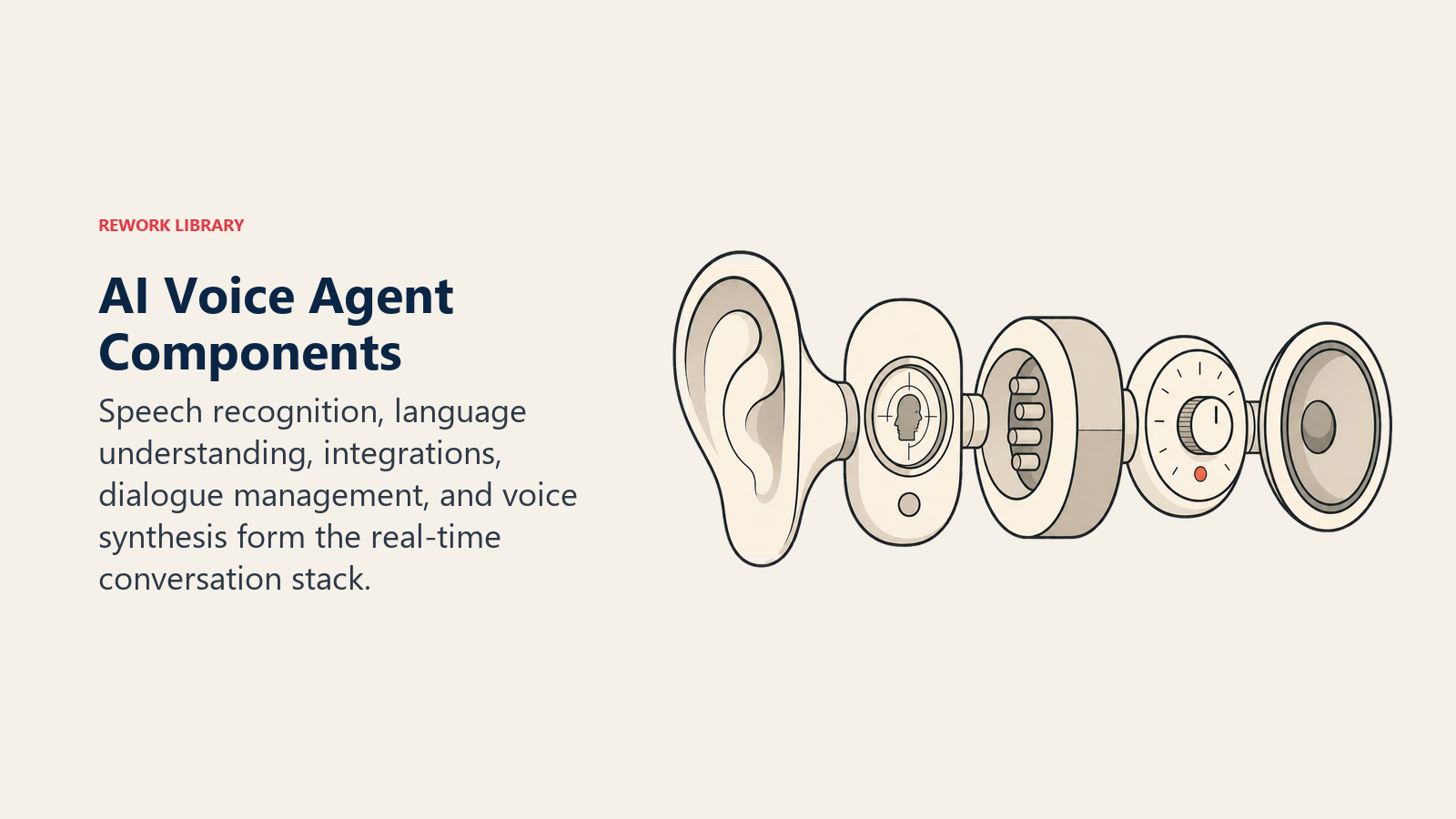
• Speech-to-Text Engine: Real-time transcription of customer speech into text with accuracy across accents, background noise, and industry terminology, typically achieving 95%+ accuracy on clear connections
• Language Understanding Core: Generative AI that interprets customer intent, extracts relevant entities like account numbers or dates, and understands context from conversation history
• Integration Layer: Connections to CRM systems, databases, scheduling platforms, and knowledge bases enabling the agent to check order status, verify accounts, and take actions during the conversation
• Dialogue Management: The reasoning system that decides what to say next, when to ask clarifying questions, when to offer alternatives, and when to escalate to human agents
• Text-to-Speech Synthesis: Natural-sounding voice generation with appropriate pacing, emotion, and prosody, increasingly indistinguishable from human speech using models like ElevenLabs or Amazon Polly
The Working Process
AI voice agents follow these steps:
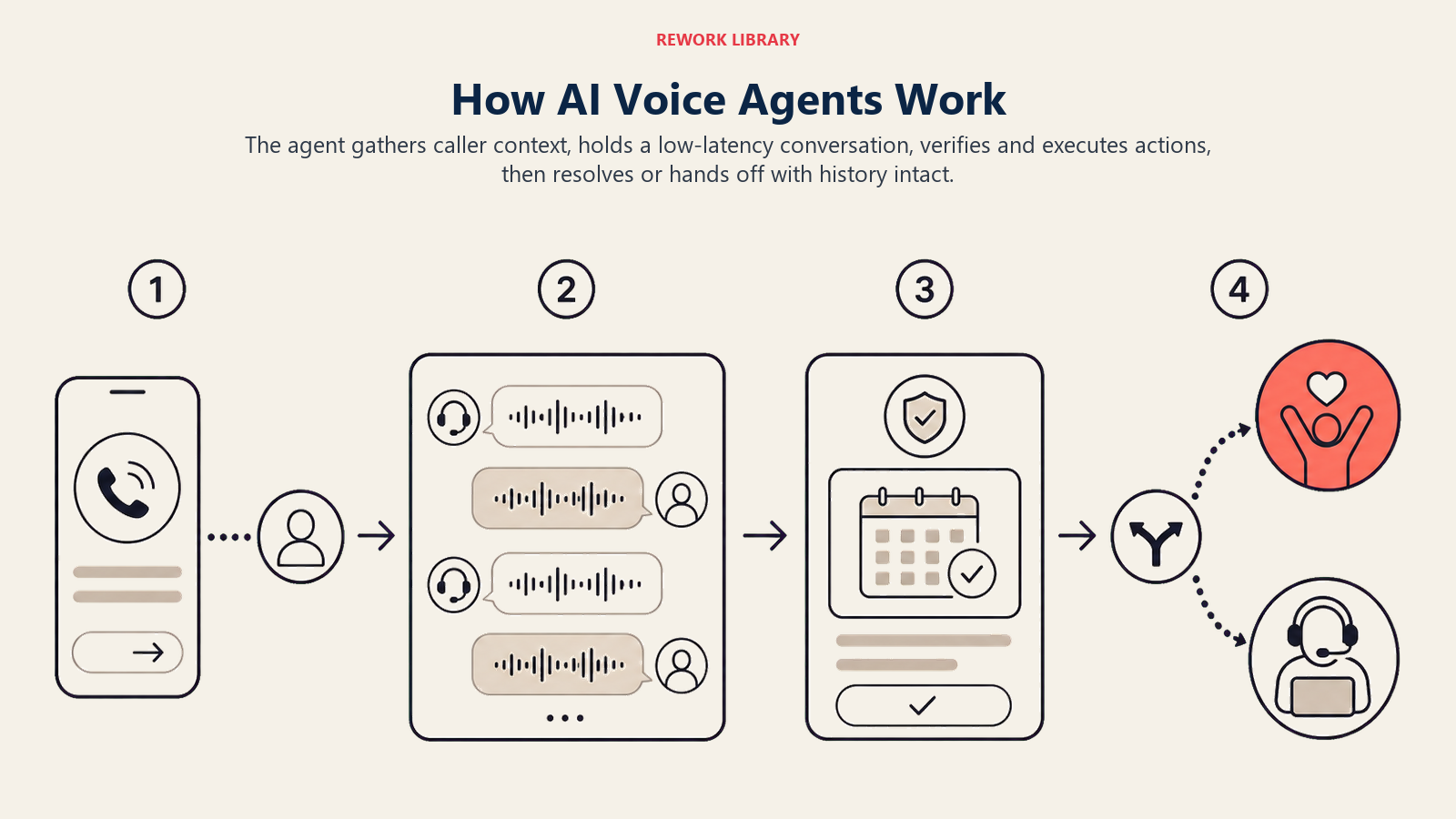
Call Initiation & Context Gathering: When a customer calls, the agent greets them, identifies the caller through phone number lookup or voice authentication, and retrieves relevant account information before conversation begins
Real-Time Conversation: As the customer speaks, the system transcribes words, interprets intent, and formulates responses in under 300 milliseconds to maintain natural flow, handling interruptions and clarifications like humans do
Action & Verification: When customers request actions like rescheduling or refunds, the agent confirms understanding, checks system constraints (available time slots, refund eligibility), executes changes, and confirms completion
Escalation or Resolution: For routine requests, the agent completes the interaction with summary and next steps. For complex issues, it gathers context and seamlessly transfers to a human agent with full conversation history
This creates a conversation experience that feels natural while operating at machine scale and speed.
Four Deployment Models
AI voice agents generally fall into four main categories:
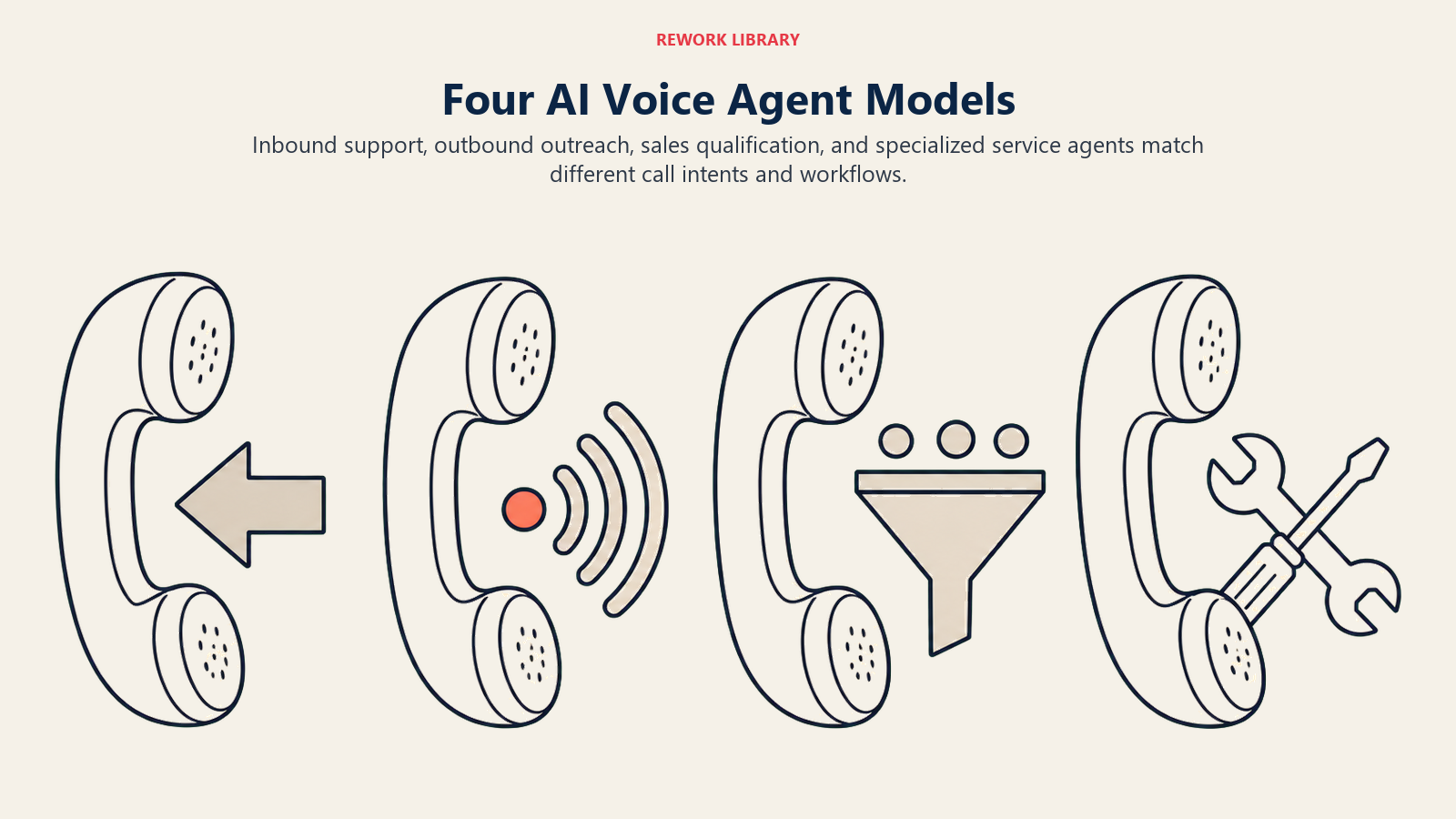
Type 1: Inbound Support Agents Best for: Customer service, technical support, account inquiries Key feature: Handle incoming calls for routine issue resolution Examples: Order status, password resets, basic troubleshooting, appointment changes
Type 2: Outbound Call Agents Best for: Appointment reminders, payment collection, customer surveys Key feature: Initiate calls to customers for proactive outreach Examples: Confirming appointments, collecting feedback, verifying deliveries
Type 3: Sales Qualification Agents Best for: Lead qualification, product information, demo scheduling Key feature: Engage prospects and route qualified leads to sales reps Examples: Answering product questions, booking sales calls, capturing requirements
Type 4: Specialized Function Agents Best for: Restaurants (reservations), healthcare (scheduling), utilities (outage reporting) Key feature: Domain-specific workflows with deep integration Examples: OpenTable-style booking, prescription refills, service appointments
AI Voice Agents in Action
Here's how businesses actually use AI voice agents:
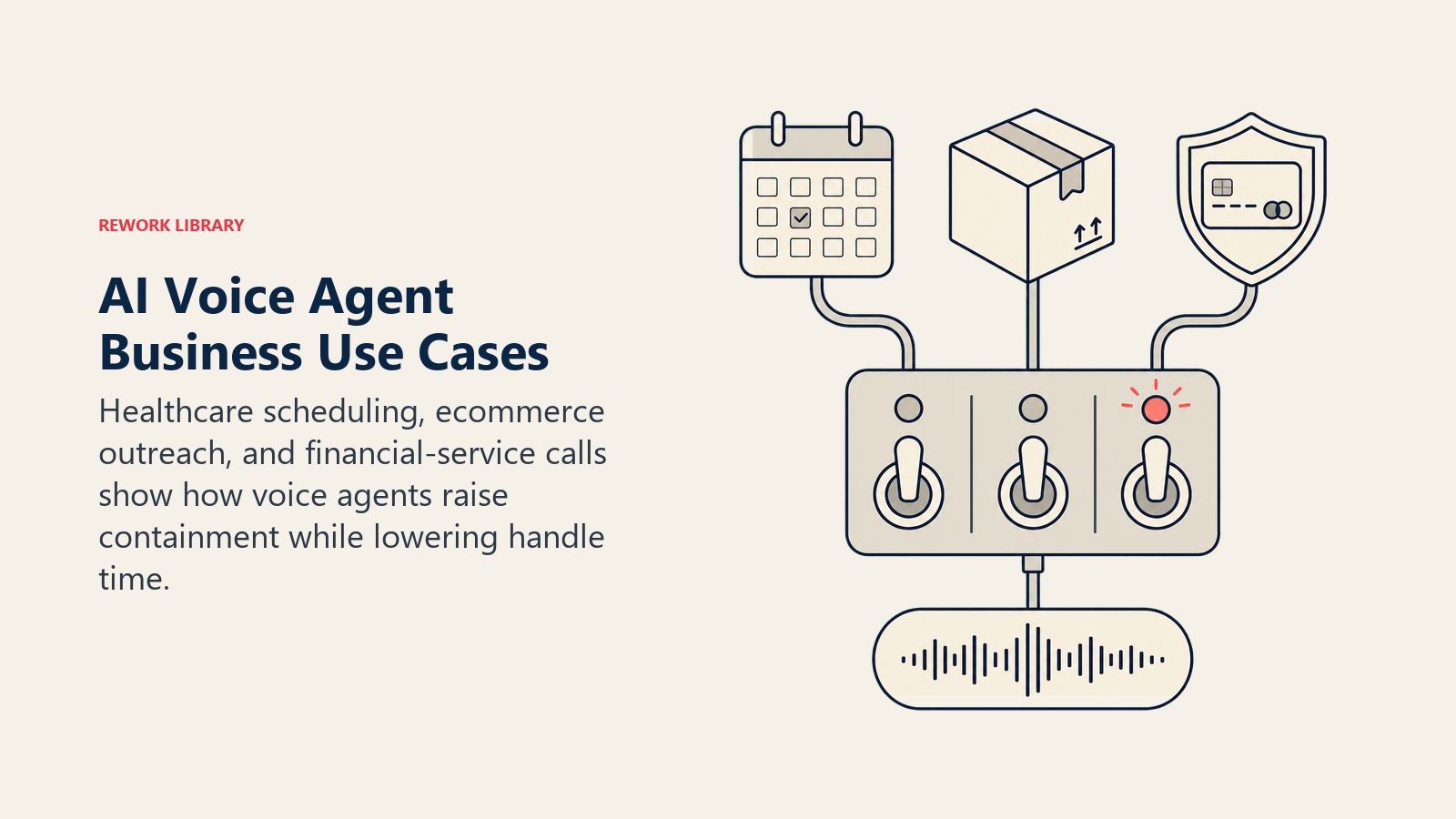
Healthcare Example: Suki's AI voice agent handles 70% of appointment scheduling and rescheduling calls for a 50-clinic network, processing 12,000+ calls monthly. Patient satisfaction scores match human schedulers (4.6/5) while reducing administrative costs by $420,000 annually.
E-commerce Example: Shopify merchants using Synthflow AI voice agents reduced cart abandonment by 15% through proactive outbound calls offering assistance. The AI handles 200+ concurrent calls, converting 22% of reached customers vs 8% baseline.
Financial Services Example: American Express deployed Amelia, an AI voice agent handling account inquiries, payment processing, and fraud alerts. The agent resolves 65% of calls without human transfer, with average handle time of 4.2 minutes vs 11.3 minutes for human agents on similar calls.
Deployment Decision Framework
Ready to deploy AI voice agents in your organization?
- Start with Conversational AI fundamentals
- Design conversation flows using Dialogue Design principles
- Integrate systems through AI Integration patterns
- Plan human handoff with Human-in-the-Loop strategies
Related AI Concepts
Explore these topics to build comprehensive voice AI strategies:
- AI Agents - Autonomous AI systems that take actions
- Speech Recognition - Converting speech to text
- Sentiment Analysis - Detecting customer emotions
- Call Analytics - Measuring conversation performance
- Latency - Why sub-300ms response time is critical for voice AI to feel natural
External Resources
- ElevenLabs - Advanced text-to-speech for voice agents
- Synthflow AI - Voice agent platform
- Amazon Polly - Text-to-speech service
Frequently Asked Questions about AI Voice Agents
What are AI Voice Agents?
AI voice agents are autonomous systems that conduct natural phone conversations with customers, handling inquiries, taking actions, and resolving issues through real-time spoken dialogue, replacing traditional IVR menus.
What's the difference between AI voice agents and IVR?
Traditional IVR uses menu trees ("press 1 for...") requiring customers to navigate options. AI voice agents understand natural speech, letting customers explain needs conversationally. IVR is rigid; voice agents adapt to context and handle unpredictable requests.
When should we use AI voice agents vs human agents?
Deploy AI for high-volume routine tasks: appointment scheduling, order tracking, password resets, information lookup, payment processing. Keep humans for complex problem-solving, sales negotiation, emotional situations, and cases requiring judgment.
How do we measure AI voice agent performance?
Track containment rate (% of calls resolved without human transfer), average handle time, customer satisfaction scores, first-call resolution rate, and cost per interaction. Best performers achieve 60-80% containment with satisfaction scores matching human baselines.
Can customers tell they're talking to AI?
Modern voice agents often disclose they're AI upfront for transparency ("Hi, I'm an AI assistant..."). Some implementations using advanced synthesis are nearly indistinguishable from humans, raising ethical questions. Best practice: be transparent while delivering excellent service.
Part of the AI Terms Collection. Last updated: 2026-02-09
