What is On-Device AI?
Turn this article into takeaways for your work.


Each assistant summarizes the article only for you and suggests best practices for your work.
On-device AI is artificial intelligence that runs directly on local hardware, a smartphone, laptop, or embedded chip, instead of sending requests to a remote server. The model's computation happens on the device itself, using onboard chips like NPUs, so the system can respond without an internet connection, and the data never has to leave the hardware it started on.
That single design choice, keep the computation local instead of routing it to a data center, changes the economics, the privacy profile, and the failure modes of an AI feature. It's also the reason your phone can now transcribe a voice memo, summarize a text thread, or rewrite an email while sitting in airplane mode.
How On-Device AI Actually Runs Locally
Running a large model on a phone used to be a non-starter. A frontier-scale large language model can have hundreds of billions of parameters and needs data-center GPUs just to answer a single query. Consumer hardware has a fraction of that memory and power budget. Three developments closed the gap.
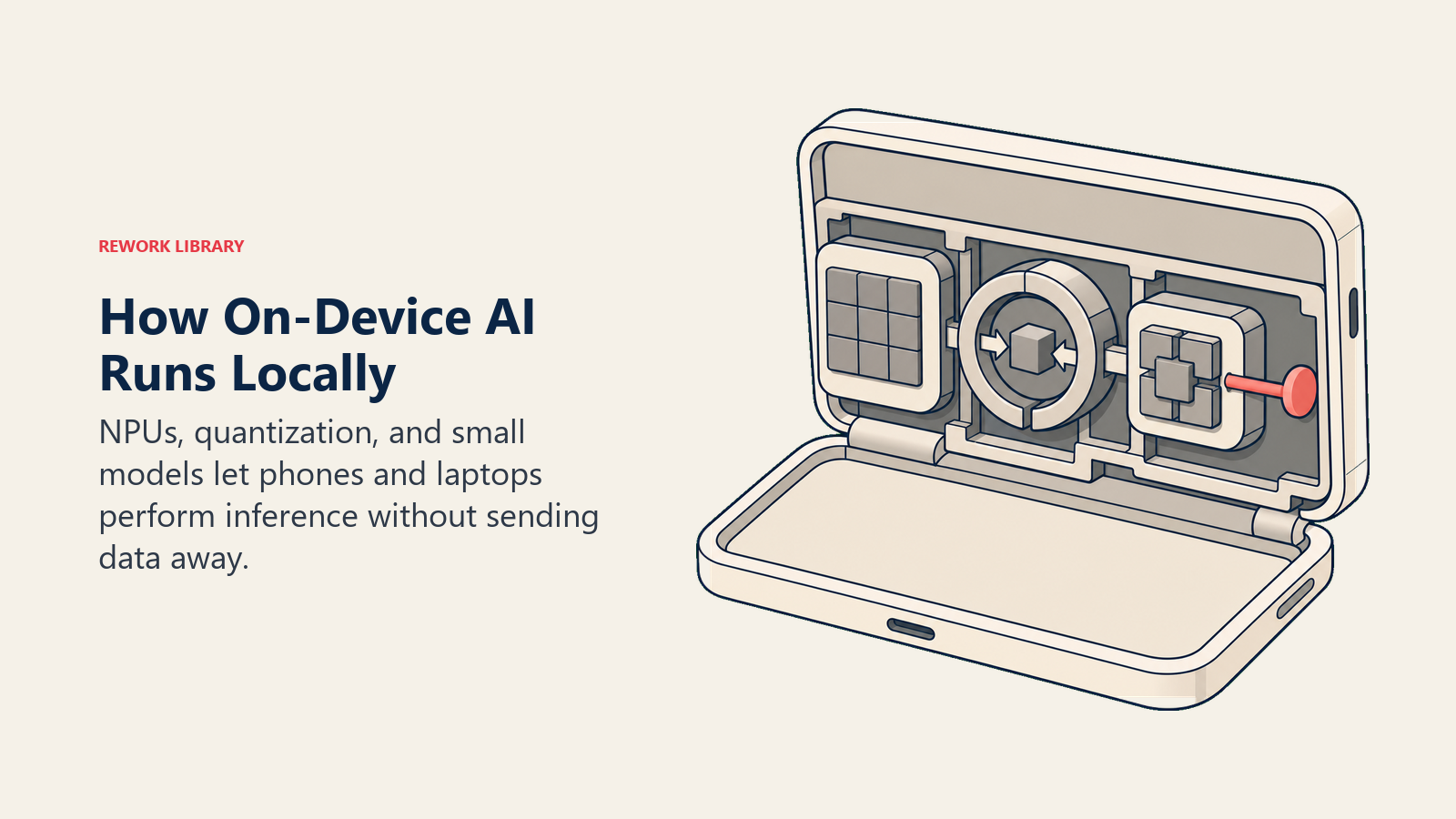
Neural Processing Units (NPUs). Modern phone and laptop chips now ship with a dedicated AI accelerator alongside the CPU and GPU. An NPU is purpose-built for the matrix math that neural networks run constantly, and it does that math far more efficiently, in both speed and battery draw, than a general-purpose processor would. Qualcomm's Snapdragon 8 Elite Gen 5, built for 2026-generation phones, ships with a Hexagon NPU that Qualcomm says runs 37 percent faster than the previous generation's, specifically to let bigger models run locally without draining the battery.
Quantization. Even with a dedicated chip, a full-precision model is usually too large to fit in a phone's memory. Quantization shrinks a model by reducing the numerical precision of its weights, often from 32-bit down to 8-bit or 4-bit, cutting the memory footprint by 4x to 8x with only a small accuracy tradeoff. This is the step that turns a model built for a server rack into one that fits on a phone.
Small Language Models (SLMs). Alongside compression, model builders are training models to be small from the start. Small language models, typically in the 1 to 10 billion parameter range, are designed to be capable enough for a defined set of tasks (summarizing, rewriting, classifying, answering questions about on-screen content) while staying light enough to run on a phone's NPU. Knowledge distillation, where a small "student" model learns to mimic a larger "teacher," is one of the main techniques used to build them.
Put together, these three pieces let a phone or laptop run inference, the step where a trained model actually produces an answer, entirely on local silicon, with no data ever sent out over the network.
Why Businesses and Users Want It: Privacy, Latency, Offline, Cost
Privacy. When inference runs on the device, the input never has to leave it. A voice memo, a photo, a draft email, or a patient note can be processed without transmitting that content to a third-party server. For regulated industries or any workflow touching sensitive data, that's often the deciding factor over the actual model quality.
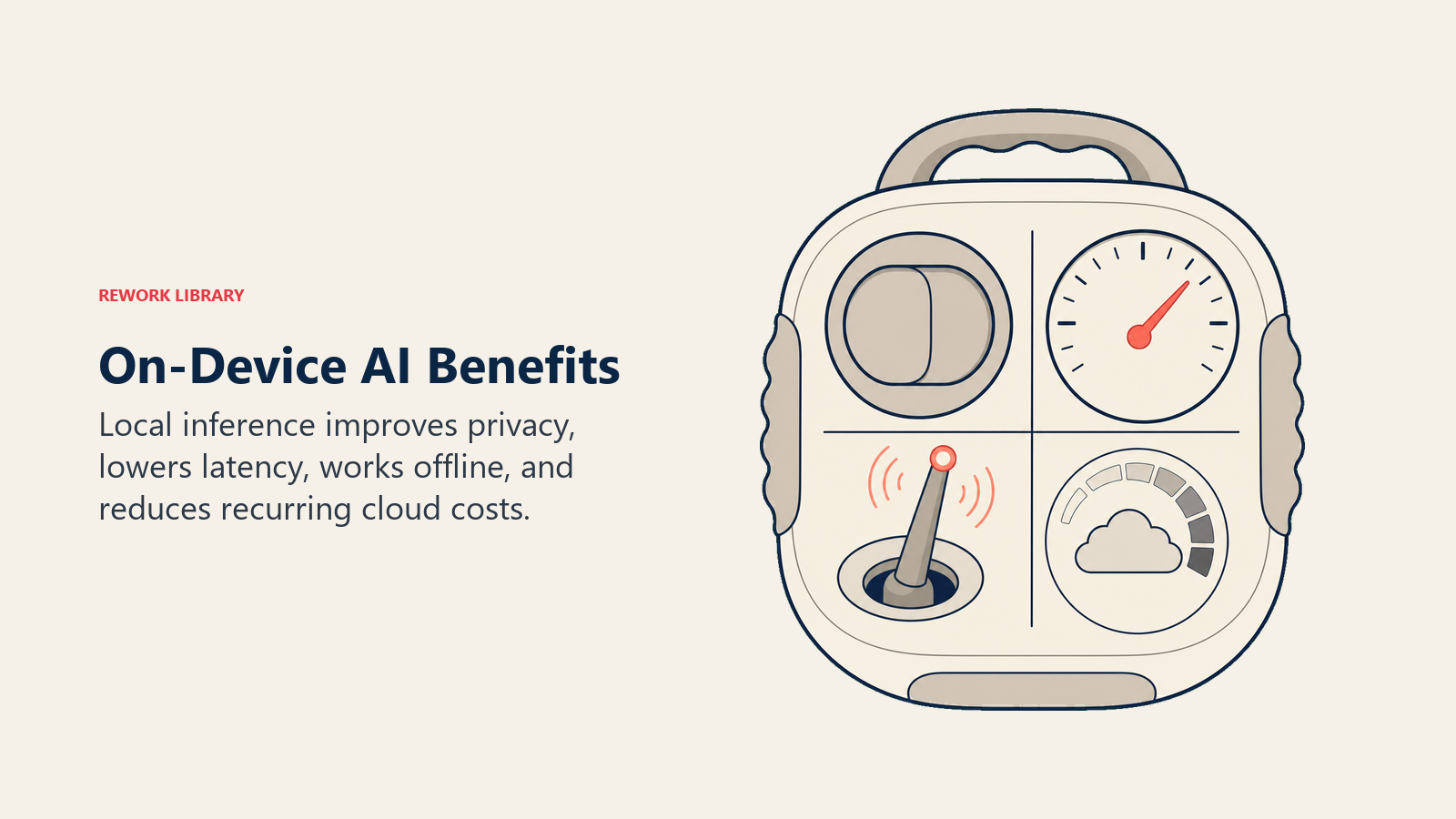
Latency. A cloud request has to travel to a data center and back, even before the model starts computing. On-device inference skips that round trip entirely, which is why local features (autocomplete, live transcription, on-screen summarization) feel instant while cloud-routed features have a visible delay.
Offline operation. A model running locally works with no signal, on a plane, in a basement, on a factory floor, or in a rural area with unreliable connectivity. Anything that depends on a live API call stops working the moment the connection drops.
Cost. Cloud inference is billed per token or per call and scales directly with usage; a feature that gets popular gets expensive. On-device inference runs on hardware the user or business already owns, so there's no marginal cost per query once the model is on the device.
The Real Limits: Model Size and Battery
On-device AI isn't a free upgrade over cloud AI, and pretending otherwise sets the wrong expectations internally. Two constraints define what's actually possible today.
Model size caps capability. Phone and laptop memory measures in single-digit or low double-digit gigabytes, not the hundreds of gigabytes a data center GPU cluster has access to. That ceiling means on-device models are, by necessity, smaller and less broadly capable than frontier cloud models. They're strong at narrow, well-defined tasks and weaker at open-ended reasoning, long documents, or anything requiring very current knowledge.
Battery and thermal limits. Even with an efficient NPU, sustained AI inference draws power and generates heat, both of which are scarce resources on a battery-powered device. That's a real constraint on how much on-device processing a device can do continuously without visibly draining the battery or throttling performance, which is part of why phone makers route heavier requests to the cloud rather than forcing everything through the local chip.
Deloitte's own 2026 forecast captures this tension directly: despite the growth of onboard AI accelerators in phones and PCs, Deloitte predicts that almost all AI computing in 2026 will still happen in large data centers or on high-end enterprise servers rather than on-device, because current NPUs are only powerful enough for lighter, one-shot inference tasks like summarizing a short email, not sustained, complex reasoning.
That's the practical shape of on-device AI today: real and growing fast, but a complement to cloud AI rather than a full replacement for it.
Key Facts
- GenAI-capable smartphones, phones that run AI models on-device, are forecast to reach 45 percent of global smartphone shipments in 2026, up from 36 percent in 2025, according to Counterpoint Research.
- Cumulative global shipments of GenAI-capable smartphones surpassed 500 million units by the third quarter of 2025, per Counterpoint Research.
- The share of smartphones shipped with generative AI capability could exceed 30 percent by the end of 2025, and close to half of all PCs sold in 2025 will have local generative AI processing capacity, according to Deloitte's 2025 TMT Predictions.
- AI PCs were projected to represent 31 percent of the worldwide PC market by the end of 2025, according to Gartner.
- Despite the rise of on-device AI accelerators, Deloitte's 2026 TMT Predictions forecast that almost all AI compute in 2026 will still run in data centers or on high-end enterprise servers rather than on PCs and phones, since today's NPUs are built for lighter, one-shot inference rather than sustained heavy workloads.
- The cost of running inference at GPT-3.5 performance level fell from $20.00 to $0.07 per million tokens between November 2022 and October 2024, a more than 280-fold drop driven largely by efficient small models, according to the Stanford AI Index 2025 report.
- Qualcomm's Snapdragon 8 Elite Gen 5, built for 2026-generation phones, ships with a Hexagon NPU that Qualcomm says runs 37 percent faster than its predecessor, specifically to run larger models locally.
On-Device AI in 2026: Real Examples
On-device AI has moved from a research demo to a standard feature across major consumer platforms.
Apple Intelligence. Apple built its AI system around on-device processing by default. Many of the models behind Apple Intelligence run entirely on the iPhone, iPad, or Mac; when a request needs a larger model than can fit on the device, it's routed to Apple's Private Cloud Compute, which Apple says runs on dedicated Apple silicon servers with the same security model as the device itself, rather than a general-purpose cloud.
Gemini Nano. Google's Gemini Nano is a compact version of its Gemini model family, built specifically to run on-device on Pixel phones through Android's AICore system, powering features like on-device summarization and smart reply without a network call.
Copilot+ PCs. Microsoft's Copilot+ PC category, launched in 2024 and now a mainstream Windows laptop tier, requires an NPU capable of at least 40 trillion operations per second (TOPS) so the machine can run on-device AI features, like live captioning and image generation, locally rather than through the cloud.
Llama on-device. Meta built its Llama 3.2 1B and 3B models specifically for edge and on-device deployment, small enough to run on phones and laptops through partners like Qualcomm and MediaTek, aimed at developers who want local summarization, rewriting, or tool-calling without a server round trip.
On-Device AI vs. Cloud AI
| Factor | On-Device AI | Cloud AI |
|---|---|---|
| Where it runs | Locally, on the phone, laptop, or device chip | Remote servers accessed over the internet |
| Data privacy | Data stays on the device by default | Data is transmitted to a third-party server |
| Latency | Near-instant, no network round trip | Adds network + queue time on every call |
| Offline capability | Works with no internet connection | Requires an active connection |
| Model size/capability | Smaller, task-focused models | Can run frontier-scale, general-purpose models |
| Cost structure | Fixed cost of the hardware, no per-query fee | Usage-based, scales with volume |
| Battery/thermal impact | Draws local power, limits sustained heavy use | No local compute cost, but depends on network |
| Best for | Privacy-sensitive, latency-sensitive, offline tasks | Complex reasoning, large context, up-to-date knowledge |
Neither column wins outright. Most production AI systems, and most of the consumer devices listed above, use a hybrid approach: handle routine, well-defined requests on-device, and route anything that needs more capability, more context, or more current information to the cloud.
Business Implications
For a business evaluating where to run an AI feature, the on-device versus cloud decision isn't really about which is "better." It's about matching the deployment model to the constraint that matters most for that specific use case.
If the workflow touches regulated or sensitive data, healthcare notes, financial records, HR information, on-device processing removes an entire category of data-transmission risk before any other privacy control gets applied. If the workflow needs to work in the field with unreliable connectivity, inspection apps, delivery drivers, remote sites, on-device is often the only option that actually functions. And if a feature is going to be used at very high volume by a large user base, on-device processing avoids a per-query cloud bill that scales with success.
The tradeoff runs the other way when a task needs broad reasoning, a long context window, or knowledge that changes often enough that a static on-device model can't keep up. A context window large enough to analyze a full contract or a long support thread generally still needs a cloud-scale foundation model, not a compressed model running on a phone chip.
The practical takeaway for a leader scoping an AI feature: define the latency, privacy, and connectivity requirements first, then decide where the inference should run. On-device isn't a cheaper substitute for cloud AI across the board; it's the right answer for a specific, growing set of use cases, and the wrong answer for others.
Related AI Concepts
- Edge AI - The broader category of running AI on local hardware, from phones to industrial sensors
- Inference - The step where a trained model actually produces an output, whether in the cloud or on-device
- Small Language Models - The compact models built specifically to run on consumer hardware
- Quantization - The compression technique that shrinks models to fit on-device
- Knowledge Distillation - How small, on-device-ready models are trained from larger ones
- Model Compression - The broader set of techniques for shrinking models beyond quantization alone
- Large Language Models - The frontier-scale models that still typically require cloud infrastructure
- Neural Networks - The underlying architecture that NPUs are built to accelerate
External Resources
- Deloitte 2026 TMT Predictions: More Compute for AI, Not Less - Why most AI inference still runs in data centers despite on-device growth
- Stanford HAI AI Index Report 2025 - Data on inference cost declines driven by small, efficient models
- Counterpoint Research: GenAI Smartphone Forecast - Shipment data and forecasts for on-device AI-capable smartphones
Frequently Asked Questions about On-Device AI
What is on-device AI?
On-device AI is artificial intelligence that runs directly on local hardware, like a smartphone, laptop, or car, instead of sending requests to a remote server. Processing happens using onboard chips such as NPUs, so the system can respond without an internet connection and the data never leaves the device.
What's the difference between on-device AI and edge AI?
On-device AI is a specific type of edge AI. Edge AI is the broader category of running AI anywhere outside a centralized cloud data center, which includes on-device processing on a phone as well as gateway servers, factory equipment, and telecom infrastructure. On-device AI specifically means the model runs on the personal or consumer hardware in front of the user.
What hardware makes on-device AI possible?
The key component is a Neural Processing Unit (NPU), a chip built specifically for the matrix computations neural networks require. Modern phone and laptop processors pair an NPU alongside the CPU and GPU, letting compressed AI models run efficiently without draining the battery the way general-purpose processors would.
Does on-device AI work without an internet connection?
Yes, that's one of its defining advantages. Because the model and the computation both live on the device, on-device AI features keep working in airplane mode, in areas with no signal, or anywhere connectivity is unreliable.
Is on-device AI more private than cloud AI?
Generally yes. Because inference happens locally, the input, like a photo, voice memo, or message, doesn't have to be transmitted to a third-party server to get a response. This matters most for regulated or sensitive data, where keeping information on the device removes an entire category of transmission risk.
What are the main limits of on-device AI?
Two constraints matter most: model size and battery life. Phones and laptops have far less memory than data-center GPU clusters, so on-device models are smaller and less broadly capable than frontier cloud models. Sustained AI processing also draws power and generates heat, which limits how much local inference a battery-powered device can handle continuously.
What are examples of on-device AI in 2026?
Apple Intelligence runs many of its models directly on iPhone, iPad, and Mac. Google's Gemini Nano runs on-device on Pixel phones. Microsoft's Copilot+ PCs require an NPU rated at 40+ TOPS specifically to run AI features locally. Meta's Llama 3.2 1B and 3B models were built specifically for on-device deployment on phones and laptops.
Should a business build on-device AI or use cloud AI?
It depends on the use case, not a blanket preference. On-device AI fits privacy-sensitive workflows, offline or field use, and high-volume features where per-query cloud costs would add up. Cloud AI fits tasks needing broad reasoning, large context windows, or knowledge that changes frequently. Most production systems use both, routing simple requests locally and complex ones to the cloud.
Will on-device AI replace cloud AI?
Unlikely, at least in the near term. Deloitte's 2026 forecast projects that most AI compute will still run in data centers even as on-device accelerators improve, because current NPUs are suited to lighter, one-shot tasks rather than sustained, complex reasoning. On-device and cloud AI are converging into a hybrid model, not a replacement of one by the other.

Co-Founder, Rework.com