What is Apple Intelligence (Apple's AI)?
Turn this article into takeaways for your work.


Each assistant summarizes the article only for you and suggests best practices for your work.
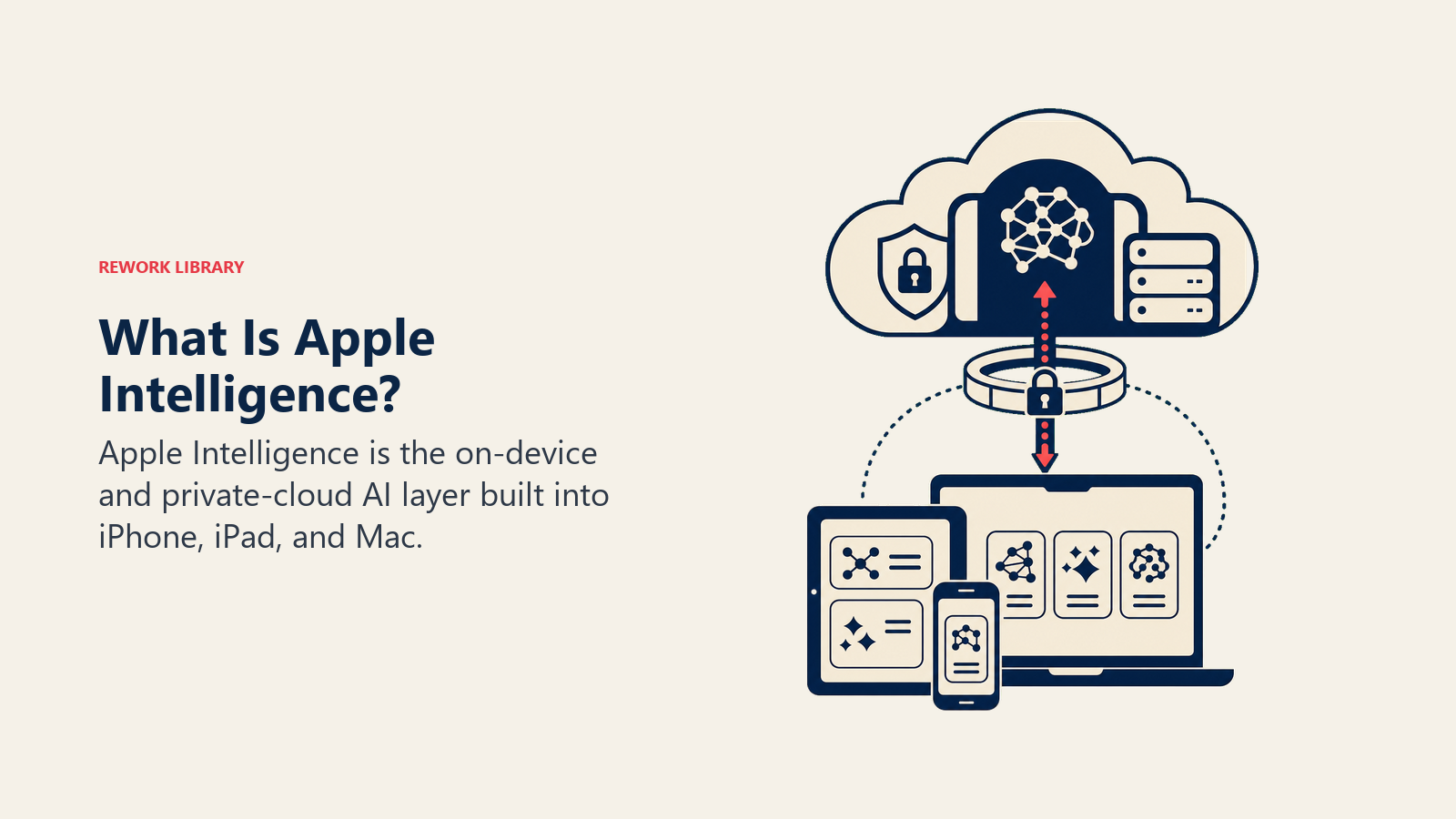
Apple Intelligence is Apple's AI system built into iPhone, iPad, and Mac. It runs a mix of on-device models and Private Cloud Compute, Apple's privacy-focused cloud processing layer, to power features like Writing Tools, Image Playground, Visual Intelligence, and a Siri now being rebuilt on a custom Google Gemini model.
For business leaders, Apple Intelligence is the AI layer that shows up on company-issued hardware whether IT plans for it or not. Any team running iPhones and Macs already has employees drafting emails, summarizing notifications, and rewriting documents with Apple's built-in AI, often without a formal rollout, license, or admin policy behind it.
What Apple Intelligence Actually Is
Apple Intelligence launched in the US on October 28, 2024, through iOS 18.1, iPadOS 18.1, and macOS Sequoia 15.1, after Apple first previewed it at WWDC in June that year. Unlike a single chatbot app, it's a system layer woven into existing apps: Mail, Messages, Photos, Notes, Safari, and the OS itself all gained AI features without requiring a separate download.
The architecture behind it has two halves. Smaller tasks, rewriting a sentence, summarizing a notification, run entirely on the device's own chip. Larger or more complex requests route to Private Cloud Compute, Apple's server infrastructure built specifically so that even Apple can't see the data being processed. That on-device-first design is the same core idea behind on-device AI generally, just applied at Apple's scale across roughly a billion active devices.
Apple Intelligence Features
Apple has expanded the feature set with each yearly OS release since the 2024 launch:
- Writing Tools: Rewrite, proofread, and summarize text in almost any app that accepts typed input, from Mail and Notes to third-party apps that use the standard text system.
- Notification and message summaries: Groups of notifications and long message threads get condensed into a short AI-written summary, reducing the need to open every app individually.
- Image Playground and Genmoji: Image Playground generates original images from a text description or photo, including a photorealistic style added in the June 2026 update. Genmoji creates custom emoji-style images the same way.
- Clean Up in Photos: A generative-AI-powered tool that removes unwanted objects or people from a photo's background, similar in concept to tools long available in dedicated photo editors.
- Visual Intelligence: Point the camera (or a screenshot) at something and ask questions about it: identify a plant, look up a restaurant, or pull structured details out of a flyer or sign, using computer vision paired with Apple's models.
- Siri, in the middle of a rebuild: Siri's promised "personal context" upgrade, understanding what's on your screen and across your apps, was delayed from its original 2025 target. Apple now plans to ship a substantially rebuilt Siri running on a custom Google Gemini model, expected with iOS 27 in fall 2026.
The Siri Overhaul and the Google Gemini Deal
Siri's AI upgrade became the most public stumble in Apple Intelligence's rollout. Apple demoed a more context-aware Siri at WWDC 2024, then pushed the feature back repeatedly through 2025, citing accuracy problems with its own models. Rather than wait longer, Apple went outside for help.
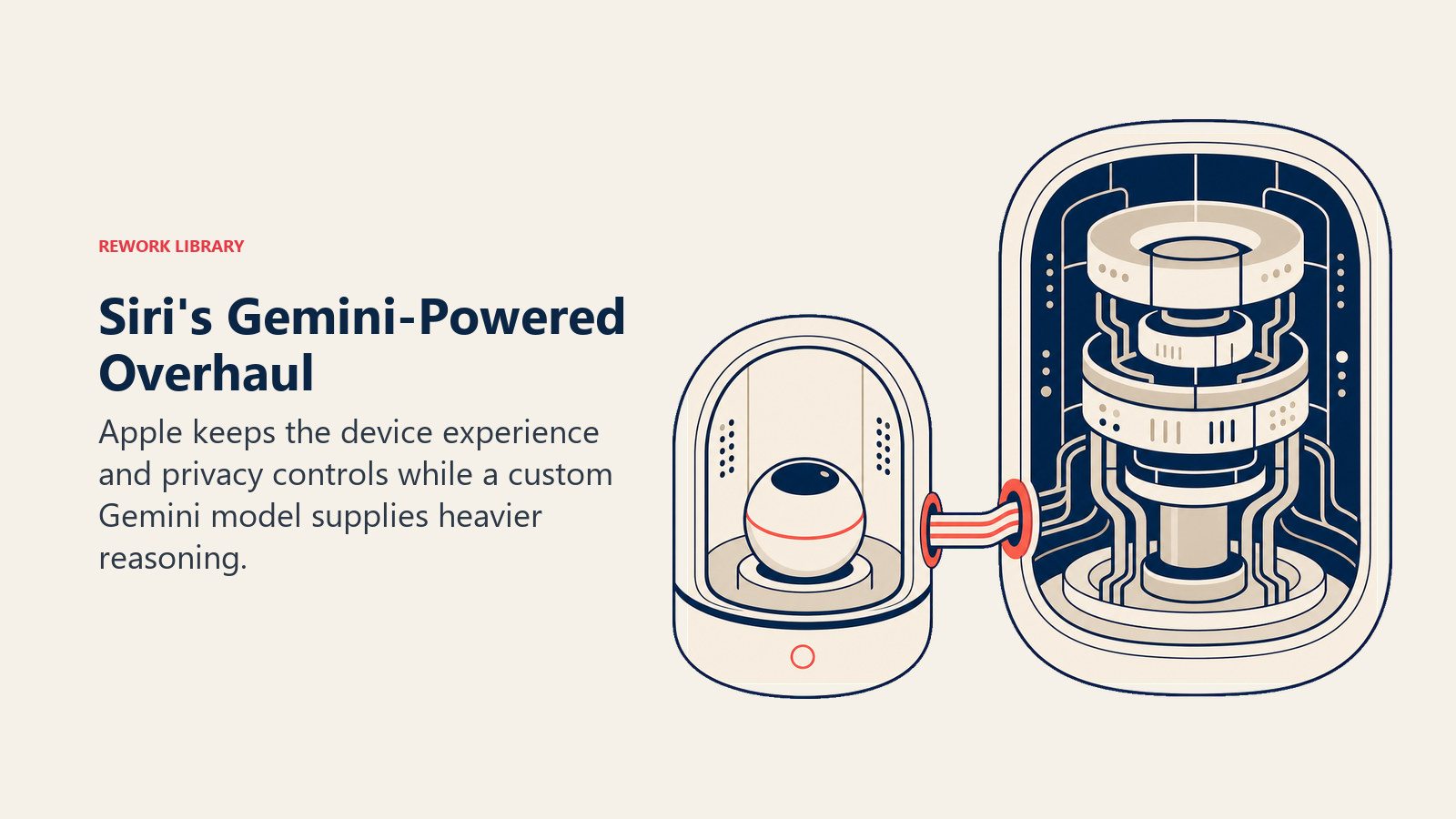
On January 12, 2026, Apple and Google jointly announced a multi-year partnership that puts a custom Google Gemini model behind the next Siri and future Apple Intelligence features. Bloomberg had reported months earlier that Apple was set to pay Google roughly $1 billion a year for the license, and outside estimates put the full multi-year deal as high as $5 billion, though neither company has confirmed exact terms. The custom model built for Apple reportedly runs at 1.2 trillion parameters, several times larger than the roughly 150 billion parameter cloud models Apple had been using on its own.
Google confirmed the integration again at Google Cloud Next in April 2026, naming Google Cloud as Apple's "preferred cloud provider" for these workloads. The Gemini-powered Siri features are expected to arrive with iOS 27 in fall 2026, following the developer and public beta cycle that started in June. This doesn't make Apple Intelligence "Gemini" the way Google Gemini is Google's own product. Apple still designs the experience, owns the on-device models, and controls what data leaves the device; Google supplies the underlying model doing the heavy reasoning behind the scenes.
Private Cloud Compute: Apple's Privacy Model
Private Cloud Compute (PCC) is the piece that lets Apple make a stronger privacy claim than most cloud AI providers. When a request is too complex for the device's own chip, it goes to PCC servers instead of a generic cloud backend, and Apple built the system around a specific set of guarantees:
- Stateless computation: PCC doesn't retain personal data after a request finishes processing.
- No privileged access: Not even Apple's own engineers can access user data during processing, enforced through cryptographic attestation rather than a policy promise.
- Verifiable transparency: Apple publishes the software images running on PCC so outside security researchers can independently confirm the privacy claims instead of taking Apple's word for it.
In June 2026, Apple extended PCC beyond its own data centers for the first time, running select Apple Intelligence workloads on Google Cloud infrastructure using NVIDIA GPUs, Intel CPUs with confidential computing (TDX), and Google's own Titan security chip, while keeping the same attestation model in place. That expansion matters for the Gemini partnership specifically: it's the mechanism Apple is using to keep Google's model behind the same privacy wall it built for its own infrastructure, rather than sending raw requests straight to a standard Google API.
Device Requirements
Apple Intelligence doesn't run on every Apple device, which is a common source of confusion for IT teams planning a hardware refresh:
| Device | Minimum requirement |
|---|---|
| iPhone | iPhone 15 Pro, iPhone 15 Pro Max, or iPhone 16 and later |
| iPad | A17 Pro chip (iPad mini) or M1 chip and later |
| Mac | Any Apple silicon Mac (M1 and later); Intel Macs are not supported |
| Software | iOS 18.1+, iPadOS 18.1+, or macOS Sequoia 15.1+ |
| Storage | About 7 GB of free device storage |
| Language setup | Device language and Siri language must both be set to a supported language |
The standard iPhone 15, iPhone 14, and every earlier iPhone are excluded entirely, along with every Intel-based Mac, regardless of how recent the machine otherwise is. For a company with a mixed device fleet, that split often means only part of the team can use Apple Intelligence features until older hardware cycles out.
Pricing: Is Apple Intelligence Free?
Yes. Apple Intelligence itself carries no subscription fee. If a device meets the hardware and software requirements, the features are included in the free OS update, no separate app, account tier, or add-on purchase required. That's a different model from Google Gemini or ChatGPT, which gate their most capable models behind paid tiers.
The one place a subscription can enter the picture is Apple's optional ChatGPT integration inside Siri and Writing Tools, which lets users route certain requests to OpenAI's models. That integration works on the free ChatGPT tier by default; a user can link a paid ChatGPT account for extended limits, but that's an OpenAI subscription, not an Apple Intelligence charge.
Business and Enterprise Relevance
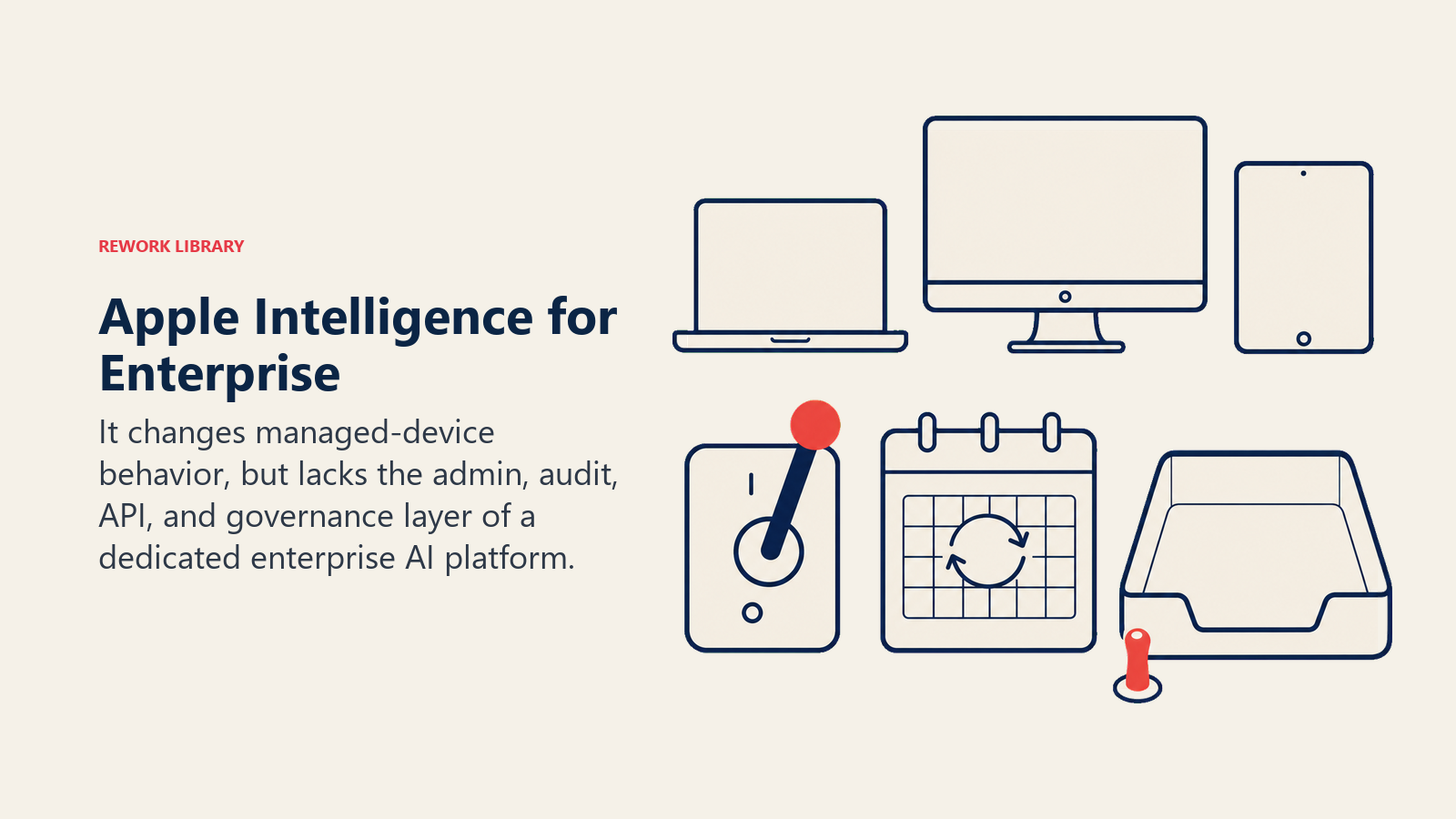
Apple Intelligence isn't packaged as an enterprise AI platform the way Microsoft Copilot or Google's Gemini Enterprise Agent Platform are. There's no dedicated admin console for building custom agents on top of it, no usage-based API pricing for internal tools, and no formal SLA aimed at IT buyers. What it does affect is the baseline behavior of company-owned Apple hardware:
- Shadow AI risk on managed devices: Writing Tools and Siri's AI features are available by default on eligible devices once a user enables Apple Intelligence, which means sensitive drafts and summaries can run through Apple's or Google's infrastructure without going through an approved AI tool list.
- MDM controls exist, but are basic: Mobile device management platforms can disable Apple Intelligence entirely on managed devices, but there's no granular, feature-by-feature enterprise policy layer comparable to what Copilot or Gemini offer through their admin consoles.
- Hardware refresh planning: Because Apple Intelligence needs an A17 Pro-class chip or newer, an M-series Mac, and current OS versions, procurement and refresh timelines now double as an AI-access decision, whether that's intentional or not.
- No dedicated business tier yet: Unlike ChatGPT Enterprise, Claude for Enterprise, or Copilot for Microsoft 365, there's no separate paid Apple Intelligence product built for company data governance, audit logs, or SSO. Teams evaluating a company-wide AI standard typically pair Apple Intelligence's consumer-grade convenience with a dedicated enterprise AI tool for anything involving sensitive company data.
Apple Intelligence vs Other AI Assistants
| Aspect | Apple Intelligence | Google Gemini | Microsoft Copilot | ChatGPT (OpenAI) |
|---|---|---|---|---|
| Cost | Free, built into the OS | Free tier + paid plans from $4.99/month | Free tier + paid plans, Copilot for Microsoft 365 add-on | Free tier + Plus at $20/month |
| Default distribution | iPhone, iPad, Mac system features | Search, Gmail, Docs, Android | Windows, Microsoft 365 apps, Edge | Standalone app and API |
| Underlying model | Apple Foundation Models, plus a custom Google Gemini model for Siri | Gemini model family | OpenAI models via Microsoft's Azure partnership | OpenAI GPT model family |
| Standout strength | Deep OS-level integration and Private Cloud Compute's privacy design | Multimodal search, ecosystem reach across Google products | Tight fit inside Word, Excel, Outlook, Teams | Broadest consumer feature set, custom GPTs |
| Enterprise path | None dedicated; relies on MDM device controls | Gemini Enterprise Agent Platform, Workspace bundling | Microsoft 365 Copilot, enterprise admin console | ChatGPT Enterprise, API |
None of these is a strict replacement for the others inside a business. Apple Intelligence is closer to an ambient layer on top of hardware employees already carry than a destination AI product, which is exactly why it's worth accounting for even without a formal rollout plan.
Limitations of Apple Intelligence
Five constraints shape where Apple Intelligence fits today: delivery speed, device eligibility, governance depth, language coverage, and dependence on an external model.
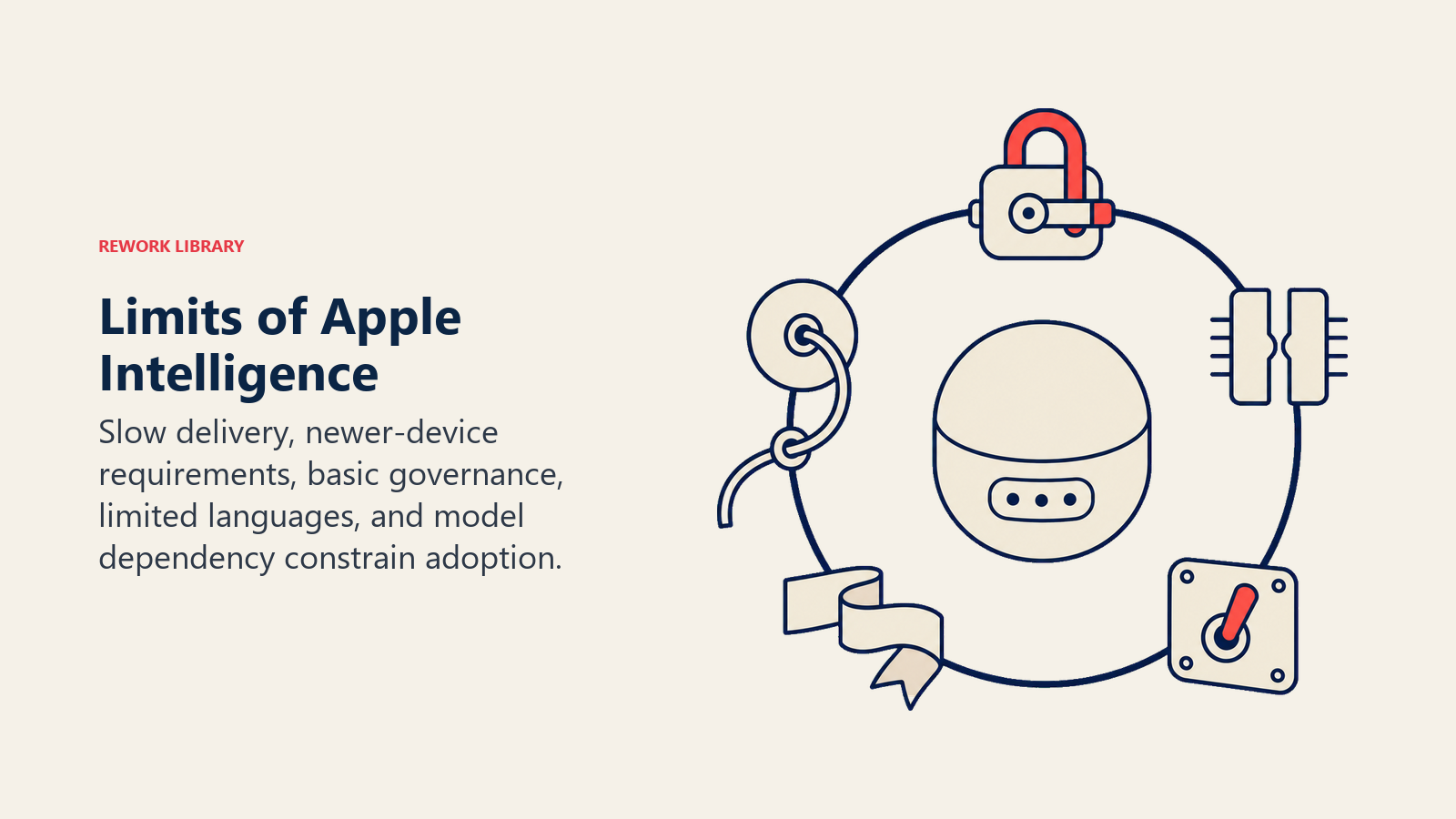
- Feature rollout has been slower than promised. The context-aware Siri upgrade demoed in 2024 slipped repeatedly through 2025 before Apple brought in Google's Gemini model to get it shipped, a reminder that Apple's own AI roadmap has real execution risk.
- Hardware requirements exclude a large share of the installed base. Anything older than an iPhone 15 Pro, a pre-M1 iPad, or an Intel Mac simply can't run it, no matter how current the software is.
- No enterprise governance layer. IT and compliance teams get a basic on/off switch through MDM, not the granular controls, audit trails, or data residency options that dedicated enterprise AI platforms provide.
- Language and region coverage is still limited. As of the June 2026 update, Apple Intelligence supports 15 languages, well short of the language coverage larger cloud-first assistants offer.
- The Gemini dependency introduces a new variable. Siri's most capable features now depend on a third-party model license rather than technology Apple fully controls, which ties part of Apple's AI roadmap to a commercial relationship with a competitor.
Key Facts
- Apple Intelligence launched in the US on October 28, 2024, through iOS 18.1, iPadOS 18.1, and macOS Sequoia 15.1. Apple Newsroom: Apple Intelligence is available today
- Apple and Google announced their multi-year AI partnership in a joint statement on January 12, 2026, putting a custom Gemini model behind the next generation of Siri. Google: Joint statement from Google and Apple
- Apple is reportedly paying Google roughly $1 billion a year for the custom Gemini license powering Siri, first reported by Bloomberg. TechCrunch: Apple nears deal to pay Google $1B annually
- The custom Gemini model built for Apple reportedly runs at 1.2 trillion parameters, several times larger than Apple's existing roughly 150 billion parameter cloud models. 9to5Mac: Apple nears $1 billion Google deal for custom Gemini model
- Apple expanded Private Cloud Compute beyond its own data centers in June 2026, running select Apple Intelligence workloads on Google Cloud infrastructure while keeping the same cryptographic privacy guarantees. Apple Security Research: Expanding Private Cloud Compute
- Apple Intelligence requires an iPhone 15 Pro or later, an iPad with an A17 Pro or M1 chip or later, or a Mac with Apple silicon; Intel Macs and the standard iPhone 15 are not supported. MacRumors: Every device that supports Apple Intelligence
- As of the June 2026 update, Apple Intelligence supports 15 languages across its features. Apple Newsroom: Apple Intelligence brings powerful AI capabilities
Frequently Asked Questions about Apple Intelligence
What is Apple Intelligence?
Apple Intelligence is Apple's AI system built into iPhone, iPad, and Mac. It combines on-device models with Private Cloud Compute, Apple's privacy-focused cloud processing, to power features like Writing Tools, Image Playground, Visual Intelligence, and Siri.
What is Apple's AI called?
Apple's AI is called Apple Intelligence. It's not a single app but a system layer built into iOS, iPadOS, and macOS, integrated across Mail, Messages, Photos, Notes, Safari, and Siri rather than sold as a standalone product.
Does Apple Intelligence use Google Gemini?
Increasingly, yes, for Siri specifically. Apple and Google announced a partnership in January 2026 that puts a custom Gemini model behind Siri's rebuilt AI features, expected with iOS 27 in fall 2026. Most other Apple Intelligence features still run on Apple's own on-device and Private Cloud Compute models.
Is Apple Intelligence free?
Yes. Apple Intelligence carries no subscription fee and is included in free iOS, iPadOS, and macOS updates on supported hardware. The only related cost is optional: linking a paid ChatGPT account for Apple's built-in ChatGPT integration, which is a separate OpenAI subscription, not an Apple Intelligence charge.
Which devices support Apple Intelligence?
iPhone 15 Pro, iPhone 15 Pro Max, and iPhone 16 or later; iPad with an A17 Pro chip or M1 chip and later; and any Apple silicon Mac (M1 and later). Intel Macs and the standard iPhone 15 and earlier are not supported.
What is Private Cloud Compute?
Private Cloud Compute is Apple's server infrastructure for AI requests too complex to run on-device. It's built so that Apple, and now its cloud partners, can't access user data during processing, using stateless computation and cryptographic attestation that outside researchers can independently verify.
Is Apple Intelligence available for businesses?
There's no dedicated enterprise version of Apple Intelligence with an admin console or usage-based pricing the way Microsoft Copilot or Google's Gemini Enterprise Agent Platform have. IT teams can enable or disable it through standard mobile device management tools, but granular, feature-level enterprise controls aren't part of the product.
Why was Siri's AI upgrade delayed?
Apple demoed a more context-aware Siri in 2024, then pushed the release back through 2025 after running into accuracy problems with its own models. Apple ultimately brought in a custom Google Gemini model to get the feature shipped, announced in January 2026.
How is Apple Intelligence different from ChatGPT or Google Gemini?
Apple Intelligence is built into the operating system on Apple hardware rather than sold as a standalone assistant app. ChatGPT and Gemini are accessed as dedicated apps or through their own subscription tiers, and both offer far broader enterprise platforms than Apple currently does.
Related AI Concepts
- What is On-Device AI? - The local-processing approach behind much of Apple Intelligence
- What is Google Gemini (Google's AI)? - The model family now powering Siri's AI upgrade
- What is Microsoft Copilot? - Microsoft's comparable AI layer, built for enterprise deployment
- What is Claude AI? - Another general-purpose assistant Apple Intelligence competes with for attention
- AI Copilots - The broader category of AI assistants embedded inside existing software
- Foundation Models - The category of large pretrained models Apple's own models and Gemini both belong to
- Multimodal AI - How Visual Intelligence combines image understanding with language
- Large Language Models - The technology underlying Siri's new Gemini-based model
- Generative AI - The category covering Image Playground and Genmoji
- Best AI Chatbots 2026 - A broader roundup of the assistants Apple Intelligence competes with
External Resources
- Apple Newsroom: Apple Intelligence is available today on iPhone, iPad, and Mac - Official 2024 launch announcement
- Apple Newsroom: Apple Intelligence brings powerful AI capabilities into everyday experiences - 2026 feature update
- Google: Joint statement from Google and Apple - Official announcement of the Gemini-Siri partnership
- Apple Security Research: Expanding Private Cloud Compute - Technical details on PCC and its Google Cloud expansion
- MacRumors: Every device that supports Apple Intelligence - Full device compatibility list
Part of the AI Terms Collection. Last updated: 2026-07-20

Co-Founder, Rework.com
On this page
- What Apple Intelligence Actually Is
- Apple Intelligence Features
- The Siri Overhaul and the Google Gemini Deal
- Private Cloud Compute: Apple's Privacy Model
- Device Requirements
- Pricing: Is Apple Intelligence Free?
- Business and Enterprise Relevance
- Apple Intelligence vs Other AI Assistants
- Limitations of Apple Intelligence
- Key Facts
- Related AI Concepts
- External Resources