What is an AI Wrapper?
Turn this article into takeaways for your work.


Each assistant summarizes the article only for you and suggests best practices for your work.
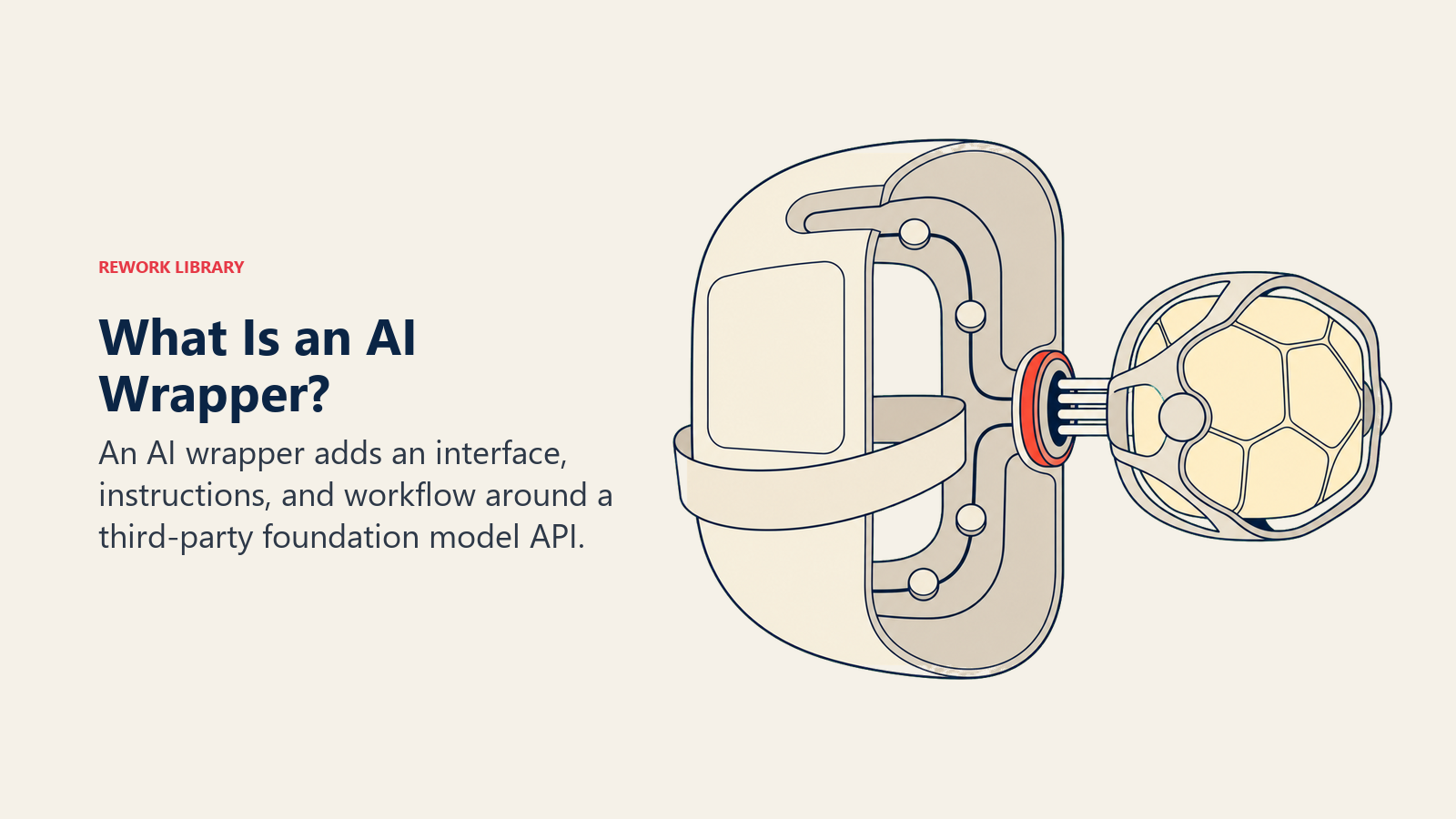
An AI wrapper is a software product built primarily on top of a third-party foundation model, usually the API from OpenAI, Anthropic, or Google, instead of a proprietary model the company trained itself. The wrapper supplies the interface, prompts, and workflow; the underlying intelligence, and the bulk of the engineering cost, belongs to someone else.
That definition sounds simple, but it hides one of the most heated debates in software right now. Some people use "AI wrapper" as an insult, shorthand for a weekend project with no real business behind it. Others point out that plenty of category-defining companies, including some worth billions, technically fit the same description. Both things can be true at once, and the difference between them is what this article is about.
How AI Wrappers Actually Work
Strip away the marketing and the architecture is usually simple. A user submits a request through an interface (a web app, a Slack bot, a browser extension). The application formats that request into a prompt, sends it to a model provider's API (most commonly large language models like GPT-4, GPT-5, or Claude), and receives text, code, or structured data back. The wrapper then reformats that output, maybe runs it through a template, stores it, or chains it into a second call, and shows the result to the user.
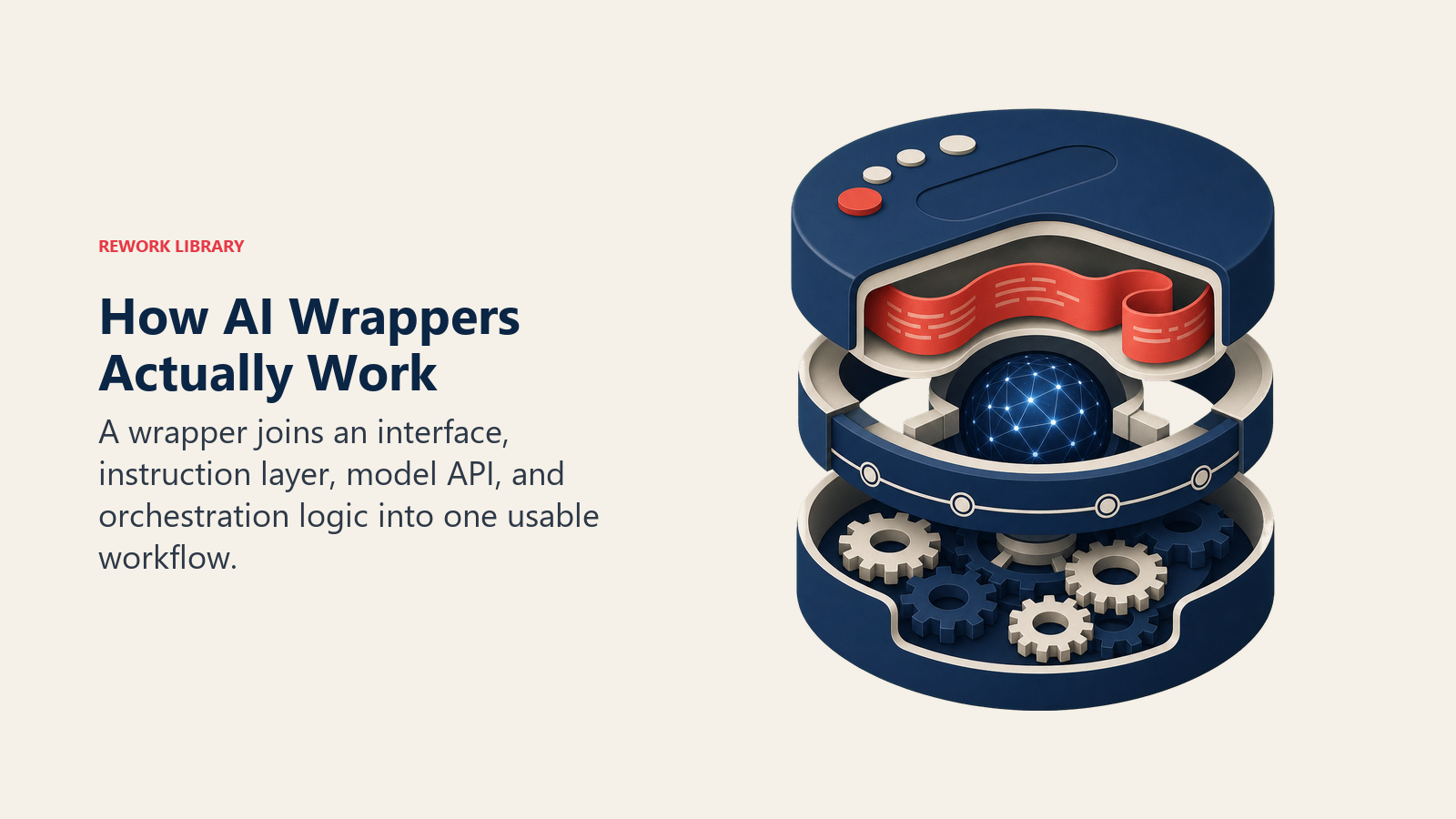
The technical pieces involved are:
- The prompt layer: instructions, examples, and formatting rules sent alongside the user's input. This is where most of the product's early differentiation lives, and it's the domain of prompt engineering.
- The API integration: the plumbing that authenticates, sends requests, handles rate limits, and manages errors between the app and the model provider. See API integration for how this typically gets built.
- The orchestration layer: logic that decides which model to call, in what order, and whether to loop, retry, or hand off to a tool. More sophisticated wrappers evolve into AI agents that chain several calls and tool invocations together rather than making one prompt-response round trip. Some now standardize those tool connections using the Model Context Protocol.
- The interface: the part users actually see and pay for. This is frequently where wrapper products spend the most design effort, because the model output alone is rarely presentable as-is.
None of this requires training a model, renting a GPU cluster, or hiring a research team. That low barrier is exactly why wrappers are easy to build and, later, easy to criticize.
The "Just a Wrapper" Criticism
The core objection is straightforward: if your product is a thin layer over someone else's API, you don't own the thing that actually does the work. The model provider can ship the same feature natively in a single release and erase your differentiation overnight. A resume rewriter, a meeting-summary bot, or a marketing-email generator that is nothing more than a system prompt and a nice front end has no technical moat, because a competitor, or the model provider itself, can replicate it in a weekend.
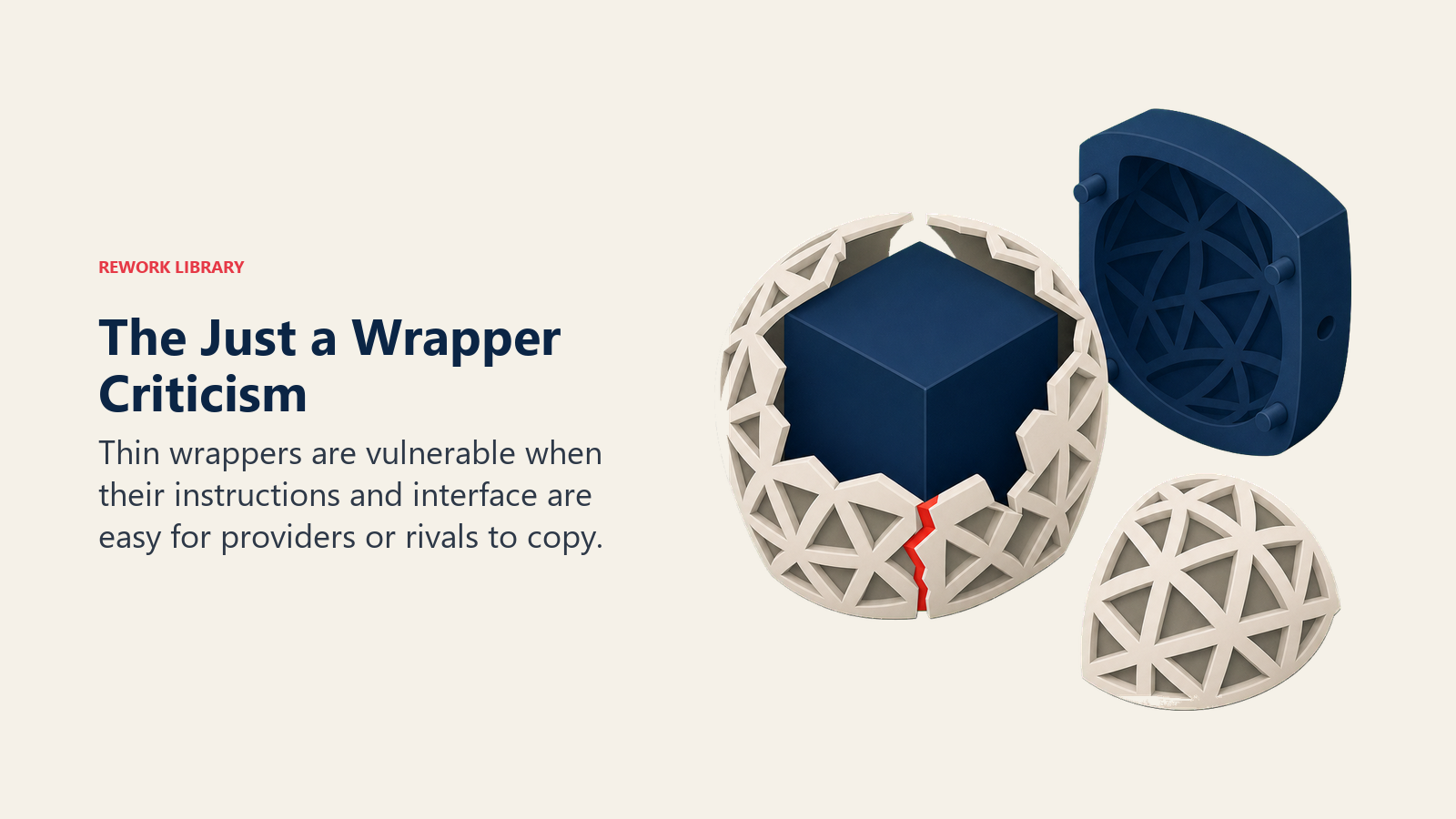
This isn't a hypothetical fear. It has happened repeatedly: waves of single-feature apps built around GPT-3 and GPT-4 lost their reason to exist the moment OpenAI or a competitor folded the same capability into ChatGPT or a first-party product. When a16z tracked which AI tools startups actually pay for, OpenAI and Anthropic themselves topped the list, ahead of any wrapper-style application layered on top of them, evidence that the model providers are capturing a large share of the value even from customers who could, in theory, build the feature themselves.
Key Facts: AI Application-Layer Spending
- Enterprise generative AI software spend hit $37 billion in 2025, up from $11.5 billion in 2024, roughly tripling in a single year. (Menlo Ventures, 2025 State of Generative AI in the Enterprise)
- 76% of enterprise AI solutions were purchased rather than built in-house in 2025, up from 53% the year before, meaning buyers increasingly favor wrapper-style vendor products over custom builds. (Menlo Ventures, 2025)
- ChatGPT's month-12 desktop retention runs at 50%, double Gemini's 25%, a gap driven by interface and habit rather than underlying model quality alone. (a16z, State of Consumer AI 2025)
The criticism has real teeth for a specific type of product: single-feature, low-switching-cost tools where the prompt is the whole product. If a competitor can copy your system prompt and your UI in an afternoon, "wrapper" is an accurate description, not an unfair one.
The Counter-Argument: Distribution, UX, Workflow, and Data
The "just a wrapper" framing breaks down once you look at where real revenue actually accumulates. Plenty of companies run on the exact same foundation models as their competitors and still build durable businesses, because the model was never the whole product. Four things tend to explain the difference.
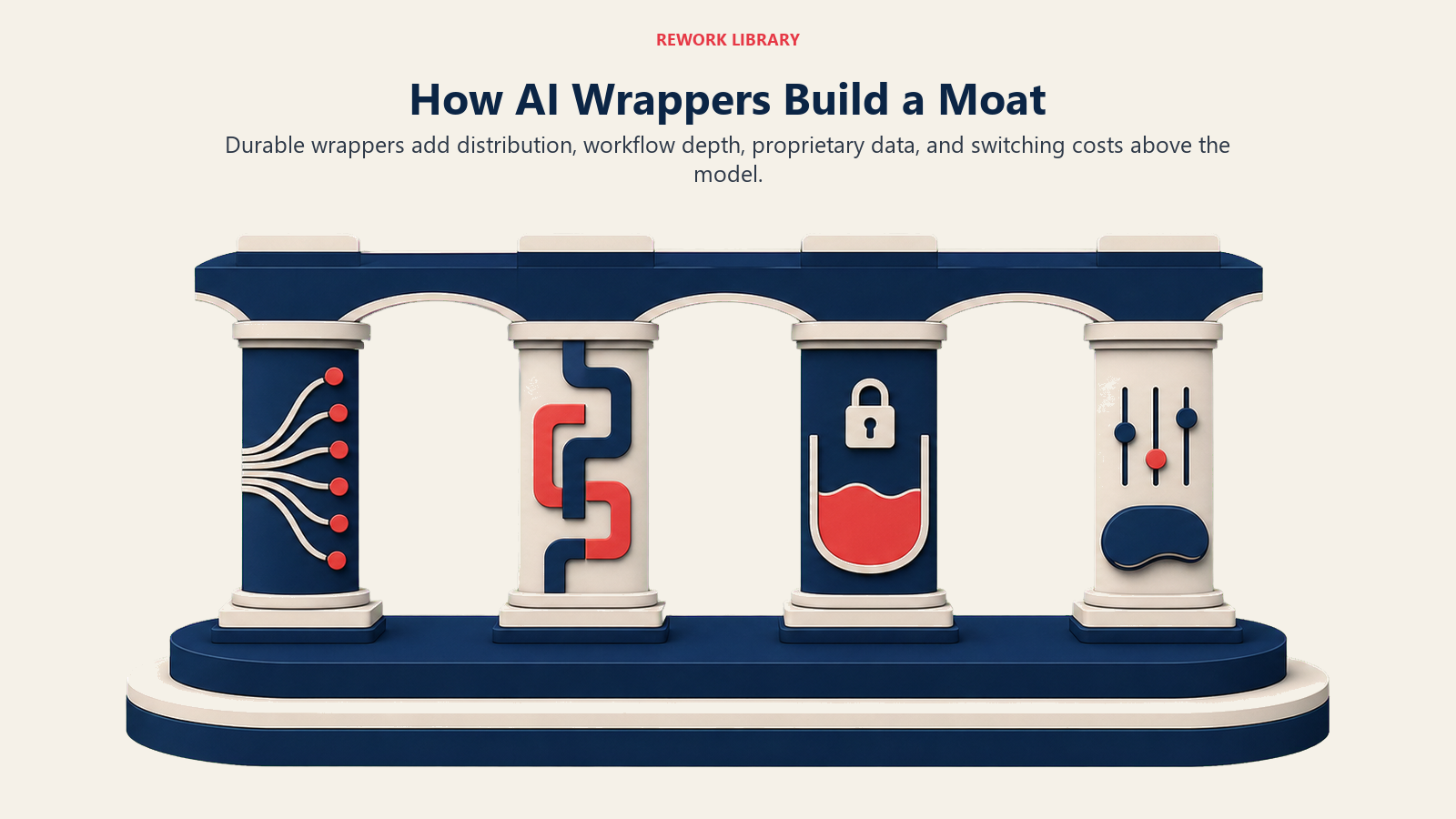
Distribution. A wrapper embedded into an existing user base, sales channel, or platform has a structural advantage a new entrant can't easily copy, even with an identical feature set. GitHub Copilot runs on OpenAI's models, same as many rivals, but it reaches developers already living inside GitHub and VS Code. That distribution channel is worth more than the marginal model quality gap.
UX and workflow depth. When a product is deeply woven into how a team already works, ripping it out costs more than switching an API key. A tool that lives inside a CRM, a codebase, or a document workflow, remembering context, formatting output to house style, integrating with existing approvals, creates switching costs the raw model never had. Anthropic's own Claude Code, built on Claude but shipped as a purpose-built coding workflow rather than a bare chat window, reached a $1 billion annualized run rate within six months of launch, a result the underlying API alone never produced on its own.
Data moats. A wrapper that accumulates proprietary usage data, customer interactions, historical decisions, domain-specific examples, gets better at its specific job over time in a way a generic model call does not. That data doesn't disappear if the underlying foundation model changes providers, and competitors without it can't just spin up the same wrapper and match performance.
Switching cost beyond the API call. Retention is the clearest signal of whether any of this is working. ChatGPT's paid-subscriber retention reaches 68% by month 12, compared with 57% for Gemini, even though both are built by frontier labs with access to comparable model quality. If retention gaps that large show up between products from the two best-resourced AI labs on earth, retention clearly isn't just a function of the underlying model. It's a function of the product wrapped around it.
How to Tell a Defensible Wrapper from a Fragile One
Use these questions to sort a real product from a feature that happens to be for sale:
- If the model provider shipped this exact feature natively next quarter, would your product still have a reason to exist? If the honest answer is no, the moat is the interface alone, and interfaces are cheap to copy.
- Does the product get better with usage, independent of model upgrades? A wrapper that accumulates workflow data, user preferences, or domain examples compounds. One that resets with every session doesn't.
- Is the audience reached through a channel the model provider doesn't have? An existing customer base, a vertical sales relationship, or a platform integration is worth more than clever prompting.
- Would switching cost the user more than changing an API key? If migrating away means losing history, integrations, or trained team habits, that's real lock-in. If it means editing one config value, it isn't.
- Is the team building product depth (workflow, data, integrations) or just prompt depth? Prompt tuning alone is the fastest thing for a competitor, or the model vendor, to replicate.
A product that scores well on two or more of these is meaningfully harder to displace than a single-feature prompt wrapper, regardless of what runs underneath it.
Real Examples Across the Spectrum
Fragile wrapper: single-purpose tools such as early "AI resume rewriter" or "AI cover letter generator" apps that consisted of a system prompt, a form, and a paywall. Most lost their commercial reason to exist once ChatGPT and competing chat assistants added the same capability as a free, one-click feature.
Wrapper that became a real product: Jasper, an AI marketing-content platform, runs on third-party foundation models but survived by owning enterprise workflow, brand voice controls, team collaboration, and marketing-specific templates rather than competing on raw text generation. The differentiation lives in the workflow layer, not the model call. See AI Build vs Buy for how companies weigh exactly this kind of vendor dependency.
Model owner's own workflow product: Claude Code and GitHub Copilot are built by, or on, the same labs providing the raw API, yet both invested heavily in developer-specific workflow (IDE integration, code context, review flows) rather than shipping the chat interface alone. That workflow investment, not model access, is what a competing "coding wrapper" would actually need to replicate.
AI Wrapper vs Foundation Model vs Full AI Product
| Dimension | AI Wrapper | Foundation Model | Full AI Product |
|---|---|---|---|
| What it is | An app built on top of a model's API | The underlying trained model itself (GPT, Claude, Gemini) | A product where AI is one component of a broader, defensible system |
| Who builds the intelligence | A third-party lab (OpenAI, Anthropic, Google) | The lab itself, at a cost of hundreds of millions of dollars | Often licensed from a foundation model, sometimes fine-tuned in-house |
| Primary value add | Interface, prompts, workflow, packaging | Raw language and reasoning capability | Workflow depth, proprietary data, distribution, and integrations |
| Defensibility source | Weak on its own; strong only with distribution, data, or workflow lock-in | Massive capital and research talent required to compete | Compounding data, switching costs, and channel advantages |
| Typical build cost | Low, days to weeks for a basic version | Extremely high, hundreds of millions in compute and research | Moderate to high, depends on integration and data work |
| Biggest risk | The model provider ships the same feature natively | Losing the capability race to a better-funded lab | Slower to build; must earn workflow trust over time |
What This Means for Founders and Investors
The application layer built on top of foundation models is where most of the enterprise dollars are actually landing right now, not at the model layer itself. Menlo Ventures found that general-purpose AI copilots alone captured $8.4 billion of enterprise AI spend in 2025, the single largest application category tracked in that year's report, more than coding tools or vertical AI combined. That's real revenue flowing to products that, by a narrow definition, are "wrappers" around someone else's model.
Investor enthusiasm has followed the same logic. Y Combinator's Winter 2025 batch grew 10% week over week in aggregate, a pace Y Combinator's Garry Tan called unprecedented in early-stage venture, with roughly 80% of that batch built around AI. Investors aren't systematically avoiding wrapper-shaped products; they're pricing in whether the founding team can convert an early prompt-based MVP into something with distribution, data, or workflow lock-in before a better-funded competitor, or the model provider itself, closes the gap.
The practical takeaway for founders: treat the first version of an AI product as a validated MVP, not the finished moat. The wrapper is often the fastest way to prove demand exists. What determines whether the business survives past that stage is whether the team builds one of the four defensibility drivers, distribution, UX and workflow depth, data accumulation, or genuine switching cost, before the underlying model provider (or a faster-moving competitor) closes the feature gap. For buyers evaluating AI vendors that fit this pattern, AI Vendor Evaluation and AI Total Cost of Ownership cover how to assess that dependency risk before signing a contract.
Related AI Concepts
- Foundation Models, the base models most AI wrappers are built on top of
- Large Language Models, the specific model type behind most wrapper products
- API Integration, the technical plumbing that connects a wrapper to its model provider
- AI Agents, what more sophisticated wrappers evolve into once they chain multiple calls together
- AI Build vs Buy, the decision framework for relying on a vendor API versus building proprietary AI
- AI Vendor Evaluation, how to assess AI vendors before depending on their roadmap
- Generative AI, the broader category AI wrappers sit inside
External Resources
- Menlo Ventures, 2025 State of Generative AI in the Enterprise, enterprise AI spend and buy-vs-build data
- a16z, State of Consumer AI 2025, retention benchmarks for AI consumer products
- TechCrunch, "A new a16z report looks at which AI companies startups are actually paying for", what AI-native startups actually spend money on
Part of the AI Terms Collection. Last updated: July 2026

Co-Founder, Rework.com
On this page
- How AI Wrappers Actually Work
- The "Just a Wrapper" Criticism
- The Counter-Argument: Distribution, UX, Workflow, and Data
- How to Tell a Defensible Wrapper from a Fragile One
- Real Examples Across the Spectrum
- AI Wrapper vs Foundation Model vs Full AI Product
- What This Means for Founders and Investors
- Related AI Concepts
- External Resources