What is AI Memory? When AI Remembers Your Business Context
Turn this article into takeaways for your work.


Each assistant summarizes the article only for you and suggests best practices for your work.
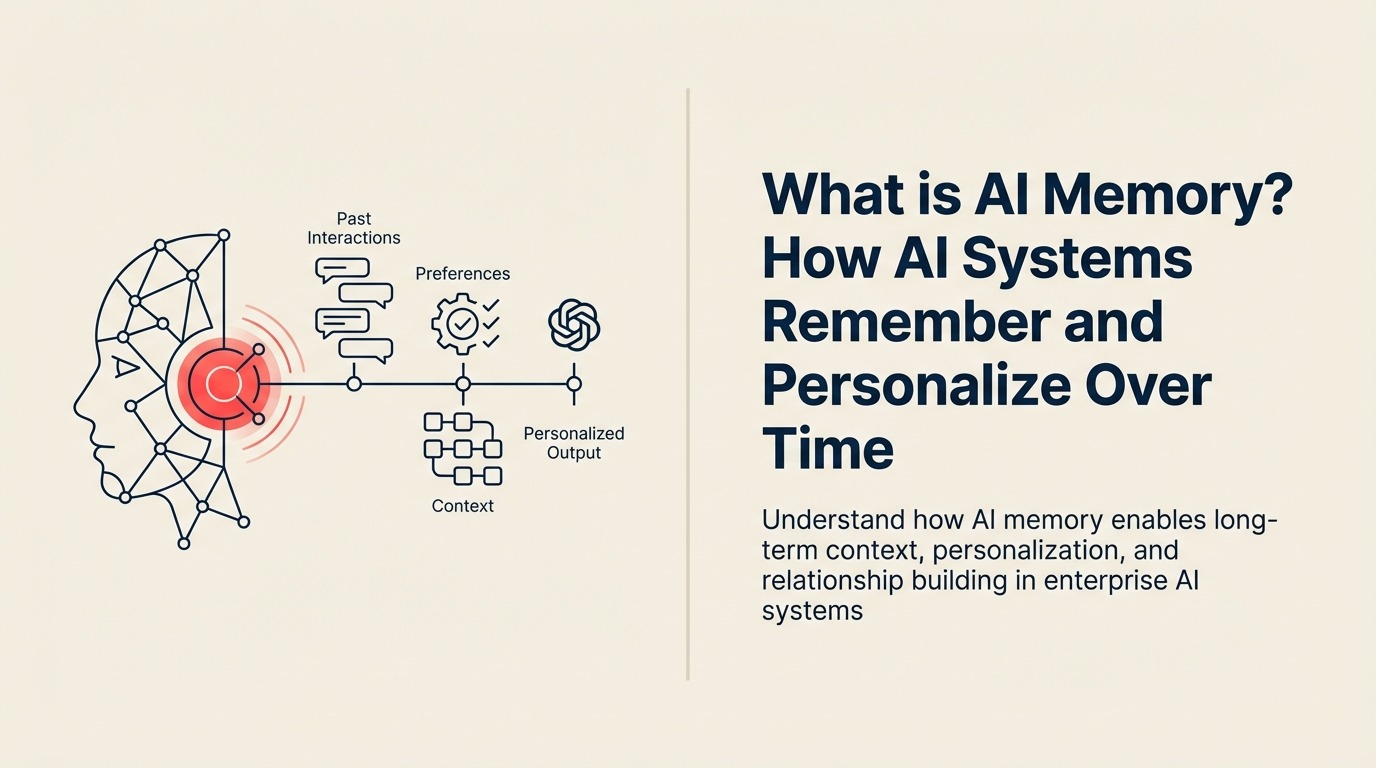
You tell your AI assistant once that your fiscal year runs April to March, that your competitive set includes five specific companies, and that your CEO prefers executive summaries under 300 words. Six months later, it still remembers. Every analysis follows your fiscal calendar, competitive mentions are automatically tracked, and summaries hit the perfect length. This is AI memory: systems that build persistent understanding of your business, getting more valuable the longer you work together.
The Academic Foundation
AI memory systems draw from research in continual learning and context management, defined as "persistent storage and retrieval mechanisms enabling AI systems to maintain knowledge across sessions and apply learned context to future interactions" (Anthropic Research, 2024).
The field evolved from stateless large language models that forgot everything between conversations to today's systems with episodic memory, semantic memory, and working memory, mirroring human cognitive architecture described in psychology research by Tulving (1972).
Unlike traditional databases that store explicit facts, AI memory systems use vector embeddings and retrieval-augmented generation to store concepts, preferences, and patterns, enabling nuanced understanding that improves over time.
What This Means for Business
For business leaders, AI memory means AI systems that build institutional knowledge about your organization, remembering preferences, learning patterns, and delivering increasingly personalized value without requiring repeated explanations.
Think of AI memory as giving your AI assistant the same advantage experienced employees have over new hires. Veteran employees know company jargon, understand unwritten rules, and anticipate needs. AI with memory develops similar organizational fluency, becoming more useful with every interaction.
In practical terms, this translates to AI that remembers your product portfolio, knows your customers' purchasing patterns, understands your writing style, and recalls past projects, eliminating repetitive context-setting and delivering relevant, personalized assistance.
Essential Components
AI memory systems consist of these essential elements:
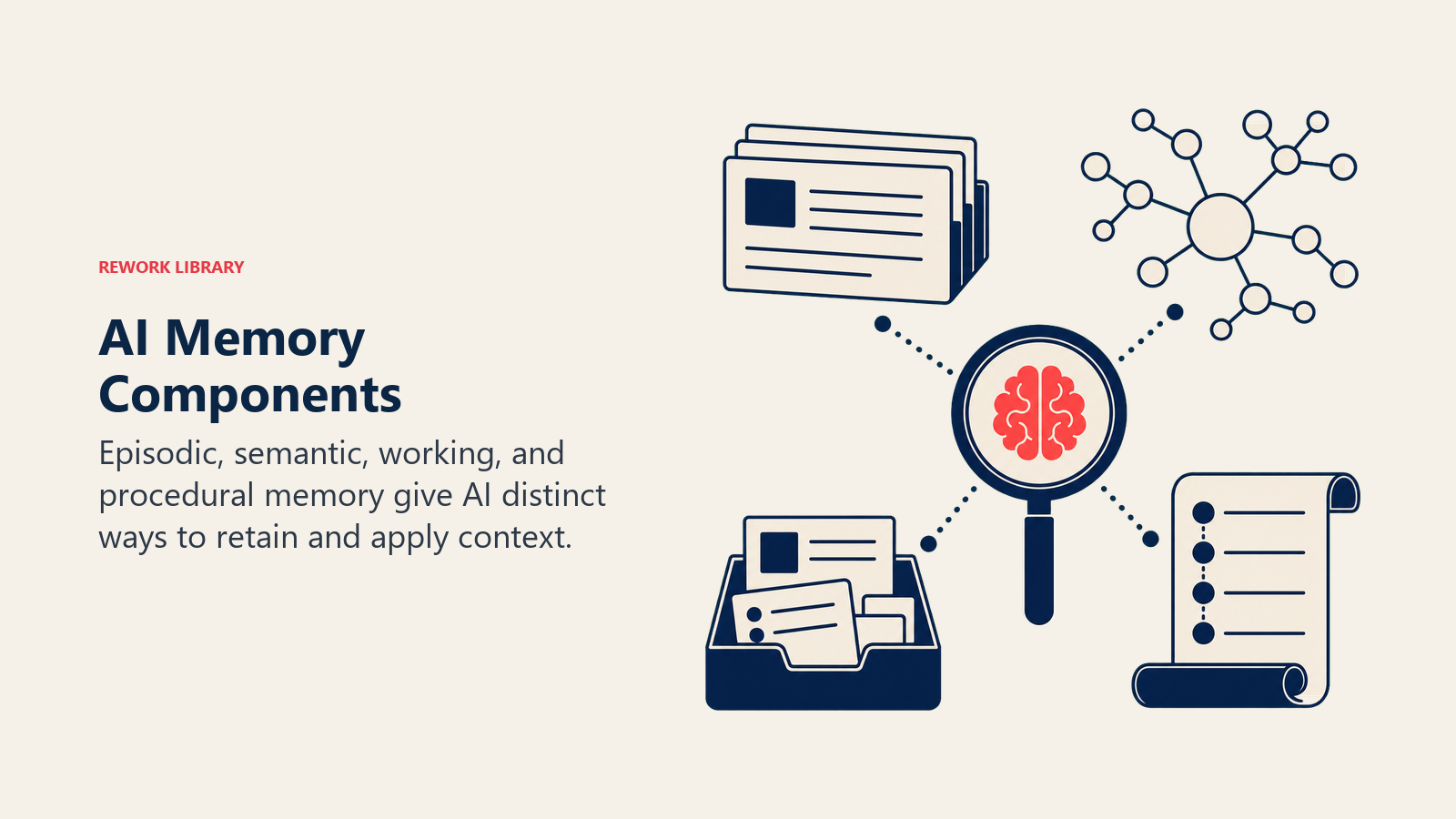
• Episodic Memory: Records of specific past interactions, like conversations, decisions made, and tasks completed, enabling the AI to reference "Remember when we discussed..." scenarios
• Semantic Memory: Generalized knowledge learned from patterns across interactions, like understanding that you prefer data-driven arguments or that specific terms mean particular things in your organization
• Working Memory: Current session context including active conversation threads, referenced documents, and immediate task state, bridging short-term and long-term memory
• Memory Management: Systems for storing, indexing, retrieving, and pruning memories based on relevance, recency, and importance, preventing information overload while maintaining useful context
• Privacy Controls: User-defined boundaries determining what gets remembered, who can access memories, and retention policies, ensuring compliance with data governance requirements
The Working Process
AI memory systems follow these steps:
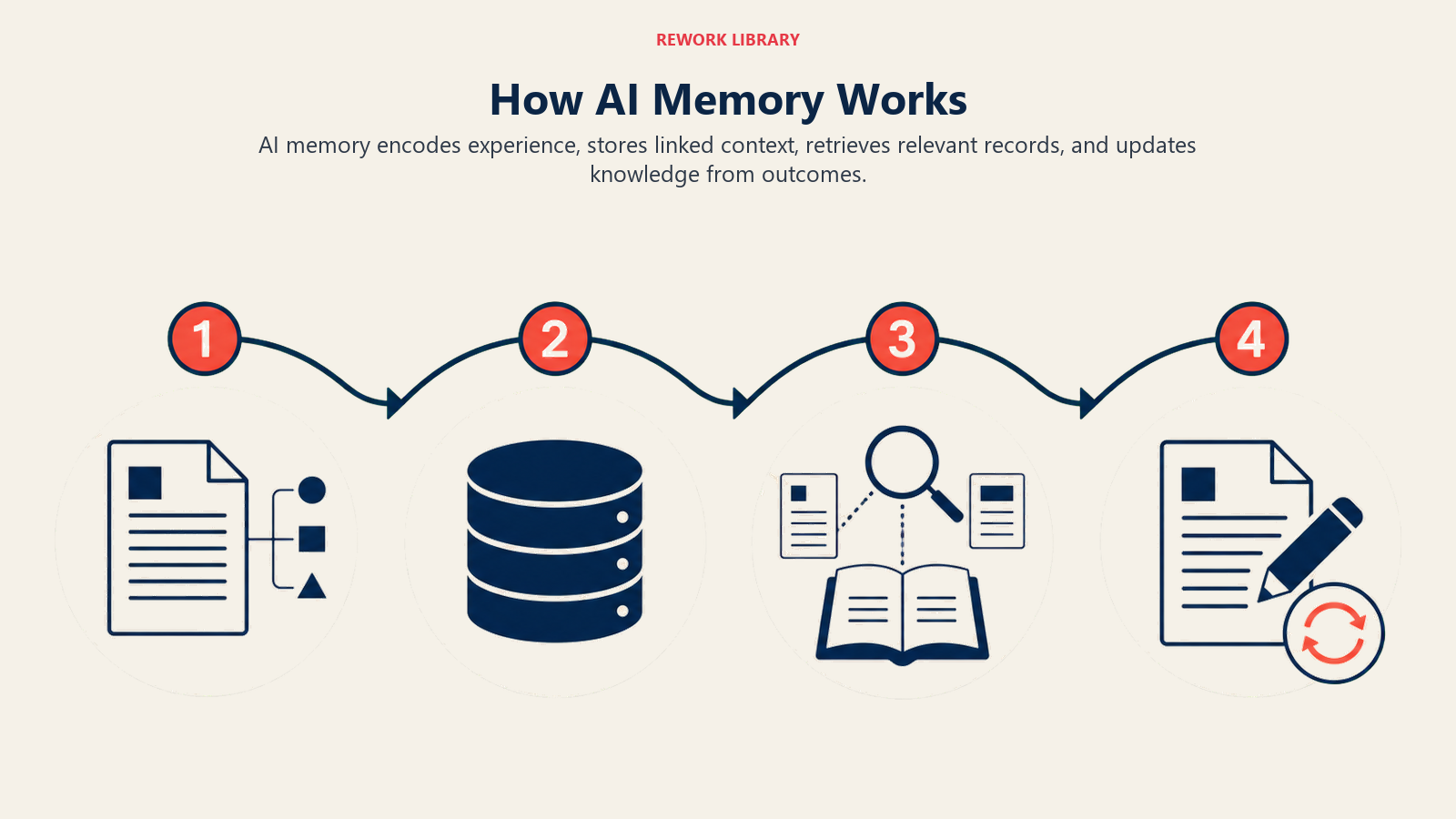
Experience & Encoding: During interactions, the system identifies information worth remembering like user preferences, business rules, project details, and outcomes, encoding these as searchable memory units
Storage & Association: Memories are stored with contextual links, associating related concepts so retrieving information about "Q4 planning" also surfaces relevant team members, past initiatives, and outcomes
Retrieval & Application: When relevant, past memories are automatically retrieved and incorporated into current context, like remembering you always want competitor analysis included in market research reports
Update & Refinement: As patterns emerge or preferences change, the system updates its understanding, learning that you've shifted focus from cost reduction to innovation or that org structure has changed
This creates a knowledge accumulation loop where AI becomes progressively more valuable as institutional memory deepens.
Four Memory Architectures
AI memory generally falls into four main categories:
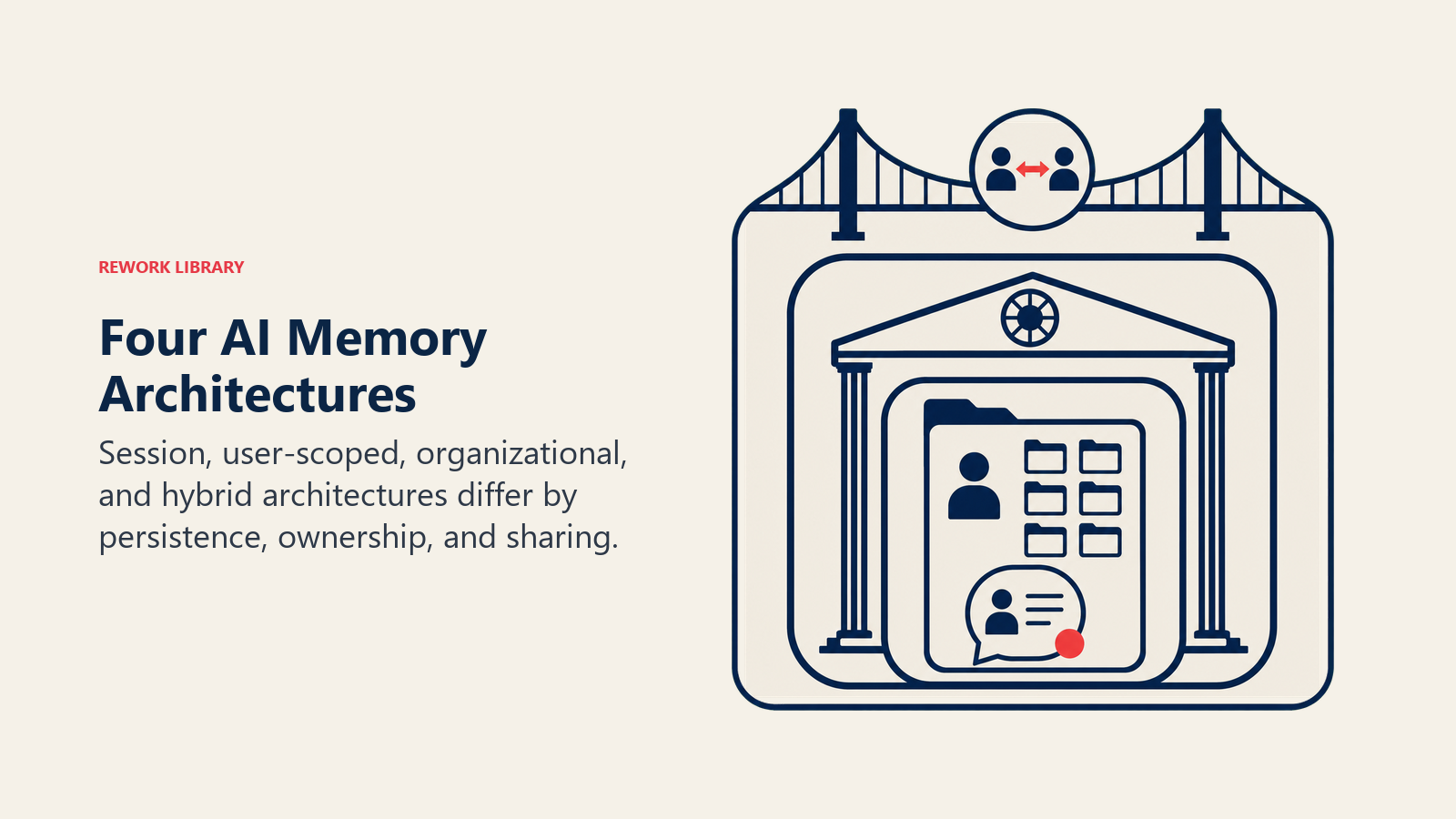
Type 1: Session-Based Memory Best for: Customer service, one-time projects Key feature: Remembers within a single conversation but forgets after Examples: Basic chatbots that maintain conversation flow but reset daily
Type 2: User-Scoped Memory Best for: Personal assistants, individual productivity tools Key feature: Remembers everything about one user across sessions Examples: ChatGPT with memory, Claude with long-term context, AI copilots
Type 3: Organization-Scoped Memory Best for: Team collaboration, knowledge management Key feature: Builds shared organizational knowledge accessible to authorized users Examples: Enterprise AI platforms with company-wide context, custom RAG systems
Type 4: Domain-Specific Memory Best for: Specialized functions like customer support, sales enablement Key feature: Remembers customer history, product knowledge, and process specifics Examples: Salesforce Einstein remembering account relationships, Zendesk AI recalling ticket history
AI Memory in Action
Here's how businesses actually use AI memory:
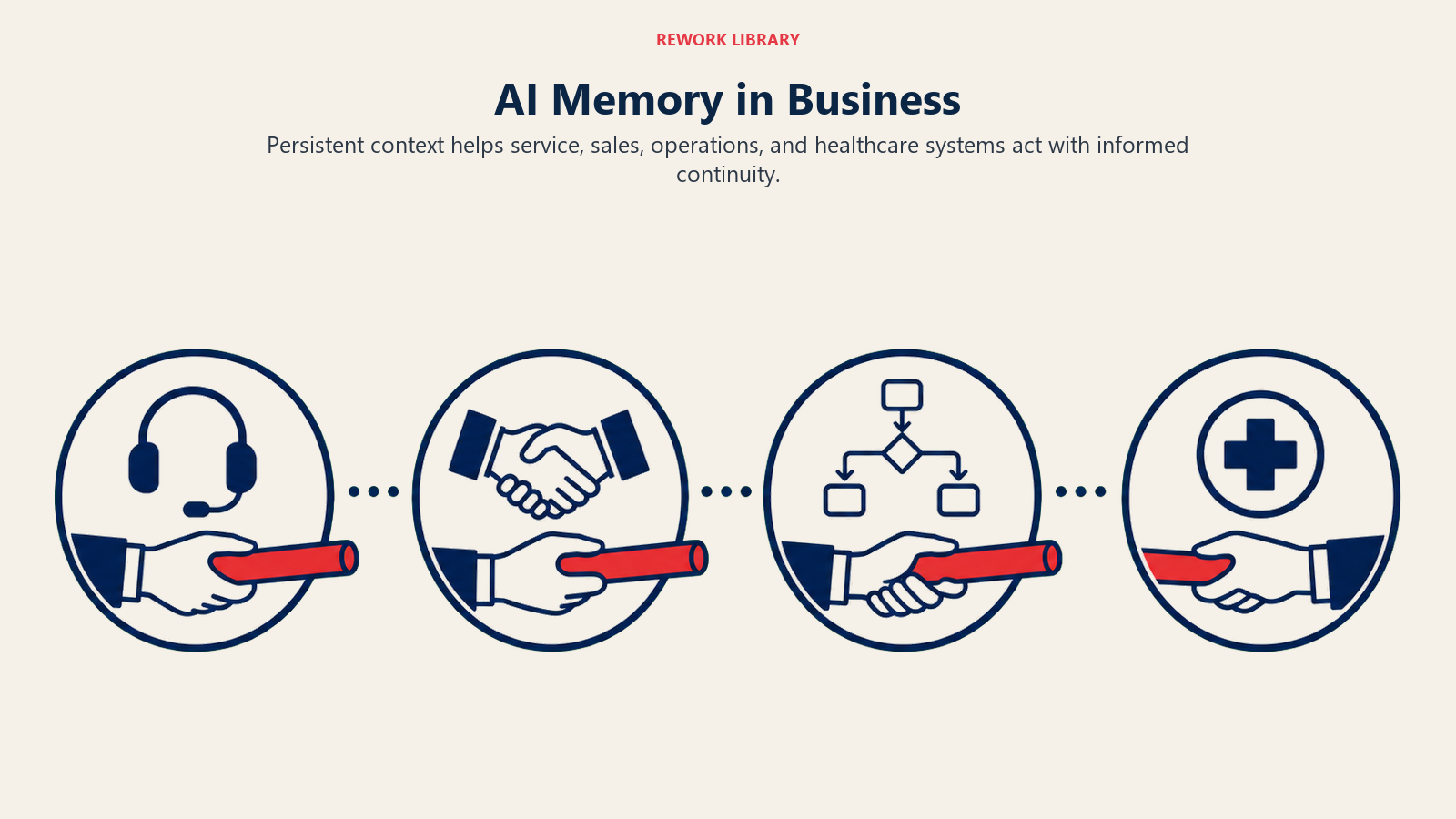
Customer Success Example: Intercom's AI remembers every customer's support history, product usage patterns, and communication preferences. When customers reach out, agents get context-aware suggestions based on past interactions, reducing resolution time by 35% and improving satisfaction scores.
Sales Example: Gong's AI builds memory of successful sales methodologies by analyzing thousands of calls. It remembers which objection-handling techniques work for specific industries and personas, coaching reps with context-specific advice that increases win rates by 20%.
Legal Example: Casetext's AI (now part of Thomson Reuters) remembers case strategies, preferred citation styles, and jurisdiction-specific nuances for each attorney, generating briefs that match individual working styles while incorporating lessons from past successful arguments.
Implementation Considerations
Ready to leverage AI memory in your organization?
- Understand storage architecture with Vector Databases fundamentals
- Design privacy frameworks using AI Governance policies
- Implement retrieval systems through RAG Architecture
- Monitor accuracy with AI Observability tools
If you're building memory into an AI agent rather than buying a finished assistant, our comparison of eight agent memory platforms covers pricing and licensing.
Related AI Concepts
Explore these topics to build comprehensive memory strategies:
- Personalization AI - Use memory for customized experiences
- Knowledge Graphs - Structure organizational knowledge
- Context Window - Understand short-term memory limits
- AI Security - Protect sensitive remembered information
External Resources
- OpenAI Research - Latest research on AI memory and context
- Anthropic Research - Studies on long-term AI safety and memory
- Google AI Research - Memory architectures and personalization
Frequently Asked Questions about AI Memory
What is AI Memory?
AI memory is the capability for AI systems to persistently store and retrieve information across sessions, building long-term context about users, organizations, and domains to deliver increasingly personalized and relevant assistance.
What's the difference between AI memory and a database?
Databases store explicit facts in structured formats. AI memory stores concepts, preferences, and patterns in ways that enable semantic understanding and contextual retrieval. Memory knows "this client prefers brief updates" while a database just stores "preference: brief."
What are the main types of AI memory?
Four types: Session-based (remembers within one conversation), user-scoped (personal memory across sessions), organization-scoped (shared team knowledge), and domain-specific (specialized function memory like customer history).
How do we ensure AI memory respects privacy?
Implement memory controls including user opt-in/opt-out, granular permissions defining who accesses what memories, retention policies for automatic deletion, and audit logs tracking memory access. Apply GDPR "right to be forgotten" principles.
Can AI memories be wrong or biased?
Yes. AI can remember incorrectly, especially if given wrong information or if patterns change. Implement memory verification, allow users to correct memories, and regularly audit stored context for accuracy and bias. Build "forget" and "correct" functions.
Part of the AI Terms Collection. Last updated: 2026-02-09
