What is AI Infrastructure?
Turn this article into takeaways for your work.


Each assistant summarizes the article only for you and suggests best practices for your work.
AI infrastructure is the full technology stack a business needs to build, deploy, and run AI models: the GPUs and cloud capacity that supply compute, the pipelines that feed data in, the model layer that does the reasoning, and the orchestration and observability tools that keep everything running reliably once real users depend on it.
Most executives only meet this stack indirectly, as a line item on a cloud invoice or a vendor's capacity waitlist. But every AI feature your company uses, a chatbot, a forecasting model, a copilot embedded in your CRM, is running on some version of this stack somewhere. Knowing what's actually in it makes it much easier to read a vendor's pricing, judge a build-vs-buy pitch, or ask the right question when an internal AI project stalls out.
The Layers of the AI Infrastructure Stack
AI infrastructure isn't one product you buy. It's a set of layers stacked on top of each other, and a weak link in any one of them slows down or breaks everything above it.
| Layer | What It Does | Common Examples |
|---|---|---|
| Compute / Hardware | Runs the actual matrix math behind training and running models | Nvidia H100, H200, and Blackwell-generation GPUs, AMD MI-series accelerators, Google TPUs, custom hyperscaler silicon |
| Cloud & Networking | Provisions GPU capacity and links thousands of chips into one working cluster | AWS, Azure, Google Cloud, specialized GPU clouds like CoreWeave, high-speed fabrics like NVLink and InfiniBand |
| Data Pipeline | Collects, cleans, and moves data so models have something to learn from or retrieve at answer time | ETL and data pipeline tools, feature stores, vector databases |
| Model Layer | The trained model that actually reasons over the input | Foundation models, large language models, fine-tuned or open-weight variants |
| Model Serving | Deploys a trained model so it can answer real requests at production scale | Model serving platforms, API gateways, model routers that send easy queries to cheap models and hard ones to frontier models |
| Orchestration | Coordinates multi-step workflows, tool calls, and the pipeline that ships a model change safely | MLOps and LLMOps pipelines, workflow and agent frameworks |
| Observability | Tracks cost, latency, quality, and drift once a model is live | AI observability and model monitoring platforms, logging and tracing tools |
The practical point: a company can have world-class GPUs and still ship a broken AI feature if its data pipeline feeds the model stale information, or if nobody's watching latency and cost once traffic scales up. Every layer has to hold for the layer above it to work.
AI Infrastructure vs an AI Data Center
The two terms get used interchangeably, but they aren't the same thing. An AI data center is the physical facility, the building, the power substation, the liquid cooling plant, that houses the GPUs. AI infrastructure is broader: it includes that hardware layer, but also the cloud services, data pipelines, model layer, orchestration, and observability tooling that sit on top of it, wherever they happen to run.
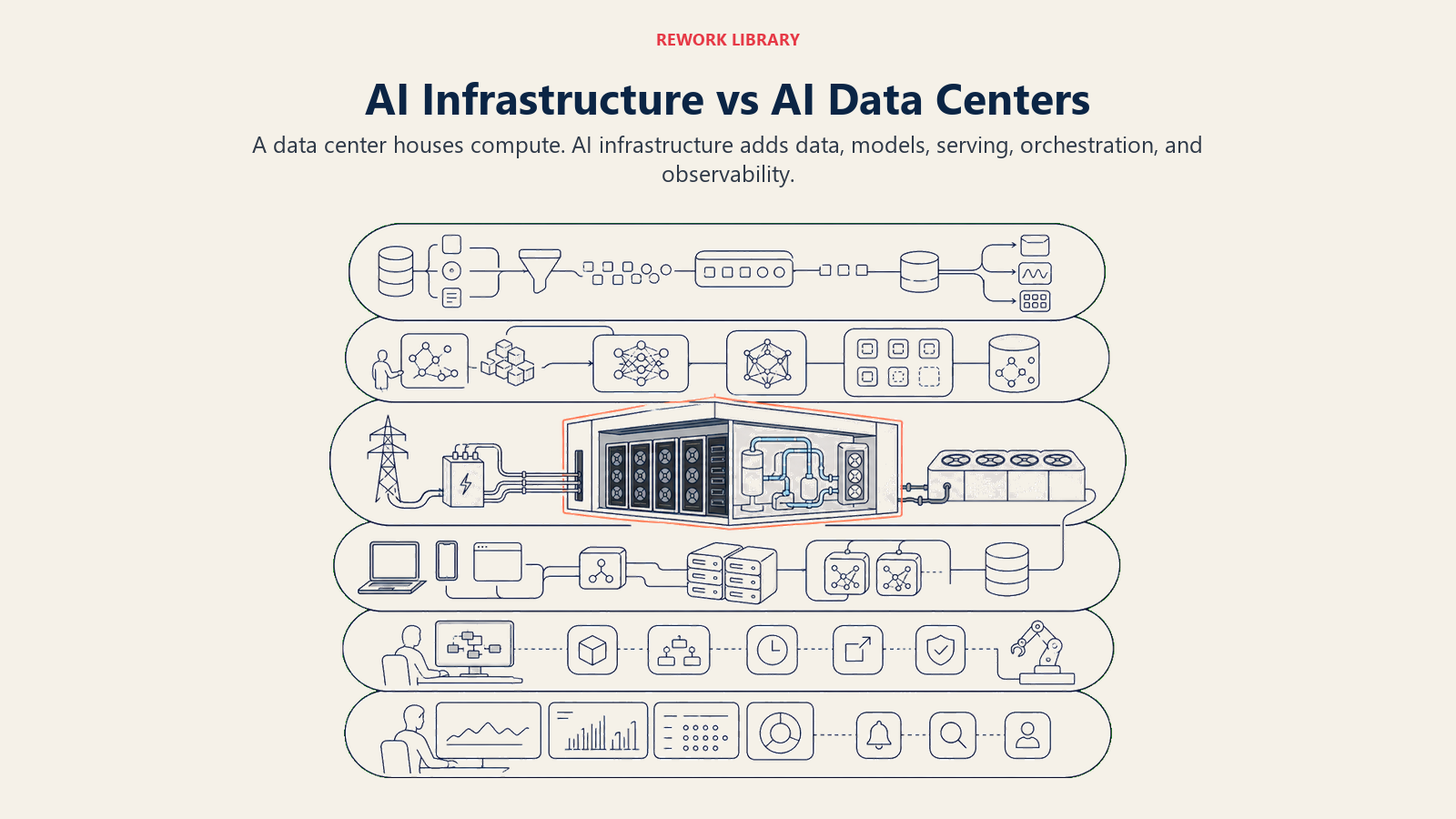
Put simply, an AI data center is one layer (compute and hardware) inside the larger AI infrastructure stack. A company can rent GPU capacity from someone else's data center and still own every other layer of its AI infrastructure, its data pipelines, its model choices, its serving and orchestration setup, without ever building a facility of its own. That distinction matters when a vendor claims to "run on AI infrastructure": the hardware is usually the easy part to point to, and the harder, more differentiated work is everything built around it.
Build vs Buy: How Companies Actually Assemble the Stack
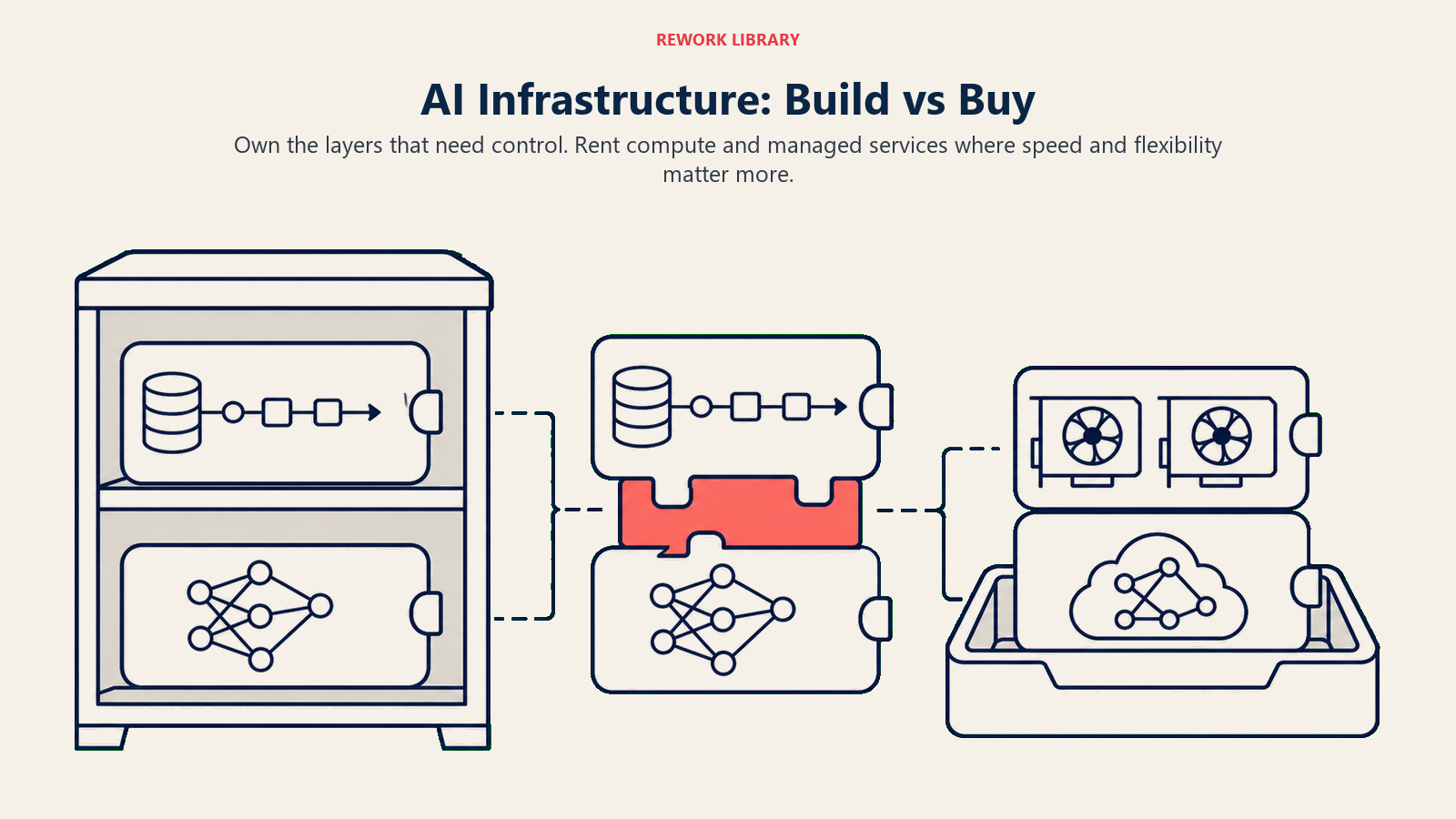
Almost no company builds every layer from scratch. The real decision is which layers to own and which to rent, and that choice looks different at each layer of the stack.
| Approach | What You Own | Best Fit |
|---|---|---|
| Fully managed API (model provider) | Nothing below the model call itself | Fast-moving teams that need a capability now and don't need to touch weights or hardware |
| Managed cloud GPU | Your data pipeline, model choices, serving setup, rented compute | Teams fine-tuning or self-hosting open-weight models without owning hardware |
| Colocation or on-premises | Everything, including physical hardware | Regulated industries, latency-sensitive workloads, or sustained usage high enough that owning beats renting |
Renting compute from a cloud provider or calling a model API is the right default for almost every business: it avoids the capital outlay, the AI data center build cost, and the specialized staff that owning hardware requires. The AI build vs buy decision usually isn't "build a data center or don't," it's "which layers of the stack do we need direct control over, and which can we safely rent." A useful gut check before signing with any vendor: run a proper vendor evaluation that asks what happens to your data pipeline and model choices if that vendor changes its pricing or its roadmap.
What Drives AI Infrastructure Costs
A handful of factors explain most of the variance between a lean AI infrastructure bill and a runaway one.
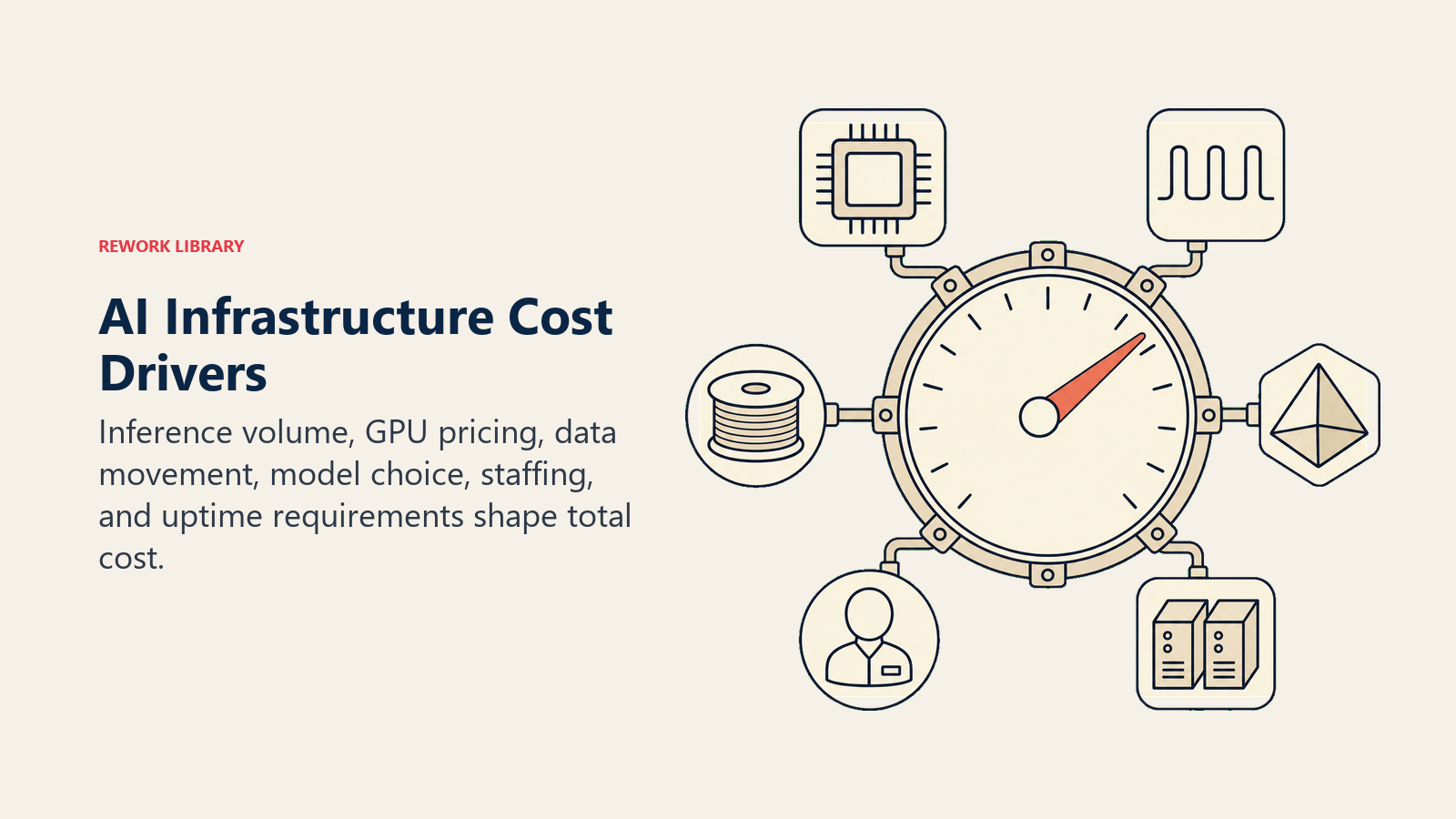
- GPU scarcity and pricing. Demand for frontier-class GPUs still regularly outpaces supply, and that scarcity flows straight through to what cloud providers charge for compute.
- Inference volume, not training. Most companies never train a model from scratch. Their bill is driven by inference, the ongoing cost of every query a live model answers, which scales directly with usage rather than showing up as a one-time cost.
- Data movement and storage. Feeding a model, especially one doing retrieval over company data, means storing and moving data repeatedly, and cloud egress fees add up fast at scale.
- Model choice. A frontier model costs more per token than a smaller, distilled, or quantization-compressed model that's been optimized to do the same job for less.
- Staffing. Someone has to own the orchestration and observability layers. MLOps and LLMOps talent is scarce, and the operational headcount to run AI infrastructure reliably is a real, ongoing line item most build-vs-buy comparisons underestimate.
- Redundancy and uptime requirements. A customer-facing AI feature that can't go down costs more to run than an internal tool that can tolerate occasional failure, because redundancy means paying for capacity you're not always using.
Any serious AI total cost of ownership model has to account for all six, not just the sticker price on a GPU-hour.
The 2026 AI Infrastructure Landscape
Three things are true about AI infrastructure spending right now, and all three affect what your company pays for AI.
Spending is still climbing fast. Gartner projects global IT spending will reach $6.15 trillion in 2026, up nearly 11% year over year, with data center systems spending alone crossing $650 billion, up from just under $500 billion the year before. The four largest US hyperscalers, Amazon, Alphabet, Microsoft, and Meta, guided a combined roughly $725 billion in capital expenditure for 2026, up about 77% from 2025's already-record $410 billion, the overwhelming majority of it AI infrastructure.
The center of gravity is shifting from training to inference. Deloitte projects inference will account for roughly two-thirds of all AI compute in 2026, up from a third in 2023 and half in 2025, and that the market for inference-optimized chips will grow to over $50 billion this year. That shift matters for cost planning: training is a front-loaded expense, but inference cost scales with every user interaction, indefinitely.
And enterprises are pulling production workloads back from public cloud. The share of enterprises using public cloud as their primary environment for production AI inference fell 15 percentage points in a year, from 56% to 41%, while 56% now run or plan to run production inference in a private cloud, largely over cost predictability and data control. Meanwhile, the hardware layer stays concentrated: Nvidia's data center segment alone generated $193.7 billion in fiscal 2026, up 68% year over year, a reminder that even as workloads shift toward inference and hybrid deployment, the underlying compute market is still dominated by a small number of chip and cloud providers.
Why AI Infrastructure Matters for Business Leaders
None of this is abstract if your company builds on or buys AI tools. A few practical takeaways worth carrying into any AI infrastructure decision:
- Ask which layer you're actually paying for. A vendor's price often bundles compute, orchestration, and observability together. Knowing the layers lets you ask what you'd pay if you swapped any one of them out.
- Inference cost is the number to model, not training cost. If your team is fine-tuning or training its own model, that's a one-time expense. The ongoing bill is inference, and it scales with adoption, which is good news when a feature succeeds and a budget problem if nobody planned for it.
- Hybrid is now the default, not the exception. The swing toward private cloud for production inference reflects real cost and control concerns, not just preference. Ask any vendor where your workload actually runs and why.
- Vendor capacity risk is a real due-diligence question. If a provider's roadmap depends on GPU or capital access it doesn't control, that's a single point of failure worth asking about directly, the same way you'd evaluate any other critical vendor.
- Owning infrastructure is rarely the right first move. For nearly every business, renting compute and buying into a managed model layer beats building. Reserve the "own it" conversation for workloads with sustained volume, strict latency needs, or regulatory requirements that force the issue.
Key Facts
- Global IT spending is projected to reach $6.15 trillion in 2026, up almost 11% year over year, with data center systems spending crossing $650 billion, up from just under $500 billion in 2025. Gartner, via CIO.com
- Data center semiconductor revenue is projected to reach $477.1 billion in 2026, with the "intelligent" datacenter segment (AI accelerators, GPUs, custom ASICs, and networking silicon) alone accounting for $281 billion, the largest identifiable category within non-memory semiconductors. IDC
- Nvidia's data center segment generated $193.7 billion in fiscal 2026, up 68% year over year, including a record $62.3 billion in the fourth quarter alone, up 75%. Nvidia
- Inference is projected to account for roughly two-thirds of all AI compute in 2026, up from a third in 2023 and half in 2025, with the inference-optimized chip market projected to exceed $50 billion this year. Deloitte
- The share of enterprises using public cloud as their primary environment for production AI inference fell 15 percentage points in a year, from 56% to 41%, while 56% now run or plan to run production inference in a private cloud. Broadcom
- The four largest US hyperscalers guided a combined roughly $725 billion in capital expenditure for 2026, up about 77% from 2025's record $410 billion, the large majority earmarked for AI infrastructure. CNBC
- Gartner predicts 40% of organizations deploying AI will use dedicated AI observability tools to monitor model performance, bias, and outputs by 2028. Gartner
Frequently Asked Questions about AI Infrastructure
What is AI infrastructure in simple terms?
AI infrastructure is the full technology stack needed to build, deploy, and run AI models: GPU compute, the cloud and networking that connect it, the data pipelines that feed models, the model layer itself, and the orchestration and observability tools that keep everything reliable once real users depend on it.
What are the main layers of AI infrastructure?
The core layers are compute and hardware (GPUs and accelerators), cloud and networking (capacity and interconnects), the data pipeline (collecting and moving data), the model layer (the trained model doing the reasoning), model serving (deploying it for live traffic), orchestration (coordinating workflows and deployment), and observability (monitoring cost, latency, and quality in production).
How is AI infrastructure different from an AI data center?
An AI data center is the physical facility housing GPUs and cooling systems, one layer of the stack. AI infrastructure is broader: it includes that hardware layer plus the cloud services, data pipelines, model layer, orchestration, and observability tooling built on top of it, regardless of whose data center it physically runs in.
Should a business build its own AI infrastructure or buy it?
For almost every business, renting compute and buying into a managed model layer is the right default. Building your own only makes sense for regulated industries, latency-sensitive workloads, or usage volume high enough that owning hardware beats renting it long-term.
What drives the cost of AI infrastructure?
The biggest drivers are GPU scarcity and pricing, ongoing inference volume (not training, which is usually a one-time cost), data movement and storage, which model you choose, MLOps and LLMOps staffing, and the redundancy needed for uptime-sensitive workloads.
What's the difference between MLOps and AI infrastructure?
AI infrastructure is the full stack, hardware through observability. MLOps is the operational discipline, and the tooling, that runs on top of that stack to deploy, monitor, and maintain models reliably. MLOps depends on AI infrastructure existing; it doesn't replace any layer of it.
Do small and mid-size businesses need their own AI infrastructure?
Almost never their own hardware. Most small and mid-size businesses consume AI infrastructure indirectly, through a SaaS product or a model API, and never touch the compute, data pipeline, or serving layers directly. The infrastructure decisions that matter for them are usually about which vendor to trust, not which chips to buy.
What's changing in AI infrastructure in 2026?
Two shifts stand out: spending is moving from training toward inference, since inference now makes up roughly two-thirds of AI compute and scales with usage rather than being a one-time cost, and enterprises are pulling production workloads back from public cloud toward private cloud and hybrid setups over cost predictability and data control.
Related AI Concepts
- What is an AI Data Center? - The physical facility layer inside the broader AI infrastructure stack
- MLOps - The operational discipline that runs on top of AI infrastructure to keep models reliable
- What is LLMOps? - MLOps applied specifically to large language model applications
- Model Serving - How a trained model gets deployed to answer real production traffic
- AI Observability - The monitoring layer that catches cost, latency, and quality problems in production
- AI Total Cost of Ownership - How infrastructure economics flow into what a business actually pays for AI
- AI Build vs Buy - The framework for deciding which infrastructure layers to own versus rent
- Edge AI - The alternative to centralized infrastructure for latency-sensitive workloads
- Foundation Models - The pre-trained models that sit at the model layer of the stack
- Inference - The production workload now driving most AI infrastructure cost
External Resources
- Gartner: IT Spending to Exceed $6 Trillion by 2026 (via CIO.com) - Global IT and data center spending forecast
- IDC: Semiconductor Market Forecast, the AI Supercycle - Data center semiconductor and "intelligent" datacenter forecast
- Nvidia: Fourth Quarter and Fiscal 2026 Financial Results - Data center segment revenue and growth
- Deloitte: Compute Power for AI, 2026 TMT Predictions - Inference share of compute and inference-chip market forecast
- Broadcom: The AI Tipping Point, Private Cloud Outlook 2026 - Enterprise shift from public to private cloud for production AI inference
Part of the AI Terms Collection. Last updated: 2026-07-20

Co-Founder, Rework.com
On this page
- The Layers of the AI Infrastructure Stack
- AI Infrastructure vs an AI Data Center
- Build vs Buy: How Companies Actually Assemble the Stack
- What Drives AI Infrastructure Costs
- The 2026 AI Infrastructure Landscape
- Why AI Infrastructure Matters for Business Leaders
- Key Facts
- Related AI Concepts
- External Resources