What is an AI Chatbot? Definition, Types, and How It Works (2026)
Turn this article into takeaways for your work.


Each assistant summarizes the article only for you and suggests best practices for your work.
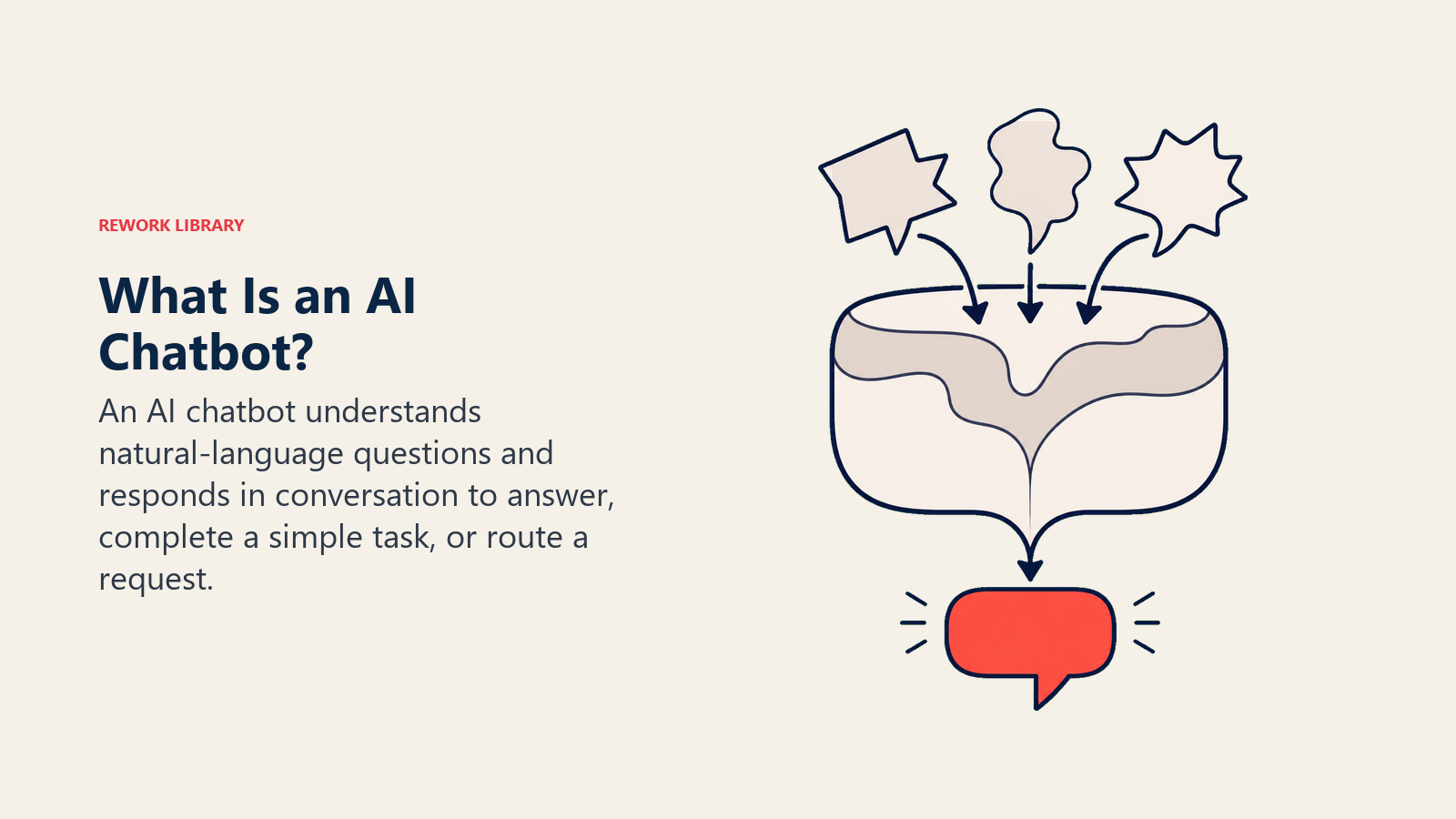
An AI chatbot is software that holds a conversation in natural language, by text or voice, to answer questions, complete a simple task, or route a request to the right place. Early chatbots matched keywords against scripted replies. Modern ones run on large language models, so they understand intent and context instead of just spotting a trigger word.
That one distinction, scripted versus genuinely understanding, explains almost every complaint people have about chatbots and almost every recent improvement. If you've typed "talk to a human" in frustration at a bot that kept misreading your question, you were up against the old kind. This page covers both kinds, how they actually work under the hood, where each type fits a business need, and how a chatbot differs from the AI agents and copilots it keeps getting confused with.
Rule-Based Chatbots vs LLM-Powered Chatbots
Not every "chatbot" runs the same technology, and the gap between the two kinds is bigger than most buyers expect.
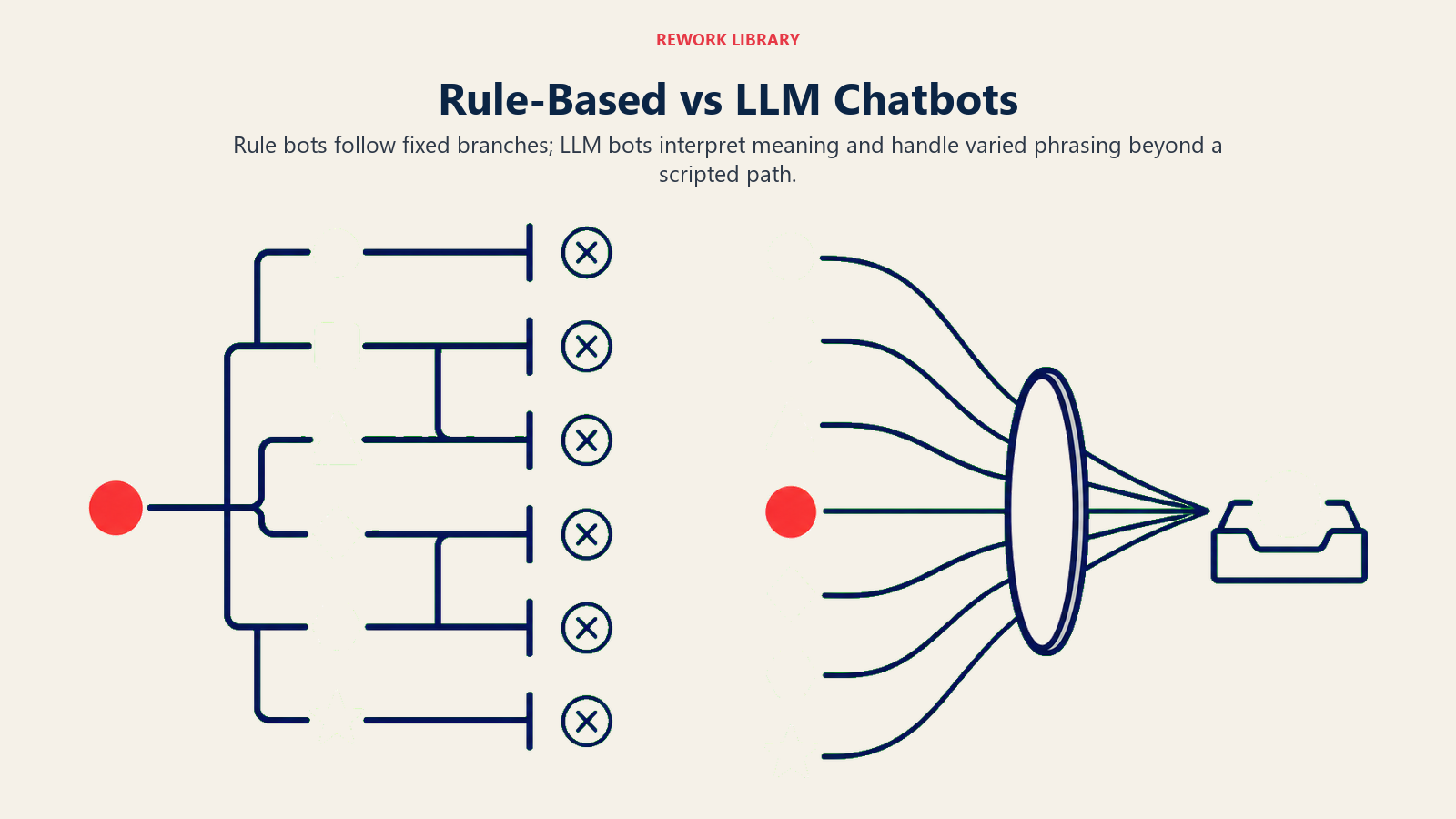
Rule-based chatbots work off a decision tree. A user's message gets matched against a list of keywords or button choices, and the bot replies with a pre-written answer or moves to the next branch. "Press 1 for billing" is the phone-tree version of the same idea. These bots are cheap to build, predictable, and easy to audit, but they break the moment someone phrases a question in a way the tree didn't anticipate.
LLM-powered chatbots run on a large language model instead of a fixed script. Rather than matching exact phrases, the model reads the full message for meaning, so "I never got my package" and "where's my order" land in the same intent even though they share almost no words. This is the shift that turned chatbots from a source of user frustration into something people will actually use for a real question. Most of what businesses deploy today, and everything covered as a "chatbot" in Best AI Chatbots in 2026, is this second kind, or a hybrid that uses rules for simple lookups and an LLM for everything else.
| Rule-based chatbot | LLM-powered chatbot | |
|---|---|---|
| How it decides | Matches keywords or menu choices against a script | Reads the full message for meaning and intent |
| Handles rephrased questions | No, breaks outside the scripted paths | Yes, understands variations and typos |
| Setup cost and speed | Low cost, fast to launch | Higher cost, needs a model, prompts, and testing |
| Predictability | Fully predictable, every path is known in advance | Mostly predictable, with some risk of an off-script or wrong answer |
| Best fit | Narrow, high-volume, unchanging questions | Open-ended support, sales, and internal Q&A |
How an AI Chatbot Works
Strip away the marketing and an LLM-powered chatbot runs through the same three-step loop on every message.
Input processing. The bot receives the message (text, or voice converted to text) and passes it through natural language processing to break it into something the model can reason about: what topic this is, what the user is actually asking for, and what, if anything, from earlier in the conversation still matters.
Intent and context matching. The system figures out what the user wants to accomplish, not just what words they used. "How do I cancel?" is a request for information; "I want to cancel" is a request for action. Well-built bots also pull in relevant account or product data at this step, often through retrieval-augmented generation, so the answer reflects the actual account instead of a generic script.
Response generation. The model drafts a reply that fits the tone, the channel, and the conversation so far, then sends it. Good implementations follow deliberate dialogue design rules here: when to ask a clarifying question, when to hand off to a human, and when to stop rather than guess.
This loop runs in under a second per turn, which is what makes a conversation feel like a conversation instead of a form with extra steps.
Types of AI Chatbots
Chatbots split into a few recognizable categories based on what job they're built to do.
Type 1: Virtual Assistants Best for: task completion and information lookup Key feature: pulls answers or executes small actions across connected systems Example: an internal HR bot that answers policy questions and files a time-off request
Type 2: Customer-Service Bots Best for: support deflection and first-line troubleshooting Key feature: resolves common issues and escalates the rest with full context attached Example: a website bot that handles order status, returns, and account questions before routing anything complex to a live agent
Type 3: Companion and Engagement Bots Best for: ongoing, personality-driven interaction rather than a single task Key feature: optimized for tone, memory of past chats, and sustained engagement over accuracy on any one fact Example: wellness and habit-tracking apps that check in daily and adapt their tone to the user
Type 4: Sales and Lead-Capture Bots Best for: qualifying visitors and booking meetings without a rep on standby Key feature: asks qualifying questions in real time and routes hot leads immediately Example: a pricing-page bot that answers plan questions and schedules a demo for qualified visitors
Business Use Cases for AI Chatbots
Where chatbots actually earn their keep in a company, beyond the generic "customer service" answer:
- Website support deflection. Answering the same 20 questions (shipping times, return policy, account setup) so a human agent only sees the cases that need judgment.
- Internal IT and HR helpdesks. Password resets, benefits questions, and policy lookups handled instantly instead of sitting in a ticket queue.
- E-commerce product discovery. A bot that asks a few questions and narrows a catalog down to three relevant products, instead of a shopper scrolling through filters.
- Appointment and demo scheduling. Booking a call or a service slot directly inside the conversation, with no back-and-forth email required.
- Lead qualification on landing pages. Asking budget, timeline, and use-case questions before a lead ever reaches a sales rep's calendar.
- Onboarding walkthroughs. Guiding a new employee or new customer through setup steps one at a time, answering questions as they come up.
Chatbot vs AI Agent vs AI Copilot
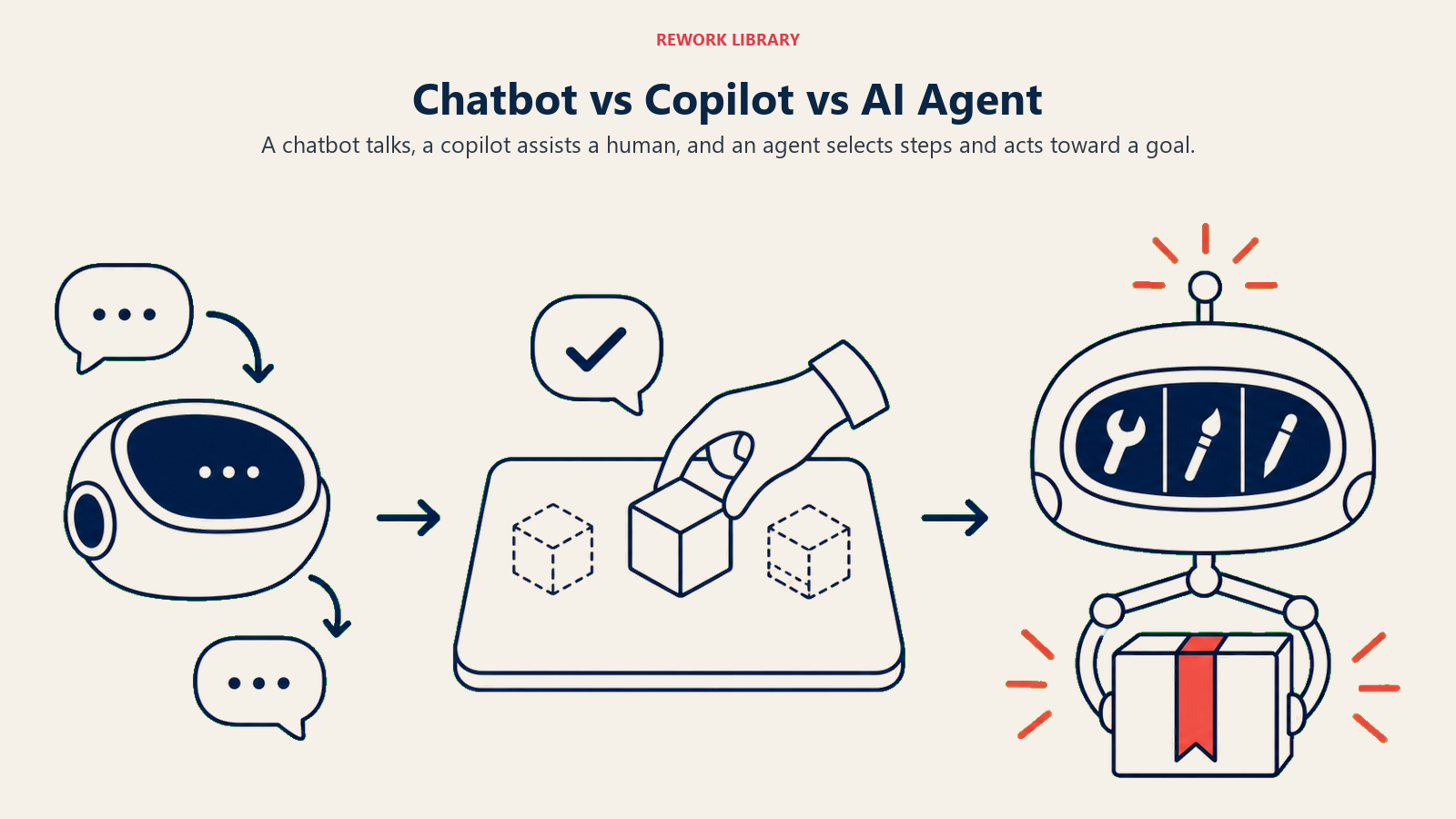
This is where most of the confusion (and most of the marketing spin) shows up. All three involve a language model. Only one of them acts on its own.
| Aspect | Chatbot | AI Copilot | AI Agent |
|---|---|---|---|
| Core job | Holds a conversation, answers or routes | Assists a human inside a tool they're already using | Reaches a goal, choosing its own steps |
| Takes actions in your systems | Rarely, only where explicitly wired in | Suggests or drafts for a human to approve | Yes, calls tools and acts without waiting for approval on each step |
| Where it lives | A dedicated chat window or widget | Embedded inside existing software (email, CRM, docs) | Runs a task end to end, often with no chat window at all |
| Handles the unexpected | Poorly if rule-based, reasonably if LLM-powered, but still reactive | Human stays in the loop for anything unusual | Reasons about it, then acts or escalates on its own |
| Best fit | Bounded Q&A and simple routing | Productivity boosts on tasks a person still owns | Judgment-light, multi-step work with clear rules and a defined handoff |
The fast test: does it only talk, or does it also act? A chatbot that starts processing refunds, updating CRM records, and emailing shipping labels on its own has quietly become an agent wearing a chat interface. See AI Agents vs Chatbots, RPA, and Automation for the full breakdown across five dimensions, What Is an AI Agent? for the plain-English definition of the more autonomous category, What is Agentic AI? for how that autonomy scales into multi-step systems, and AI Copilots for the "assists a human, doesn't replace the decision" middle ground. For a deeper look at chatbots that maintain context across a longer, more natural exchange, see Conversational AI.
Limitations of AI Chatbots
Chatbots are useful precisely because they're bounded, but that boundary comes with real tradeoffs a buyer should plan for.
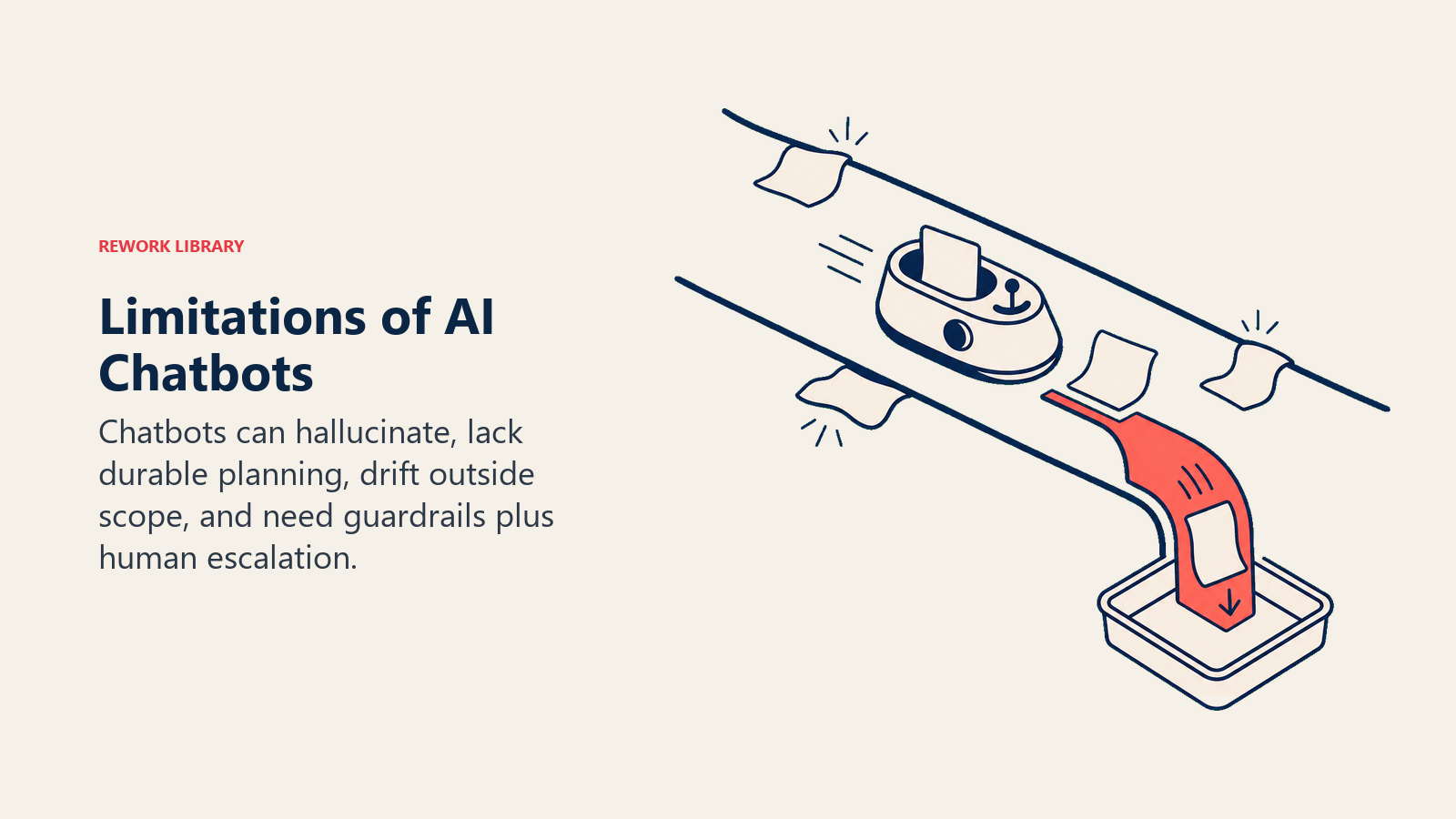
Hallucination risk. An LLM-powered bot can generate a confident, wrong answer, inventing a policy, a price, or a return window that doesn't exist. This is a known failure mode, not an edge case; see AI Hallucination for why it happens and how to catch it before a customer does.
No real planning or memory beyond the conversation. A chatbot answers what's in front of it. It doesn't break a goal into steps, track a multi-day task, or take action across systems the way an agent does. Ask it to "process this return and update the ERP" and a pure chatbot will describe what to do, not do it.
Breaks outside its script or training. Rule-based bots fail hard on rephrased questions. Even LLM-powered bots can drift off-topic or answer something they should have escalated, which is why production deployments need guardrails: defined limits, monitored outputs, and a clear handoff to a human when the bot hits the edge of what it should answer alone.
Uneven quality across use cases. A bot tuned for FAQ deflection can sound confident and still be wrong on anything outside its narrow training. Teams running chatbots at scale increasingly add a dedicated review layer that scores and flags bad conversations before they reach a customer.
If you're evaluating tools to build one, Best AI Chatbot Builders in 2026 covers platform options and where each one is strongest.
Key Facts
- Gartner projected that conversational AI deployments in contact centers would reduce agent labor costs by $80 billion by 2026, with one in 10 agent interactions automated, up from about 1.6% when the forecast was published. Gartner
- A 2026 Gartner survey found customers are roughly 3 times more likely to use a third-party generative AI tool than a company's own chatbot when resolving a customer service issue. Gartner
- AI agent and chatbot adoption inside service organizations rose from 39% to 66% year over year, per Salesforce's State of Service research, one of the fastest enterprise software adoption curves the report has tracked. Salesforce
- 74% of consumers now expect customer service to be available 24/7, a shift Zendesk's CX Trends 2026 report (survey of 11,000+ consumers and CX leaders across 22 countries) attributes largely to AI-enabled chat becoming the norm. Zendesk
- 68% of consumers say chatbots should carry the same level of expertise and quality as a highly skilled human agent, the same Zendesk report found, a bar most deployed bots still don't clear. Zendesk
- The global chatbot market is projected to reach $11.8 billion in 2026 and grow to $41.2 billion by 2033, a 19.6% compound annual growth rate. Grand View Research
- McKinsey estimates that applying generative AI to customer care functions could lift productivity by 30% to 45% of current function costs. McKinsey
Frequently Asked Questions about AI Chatbots
What is an AI chatbot in simple terms?
An AI chatbot is software that holds a natural-language conversation, by text or voice, to answer questions, complete simple tasks, or route requests. Older ones matched keywords to scripts; most built today run on a large language model that understands intent and context.
What's the difference between an AI chatbot and an AI agent?
A chatbot mainly talks: it answers, suggests, or routes. An AI agent takes actions in your systems on its own, choosing the steps needed to reach a goal rather than waiting on a script. A chatbot that starts executing multi-step tasks across systems has effectively become an agent.
Are all AI chatbots powered by ChatGPT?
No. Many run on other large language models (Claude, Gemini, open-source models) or, for simpler use cases, on rule-based scripts with no language model at all. "AI chatbot" describes the category, not any single underlying model.
What's the difference between rule-based and LLM-powered chatbots?
A rule-based chatbot matches a message against a fixed decision tree and breaks on anything the script didn't anticipate. An LLM-powered chatbot reads the message for meaning, so it handles rephrased questions and open-ended requests that a scripted bot can't.
Can an AI chatbot fully replace human customer service?
For narrow, high-volume questions, yes, largely. For anything requiring judgment, empathy, or a decision outside its training, no. Most production deployments pair a chatbot with a clear handoff to a human rather than replacing support entirely.
Is an AI chatbot the same as an AI copilot?
No. A copilot is embedded inside a tool someone is already using (email, a CRM, a document editor) and assists with a task the person still owns. A chatbot is usually a standalone conversation window that a user goes to for an answer.
How much does it cost to add an AI chatbot to a website?
It ranges widely, from free tiers on no-code builders for a basic FAQ bot to custom builds with ongoing model and integration costs for a bot tied into a CRM and order system. See a current roundup of platform pricing in Best AI Chatbot Builders in 2026.
What's the biggest risk of deploying an AI chatbot for customer-facing work?
Hallucination, an LLM-powered bot generating a confident but wrong answer about a policy, price, or process. Guardrails, monitored outputs, and a defined escalation path are how production teams manage that risk rather than eliminate it.
Do AI chatbots learn from every conversation automatically?
Not by default. Most business chatbots don't retrain themselves live from user conversations, since that risks drifting off-brand or picking up bad data. Improvement usually comes from a team reviewing transcripts and updating the underlying prompts, knowledge base, or fine-tuning on a schedule.
Related AI Concepts
- Conversational AI - The broader category of context-aware, multi-turn systems that modern chatbots belong to
- What is Agentic AI? - How chatbot-style interfaces evolve into systems that plan and act autonomously
- AI Copilots - Embedded assistants that help a human rather than replacing the conversation
- Large Language Models - The technology powering most modern chatbots
- Natural Language Processing - How a chatbot turns a message into something it can act on
- Best AI Chatbots in 2026 - A vetted comparison of chatbot tools, from ChatGPT to free alternatives
External Resources
- Gartner: Conversational AI and Contact Center Labor Costs - The $80 billion forecast and automation rate
- Salesforce State of Service Report - Year-over-year AI adoption data in service organizations
- Zendesk CX Trends Report - Consumer expectations for AI-enabled chat and support
Part of the AI Terms Collection. Last updated: 2026-07-20
