What is AI Change Management? From AI Skeptics to AI Champions
Turn this article into takeaways for your work.


Each assistant summarizes the article only for you and suggests best practices for your work.
You've invested millions in AI tools. Adoption rate? 12%. Sound familiar? The technology works. Your people don't trust it, don't understand it, or actively resist it. AI change management bridges the gap between AI capability and AI adoption.
Defining AI Change Management
AI change management is the structured approach to preparing, equipping, and supporting individuals and teams to successfully adopt AI technologies and new AI-enabled work processes. It addresses the human side of AI transformation, managing resistance, building capabilities, and reinforcing new behaviors.
According to Prosci research, "Projects with excellent change management are six times more likely to meet objectives than those with poor change management." This applies especially to AI transformation, where fear, misunderstanding, and entrenched work habits create significant adoption barriers.
Unlike traditional change management, AI initiatives face unique challenges: fear of job displacement, black-box decision-making concerns, and the need for continuous learning as machine learning systems evolve post-deployment.
Executive Perspective
For business leaders, AI change management is the difference between owning expensive AI shelfware and achieving the productivity gains that justify your investment – it's not about the technology, it's about the people using it.
Think of AI adoption like moving from paper to spreadsheets in the 1980s. The technology enabled new capabilities, but companies that forced adoption without training saw resistance. Those that invested in change management captured competitive advantages that persist today.
In practical terms, AI change management means designing rollout strategies that build trust, creating training programs that stick, identifying and empowering AI champions, and measuring adoption metrics alongside technical performance.
The AI Adoption Curve
Employee segments and strategies:
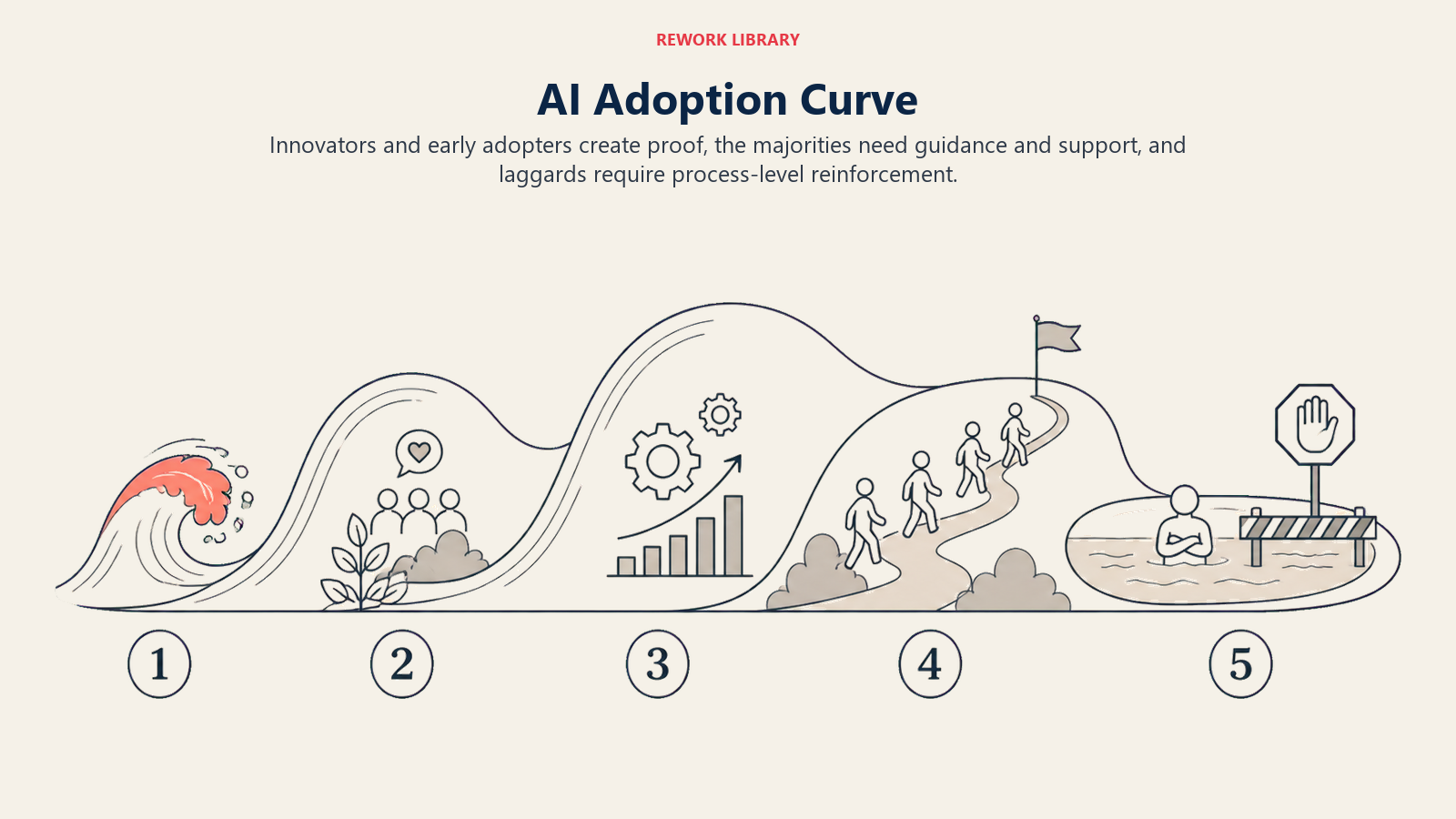
Innovators (5%):
- Characteristics: Experiment immediately, provide feedback
- Strategy: Empower as beta testers and champions
- Value: Proof points for broader organization
- Example: Early prompt engineering experts
Early Adopters (15%):
- Characteristics: Adopt quickly when shown value
- Strategy: Showcase success stories and provide advanced training
- Value: Influence majority through peer networks
- Example: Department heads using AI for planning
Early Majority (30%):
- Characteristics: Adopt once proven, need guidance
- Strategy: Structured training and clear use cases
- Value: Critical mass for cultural shift
- Example: Managers using AI for reporting
Late Majority (30%):
- Characteristics: Skeptical, need pressure or incentives
- Strategy: Mandate with support and simplified tools
- Value: Full organization coverage
- Example: Frontline workers using AI-powered tools
Laggards (20%):
- Characteristics: Resist change, prefer traditional methods
- Strategy: Process changes that require AI use
- Value: Compliance and risk management
- Example: Transitioning legacy processes
Change Management Framework
Structured approach to AI adoption:
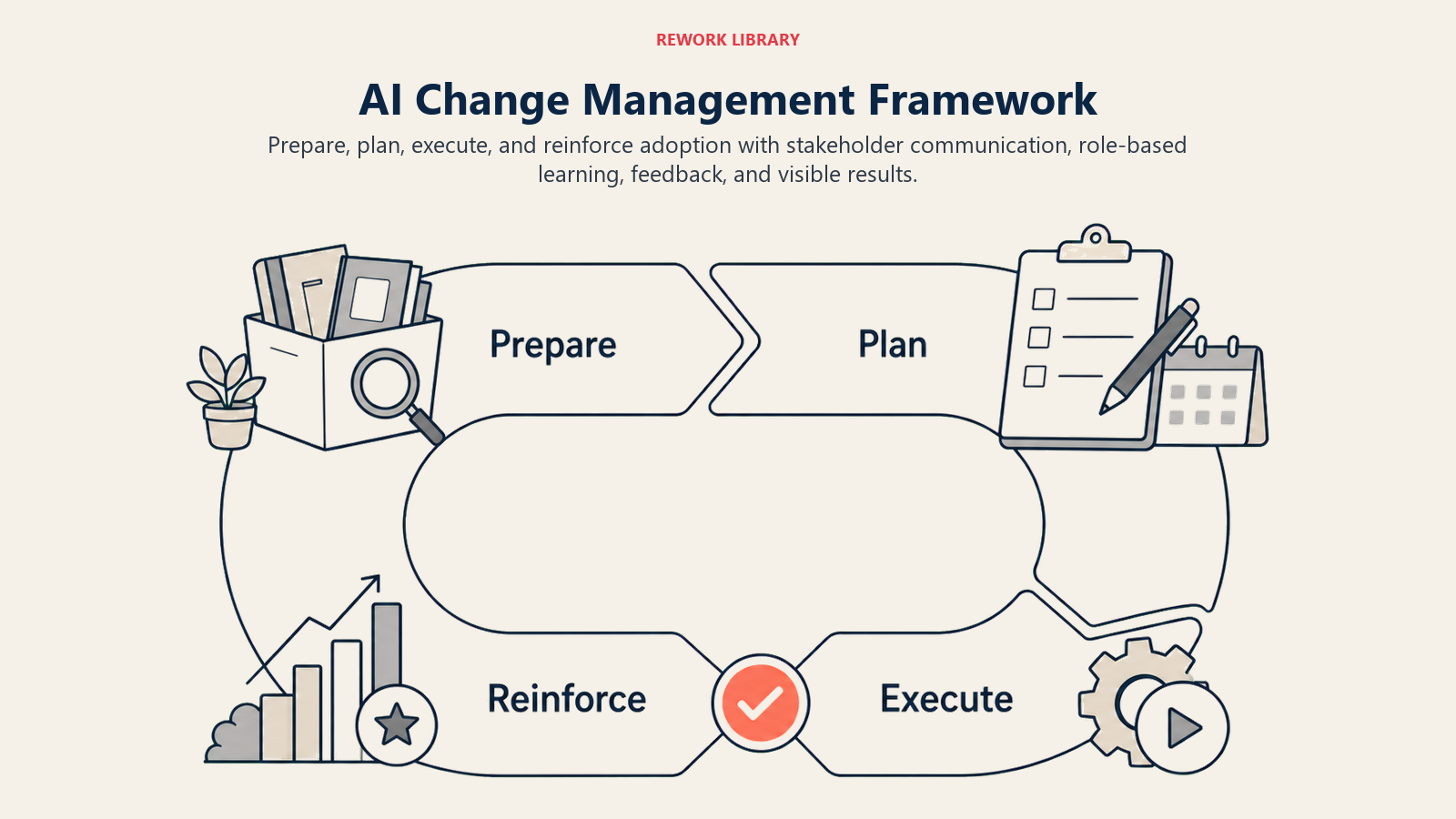
Phase 1: Prepare
- Assess readiness and resistance points
- Build coalition of executives and champions
- Develop clear vision of AI-enabled future state
- Define success metrics beyond technical performance
Phase 2: Plan
- Create stakeholder-specific communication strategies
- Design training programs for different skill levels
- Identify quick wins that build momentum
- Establish feedback loops and support systems
Phase 3: Execute
- Launch with pilot groups, not big bang
- Provide intensive support during transition
- Celebrate early successes publicly
- Address resistance with empathy and evidence
Phase 4: Reinforce
- Make AI adoption visible in performance reviews
- Share continuous improvement stories
- Refresh training as AI capabilities evolve
- Embed AI into standard operating procedures
Overcoming Resistance Patterns
Common resistance types and responses:
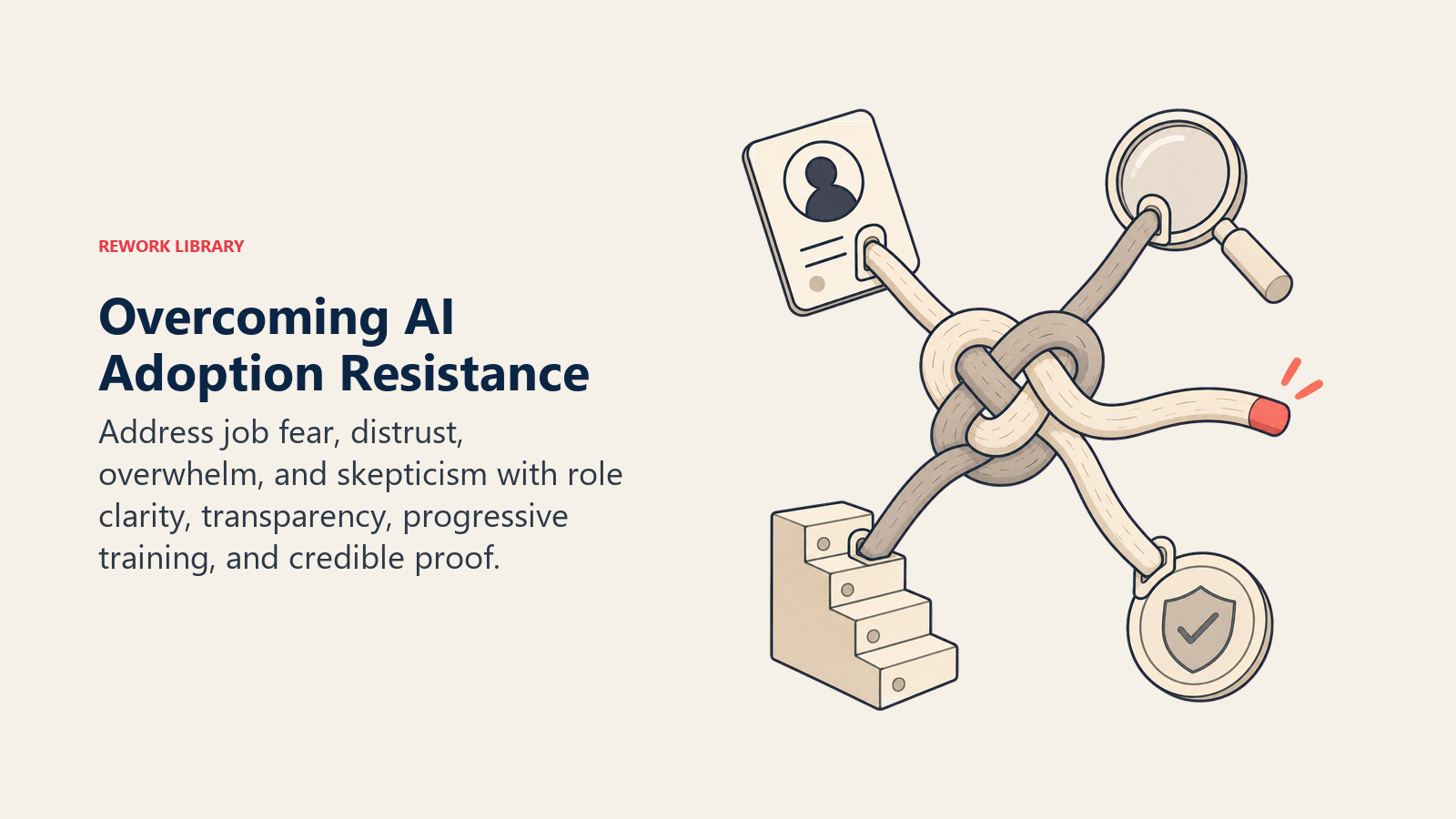
Job Security Fears:
- Concern: "AI will replace me"
- Response: Position AI as capability amplifier, highlight new roles AI creates
- Evidence: Share internal examples where AI freed time for higher-value work
- Example: Customer service reps becoming relationship managers
Trust Deficit:
- Concern: "AI makes mistakes" or "I don't understand how it works"
- Response: Implement human-in-the-loop processes, provide explainable AI transparency
- Evidence: Show accuracy metrics and override mechanisms
- Example: Radiologists using AI as second opinion, not replacement
Skill Anxiety:
- Concern: "I don't know how to use this" or "I'm not technical"
- Response: User-friendly tools, just-in-time learning, patient support
- Evidence: "If you can use Google, you can use this"
- Example: Natural language interfaces that require no coding
Loss of Autonomy:
- Concern: "AI is micromanaging me" or "Removes my judgment"
- Response: Position AI as advisor, maintain human final decision
- Evidence: Show how AI recommendations inform, not dictate
- Example: Sales reps getting next-best-action suggestions they can ignore
Training Program Design
Effective AI learning strategies:
Executive Training (2 days):
- Content: AI strategy, governance, business cases
- Format: Workshop with industry examples
- Outcome: Informed AI investment decisions
- Frequency: Annual with quarterly updates
Manager Training (1 week):
- Content: AI capabilities, team adoption, change leadership
- Format: Mix of classroom and hands-on
- Outcome: Managers coach teams effectively
- Frequency: Initial intensive, monthly refreshers
End-User Training (Role-Specific):
- Content: Specific tools and workflows
- Format: Microlearning and on-demand resources
- Outcome: Daily productive AI use
- Frequency: Continuous as tools evolve
Power User Certification:
- Content: Advanced techniques and troubleshooting
- Format: Intensive bootcamp with projects
- Outcome: Internal support network
- Frequency: Quarterly cohorts
Real-World Change Success
Organizations that got adoption right:
Insurance Example: AXA's AI adoption program started with 50 claims adjusters as pilot group, achieved 85% satisfaction, then scaled to 10,000 employees over 18 months using peer champions from pilot group as trainers, resulting in 40% productivity increase with minimal resistance.
Manufacturing Example: Siemens implemented AI quality inspection with explicit "AI as colleague" framing, provided 3-day training where workers taught AI their expertise, and maintained human override authority, achieving 95% adoption within 6 months because workers felt ownership.
Professional Services Example: Deloitte's AI change approach included mandatory partner workshops, embedded AI coaches in each practice area, and made AI capability a promotion criterion, resulting in transformation from 5% to 75% consultant AI usage in one year.
Measuring Adoption Success
Key metrics beyond technology:
Usage Metrics:
- Daily/weekly active users
- Features utilized vs. available
- Time spent in AI tools
- Voluntary vs. mandated use
Capability Metrics:
- Training completion rates
- Certification achievements
- Self-reported confidence levels
- Support ticket trends (should decrease)
Business Impact:
- Productivity gains per user
- Quality improvements
- Decision speed increases
- Cost savings realized
Cultural Metrics:
- Employee AI sentiment surveys
- Resistance incident frequency
- Internal innovation proposals
- Retention of AI-skilled talent
Common Change Failures
Pitfalls that kill adoption:
• Technology-First Rollout: Deploy AI without preparing people → Solution: Equal investment in change as technology, pilot with friendly users
• One-Size-Fits-All Training: Same training for all roles → Solution: Customize by role, technical background, and use cases
• Ignoring Middle Management: Focus on executives and frontline → Solution: Equip managers to lead change in their teams
• No Reinforcement: Launch and disappear → Solution: Continuous support, refresher training, updated communications
• Measuring Wrong Things: Only technical metrics → Solution: Track adoption behaviors and business outcomes
Creating AI Champions Network
Building internal advocates:
Identify Natural Champions:
- Look for early adopters who influence peers
- Mix of roles, levels, and departments
- Already experimenting with AI tools
- Respected within their networks
Empower Champions:
- Early access to new AI capabilities
- Direct line to leadership and product teams
- Recognition and career development opportunities
- Time allocated for advocacy (10-20% of role)
Champion Responsibilities:
- Demonstrate AI use in daily work
- Run lunch-and-learn sessions
- Provide peer-to-peer support
- Collect feedback for improvement
Champion Network Value:
- More credible than top-down mandates
- Faster problem identification and resolution
- Cultural shift through grassroots movement
- Sustainable beyond initial rollout
Building Your Change Strategy
Steps to drive AI adoption:
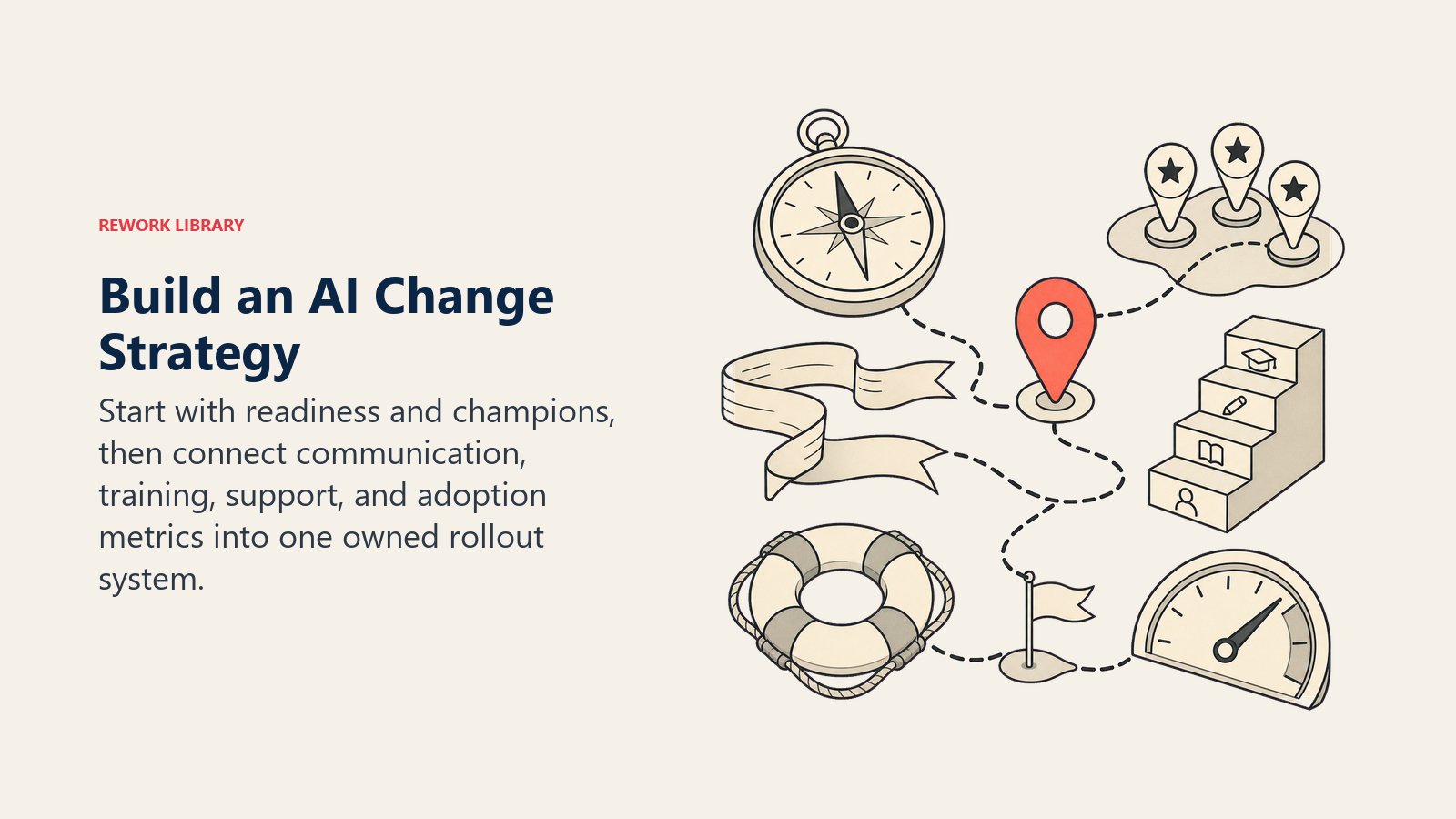
- Start with AI Governance framework for trust
- Build capability through AI Talent Strategy
- Create structure with AI Center of Excellence
- Address concerns with Explainable AI
Frequently Asked Questions about AI Change Management
What is AI Change Management?
AI change management is the structured approach to preparing, equipping, and supporting individuals and teams to successfully adopt AI technologies and new AI-enabled work processes, addressing the human side of AI transformation including resistance, capabilities, and behavior change.
What are the five segments of the AI adoption curve?
Innovators (5% - experiment immediately), Early Adopters (15% - adopt when shown value), Early Majority (30% - adopt once proven), Late Majority (30% - skeptical, need pressure), and Laggards (20% - resist change, prefer traditional methods).
What are the four common resistance patterns to AI adoption?
Job Security Fears (AI will replace me), Trust Deficit (AI makes mistakes or is a black box), Skill Anxiety (I don't know how to use this), and Loss of Autonomy (AI micromanages or removes judgment).
What are the four phases of the AI change management framework?
Prepare (assess readiness and build coalition), Plan (create communication and training strategies), Execute (launch with pilots and intensive support), and Reinforce (embed AI into performance and processes).
What metrics should I track for AI adoption success?
Usage Metrics (active users, features utilized), Capability Metrics (training completion, confidence levels), Business Impact (productivity gains, quality improvements), and Cultural Metrics (sentiment surveys, innovation proposals).
Related Resources
Explore these related concepts to deepen your understanding of AI change:
- AI Talent Strategy - Building the capabilities needed for AI adoption
- AI Governance - Framework that builds trust in AI systems
- Prompt Engineering - Core skill for AI-enabled workforce
- Human-in-the-Loop - Approach that addresses trust concerns
External Resources
- Prosci Change Management - Research-backed change management methodologies
- MIT Sloan Management Review - Digital transformation and AI adoption research
Part of the AI Terms Collection. Last updated: 2026-02-09

Co-Founder, Rework.com
On this page
- Defining AI Change Management
- Executive Perspective
- The AI Adoption Curve
- Change Management Framework
- Overcoming Resistance Patterns
- Training Program Design
- Real-World Change Success
- Measuring Adoption Success
- Common Change Failures
- Creating AI Champions Network
- Building Your Change Strategy
- Related Resources
- External Resources