What is IBM watsonx?
Turn this article into takeaways for your work.


Each assistant summarizes the article only for you and suggests best practices for your work.
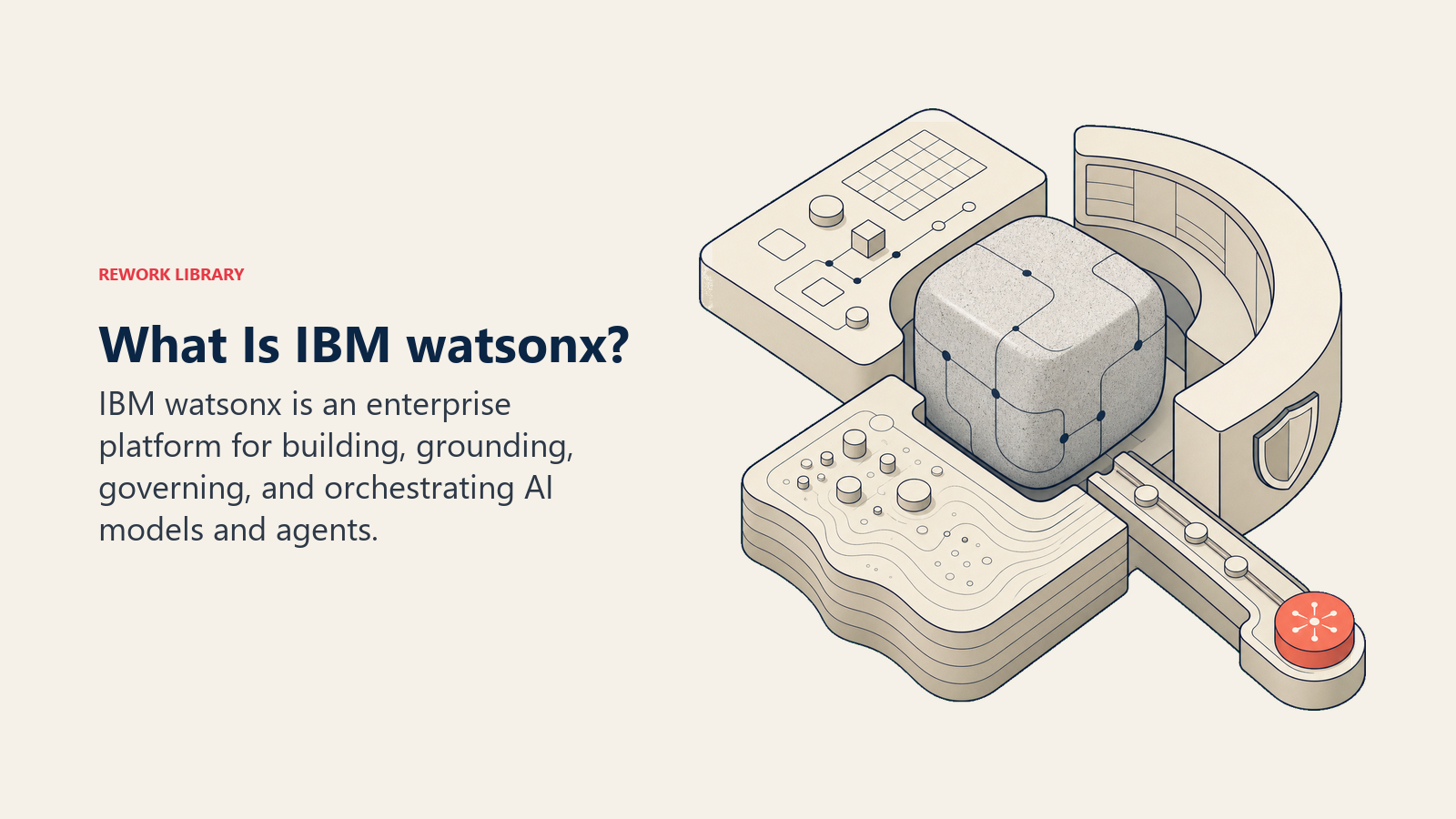
IBM watsonx is IBM's enterprise AI and data platform: watsonx.ai for building and deploying models, watsonx.data for storing and governing the data behind them, and watsonx.governance for tracking risk and compliance across the AI lifecycle. Launched in 2023, it's the successor to the Watson brand IBM built around narrow, single-purpose AI systems like the one that won Jeopardy!.
If you're asking "what is IBM Watson AI" today, watsonx is the honest answer. IBM retired the old idea of Watson as a single product years ago and rebuilt the brand around a platform: a place where enterprise teams train or fine-tune models, ground them in governed company data, watch what those models do once they're live, and increasingly, wire them into agents that take action rather than just answer questions.
What Each Component of watsonx Does
Watsonx isn't one product. It's three core services plus a fourth, newer one for agents, and understanding what each does is the fastest way to understand the platform.
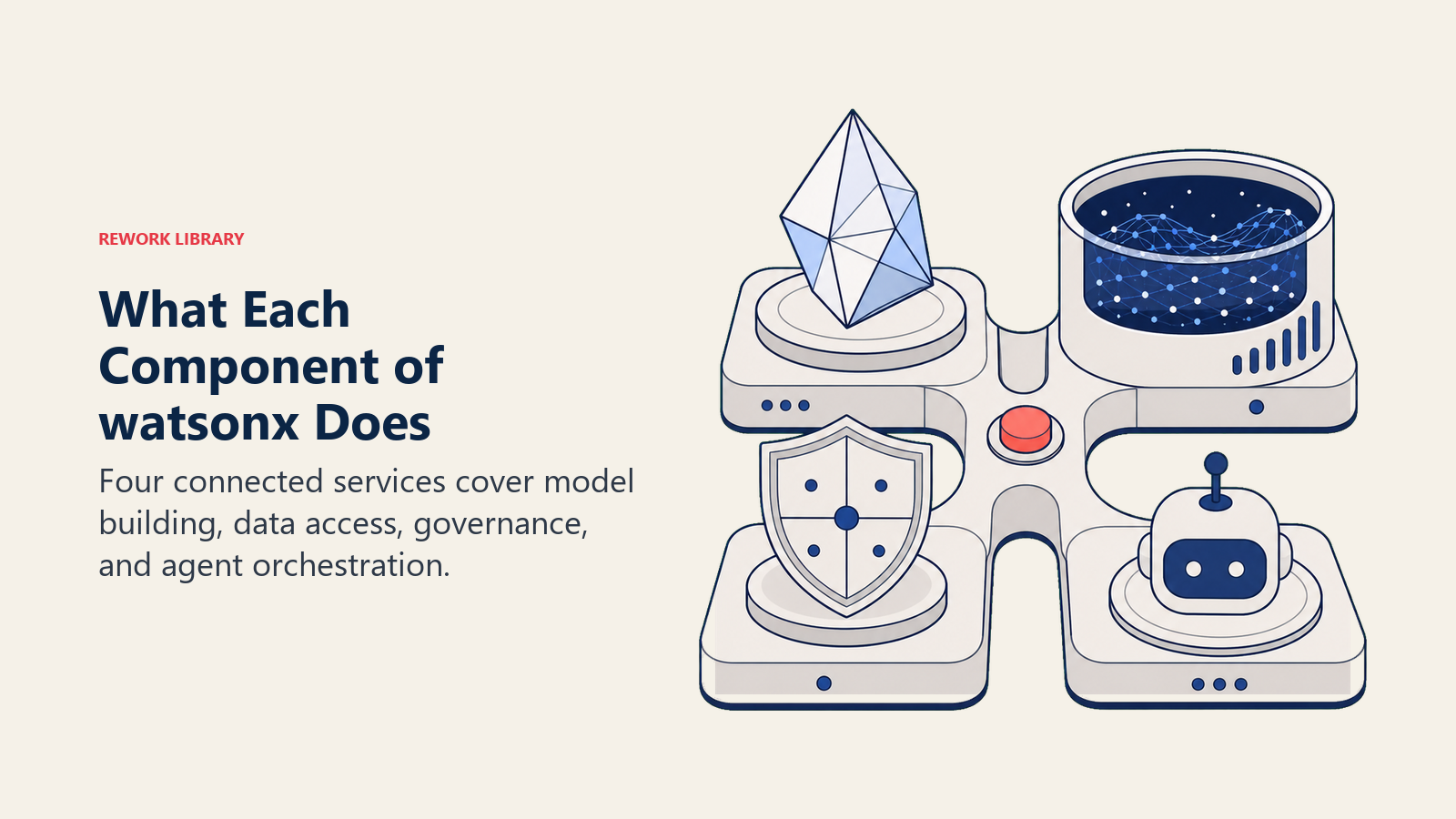
watsonx.ai is the model workbench. It's where teams access foundation models, IBM's own Granite family and third-party models from Meta, Mistral, and others, then prompt, fine-tune, and deploy them through a shared Prompt Lab and API layer. It's the closest thing to a single front door for machine learning and generative AI work on the platform.
watsonx.data is the data layer underneath. It's built as an open data lakehouse, letting teams query data across cloud and on-premises stores through one entry point instead of copying it into a separate AI-specific warehouse. For any AI initiative, the model is only as good as the data feeding it, and watsonx.data is IBM's answer to the cost and complexity of getting that data AI-ready in the first place.
watsonx.governance is the control layer. According to IBM's own product page, it's built to monitor, govern, and manage AI systems, models, applications, and agents, across IBM technology as well as third-party platforms like OpenAI, AWS, and Meta. That cross-platform reach matters: governance here isn't limited to models IBM sold you, which fits how most large enterprises actually run AI, spread across several vendors at once.
watsonx Orchestrate is the newest piece and the one IBM has pushed hardest through 2026. It's an agentic workflows product: a place to build, orchestrate, and deploy AI agents that carry out multi-step business tasks, with a catalog of prebuilt agents for functions like HR, procurement, and sales, plus tools for building custom ones. It sits alongside watsonx.ai rather than inside it, its own product with its own pricing.
Granite: The Open Models Inside watsonx
IBM's own Granite family is the model line watsonx is built to showcase, and it's a genuinely open one. Granite models are released under the Apache 2.0 license, which means the weights are free to download, inspect, fine-tune, and run on infrastructure IBM never touches. The current generation, Granite 4.1, ships as dense decoder-only language models in 3B, 8B, and 30B parameter sizes, with native support for multiple languages, coding tasks, retrieval-augmented generation, tool calling, and structured JSON output, according to IBM's Granite model documentation on GitHub.
The Granite family extends past general-purpose language models too. IBM publishes Granite Vision models for document-heavy visual tasks, Granite Speech models for transcription and spoken-language understanding, Granite Embedding models for search and RAG pipelines, and Granite Guardian models built specifically for content moderation and safety checks, per the official Granite hub on Hugging Face. The smaller sizes in that lineup are IBM's entry in the broader shift toward small language models: models sized for lower latency and cheaper inference on agentic, tool-heavy workloads rather than raw benchmark scores.
Granite isn't the only option inside watsonx.ai, though. The catalog also includes third-party open and commercial models, Meta's Llama family, Mistral's models, and others available through IBM's documented third-party foundation model catalog, so teams aren't locked into Granite even while using IBM's infrastructure to run everything.
watsonx Orchestrate and Agents in 2026
Model access alone doesn't finish an enterprise AI project. Somebody still has to wire that model into an actual workflow: a case gets triaged, a purchase order gets approved, a candidate gets screened. That's the gap watsonx Orchestrate is built to close, and it's the part of the platform IBM has leaned into hardest this year as the broader industry pivots from chatbots toward autonomous, task-completing agents.
Orchestrate gives teams a catalog of prebuilt domain agents for common back-office functions, plus a builder for creating custom agents that call internal tools, APIs, and other agents in sequence. It's priced and packaged separately from watsonx.ai, and billed by Monthly Active Units rather than tokens, which is a deliberate difference: IBM is metering how many people and processes actually touch an agent in a given month, not how much text a model generates. That's a meaningfully different cost model to budget for than the per-token pricing used elsewhere on the platform, and it's worth understanding before scaling an agent pilot into a company-wide rollout.
Who watsonx Is For
Watsonx is built for large, often regulated enterprises, not solo developers or small teams experimenting with a single API key. The platform assumes real governance requirements: audit trails, model risk management, and the ability to prove to a regulator or an internal compliance team what a model did and why.
That shows up most clearly in three groups of buyers. Banks, insurers, healthcare systems, and government agencies use watsonx.governance because AI decisions in those industries carry legal and compliance weight that a spreadsheet of model metrics doesn't satisfy. IT and data platform teams already running IBM infrastructure, Cloud Pak for Data, IBM Z mainframes, or a hybrid cloud footprint, get a shorter path to production because watsonx is built to run anywhere that infrastructure already lives, including fully on-premises. And enterprise teams standing up their first agent programs turn to watsonx Orchestrate specifically because it packages governance and agent orchestration together rather than treating them as separate purchases.
Teams that want a single hyperscaler-native stack tightly bundled with one public cloud's other AI services, or that don't need on-premises deployment or cross-platform governance, are usually better served elsewhere; that trade-off is exactly what the comparison table below is for.
How watsonx Is Priced
Watsonx doesn't use one pricing model across the board. Each service is metered differently, and understanding which meter applies to which workload matters before committing budget.
watsonx.ai and watsonx.data run on IBM's Resource Unit (RU) system. Compute, storage, and inference consumption all convert into RUs, but the conversion rate is service-specific: a training job consumes RUs differently than an inference call or a stored data file, and IBM publishes separate per-service conversion tables rather than one flat rate. Enterprises typically prepurchase an annual or multi-year RU pool at a discounted rate rather than paying on demand, according to Redress Compliance's IBM watsonx licensing guide. That structure rewards workload forecasting: teams that can commit to a usage band ahead of time pay less per unit than teams buying RUs reactively.
watsonx Orchestrate is priced separately and more simply on paper. Its Essential Edition starts at roughly $500 per month and covers core agent building, orchestration, a catalog of prebuilt integrations, and cloud or on-premises deployment, according to BlockSentient's 2026 watsonx Orchestrate review. Standard and Premium tiers, which add advanced workflow automation, document processing, dedicated data isolation, and higher-throughput capacity, are custom-quoted rather than list-priced.
As with any consumption-based AI platform, the quoted starting rate is rarely the full year-one number once inference volume, fine-tuning runs, storage, and agent usage across multiple teams get added up. Running that math properly, rather than budgeting off a single headline figure, is exactly the job of an AI total cost of ownership framework.
watsonx vs. Vertex AI vs. Bedrock vs. Azure AI Foundry
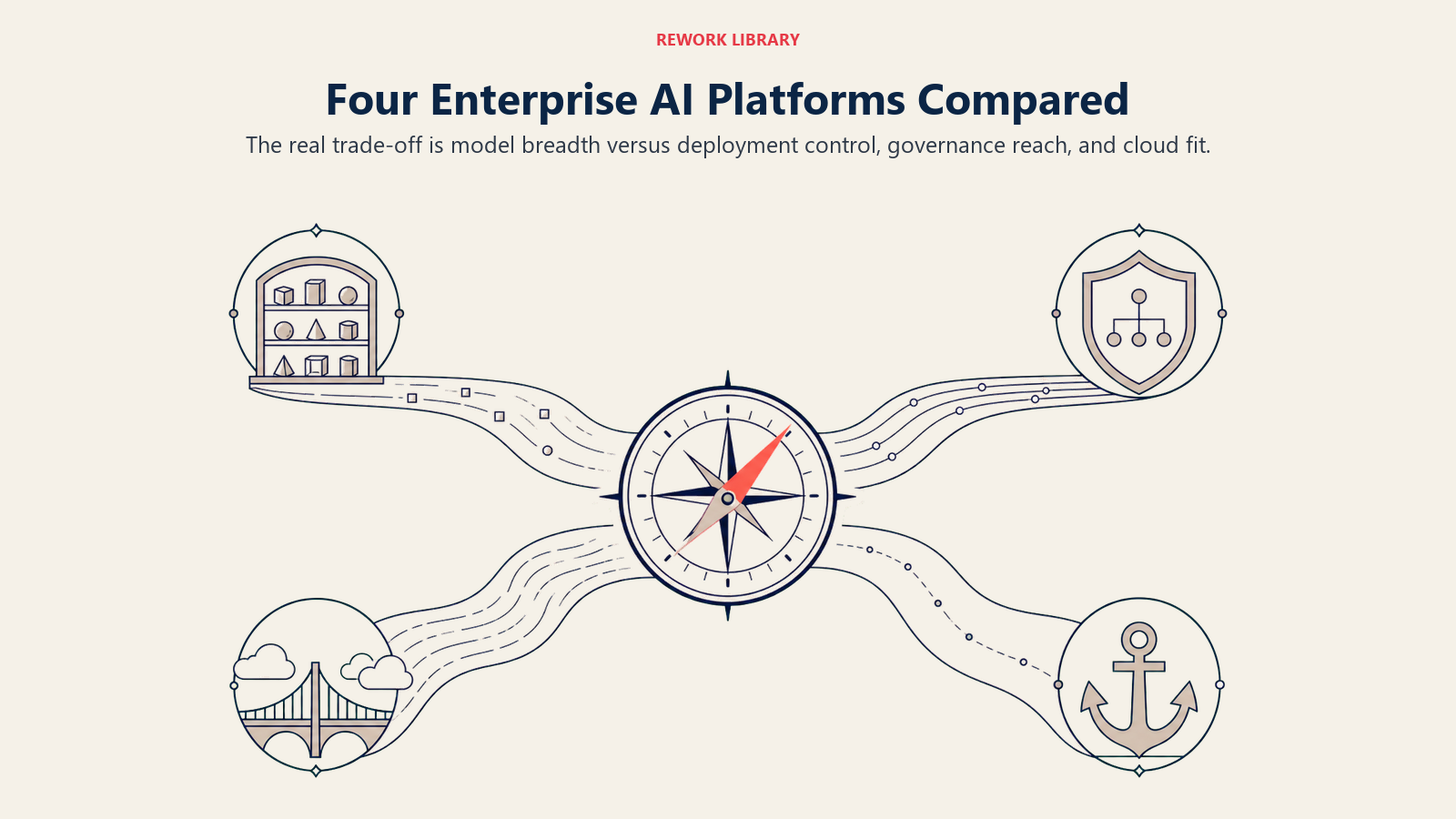
All four platforms give enterprise teams access to leading foundation models, fine-tuning, and some form of agent tooling. The differences show up in openness, governance reach, and which infrastructure you're already standing on.
| Dimension | IBM watsonx | Google Vertex AI | AWS Bedrock | Azure AI Foundry |
|---|---|---|---|---|
| Flagship open models | Granite (Apache 2.0), plus third-party Llama, Mistral, and others | Gemini, plus 200+ models via Model Garden | Roughly 40 models from about eight providers | Deepest first-party OpenAI/GPT integration, plus open models |
| Governance reach | watsonx.governance monitors IBM and third-party models (OpenAI, AWS, Meta) from one console | Model monitoring built into the platform, GCP-centric | AWS-centric monitoring and IAM controls | Microsoft Entra ID and Purview integration |
| Agent tooling | watsonx Orchestrate: prebuilt domain agents plus custom agent builder | Agent Builder: ADK, Agent Studio, Agent Garden | Bedrock AgentCore | Foundry Agent Service |
| Pricing model | Resource Units for watsonx.ai/data, Monthly Active Units for Orchestrate | Per-token inference, per-node-hour training | Per-token inference, provisioned throughput | Per-token inference, consumption and provisioned tiers |
| Deployment options | IBM Cloud, AWS, Azure, or fully on-premises via Cloud Pak for Data | Primarily Google Cloud | Primarily AWS | Primarily Azure |
| Strongest fit | Regulated enterprises needing hybrid or on-premises deployment and cross-vendor governance | GCP-native teams with BigQuery data gravity | AWS-native or Claude-centric teams | Microsoft 365 and Azure-native enterprises |
Watsonx's clearest edge over the three hyperscaler platforms is deployment flexibility and governance that isn't locked to one cloud. Its clearest gap is model catalog depth: Vertex AI's Model Garden alone lists over 200 models, well past what watsonx.ai currently offers. Teams should treat that trade-off, breadth of models versus deployment control and cross-platform governance, as the real decision, not a feature checklist, which is the kind of comparison an AI vendor evaluation process is built to structure.
Key Facts
- IBM unveiled the watsonx platform on May 9, 2023, at its annual Think conference, positioning it as the foundation for the company's generative AI push, according to IBM's official press release.
- The original Watson defeated Jeopardy! champions Ken Jennings and Brad Rutter in February 2011, running on a system of 90 servers with 2,880 processor cores, according to IBM's own Watson history page.
- IBM sold its Watson Health data and analytics assets to Francisco Partners in a deal announced January 21, 2022 and completed that June, and the business now operates independently as Merative, according to IBM's press release announcing the sale.
- IBM reported $15.9 billion in total revenue for Q1 2026, up 9% year over year, with software revenue of $7.1 billion, up 11% year over year, according to IBM's official Q1 2026 results release.
- Granite 4.1, IBM's current generation of open language models, ships as dense decoder-only models in 3B, 8B, and 30B parameter sizes under the Apache 2.0 license, per IBM's Granite model repository.
- watsonx.governance is built to monitor and manage AI systems across both IBM technology and third-party platforms including OpenAI, AWS, and Meta, according to IBM's watsonx.governance product page.
- watsonx Orchestrate's Essential Edition starts at roughly $500 per month, billed by Monthly Active Units rather than tokens, according to BlockSentient's 2026 pricing review.
Classic Watson vs. watsonx Today
It's worth separating the two eras, because they're genuinely different products wearing the same family name. The original Watson was a single-purpose question-answering system, five years in development, built to parse natural-language trivia clues and search a fixed body of knowledge fast enough to beat human champions on live television. It won. It also wasn't something a business could buy and repurpose; it was a research demonstration that IBM spent the following decade trying to commercialize into vertical products like Watson Health, Watson Assistant, and Watson Discovery, with mixed results. Watson Health, the highest-profile of those bets, was sold off entirely in 2022.
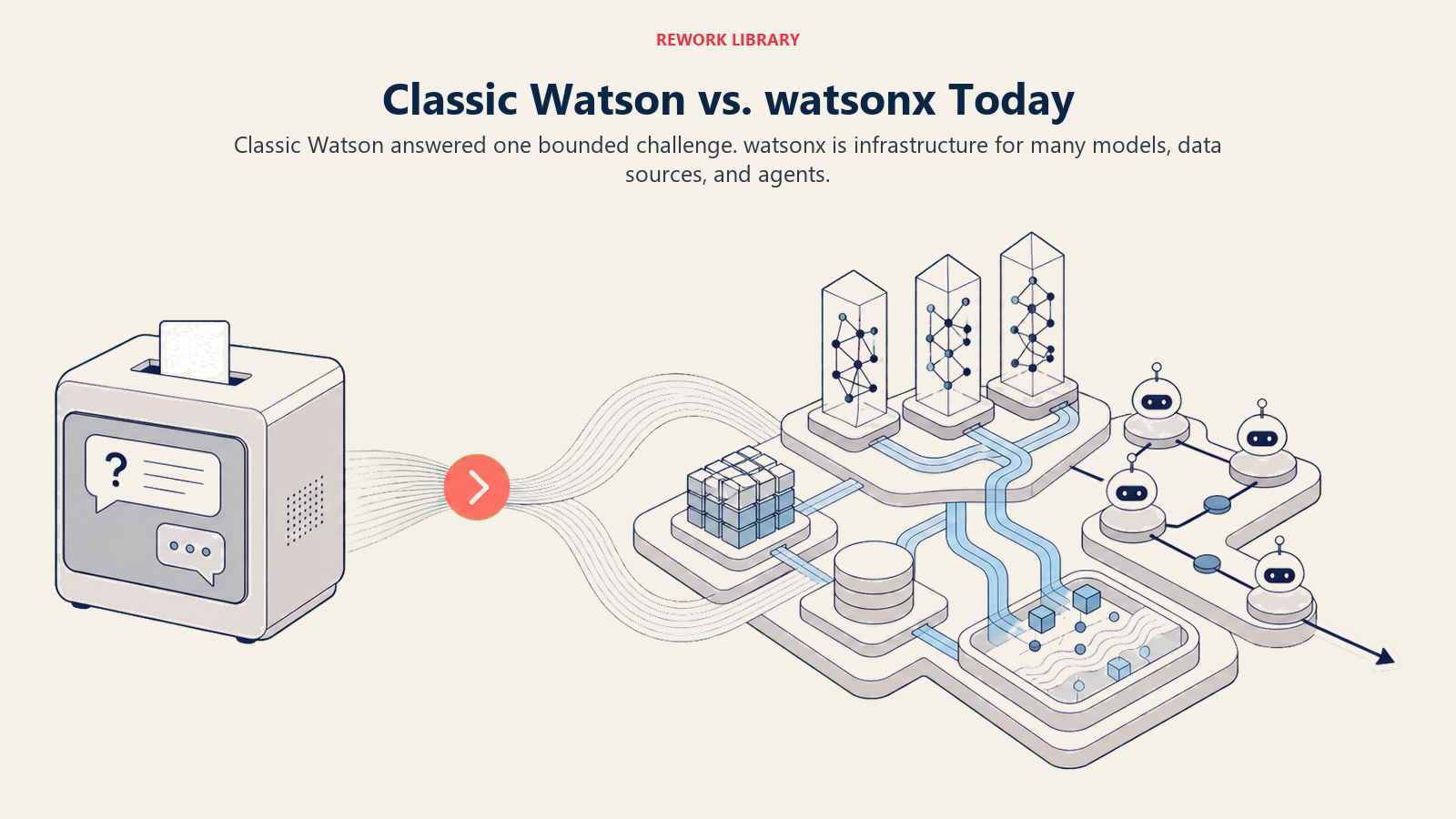
Watsonx is a different kind of thing. Instead of one model tuned for one task, it's infrastructure: a place to bring your own data, choose from open and third-party models, fine-tune and deploy them, and govern whatever comes out the other end. The Jeopardy!-winning Watson could answer trivia; watsonx is meant to be the platform underneath whatever your AI systems need to do next, which is a much broader and, so far, much less flashy bet.
Limitations to Know
Watsonx isn't the default choice for every team, and a few gaps are worth weighing before committing budget.
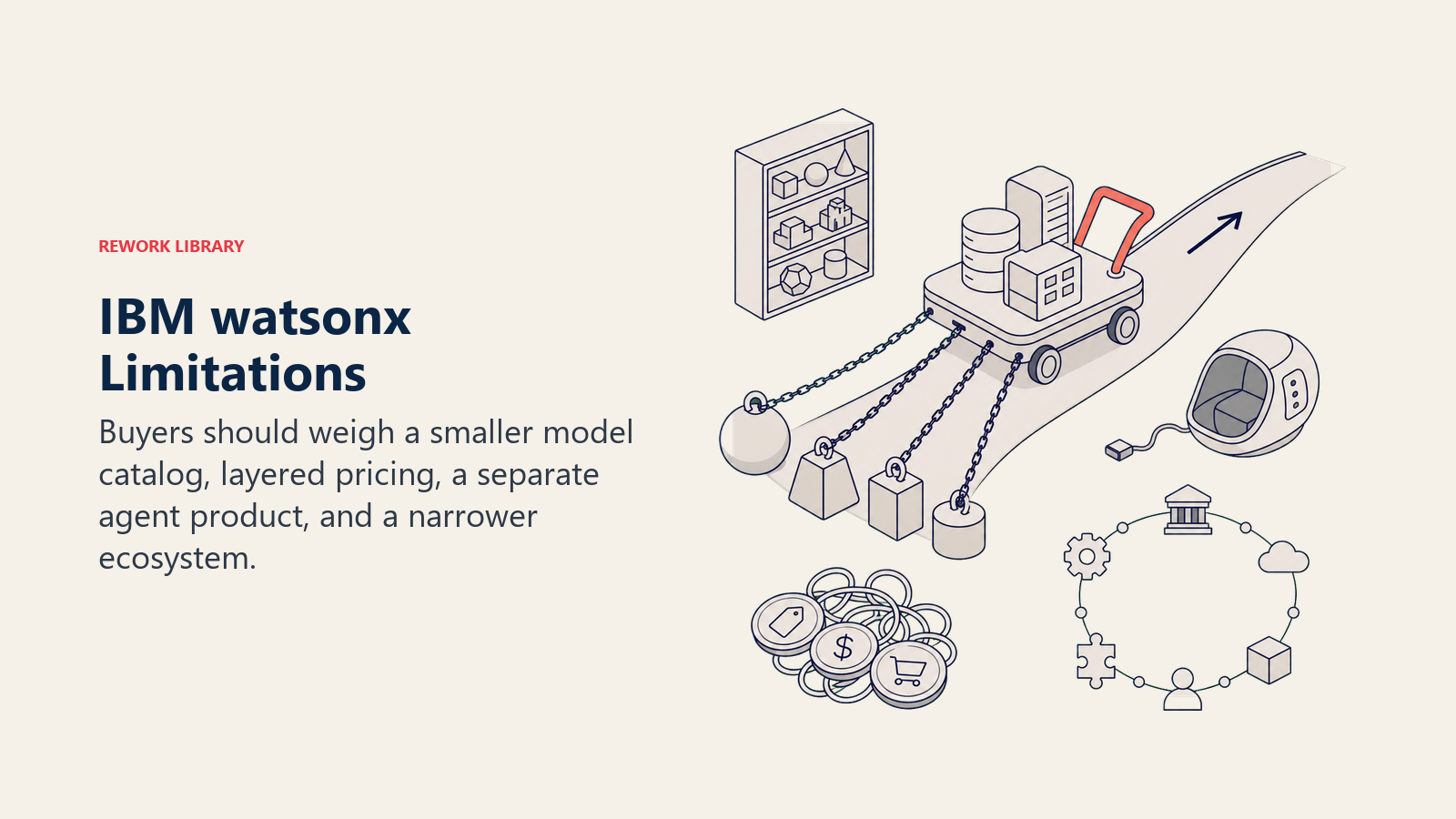
- Model catalog is smaller than the hyperscalers'. Granite plus a growing but still limited third-party list doesn't match Vertex AI's 200-plus Model Garden or the frontier-model breadth available through Bedrock and Azure AI Foundry.
- Pricing is layered and harder to estimate upfront. Resource Units convert differently by service, and getting an accurate year-one number requires modeling actual workload mix rather than reading a single rate card.
- Orchestrate is priced and packaged separately from watsonx.ai. Teams evaluating "watsonx" as one line item need to budget for agent orchestration as its own purchase, not an included feature.
- It's a smaller ecosystem than AWS, Google Cloud, or Azure. Fewer third-party integrations, tutorials, and hires with hands-on watsonx experience exist compared to the three dominant hyperscaler AI stacks.
- The brand carries baggage. Some buyers still associate "Watson" with the pre-2023 vertical products that underdelivered, which means the pitch for watsonx sometimes has to work harder to establish that it's a different platform built on different foundations.
Frequently Asked Questions about IBM watsonx
What is IBM watsonx?
IBM watsonx is IBM's enterprise AI and data platform, built around watsonx.ai for building and deploying models, watsonx.data for managing the data behind them, and watsonx.governance for monitoring risk and compliance. It launched in May 2023 as the successor to the earlier, narrower Watson brand.
What is IBM Watson AI, and is it the same as watsonx?
Classic Watson was the single-purpose system that won Jeopardy! in 2011 and later powered vertical products like Watson Health and Watson Assistant. Watsonx, launched in 2023, replaced that approach with a broader platform for building, governing, and deploying AI models and agents. They share a name and a research lineage, but they are different products.
What are the main components of watsonx?
Three core services, watsonx.ai for model building and deployment, watsonx.data for the underlying data lakehouse, and watsonx.governance for AI risk and compliance monitoring, plus watsonx Orchestrate, a separate product for building and running AI agents.
What is IBM Granite?
Granite is IBM's family of open foundation models, released under the Apache 2.0 license. The current generation, Granite 4.1, ships as language models in 3B, 8B, and 30B parameter sizes, alongside separate Granite Vision, Speech, Embedding, and Guardian models for other tasks.
How much does IBM watsonx cost?
watsonx.ai and watsonx.data use a Resource Unit consumption model, where compute, storage, and inference convert into RUs at rates that vary by service, typically purchased as a discounted annual or multi-year pool. watsonx Orchestrate is priced separately, with its Essential Edition starting around $500 per month billed by Monthly Active Units.
Who should use IBM watsonx?
Large, often regulated enterprises, banks, insurers, healthcare systems, government agencies, and organizations already running IBM infrastructure like Cloud Pak for Data or IBM Z. It's a stronger fit for teams that need on-premises or hybrid deployment and governance across multiple AI vendors, not solo developers or small teams needing the widest possible model catalog.
How does watsonx compare to Vertex AI, Bedrock, and Azure AI Foundry?
Watsonx's edge is deployment flexibility (including full on-premises) and governance that reaches across IBM and third-party models alike. Its main gap is model catalog depth: Vertex AI's Model Garden alone lists over 200 models, more than watsonx.ai currently offers. The right choice usually depends on which cloud you're already standing on and how much on-premises or cross-vendor governance you need.
Can watsonx govern models that aren't from IBM?
Yes. watsonx.governance is built to monitor and manage AI systems across IBM technology as well as third-party platforms, including OpenAI, AWS, and Meta, which sets it apart from governance tools tied to a single vendor's own models.
Related AI Concepts
- What is Vertex AI? - Google Cloud's competing enterprise AI platform, useful for comparing model catalogs and pricing models
- Foundation Models - The broader category of pre-trained models that Granite and watsonx's third-party catalog both belong to
- AI Governance - The discipline watsonx.governance is built to operationalize across an organization's AI systems
- What is LLMOps? - The operational practices watsonx.ai supports for versioning, evaluating, and monitoring generative AI in production
- MLOps - The broader model-lifecycle discipline watsonx.data and watsonx.ai are built to support
- AI Agents - The building blocks watsonx Orchestrate assembles into multi-step business workflows
External Resources
- IBM watsonx product overview - IBM's official platform page covering watsonx.ai, watsonx.data, and watsonx.governance
- IBM Granite on Hugging Face - IBM's open-weight Granite model family, released under Apache 2.0
- IBM watsonx.governance product page - Details on cross-platform AI monitoring and compliance

Co-Founder, Rework.com
On this page
- What Each Component of watsonx Does
- Granite: The Open Models Inside watsonx
- watsonx Orchestrate and Agents in 2026
- Who watsonx Is For
- How watsonx Is Priced
- watsonx vs. Vertex AI vs. Bedrock vs. Azure AI Foundry
- Key Facts
- Classic Watson vs. watsonx Today
- Limitations to Know
- Related AI Concepts
- External Resources