What is Google Gemini (Google's AI)?
Turn this article into takeaways for your work.


Each assistant summarizes the article only for you and suggests best practices for your work.
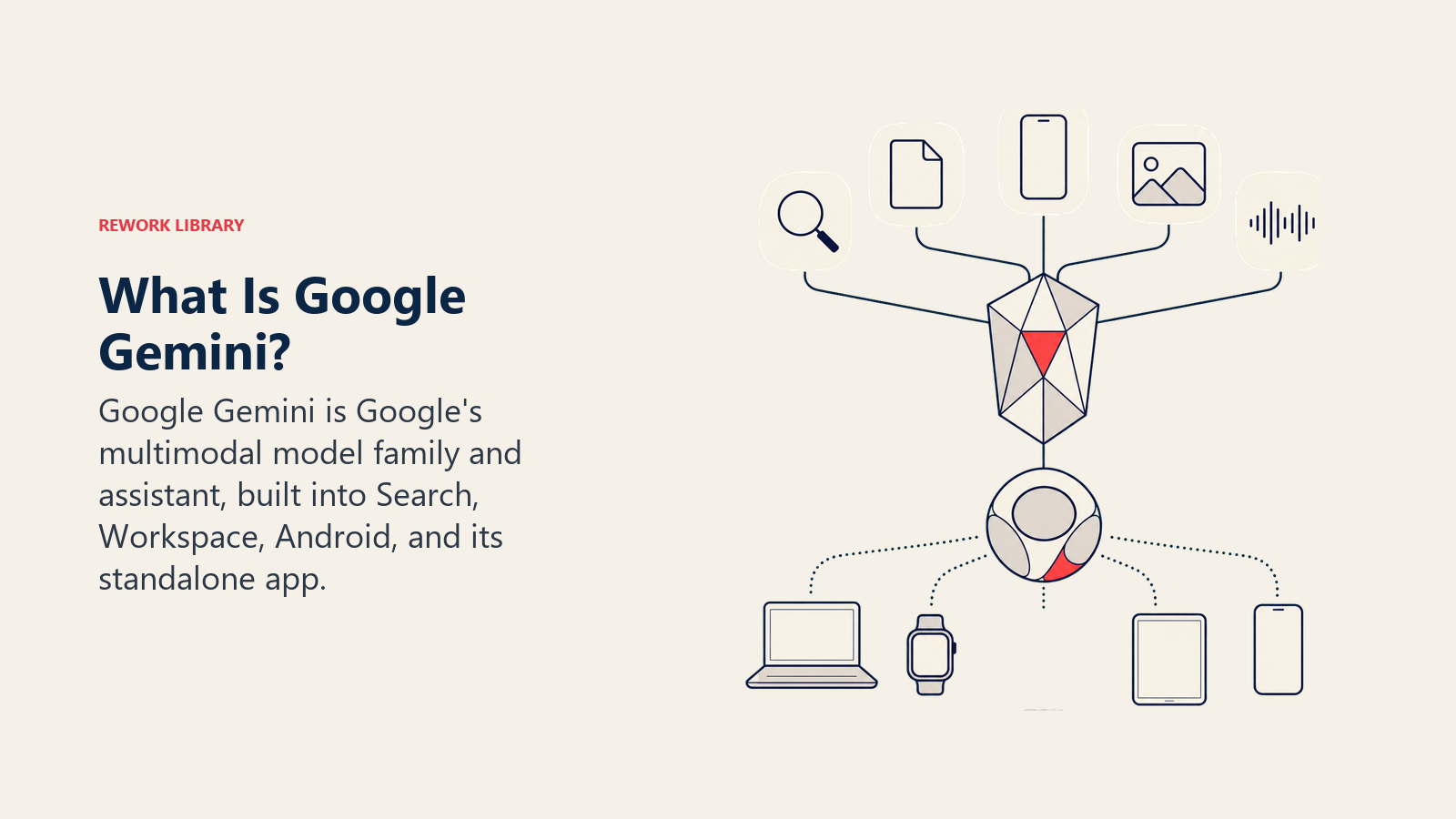
Google Gemini is the name of Google's AI: a family of AI models plus the free assistant app built on them, the direct answer to "what's Google's AI called." Gemini replaced Bard in February 2024, and by 2026 it powers Google Search, Workspace, Android, and a standalone app used by hundreds of millions of people every month.
For business leaders, Gemini is Google's answer to "what AI should we standardize on." It's the AI already built into the tools most teams use every day, Search, Gmail, Docs, Sheets, Android, so a large share of employees are touching some version of Gemini whether or not they've ever opened the dedicated app or paid for a subscription.
From Bard to Gemini: A Quick History
Google launched Bard, its first public AI chatbot, in February 2023, opening it to more than 180 countries by May of that year. In December 2023, Google introduced Gemini as its next-generation model family, and by February 2024 it had folded the Bard chatbot into the Gemini name entirely, along with the "Duet AI" branding it had used across Workspace and Cloud. Since then, "Gemini" has referred to three things at once: the underlying large language model family, the consumer chatbot app, and the AI features layered into Google's other products.
The rename wasn't just cosmetic. It reflected a shift from a single experimental chatbot to a unified model family meant to power everything from a quick Search answer to a multi-step coding task, which is closer to how Google talks about Gemini today.
The Gemini Model Family in 2026
Gemini isn't one model, it's a tiered family, each version optimized for a different balance of capability, speed, and cost:
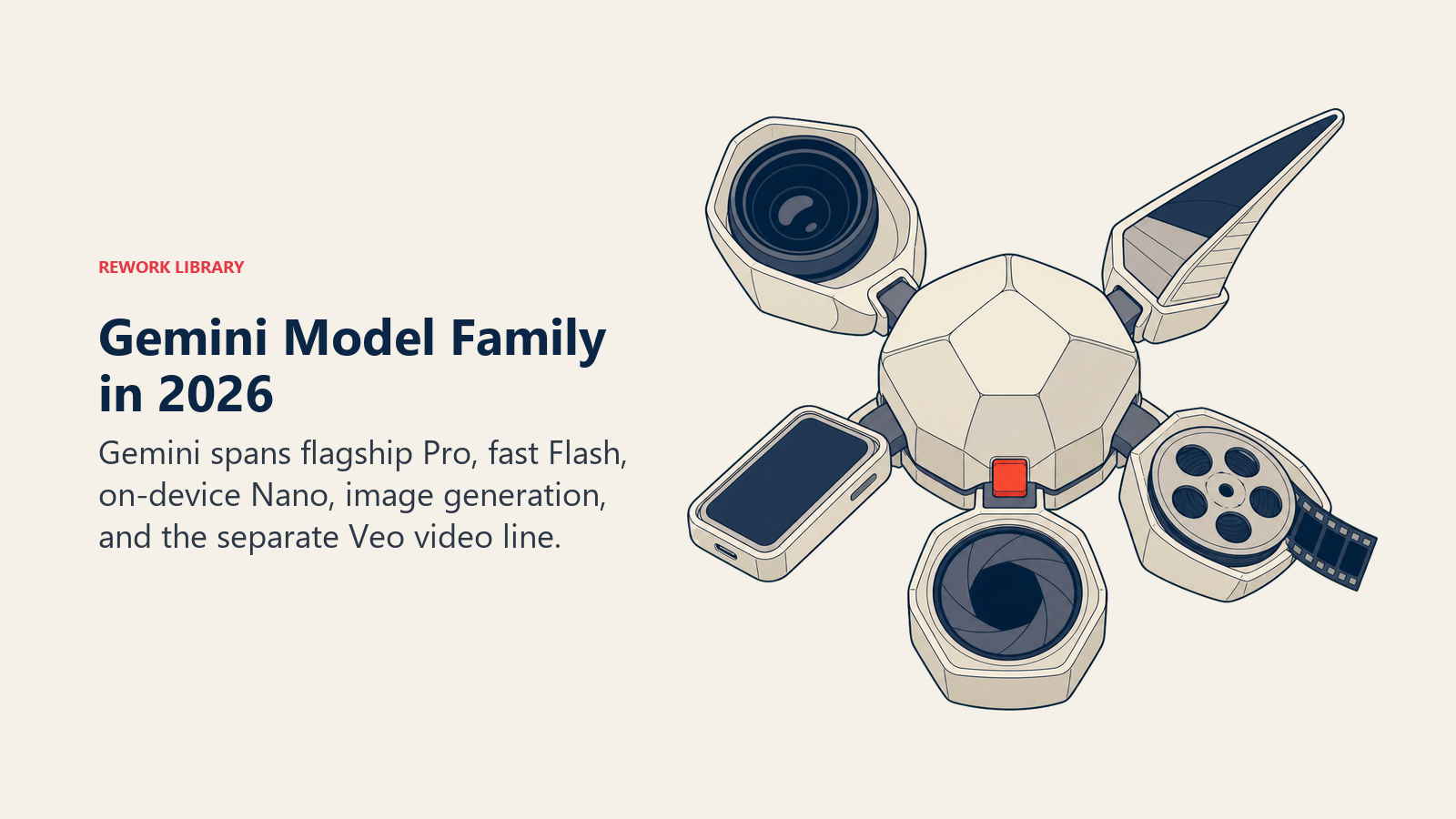
- Gemini 3.1 Pro: The flagship reasoning model, with a 1 million token context window and pricing around $2 per million input tokens and $12 per million output tokens through the API. It's the model behind Deep Research, complex coding tasks, and the highest tier of Search's AI Mode.
- Gemini 3 Flash: A faster, cheaper model built for high-volume use, priced around $0.50 per million tokens, that still performs competitively with Pro on several coding and reasoning benchmarks.
- Gemini 3.1 Flash-Lite: An even lighter, faster variant aimed at latency-sensitive apps, running at roughly a third the cost of Flash.
- Gemini Nano: The on-device model that runs locally on supported Android phones through Android's AICore system, no network connection required. The v3 update, released alongside Android 17 at Google I/O 2026, added function calling so apps can trigger structured AI actions without a round trip to Google's servers.
- Image and video models: Google's image generation line, nicknamed "Nano Banana," sits alongside the text models. Nano Banana Pro (Gemini 3 Pro Image) handles high-resolution, multi-subject image generation and editing, while a faster Nano Banana 2 variant targets high-volume workflows. Video generation runs on the separate Veo model line, bundled into several Gemini subscription tiers.
Like most modern AI systems, the flagship models are multimodal: they read and generate text, interpret images, transcribe and reason about audio, and process video, all through the same underlying foundation model.
Where Gemini Shows Up
Gemini isn't confined to one app. By mid-2026 it appears across most of Google's product surface:
- The Gemini app: The standalone consumer assistant (web, iOS, Android) is the most direct equivalent to ChatGPT or Claude's chat interface. It passed 900 million monthly active users at Google I/O 2026, more than double its user count a year earlier.
- Google Search, AI Mode and AI Overviews: AI Overviews are the short AI-written summaries that appear above regular results on many searches. AI Mode is a separate, fuller conversational experience, closer to chatting with an assistant than scanning a results page, where you can ask follow-up questions and get research-style answers. AI Mode alone crossed 1 billion monthly active users at the same I/O keynote.
- Google Workspace: Gemini is built into Gmail, Docs, Sheets, Slides, and Meet, drafting emails, summarizing threads, building slides, and analyzing spreadsheet data. Since 2025, Google folded the standalone Gemini add-on into the core Workspace plans rather than selling it separately.
- Android and Chrome: Gemini has replaced Google Assistant as the default assistant on most modern Android devices and is integrated into Chrome for page summarization and in-browser research.
- Developer and enterprise access: Businesses can call Gemini models directly through the Gemini API, or deploy them at scale through the Gemini Enterprise Agent Platform (the successor to Vertex AI's generative AI tooling), which supports custom agentic AI deployments, not just chat.
Google AI Pricing and Plans (July 2026)
Google sells Gemini access through a tiered subscription model, separate from the pay-as-you-go API pricing developers use to build on top of the models.
| Plan | Price | Model access | Storage | Notable extras |
|---|---|---|---|---|
| Free | $0/month | Gemini 3.5 Flash, limited Gemini 3.1 Pro access | 15 GB shared | Basic image generation, Gemini Live, Canvas |
| Google AI Plus | $4.99/month | Gemini 3 Pro (capped, 128K context) | 400 GB | Veo 3.1 Fast, 200 AI credits/month, Deep Research (limited) |
| Google AI Pro | $19.99/month | Gemini 3.1 Pro (1M context) | 5 TB | Veo 3.1 Lite, Deep Research, YouTube Premium Lite |
| Google AI Ultra (5x) | $99.99/month | Highest available usage limits on Gemini 3.1 Pro | 20+ TB | Priority access to new features, full YouTube Premium |
| Google AI Ultra (20x) | $199.99/month | Same models, 20x Pro's usage limits | 20+ TB | Project Genie access, heaviest-use ceiling |
A few pricing notes worth knowing: Google AI Plus dropped from $7.99 to $4.99 in June 2026, and the top Ultra tier dropped from $250 to $200 at I/O 2026 while a new $99.99 entry Ultra tier was added. For teams rather than individuals, Gemini now comes bundled into Google Workspace's Business Standard, Plus, and Enterprise plans rather than as a separate add-on, and per-seat Workspace prices rose to absorb that cost. Large-scale or custom deployments go through the Gemini Enterprise Agent Platform, priced on usage (token volume) or negotiated enterprise contracts rather than a flat per-seat fee.
Business Use Cases for Gemini
Gemini's biggest practical advantage for most companies is that it's already inside tools employees use daily, which lowers the adoption barrier compared to standalone AI tools:
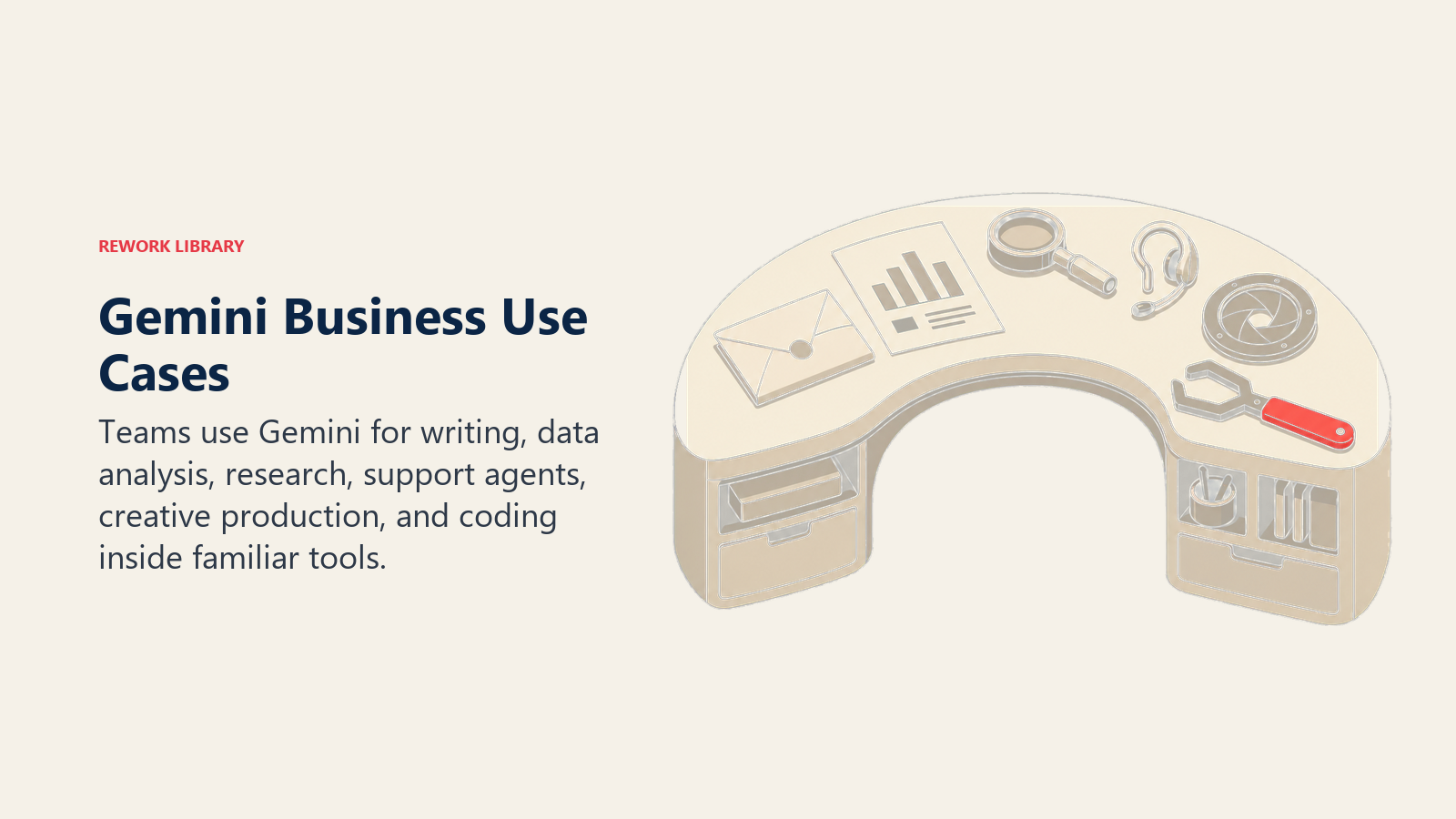
- Document and email drafting: Gemini inside Gmail and Docs drafts replies, summarizes long threads, and rewrites drafts in a specified tone, functioning as an AI copilot rather than a separate destination to visit.
- Spreadsheet and data analysis: In Sheets, Gemini can build formulas, summarize datasets, and generate charts from a plain-language request, useful for finance and ops teams working outside a dedicated BI tool.
- Research and competitive intelligence: Deep Research mode runs multi-step web research and returns a cited report, a faster starting point than manual search for market or competitor scans.
- Customer support and internal agents: Through the Gemini Enterprise Agent Platform, businesses build custom support and workflow agents that pull from internal data sources rather than relying on the consumer chat app.
- Marketing content and creative assets: Nano Banana handles on-brand image generation and edits, and Veo handles short video generation, useful for teams producing marketing creative without a separate design tool.
- Developer productivity: Gemini 3 Flash and Pro power coding assistance inside Android Studio and Google's newer Antigravity coding environment, similar in spirit to GitHub Copilot but tied to Google's own model family.
Gemini vs ChatGPT vs Claude
All three are general-purpose AI assistants with a free tier and paid upgrades, but they differ in distribution, pricing structure, and where they're strongest. For a deeper side-by-side, see the full Claude vs ChatGPT vs Gemini comparison.
| Aspect | Google Gemini | ChatGPT (OpenAI) | Claude (Anthropic) |
|---|---|---|---|
| Free tier | Yes, Gemini 3.5 Flash + limited Pro | Yes, limited flagship access | Yes, limited Claude access |
| Entry paid plan | AI Plus, $4.99/month | Plus, $20/month | Pro, $20/month |
| Top consumer tier | AI Ultra, $199.99/month | Pro, $200/month | Max 20x, $200/month |
| Default distribution | Built into Search, Gmail, Docs, Android | Standalone app and API, ChatGPT Atlas browser | Standalone app, Claude Code, API |
| Standout strength | Deep integration across Google's ecosystem, multimodal search | Broadest consumer feature set (voice, custom GPTs, memory) | Coding and long-form reasoning, favored by developer teams |
| Enterprise path | Gemini Enterprise Agent Platform, Workspace bundling | ChatGPT Enterprise, API | Claude for Enterprise, API |
None of the three is a strict upgrade over the others. Teams already living in Google Workspace get the most out of Gemini's default integration; teams prioritizing coding depth often lean toward Claude; teams wanting the widest range of consumer-facing features often default to ChatGPT.
What is Google's AI Mode in Search?
It's worth separating two Search features people often confuse. AI Overviews are the automatically generated summaries that appear above the normal blue links for many queries, meant to answer a question directly without a click. AI Mode is a distinct, opt-in tab inside Search that behaves more like a conversation: you can ask a question, get a fuller synthesized response with sources, then ask a follow-up without starting a new search. AI Overviews now appear on roughly half of tracked U.S. queries, while AI Mode has grown into a separate billion-user product in its own right. For a broader look at how Gemini's Search features stack up against other AI-powered search tools, see Perplexity vs ChatGPT Search vs Gemini and the best AI search engines roundup.
Limitations of Google Gemini
Gemini's practical limits show up across answer quality, availability, commercial predictability, and organizational control.
- Accuracy in AI Overviews and AI Mode is not guaranteed. Like any generative AI system, Gemini can produce confidently wrong summaries, which matters more in Search than in a standalone chatbot because the AI answer often appears before any source link.
- Feature and pricing rollout is uneven by region. Several 2026 features, including some subscription perks and Gemini Nano's newer capabilities, are U.S.-first or limited to specific hardware (Pixel 10, Galaxy S26, and a short list of other flagship phones for the fastest on-device features).
- Plan structure changes often. Google adjusted AI Plus and AI Ultra pricing twice within a few months of each other in 2026, which makes it worth checking current pricing before committing a team to a specific tier.
- Enterprise governance is still maturing. As with other frontier AI vendors, businesses deploying Gemini-based agents at scale need their own oversight process; the platform provides the tools, not a finished governance framework.
- Context and usage limits still gate the free and lower tiers. Full 1 million token context and the highest usage ceilings are reserved for AI Pro and AI Ultra, not the free tier or AI Plus.
Key Facts
- The Gemini app reached over 900 million monthly active users by Google I/O 2026 (May 19, 2026), more than double the 400 million reported a year earlier, with daily requests growing more than 7x in that same period. Google: Sundar Pichai's I/O 2026 keynote
- AI Mode in Google Search surpassed 1 billion monthly active users, announced at the same Google I/O 2026 keynote. Google: Sundar Pichai's I/O 2026 keynote
- Google's AI Overviews appear on roughly 48% of tracked search queries as of early 2026 and reach billions of users globally across more than 200 countries. Google: Search updates at I/O 2026
- Google cut its top AI Ultra tier from $250 to $200 a month at I/O 2026, while introducing a new $99.99 entry Ultra tier with 5x Pro usage limits. Engadget
- Google AI Plus dropped from $7.99 to $4.99 a month in June 2026, with its included storage doubled to 400 GB. 9to5Google
- Google renamed its chatbot from Bard to Gemini in February 2024, unifying the chatbot, app, and model family under one name after Bard launched in February 2023. Google: Bard is now Gemini
- Gemini 3.1 Pro, the 2026 flagship model, supports a 1 million token context window and leads on the majority of benchmarks Google publishes for the model family. Google AI for Developers: Gemini 3
- Gemini Nano v3, Google's on-device model, launched alongside Android 17 at I/O 2026, adding function calling so apps can run structured AI tasks without a network round trip. Android Developers: Gemini Nano
Frequently Asked Questions about Google Gemini
What is Google's AI called?
Google's AI is called Gemini. It's both the name of Google's family of AI models and the free assistant app (web, iOS, Android) built on top of them. Gemini replaced the earlier Bard branding in February 2024.
What is Gemini AI?
Gemini AI is Google's flagship artificial intelligence system, a multimodal model family (Gemini 3.1 Pro, Gemini 3 Flash, Gemini Nano, and others) that understands text, images, audio, and video, plus the consumer app, Search integration, and Workspace features built on those models.
What is Google AI?
"Google AI" typically refers to the same thing as Gemini: Google's overall AI product line, including the Gemini app, Gemini inside Search (AI Overviews and AI Mode), Gemini in Workspace apps like Gmail and Docs, and the Google AI Pro and Ultra subscription plans.
What is the name of Google's AI?
Its name is Gemini. Before February 2024 it was called Bard. Google unified the chatbot, the underlying model family, and the Workspace AI features under the single Gemini name to reduce confusion between the app and the model.
Is Google Gemini free to use?
Yes. Gemini has a free tier with Gemini 3.5 Flash and limited Gemini 3.1 Pro access, basic image generation, and 15 GB of shared Google storage. Paid plans (AI Plus at $4.99/month, AI Pro at $19.99/month, and two AI Ultra tiers at $99.99 and $199.99/month) add higher usage limits, full model access, more storage, and features like Deep Research and video generation.
How is Gemini different from ChatGPT and Claude?
All three are general-purpose AI assistants with free and paid tiers. Gemini's main advantage is default distribution, it's built into Google Search, Gmail, Docs, and Android, so most people encounter it without installing anything separate. ChatGPT and Claude are typically accessed as standalone apps and are often rated stronger on specific coding or long-form reasoning benchmarks, depending on the task.
What's the difference between AI Overviews and AI Mode in Google Search?
AI Overviews are the short AI-generated summaries that appear above regular results for many searches. AI Mode is a separate, fuller conversational search experience where you can ask follow-up questions and get a more research-style response, closer to a chatbot than a traditional results page.
Can businesses use Gemini for enterprise work?
Yes. Google sells Gemini for business through Google Workspace, where it's bundled into the Business Standard, Plus, and Enterprise plans, and through the Gemini Enterprise Agent Platform for custom, usage-based deployments and AI agents.
What happened to Google Bard?
Bard was Google's original AI chatbot, launched in February 2023. Google renamed it Gemini in February 2024 and retired the Bard name; the old bard.google.com address now redirects to Gemini.
Related AI Concepts
- Large Language Models - The technology underlying every Gemini model
- Multimodal AI - How Gemini processes text, images, audio, and video together
- Foundation Models - The broader category Gemini and its competitors belong to
- Generative AI - The category of AI that produces text, images, and other content
- AI Copilots - How Gemini functions inside Workspace apps like Gmail and Docs
- What is Agentic AI? - The autonomous systems Gemini powers through the Gemini Enterprise Agent Platform
- Model Context Protocol - The open standard Gemini and other model providers use to connect AI to external tools and data
- Best AI Chatbots 2026 - A broader roundup of Gemini's chatbot competitors
External Resources
- Google: Sundar Pichai's I/O 2026 keynote - Official user growth and product announcements
- Google AI: Subscription plans - Current official pricing for Free, AI Plus, AI Pro, and AI Ultra
- Google AI for Developers: Gemini 3 - Technical specifications for the current model family
- Android Developers: Gemini Nano - Documentation on the on-device model
- Google: Bard is now Gemini - The original rebrand announcement
Part of the AI Terms Collection. Last updated: 2026-07-20

Co-Founder, Rework.com