What is AI Competitive Advantage? Building Defensible AI Moats
Turn this article into takeaways for your work.


Each assistant summarizes the article only for you and suggests best practices for your work.
Your competitors can buy the same AI models you use. So what makes your AI a competitive advantage? The answer determines whether AI transforms your business or just increases your cloud bills.
Defining AI Competitive Advantage
AI competitive advantage is the sustained superior performance and market position achieved through strategic application of artificial intelligence in ways that competitors cannot easily replicate. It goes beyond AI adoption to create defensible moats through proprietary data, unique applications, network effects, or organizational capabilities.
According to Harvard Business Review, "True AI advantage doesn't come from the algorithms – which competitors can copy – but from how you apply them to unique assets and workflows that can't be easily reproduced." This insight emerged as early AI adopters realized that using the same cloud AI services as competitors provided no differentiation.
Unlike traditional competitive advantages based on physical assets or geographic location, AI advantage often stems from data network effects, speed of learning loops, and embedding AI so deeply into operations that replication requires complete business model transformation.
Executive Perspective
For business leaders, AI competitive advantage is about asking not 'can we use AI?' but 'can we use AI in ways our competitors can't?' – it's the difference between AI as commodity cost and AI as strategic differentiator.
Think of AI advantage like Coca-Cola's secret formula. The manufacturing process is replicable, but the formula, brand, and distribution network create a moat. Similarly, your AI models may be standard, but your proprietary data, unique applications, and organizational integration create the advantage.
In practical terms, AI competitive advantage means identifying where your unique assets (customer data, domain expertise, workflows) combine with AI to create value competitors can't match, then building systems that get stronger with use.
Types of AI Competitive Moats
Defensible advantage sources:
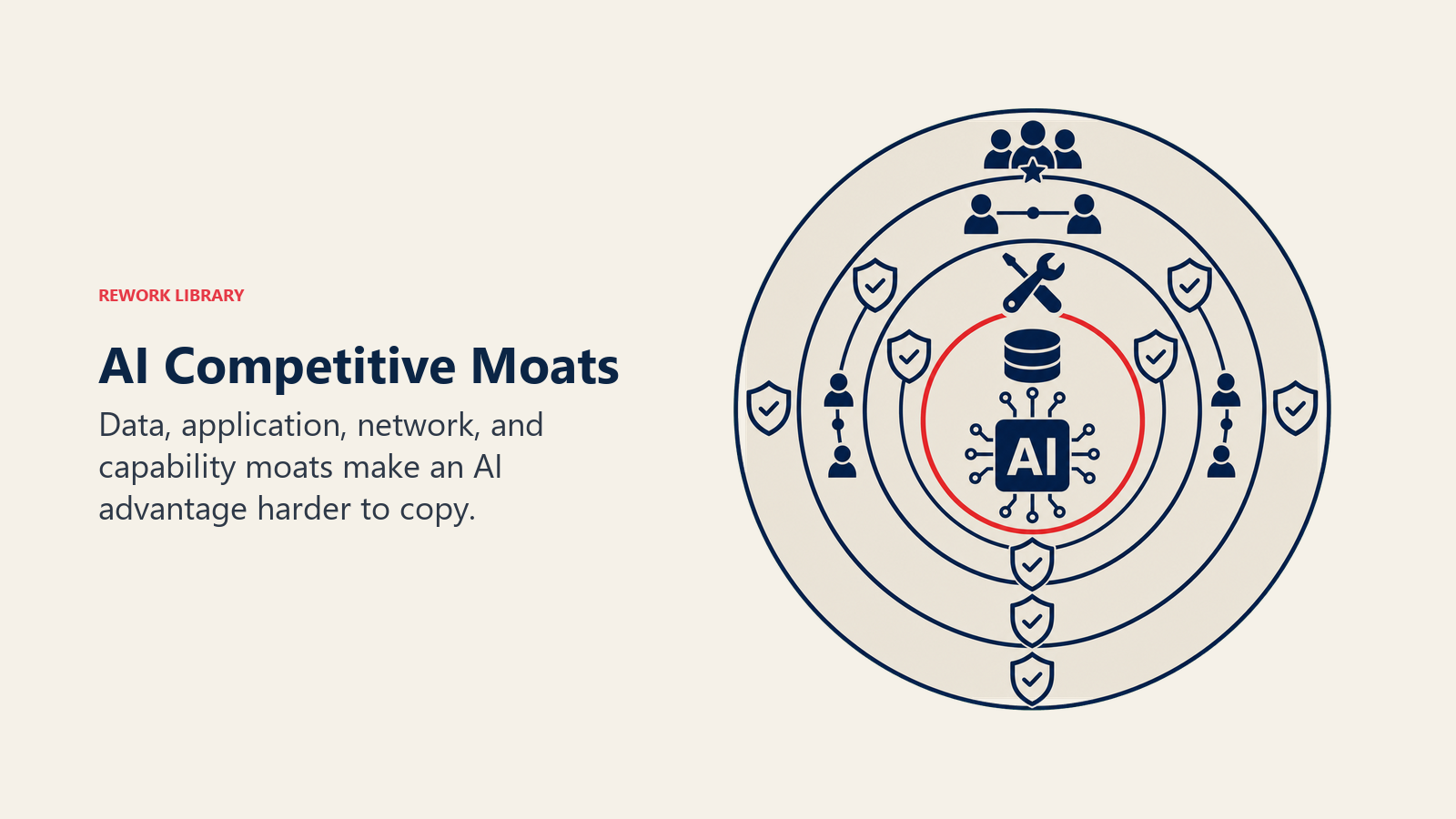
Data Moats:
- Advantage: Proprietary datasets competitors can't access
- Strength: Self-reinforcing as more usage creates more data
- Example: Google's search data improving search results
- Vulnerability: Privacy regulations or user defection
Application Moats:
- Advantage: Unique AI applications of common technology
- Strength: First-mover advantage in new categories
- Example: Netflix using AI for content recommendations
- Vulnerability: Feature replication by competitors
Integration Moats:
- Advantage: AI embedded so deeply that switching costs are high
- Strength: Workflow lock-in beyond just technology
- Example: Amazon's AI-powered supply chain optimization
- Vulnerability: Disruptive business model changes
Talent Moats:
- Advantage: Superior AI talent and organizational capability
- Strength: Cultural and structural, hard to copy
- Example: DeepMind's research excellence
- Vulnerability: Talent poaching and diffusion
Network Moats:
- Advantage: AI improves as network grows
- Strength: Winner-take-most dynamics
- Example: LinkedIn's AI matching getting better with scale
- Vulnerability: Platform risk and regulation
Strategic Positioning Framework
AI strategy choices:
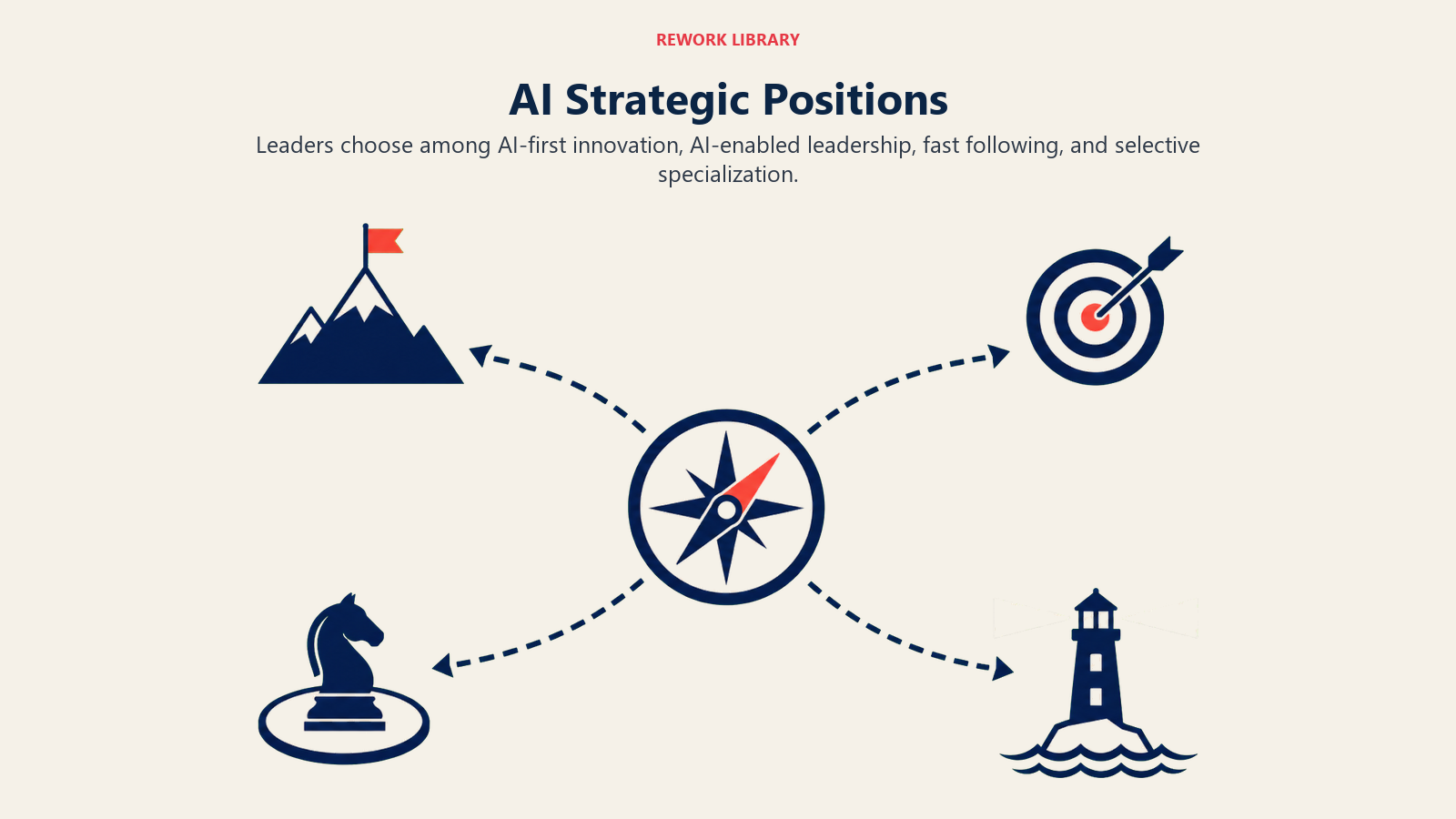
Position 1: AI-First Innovator Strategy: Build proprietary AI as core differentiator Investment: High R&D, talent acquisition, infrastructure Timeline: 3-5 years to advantage Risk: Technology changes, high burn rate Example: Tesla's self-driving development
Position 2: AI-Enabled Leader Strategy: Use AI to enhance existing advantages Investment: Moderate, focused on strategic applications Timeline: 12-24 months to impact Risk: Competitor replication, vendor dependence Example: Walmart using AI for inventory optimization
Position 3: Fast Follower Strategy: Adopt proven AI applications quickly Investment: Lower, technology partnerships Timeline: 6-12 months to parity Risk: Permanent disadvantage in AI-native markets Example: Traditional banks adding AI features
Position 4: Selective Adopter Strategy: AI where clear ROI, traditional elsewhere Investment: Minimal, targeted projects Timeline: Ongoing incremental improvements Risk: Disruption by AI-first competitors Example: Specialized manufacturers using AI for quality control
First-Mover vs Fast-Follower
Timing strategy considerations:
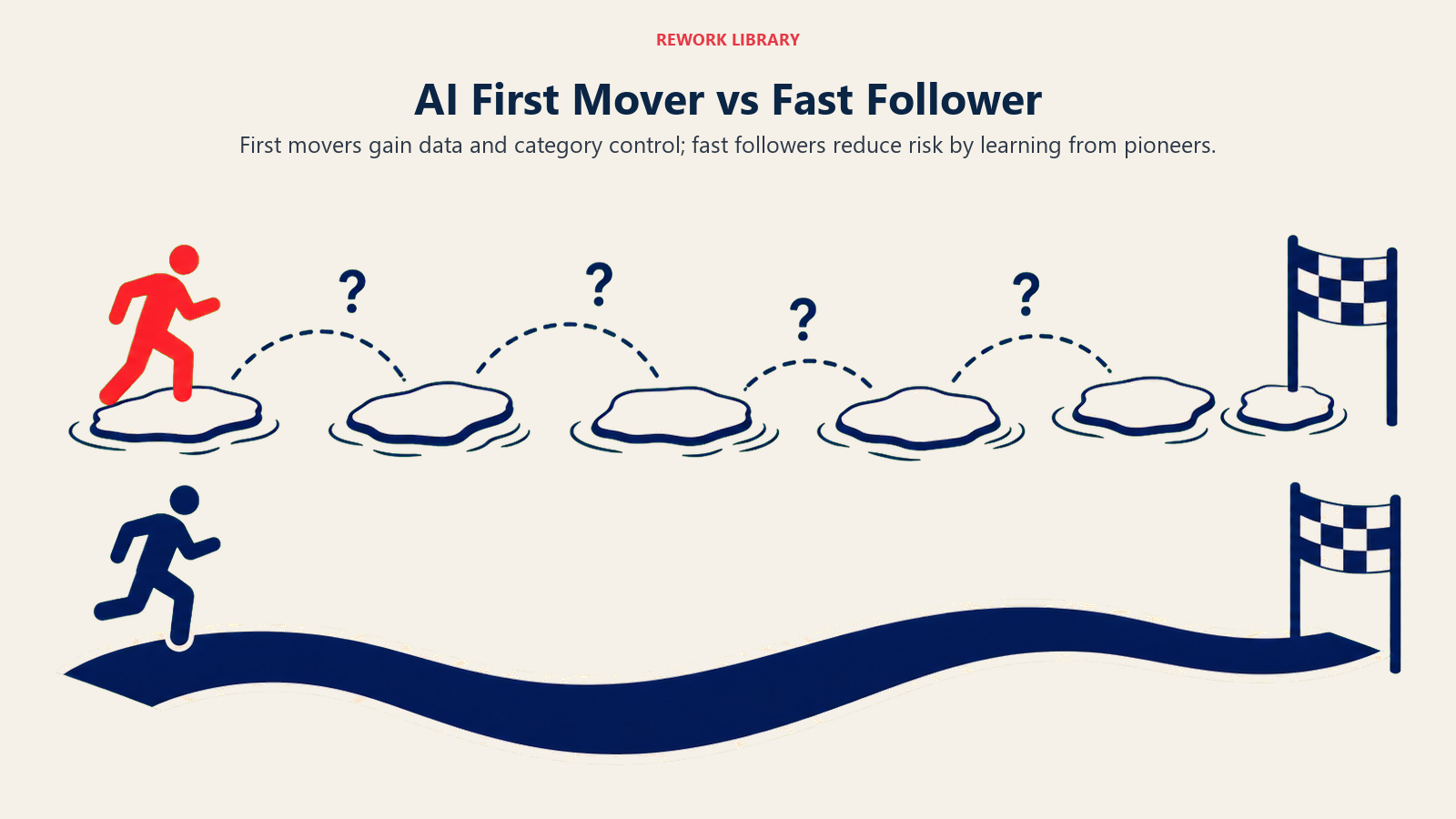
First-Mover Advantages:
- Capture proprietary data before competitors
- Define category and customer expectations
- Build network effects and switching costs
- Attract top AI talent to innovative projects
First-Mover Disadvantages:
- Higher development costs and failure risk
- Educate market on new capabilities
- Technology may evolve, making early investments obsolete
- Regulatory uncertainty in new applications
Fast-Follower Advantages:
- Learn from pioneer mistakes and iterate faster
- Lower R&D costs, use proven technology
- Clear market validation before investment
- Avoid regulatory pioneering risks
Fast-Follower Disadvantages:
- Data moats already established by first-movers
- Customer switching costs and incumbent advantage
- Talent already recruited by leaders
- Network effects may create winner-take-most markets
Decision Framework: Choose first-mover when you have unique data assets, strong technical capability, and AI aligns with core competency. Choose fast-follower when AI is enabling technology for existing advantage, resources are limited, or market validation is uncertain.
Building Defensible AI Advantage
Strategies that create moats:
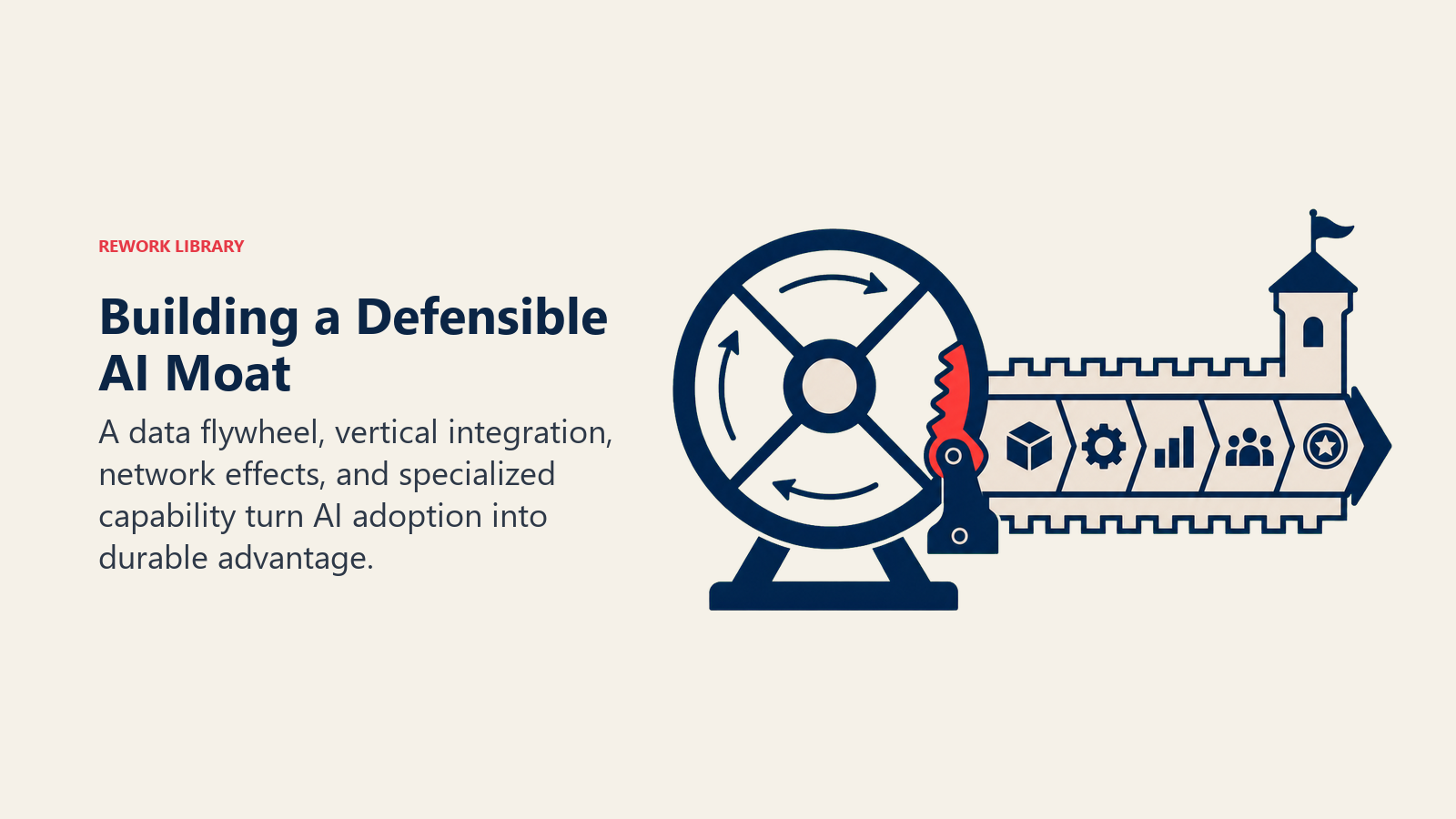
Data Flywheel Strategy:
- AI improves product → More users → More data → Better AI
- Example: Spotify's recommendation engine gets better with each listen
- Implementation: Design products that generate valuable training data
- Timeline: 18-36 months to self-reinforcing loop
Vertical Integration:
- Control full stack from data to user experience
- Example: Apple's on-device AI with hardware optimization
- Implementation: Build capabilities across the AI value chain
- Timeline: 3-5 years to full integration advantage
Ecosystem Lock-In:
- Create platforms where third parties build on your AI
- Example: Salesforce Einstein ecosystem
- Implementation: APIs and developer programs that spread adoption
- Timeline: 2-4 years to meaningful ecosystem
Operational Embedding:
- Weave AI into core processes so deeply that extraction is painful
- Example: UPS's ORION routing system integrated into operations
- Implementation: Change workflows around AI, not just add AI to workflows
- Timeline: 12-24 months per major process
Real-World Competitive Advantage
Organizations with defensible AI moats:
Technology Example: Meta's AI advantage comes from unmatched social data (3 billion users), creating recommendation systems competitors can't replicate without equivalent user base, resulting in engagement metrics that drive ad revenue competitors struggle to match.
Financial Services Example: JPMorgan's COiN contract analysis AI processes legal documents 360,000 hours of work in seconds, trained on decades of proprietary contracts competitors don't have access to, creating efficiency advantage that compounds over time.
Retail Example: Amazon's AI advantage spans multiple moats: recommendation engines trained on 20+ years of purchase data, supply chain optimization from billions of transactions, and Alexa ecosystem creating switching costs, making replication require rebuilding entire business model.
Healthcare Example: Cleveland Clinic's AI diagnostic advantage built on proprietary patient outcome data linked to treatment decisions, creating prediction accuracy competitors can't match without decades of similar data collection and clinical expertise integration.
Competitive Threat Assessment
Evaluating your position:
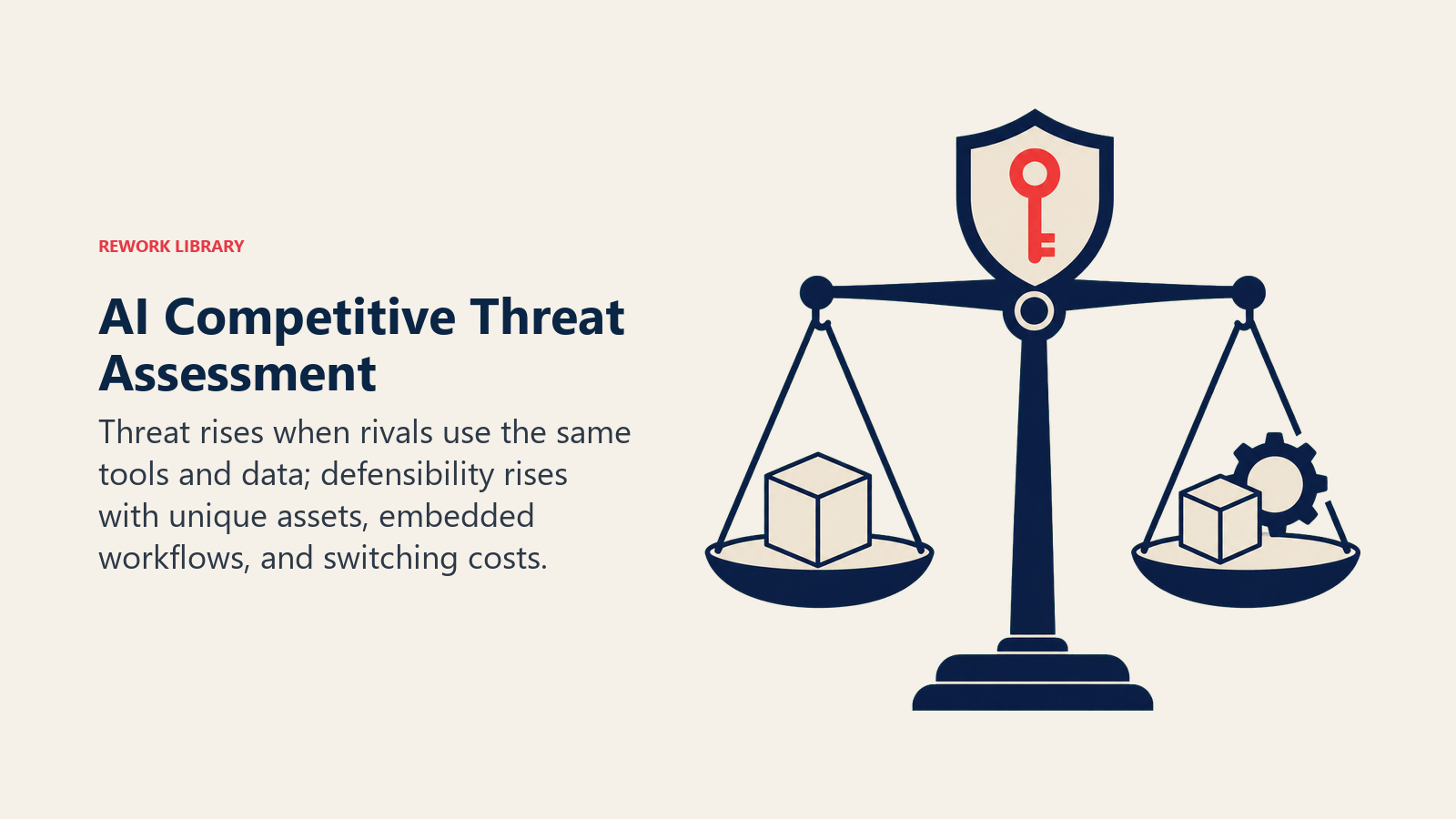
High Threat Indicators:
- Competitors using same AI tools for same applications
- No proprietary data advantage or network effects
- AI vendors could disintermediate your business
- Low switching costs for customers
- Fast-evolving technology where your AI becomes obsolete
Sustainable Advantage Indicators:
- Unique data assets from business operations
- AI embedded in workflows with high switching costs
- Network effects that strengthen with scale
- Organizational AI capabilities competitors lack
- Regulatory moats protecting your AI applications
Action Framework: If high threat: Urgently build data moats, embed AI deeply, or focus AI on operations not products If sustainable advantage: Accelerate investment, build ecosystem, defend against disruption
Common Strategy Mistakes
Pitfalls that waste AI investment:
• AI for AI's Sake: Adopting AI without strategic rationale → Solution: Only invest in AI that strengthens core advantage
• Commodity Capabilities: Using same tools same way as competitors → Solution: Find unique applications or proprietary data
• Ignoring Moats: Building AI without defensibility → Solution: Design for network effects and switching costs
• Feature Parity Focus: Matching competitor AI features → Solution: Differentiate through unique capabilities
• Technology Obsession: Chasing latest AI vs. business value → Solution: Focus on advantage creation, not technology trends
Measuring AI Advantage
Metrics beyond technology performance:
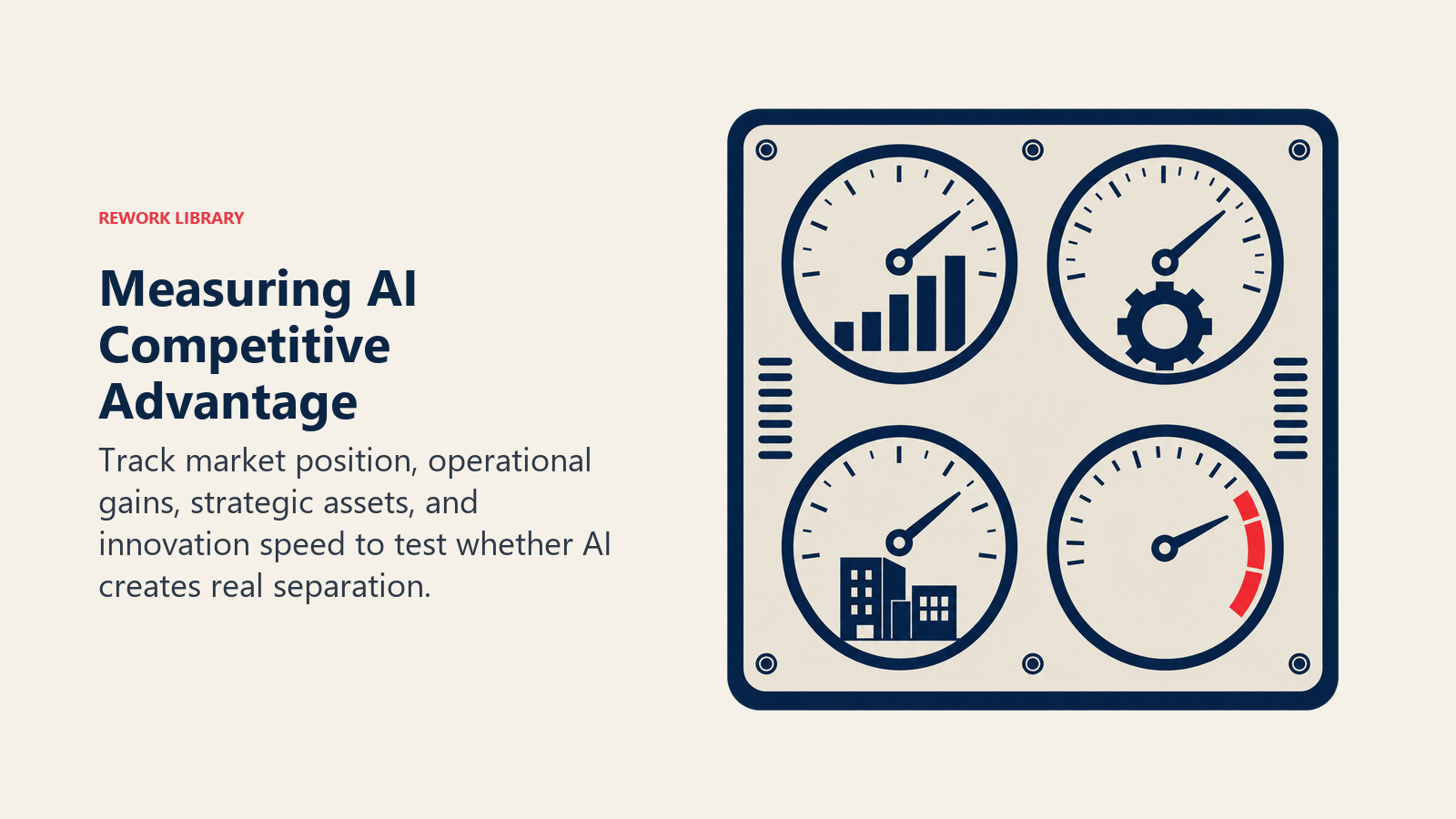
Market Position Metrics:
- Market share gains in AI-enabled products
- Customer acquisition cost vs. competitors
- Pricing power (can you charge premium for AI features?)
- Customer switching rates (are they staying for AI?)
Operational Metrics:
- Cost advantage from AI automation
- Speed-to-market improvements
- Quality or accuracy vs. industry benchmarks
- Productivity gains vs. competitor disclosed numbers
Strategic Asset Metrics:
- Proprietary data volume and uniqueness
- AI talent retention and acquisition vs. competitors
- Patent portfolio and technical publications
- Partnership and ecosystem strength
Sustainability Metrics:
- Time required for competitor to replicate your AI
- Investment required for competitor to reach parity
- Strength of network effects or data moats
- Organizational AI maturity vs. industry
Building Your Advantage
Steps to defensible AI position:
- Build capability through AI Talent Strategy
- Create structure with AI Center of Excellence
- Understand foundations via Machine Learning
- Manage deployment with MLOps
Frequently Asked Questions about AI Competitive Advantage
What is AI Competitive Advantage?
AI competitive advantage is sustained superior performance and market position achieved through strategic application of artificial intelligence in ways competitors cannot easily replicate, going beyond AI adoption to create defensible moats through proprietary data, unique applications, network effects, or organizational capabilities.
What are the five types of AI competitive moats?
Data Moats (proprietary datasets), Application Moats (unique AI applications), Integration Moats (AI embedded deeply with high switching costs), Talent Moats (superior AI capabilities and culture), and Network Moats (AI improves as network grows).
When should I choose first-mover vs fast-follower AI strategy?
Choose first-mover when you have unique data assets, strong technical capability, and AI aligns with core competency. Choose fast-follower when AI is enabling technology for existing advantage, resources are limited, or market validation is uncertain.
What are the four strategic positioning options for AI?
AI-First Innovator (build proprietary AI as core differentiator, 3-5 year timeline), AI-Enabled Leader (use AI to enhance existing advantages, 12-24 months), Fast Follower (adopt proven AI quickly, 6-12 months), and Selective Adopter (AI where clear ROI, ongoing incremental).
How do I know if my AI advantage is defensible?
Check for: unique data assets from operations, AI embedded in workflows with high switching costs, network effects that strengthen with scale, organizational AI capabilities competitors lack, and regulatory moats protecting your applications. If missing these, your advantage is vulnerable.
Related Resources
Explore these related concepts to deepen your understanding of AI strategy:
- AI Governance - Framework for managing AI as strategic asset
- AI Talent Strategy - Building capabilities for sustainable advantage
- Machine Learning - Technical foundation of AI advantage
- AI Integration - Embedding AI for competitive moats
External Resources
- MIT Sloan Management Review - AI competitive positioning research
- McKinsey AI Insights - Industry competitive analysis
Part of the AI Terms Collection. Last updated: 2026-02-09

Co-Founder, Rework.com
On this page
- Defining AI Competitive Advantage
- Executive Perspective
- Types of AI Competitive Moats
- Strategic Positioning Framework
- First-Mover vs Fast-Follower
- Building Defensible AI Advantage
- Real-World Competitive Advantage
- Competitive Threat Assessment
- Common Strategy Mistakes
- Measuring AI Advantage
- Building Your Advantage
- Related Resources
- External Resources