What is Sovereign AI?
Turn this article into takeaways for your work.


Each assistant summarizes the article only for you and suggests best practices for your work.
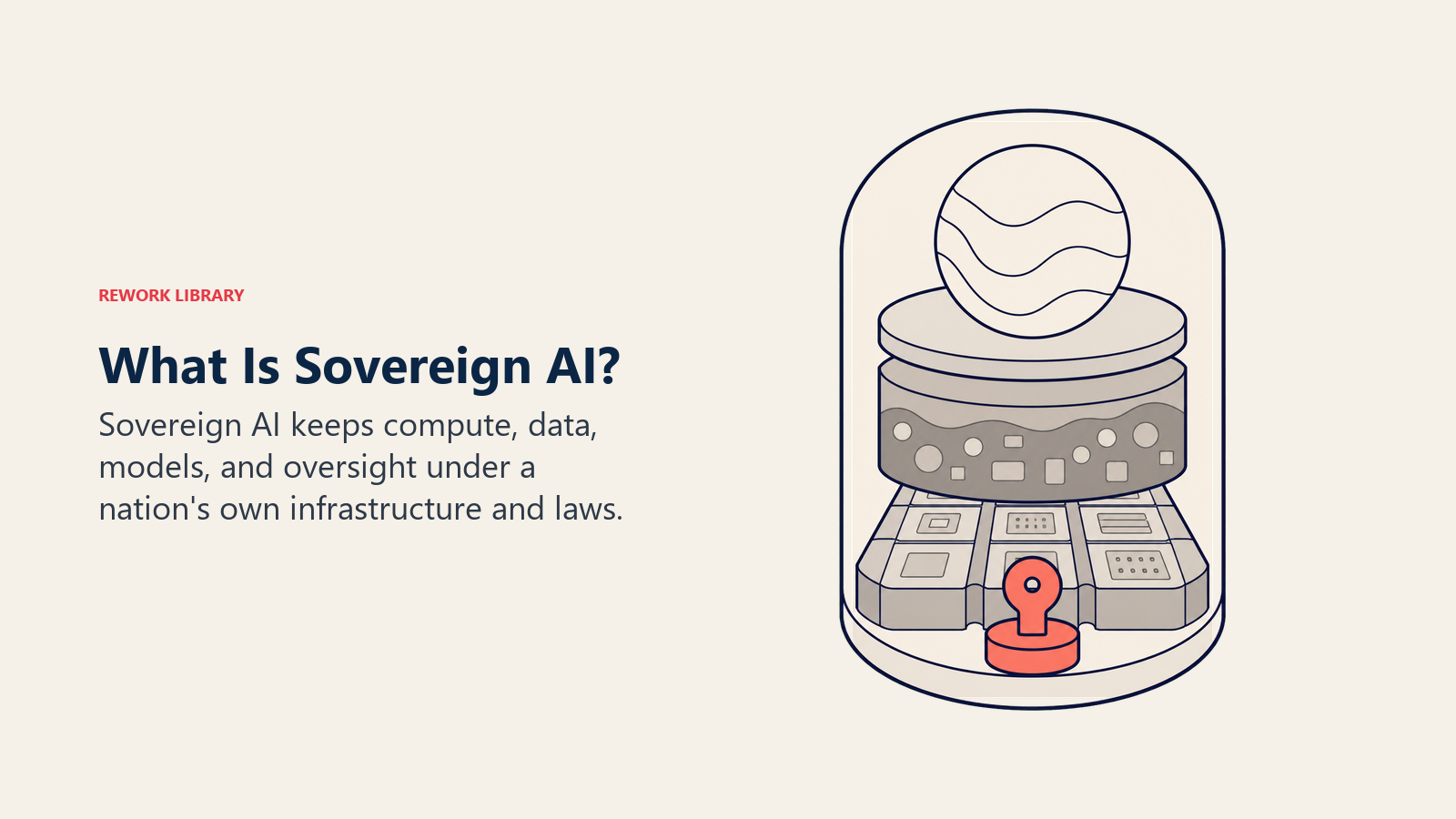
Sovereign AI is a nation's ability to develop, deploy, and control artificial intelligence using its own compute infrastructure, data, algorithms, and workforce, rather than depending entirely on foreign cloud providers or foreign-owned models. It covers the chips that train and run AI, the data that feeds it, and the laws that govern it.
For business leaders, sovereign AI is a real operating constraint now, not a policy abstraction. If your company processes customer data, runs regulated workloads, or sells into government contracts anywhere outside your home market, the country you're operating in increasingly has an opinion about where the artificial intelligence touching that data physically runs, who can access it, and under whose legal jurisdiction. That opinion is showing up in procurement requirements, data laws, and multi-billion-dollar national infrastructure programs, and it changes how you buy, deploy, and budget for AI.
Why Governments Are Racing Toward Sovereign AI
Three pressures are pushing sovereign AI from a niche policy debate to a mainstream government priority.
Data residency and privacy. Financial records, health data, and citizen information are increasingly required by law to stay within national borders and under domestic legal control. Relying on a foreign-owned cloud for AI that touches this data creates a compliance gap that regulators are closing fast, echoing how the EU AI Act already forces companies to classify and govern AI risk by jurisdiction.
National security. Critical infrastructure, defense systems, and public services now run partly on AI. A country that can't operate that AI without a foreign provider's cooperation has effectively outsourced a piece of its national security, which is why sovereign AI sits alongside AI security on the agenda of defense and interior ministries, not just tech ministries.
Economic competitiveness. Compute capacity is becoming a strategic asset like oil or semiconductors. Countries that own domestic AI infrastructure can shape their own industrial policy, attract AI-dependent industries, and capture the jobs and tax revenue that come with building and running that infrastructure, rather than renting capacity indefinitely from a handful of foreign hyperscalers. This is the same logic behind AI competitive advantage, just applied at the level of an entire economy.
What Sovereign AI Actually Involves
Sovereign AI is not one thing. In practice it's a stack, and most national programs build it in three layers.
Domestic compute. This is the physical layer: data centers, GPUs, and power infrastructure located inside a country's borders and controlled by domestic entities. Governments are funding "AI gigafactories" and hyperscale campuses specifically so training and inference don't have to leave the country, a form of large-scale edge AI infrastructure at national scale.
Local or national models. Some countries stop at sovereign compute and keep using foreign-built large language models. Others go further and fund homegrown foundation models trained on local languages, laws, and cultural context, so the model itself reflects national priorities rather than the defaults of a foreign lab.
Regulation and oversight. Sovereign AI only means something if there's a legal framework backing it up, rules on where data can be processed, who can access AI systems, and how liability works when something goes wrong. This is where sovereign AI overlaps directly with AI governance and AI liability: the infrastructure is the hardware, the regulation is what makes it actually sovereign.
Sovereign AI vs Cloud AI
Most companies already use cloud AI. The table below shows where sovereign AI departs from that default.
| Aspect | Cloud AI (Default) | Sovereign AI |
|---|---|---|
| Where compute runs | Wherever the provider's global data centers are, often outside the user's country | Inside national borders, on domestically owned or controlled infrastructure |
| Legal jurisdiction | Governed by the provider's home country's laws and terms of service | Governed by the deploying nation's laws, courts, and regulators |
| Data control | Data may transit or be processed abroad depending on provider architecture | Data stays under domestic legal control end to end |
| Who owns the model | Usually the foreign vendor (OpenAI, Google, Microsoft, and similar) | May be foreign-built but locally hosted, or a domestically trained model |
| Primary buyer motivation | Speed, scale, and lowest cost per unit of compute | Compliance, national security, and strategic independence |
| Typical cost | Lower, benefits from global hyperscale economies of scale | Higher, smaller scale and duplicated infrastructure across regions |
| Best fit | Most commercial workloads without strict residency requirements | Regulated industries, public sector, defense, and critical infrastructure |
Neither model is universally "better." Cloud AI wins on cost and speed for most commercial use. Sovereign AI wins wherever compliance, national security, or AI vendor evaluation rules make foreign-hosted AI a nonstarter.
Sovereign AI in 2026: Real Examples by Region
The European Union. The European Commission's InvestAI initiative aims to mobilize roughly €200 billion in AI investment across the EU through 2030, including €20 billion set aside to build four to five AI "gigafactories," each designed to support frontier model training with more than 100,000 advanced processors. The goal, in the Commission's own words, is sovereign access to high-performance computing so European companies aren't structurally dependent on non-European suppliers.
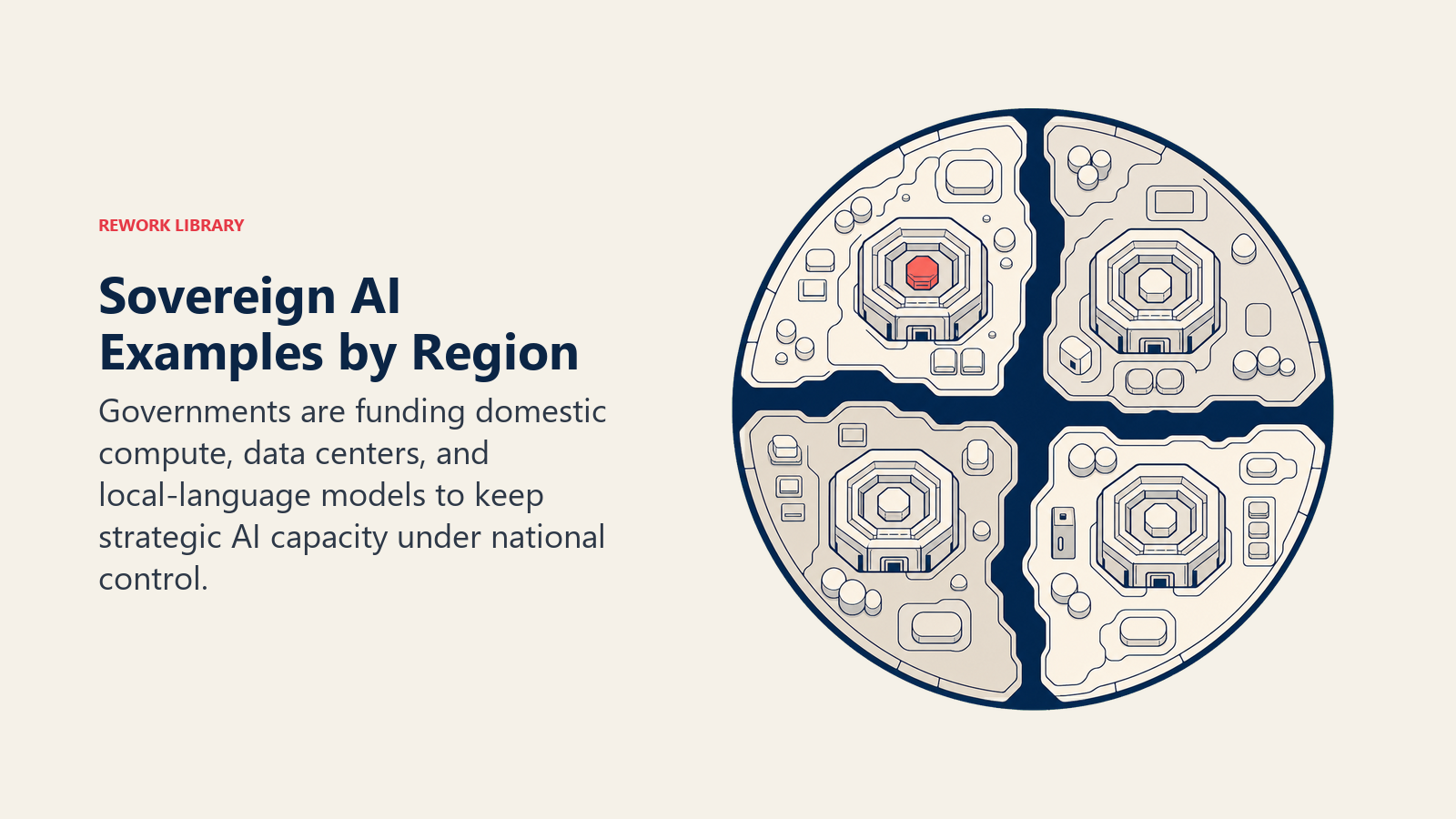
India. India's Cabinet approved the IndiaAI Mission at an outlay of roughly Rs 10,372 crore (about $1.25 billion), funding shared compute infrastructure available to startups, academia, and government agencies at subsidized rates. The mission has onboarded more than 38,000 GPUs for its common compute facility, well past its original 10,000-GPU target, and India has separately struck a $1 billion sovereign AI infrastructure deal with Nvidia.
The Gulf states. The UAE's Stargate UAE project, a partnership among G42, OpenAI, Oracle, Nvidia, Cisco, and SoftBank, is building a planned 5-gigawatt AI data center campus in Abu Dhabi, with its first 200-megawatt phase targeted for 2026. Saudi Arabia's HUMAIN, backed by the kingdom's Public Investment Fund, is building data centers in Riyadh and Dammam and plans to scale toward roughly 6 gigawatts of AI data center capacity by the mid-2030s, part of a broader Saudi AI sector that pulled in $9.1 billion across 70 deals in 2025.
National models. Beyond raw compute, several governments are backing homegrown models tuned to local languages and law. France's Mistral AI is deploying thousands of Nvidia Grace Blackwell systems with government backing, and similar national-model efforts are underway in Japan, Germany, and Singapore, all reflecting the same instinct: control the reasoning models your public sector depends on, don't just rent them.
What Sovereign AI Means for Multinational Companies
If you operate across borders, sovereign AI shows up in your business as friction, not headlines.
Procurement gets more complicated. "Which cloud provider" is turning into "which cloud provider, hosted where, under which country's law." Vendor selection now needs a jurisdiction column, which is one more variable in an already involved AI vendor evaluation process.
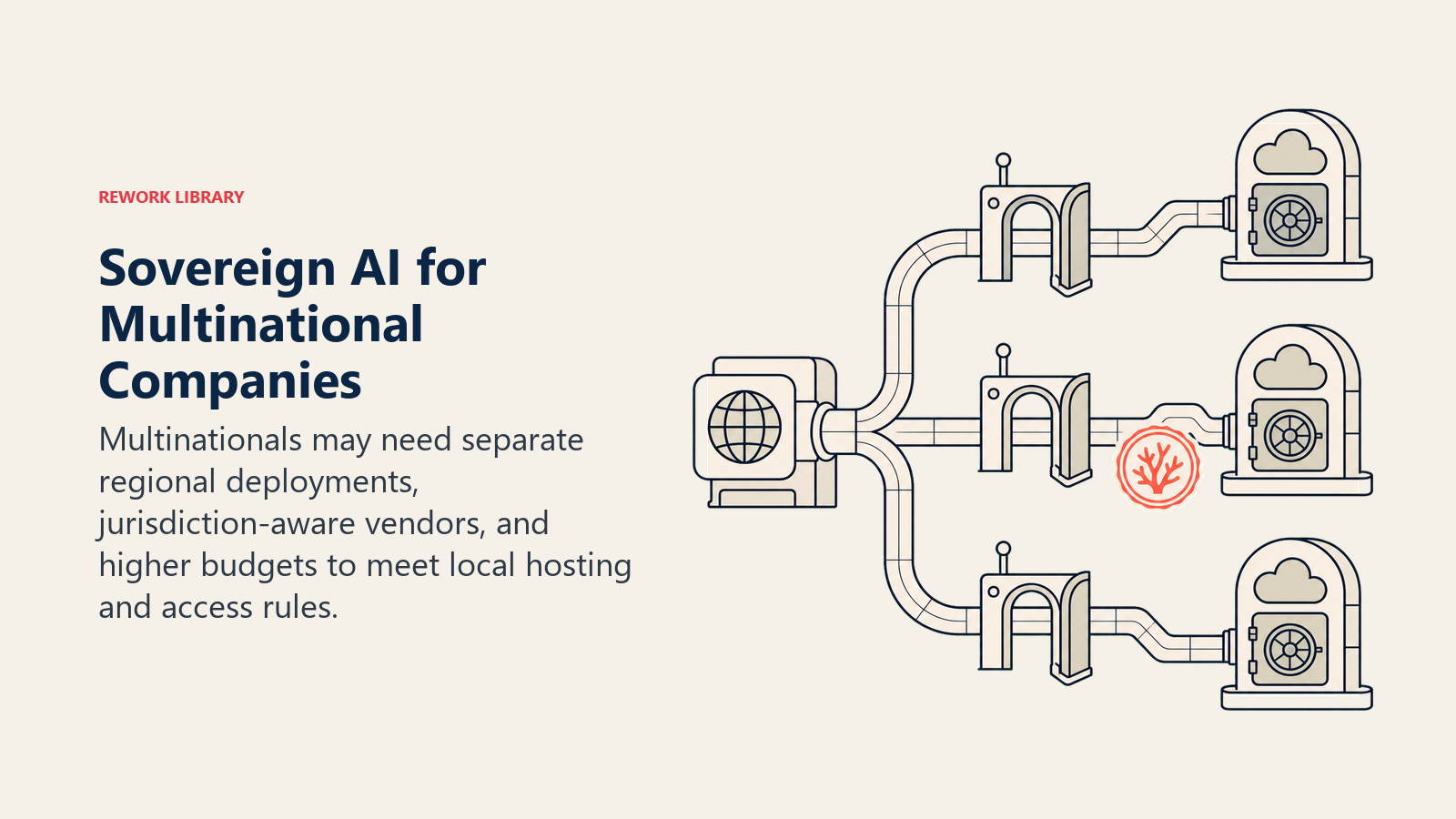
Single-region deployments stop being sufficient. Companies serving customers in the EU, India, and the Gulf may need separate AI deployments per region to satisfy each jurisdiction's residency and access rules, instead of one global architecture. That's more infrastructure to monitor, patch, and govern.
Costs go up before they go down. Duplicating compute across regions, and working with smaller sovereign cloud providers instead of global hyperscalers at full economy of scale, raises your effective AI total cost of ownership. Budget for this as a real line item, not a rounding error.
Build-versus-buy decisions get a new variable. The classic AI build vs buy question now includes "build or buy where," since a model that's perfectly fine to use in one market may be legally unusable in another without a locally hosted equivalent.
Regulated industries feel it first and hardest. Banks, healthcare systems, insurers, and defense contractors are already being asked by regulators and government customers to prove exactly where their AI runs and who can access it, which pulls sovereign AI requirements out of policy papers and directly into contract terms.
The practical response most multinationals are landing on: treat sovereignty requirements as a segmentation problem. Map which markets actually require domestic hosting, prioritize sovereign-compliant deployments there, and keep the global cloud default everywhere else instead of over-engineering every market to the strictest standard.
Key Facts
- $30 billion+: Nvidia's sovereign AI revenue surged past this mark in fiscal year 2026, roughly 14% of total company revenue, as governments in Singapore, India, Japan, Germany, the UAE, and Saudi Arabia build national AI infrastructure. Forbes
- 35% of countries will be locked into region-specific, sovereign AI platforms by 2027, up from just 5% today, according to Gartner. Gartner
- At least 1% of GDP is the minimum share of national output Gartner expects countries with a serious sovereign AI stack to spend on AI infrastructure by 2029. Gartner, via AI Data Press
- 71% of executives characterize sovereign AI as an "existential concern" or "strategic imperative" for their organization, per McKinsey's global sovereign AI research. McKinsey
- $600 billion is the size McKinsey projects the global sovereign AI market could reach by 2030, spanning energy, compute, data, models, and applications. McKinsey
- €200 billion is the investment the European Commission's InvestAI initiative aims to mobilize across the EU through 2030, including €20 billion earmarked for four to five AI gigafactories. European Commission
- Rs 10,372 crore (about $1.25 billion) is India's Cabinet-approved outlay for the IndiaAI Mission, which has onboarded more than 38,000 GPUs for its shared compute facility, well above its original 10,000-GPU target. IndiaAI / Government of India
- 5 gigawatts is the planned capacity of Stargate UAE, the Abu Dhabi AI data center campus backed by G42, OpenAI, Oracle, Nvidia, Cisco, and SoftBank, with its first 200-megawatt phase targeted for 2026. Rest of World
Frequently Asked Questions about Sovereign AI
What is sovereign AI in simple terms?
Sovereign AI is a country's ability to build, run, and control its own AI systems, the compute, the data, and increasingly the models, so it isn't fully dependent on foreign providers for a technology that's now core to its economy, security, and public services.
How is sovereign AI different from cloud AI?
Cloud AI typically runs on infrastructure owned by large global providers, often headquartered abroad, under that provider's terms and legal jurisdiction. Sovereign AI keeps compute, data, and often the model itself inside national borders and under domestic legal control, even when it still uses commercial hardware like Nvidia GPUs.
Why are governments investing so heavily in sovereign AI right now?
Three drivers converge: data residency and privacy laws that restrict where sensitive information can be processed, national security concerns about depending on foreign AI for critical infrastructure and defense, and economic competitiveness, since countries that control AI capacity can shape their own industrial policy instead of renting it indefinitely.
Does sovereign AI mean building AI models entirely from scratch?
Not always. Some countries train their own foundation models tuned to local languages and law. Others focus on sovereign compute and data governance while still using foreign-developed models, as long as the infrastructure and oversight stay domestic.
Which countries are furthest along in sovereign AI as of 2026?
The European Union, India, and the Gulf states, particularly the UAE and Saudi Arabia, are among the furthest along, each committing tens of billions of dollars to domestic compute, data centers, and in some cases homegrown models. See the Key Facts above for specific figures.
What does sovereign AI mean for multinational companies?
It usually means more complexity rather than less choice. Multinationals may need separate AI deployments per region to satisfy data residency rules, evaluate vendors partly on where their infrastructure physically sits, and budget for regional compute instead of one global cloud contract.
Is sovereign AI only relevant to governments?
No. Regulated industries, including banks, healthcare systems, and defense contractors, increasingly need to prove their AI runs within the jurisdiction, and under the legal control, their regulators require, which pulls sovereign AI requirements down into everyday enterprise procurement.
Will sovereign AI make AI more expensive for companies?
Likely yes, in the near term. Building or renting country-specific compute and maintaining multiple regional deployments costs more than relying on one global cloud footprint. Gartner estimates nations building a real sovereign AI stack will need to spend at least 1% of GDP on AI infrastructure by 2029, and companies operating in those markets will feel a version of that cost too.
Related AI Concepts
- AI Governance - The policies and oversight structures that make sovereignty enforceable
- EU AI Act - Europe's binding AI regulation and a model for sovereignty-driven law
- AI Liability - Who's accountable when AI operating under different national rules causes harm
- Edge AI - The local-infrastructure logic behind sovereign compute, applied at a smaller scale
- AI Total Cost of Ownership - How regional, sovereignty-driven deployments change your AI cost model
External Resources
- Forbes: Is Sovereign AI Nvidia's Secret Weapon? - Nvidia's sovereign AI revenue and country-level deployments
- Gartner: 35% of Countries Locked Into Region-Specific AI Platforms by 2027 - Adoption forecast for sovereign, region-specific AI
- McKinsey: Sovereign AI Ecosystems - Executive sentiment and market sizing for sovereign AI
- European Commission: AI Gigafactories - The EU's InvestAI and gigafactory program
- IndiaAI Mission Cabinet Approval - India's national AI compute and funding program
- Rest of World: The Gulf's Big Bet on AI - UAE and Saudi sovereign AI infrastructure spending
Part of the AI Terms Collection. Last updated: 2026-07-16
