What is LoRA (Low-Rank Adaptation)?
Turn this article into takeaways for your work.


Each assistant summarizes the article only for you and suggests best practices for your work.
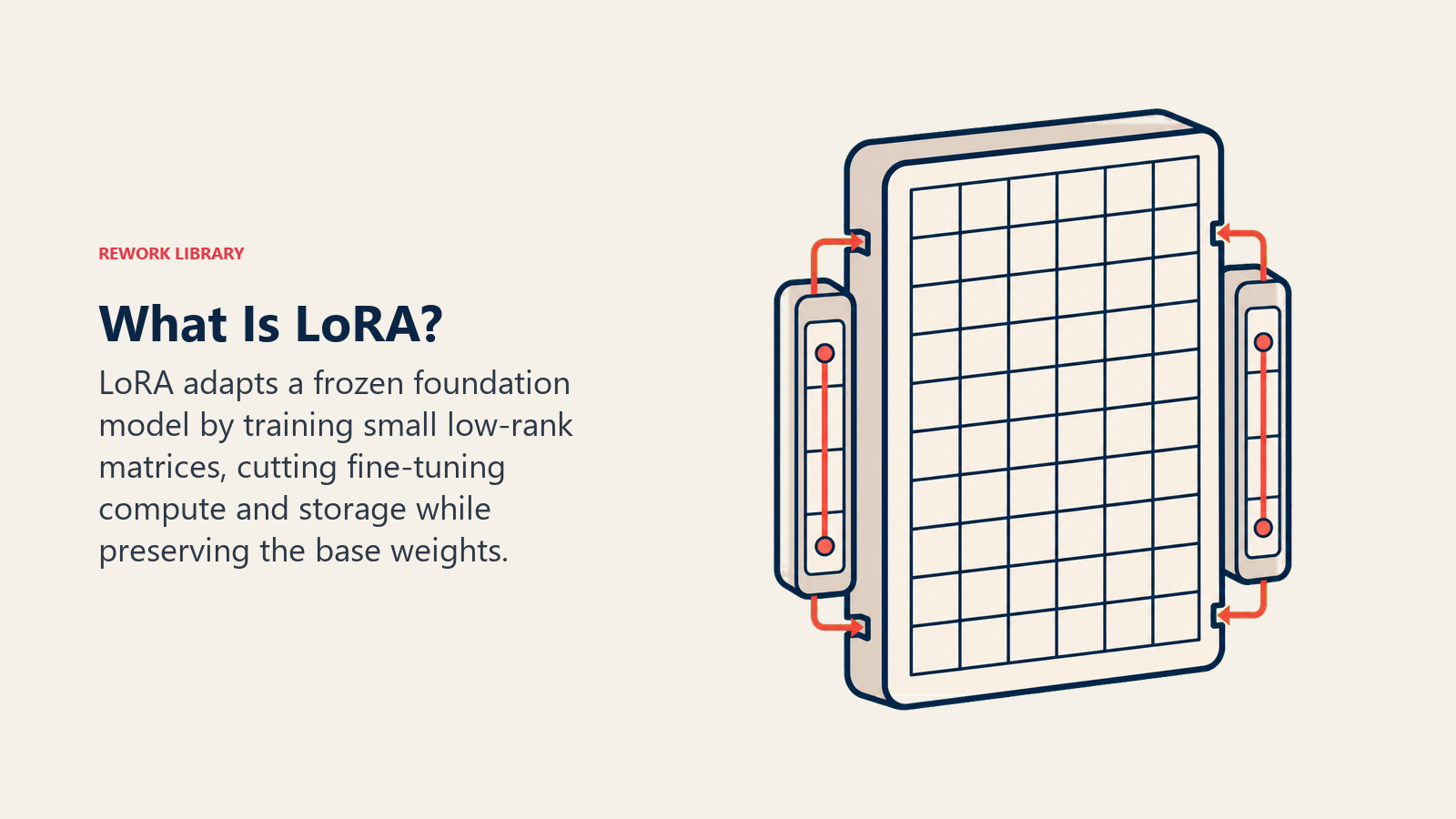
If you've asked "what is LoRA in AI" while reading about fine-tuning costs, here's the short answer: LoRA (Low-Rank Adaptation) is a parameter-efficient fine-tuning technique that freezes a pre-trained model's original weights and trains small "adapter" matrices alongside them instead. Rather than updating billions of parameters, LoRA updates a tiny fraction, often under 1%, while matching or approaching the quality of full fine-tuning at a fraction of the compute and storage cost.
How LoRA Works
Every large neural network layer contains weight matrices that get updated during training. Full fine-tuning touches every one of those numbers. LoRA takes a different approach: it freezes the original weight matrix entirely and adds a second, much smaller pathway next to it, built from two thin matrices multiplied together (a "low-rank decomposition"). During training, only those two small matrices learn. The original model never changes.
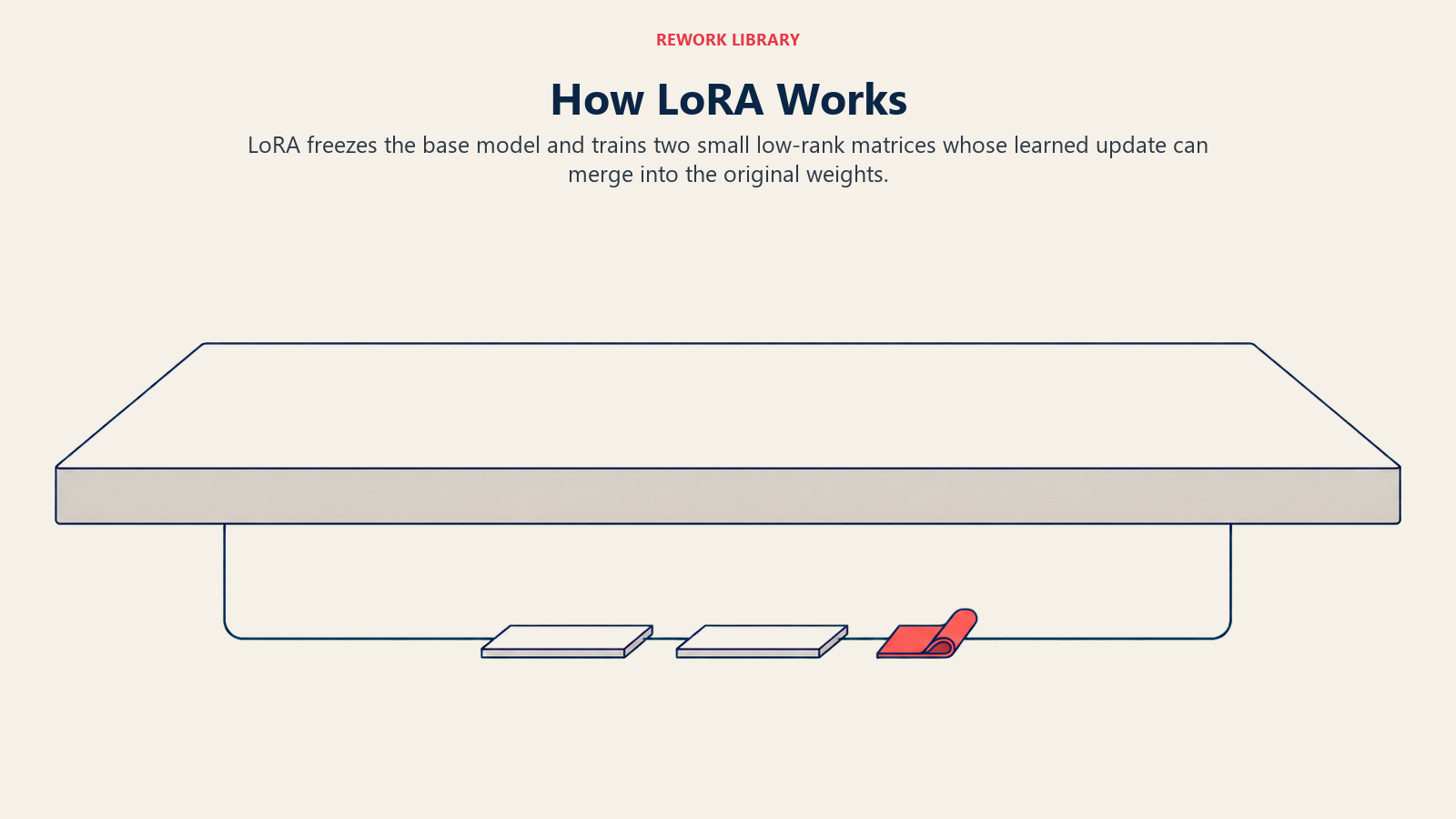
The intuition is simpler than the math sounds. A large weight matrix might have millions of parameters, but the change needed to adapt a model to a new task or a new writing style often lives in a much smaller subspace. LoRA bets that this "delta," the difference between the general-purpose model and the specialized one you want, can be captured by two small matrices instead of one huge one. The technique grew out of earlier transfer learning research, which established that adapting a pre-trained model to a new task rarely requires retraining it from scratch.
At inference time, the two small matrices can be mathematically merged back into the original weights, so a LoRA-adapted model runs exactly as fast as the base model. No extra layers, no added latency, because the adapter effectively disappears into the weights once training is done.
Key Facts: LoRA (Low-Rank Adaptation)
- LoRA cuts the number of trainable parameters by 10,000 times and GPU memory requirements by 3 times versus full fine-tuning of GPT-3 175B with Adam, per the original LoRA paper (Hu et al., 2021, arXiv:2106.09685).
- A LoRA checkpoint for GPT-3 175B takes about 35MB, versus roughly 350GB for a fully fine-tuned copy, a reduction of about 10,000x at rank r=4 (Hu et al., 2021).
- QLoRA, a LoRA variant that adds 4-bit quantization, fine-tunes a 65-billion-parameter model on a single 48GB GPU while matching full 16-bit fine-tuning quality (Dettmers et al., 2023, arXiv:2305.14314).
Why LoRA Matters for Business AI
For business leaders, LoRA means you can customize a large foundation model to your company's tone, terminology, or task without paying for the compute, storage, and engineering time that full fine-tuning demands. Think of it as swapping a small, purpose-built attachment onto a general-purpose tool instead of rebuilding the whole tool from scratch.
That cost gap is not marginal. According to Hu et al. (2021), LoRA reduces GPT-3 175B's trainable parameter count by 10,000 times and its GPU memory requirement by 3 times compared to full fine-tuning, while performing on par with or better than full fine-tuning on benchmark tasks across RoBERTa, DeBERTa, GPT-2, and GPT-3. That combination, near-equal quality at a fraction of the resource cost, is why LoRA became the default fine-tuning approach for most teams working with large language models rather than the exception.
Storage adds up the same way. A full fine-tuned copy of GPT-3 175B needs roughly 350GB. A LoRA adapter for the same model needs about 35MB (Hu et al., 2021). That means a company can keep dozens of task-specific adapters, one for legal document review, one for customer support tone, one for a specific product line, on a shared base model without duplicating hundreds of gigabytes for each variant. Hu et al. note that hosting 100 adapted models this way costs roughly 354GB total instead of about 35TB for 100 separate full copies.
LoRA also made a second breakthrough possible: QLoRA. Introduced by Dettmers et al. (2023), QLoRA combines LoRA with 4-bit quantization of the frozen base model, shrinking memory needs enough to fine-tune a 65-billion-parameter model on a single 48GB GPU while preserving full 16-bit fine-tuning task performance. The paper's resulting model family, Guanaco, reached 99.3% of ChatGPT's performance level on the Vicuna benchmark after just 24 hours of fine-tuning on one GPU. That result moved large-model customization from multi-GPU server clusters to a single workstation GPU for many teams.
Common Use Cases for LoRA
LoRA shows up wherever teams need many specialized versions of one base model without the cost of fully retraining each one.
- Domain adaptation. Teaching a general-purpose LLM your industry's vocabulary, such as legal, medical, or financial terminology, without touching the base model.
- Brand voice and tone. Adapting a model's writing style to match a company's support scripts or marketing voice.
- Multi-tenant AI products. SaaS platforms that serve many customers can keep one shared base model and swap in a lightweight LoRA adapter per customer, avoiding the storage and serving cost of hundreds of full model copies.
- Rapid experimentation. Because LoRA training runs in hours rather than days and needs far less GPU memory, teams can test more fine-tuning ideas within the same budget.
- Image and diffusion model customization. LoRA is widely used outside text models too, letting artists and product teams adapt image-generation models to a specific art style or product line with a small adapter file instead of a multi-gigabyte retrained model.
- Edge and resource-constrained deployment. Combined with model optimization techniques, LoRA adapters keep specialized capability available even where full retraining infrastructure is not.
LoRA vs Full Fine-tuning vs RAG
These three approaches solve related but different problems, and teams often combine more than one.
| Approach | What it changes | Best for | Compute/storage cost | Update speed |
|---|---|---|---|---|
| Full fine-tuning | Every model weight | Maximum customization when you have the budget and a large, high-quality dataset | Highest (full GPU cluster, full model storage per version) | Slow to retrain |
| LoRA (and QLoRA) | A small set of added low-rank adapter matrices, base weights stay frozen | Teaching new tone, terminology, or task-specific behavior efficiently | Low (single GPU feasible, adapters measured in MB) | Fast to retrain, easy to swap adapters |
| Retrieval-augmented generation | Nothing in the model, it retrieves relevant documents at query time and feeds them into the prompt | Keeping answers current with fast-changing facts, or citing specific source documents | Low (no training required, just an indexed knowledge base) | Instant, update the source documents |
The practical rule of thumb: use RAG when you need the model to know current or proprietary facts, use LoRA when you need the model to behave or write differently, and reserve full fine-tuning for the rare cases where LoRA's smaller parameter budget genuinely cannot capture the needed change. Many production systems combine LoRA-adapted models with RAG for retrieval, since the two solve separate problems.
Limitations of LoRA
LoRA is not a universal replacement for full fine-tuning, and it comes with real tradeoffs.
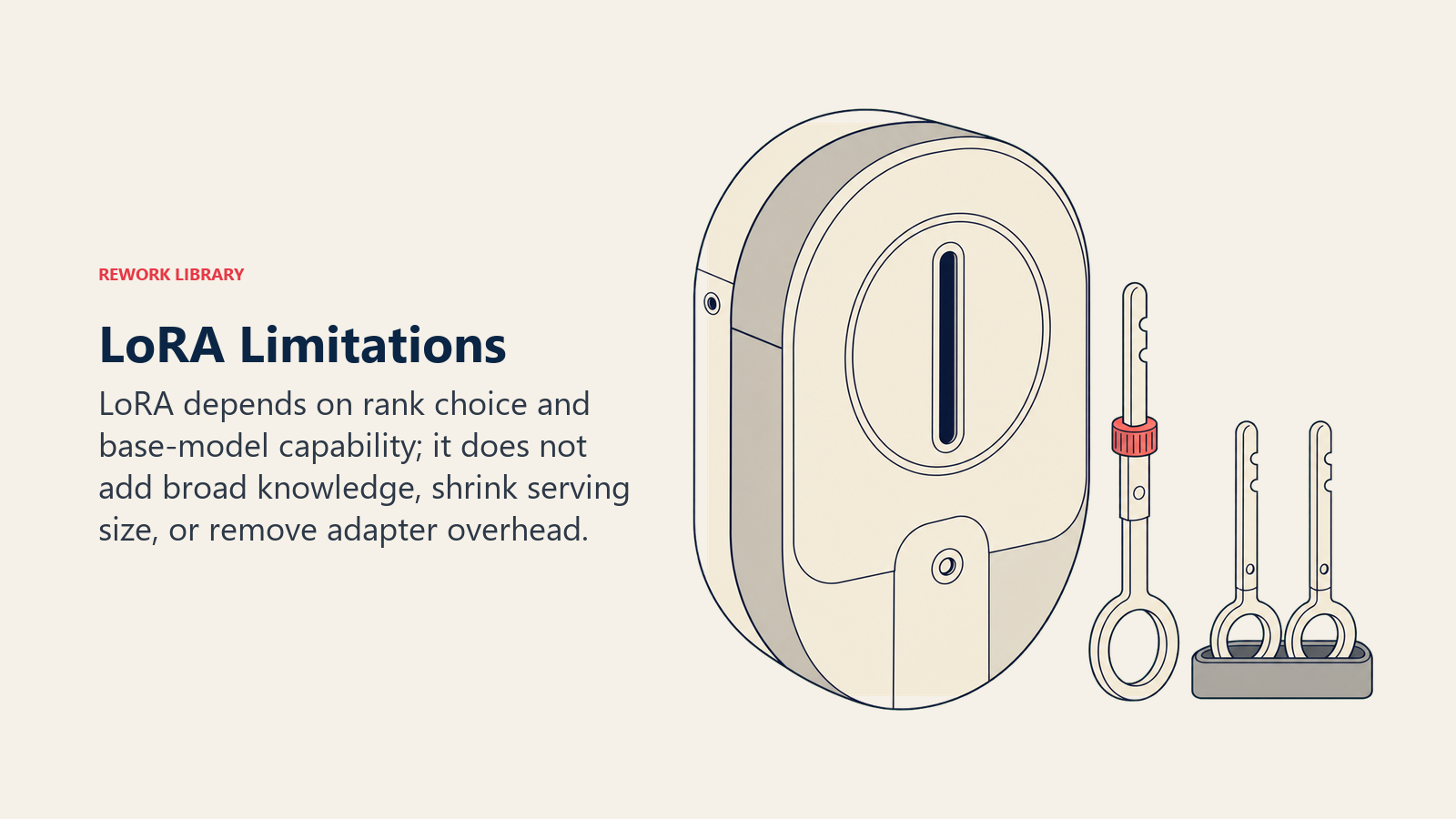
- Rank choice matters. Too low a rank can underfit complex tasks, while too high a rank starts eroding LoRA's efficiency advantage. Hu et al. (2021) found that a rank as small as one was often sufficient for their tested GPT-3 tasks, but this is task-dependent and needs validation for each use case.
- Not ideal for teaching genuinely new knowledge. LoRA adapts behavior and style well but is not the right tool for injecting large amounts of new factual knowledge the base model never saw. Retrieval-augmented generation or continued pre-training generally handle that better.
- Still requires a capable base model. LoRA adapts what a foundation model already knows; it cannot compensate for a base model that lacks the underlying capability altogether.
- Adapter management overhead. Running many LoRA adapters in production requires infrastructure to load, swap, and version them correctly, which is a smaller problem than full model versioning but not a zero one.
- Different from compression techniques. LoRA reduces training cost, not necessarily inference cost or model size at serving time (once merged, the model is the same size as the base model). Teams looking to shrink the deployed model itself typically pair LoRA with separate model compression or knowledge distillation work.
Learn More
- Fine-tuning - the broader category of techniques LoRA belongs to
- Foundation Models - the base models LoRA adapters are trained on top of
- Large Language Models - the model class LoRA was originally built for
- Quantization - the technique QLoRA combines with LoRA
- Transfer Learning - the research foundation LoRA builds on
- Knowledge Distillation - an alternative approach for shrinking models rather than adapting them
Frequently Asked Questions about LoRA
What is LoRA in AI, in one sentence?
LoRA (Low-Rank Adaptation) is a parameter-efficient fine-tuning method that freezes a pre-trained model's weights and trains small added adapter matrices instead, matching much of full fine-tuning's quality at a fraction of the compute and storage cost.
Is LoRA a type of fine-tuning?
Yes. LoRA is a parameter-efficient fine-tuning (PEFT) technique, a category of methods that adapt a pre-trained model by updating only a small subset of parameters instead of the entire model, unlike full fine-tuning which updates every weight.
How much cheaper is LoRA than full fine-tuning?
According to the original LoRA paper (Hu et al., 2021), LoRA reduces trainable parameters by 10,000 times and GPU memory requirements by 3 times compared to full fine-tuning of GPT-3 175B with Adam, while matching or exceeding full fine-tuning quality on tested benchmarks.
What is QLoRA and how is it different from LoRA?
QLoRA adds 4-bit quantization of the frozen base model to standard LoRA, cutting memory needs further. Dettmers et al. (2023) showed QLoRA can fine-tune a 65-billion-parameter model on a single 48GB GPU while preserving full 16-bit fine-tuning performance.
Does LoRA slow down the model at inference time?
No. Once training finishes, the small LoRA matrices can be mathematically merged back into the original weights, so the adapted model runs at the same speed as the base model with no added inference latency.
When should I use LoRA instead of RAG?
Use LoRA when you need the model to write in a different tone, follow a specific format, or handle a specialized task. Use retrieval-augmented generation when you need the model to reference current or proprietary facts, since RAG updates what the model sees at query time rather than what it has learned.
Can LoRA teach a model completely new knowledge?
Not efficiently. LoRA is better suited to adapting existing behavior and style than injecting large amounts of new factual knowledge. For new knowledge, retrieval-augmented generation or continued pre-training are typically better fits.
Is LoRA only used for language models?
No. LoRA is widely used for image and diffusion models too, letting teams adapt image generators to a specific art style or product line with a small adapter file instead of retraining the full model.
Part of the AI Terms Collection. Last updated: July 2026
