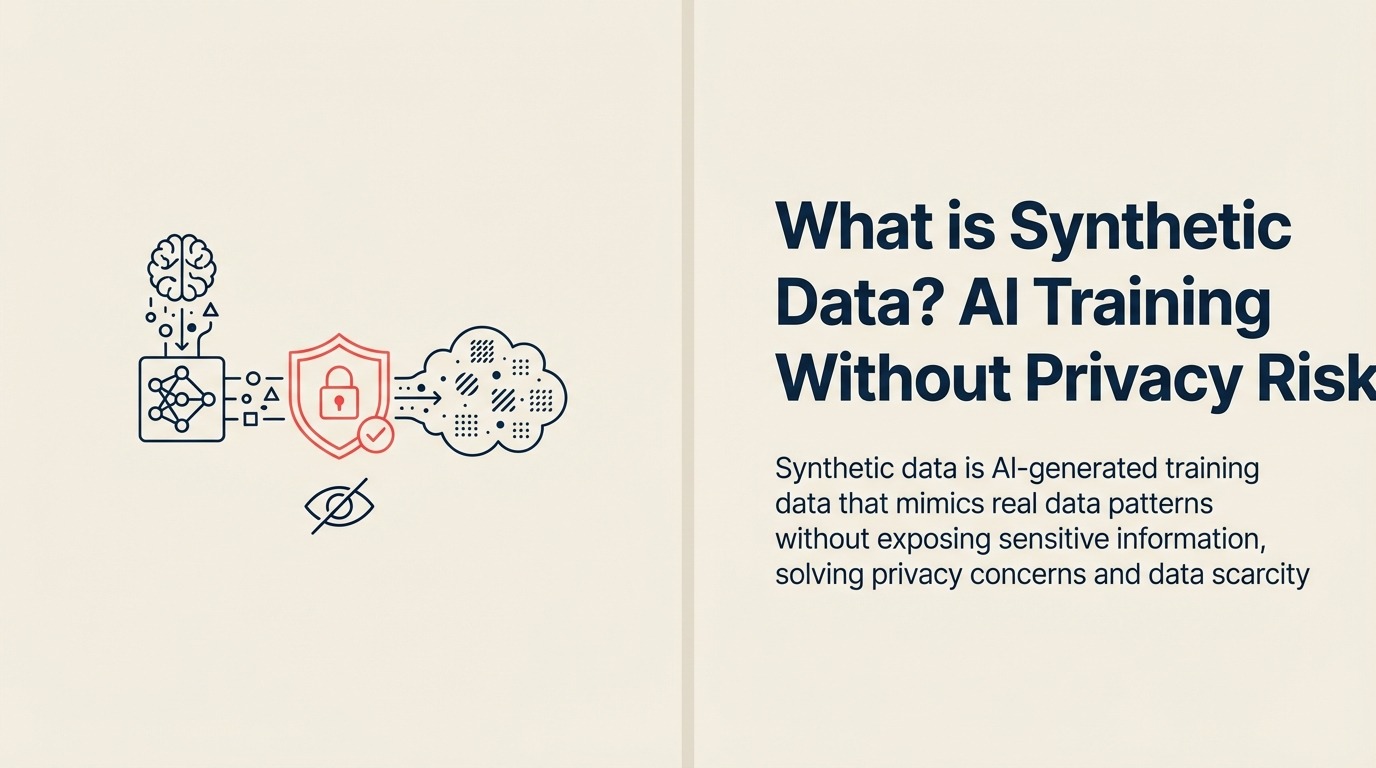
What is Synthetic Data? Training AI Without Compromising Privacy
Turn this article into takeaways for your work.


Each assistant summarizes the article only for you and suggests best practices for your work.
Every AI model needs data to learn from. But what if your most valuable data is locked away by privacy regulations, competitive concerns, or simply doesn't exist yet? Synthetic data has emerged as the solution, enabling companies to train large language models and AI systems without exposing sensitive customer information or waiting years to collect real-world examples.
From Constraint to Competitive Advantage
Synthetic data generation emerged as a critical technology around 2018 when privacy regulations like GDPR made it increasingly difficult to share real customer data for AI training. What started as a workaround has become a strategic advantage.
Gartner defines synthetic data as "information that's artificially manufactured rather than generated by real-world events, designed to mimic the patterns, correlations, and statistical properties of actual data without containing any real personal information."
The field exploded when researchers discovered that carefully generated synthetic datasets could train AI models just as effectively as real data, while eliminating privacy concerns, reducing bias, and enabling scenarios that haven't happened yet.
Making Sense for Business Leaders
For business leaders, synthetic data means the ability to train AI systems on realistic scenarios without exposing customer information, sharing competitive intelligence, or waiting years to collect rare events, accelerating AI deployment while maintaining compliance and security.
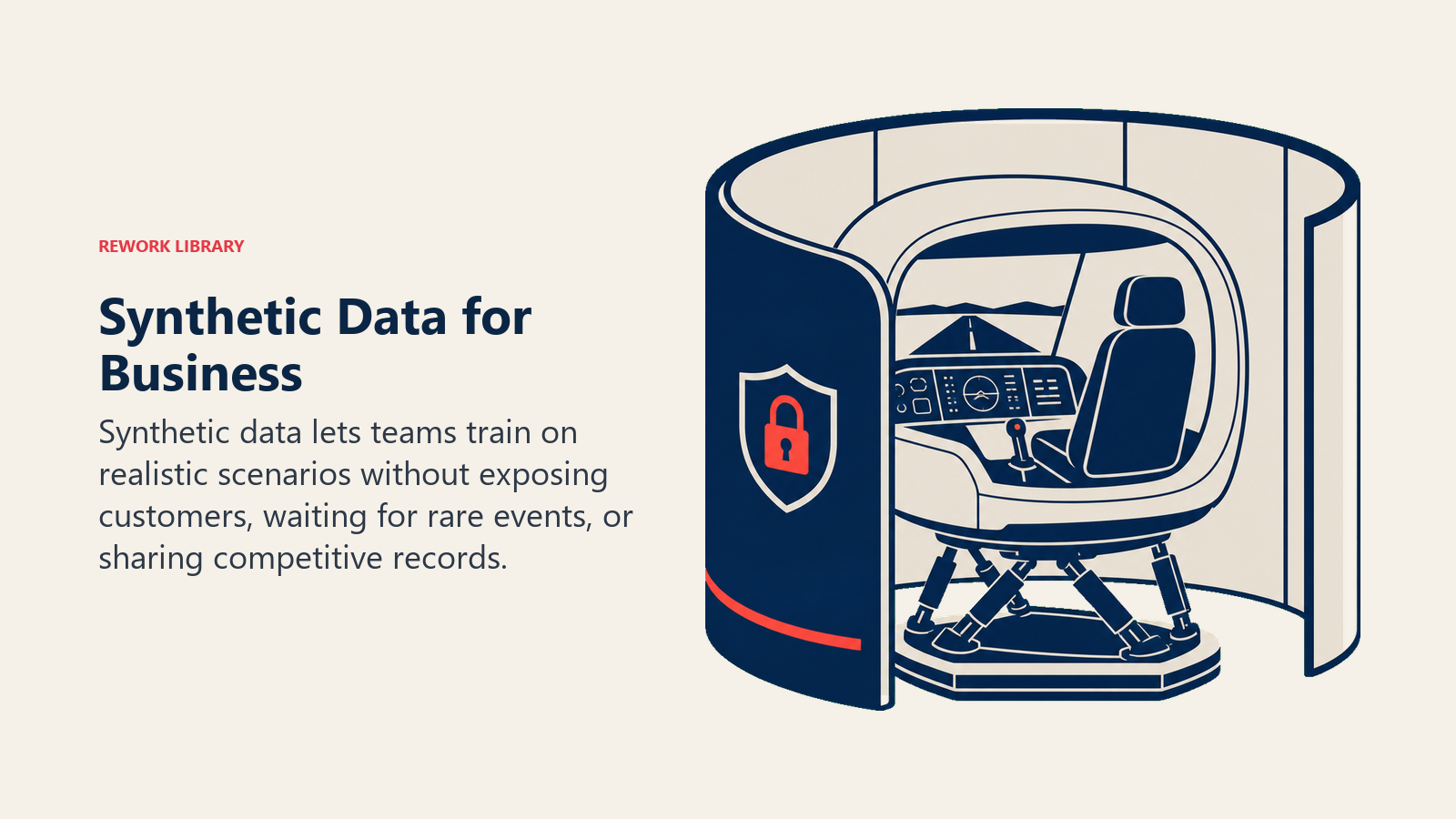
Think of it as creating a hyper-realistic flight simulator instead of risking actual planes and pilots. The synthetic environment captures all the important patterns and edge cases without any real-world consequences. Financial institutions can generate millions of realistic fraudulent transactions for training without using actual customer data.
In practical terms, synthetic data enables you to build AI systems for sensitive domains like healthcare and finance, augment limited datasets with rare scenarios, and share training data with partners without legal or competitive risks.
Key Characteristics of Synthetic Data
Synthetic data encompasses these essential characteristics:
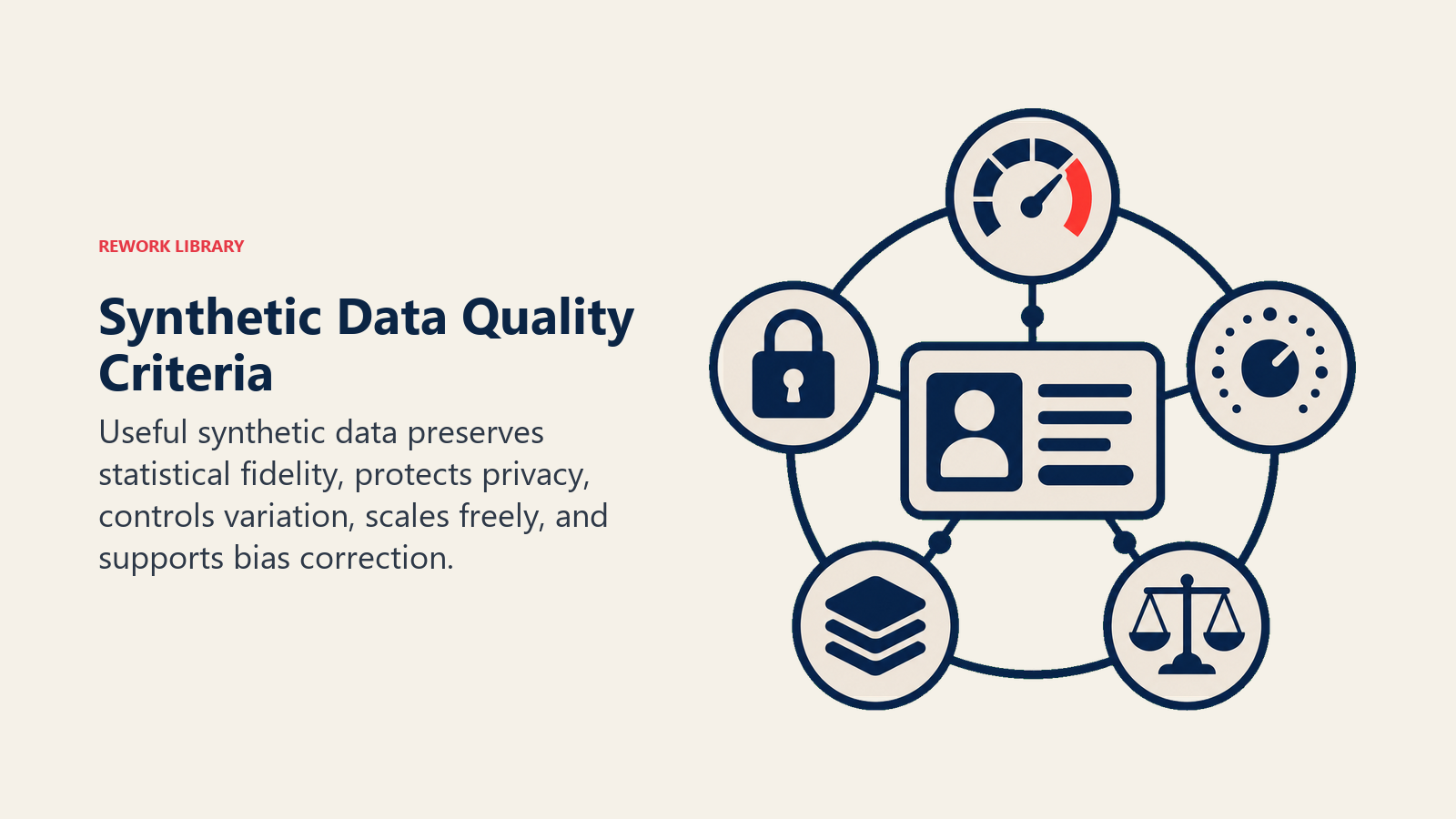
• Statistical Fidelity: Generated data preserves the same statistical properties and correlations as real data, ensuring AI models learn the right patterns
• Privacy Preservation: Contains no actual personal information, making it safe to share, store, and use without privacy concerns or regulatory restrictions
• Controlled Variation: You can generate exactly the edge cases and scenarios you need, including rare events that would take years to collect naturally
• Unlimited Scale: Create as much training data as needed without the cost, time, or privacy constraints of collecting real-world data
• Bias Control: Deliberately balance datasets to reduce bias or create representative samples that real-world data collection might miss
How Synthetic Data is Generated
Creating synthetic data follows these approaches:
Learn Real Patterns: AI models analyze existing datasets to understand the statistical relationships, distributions, and patterns that make data realistic
Generate New Examples: Using techniques like generative AI, the system creates new data points that follow the same patterns but contain no actual real-world information
Validate and Refine: Generated data is tested to ensure it maintains statistical properties while confirming that individual records can't be traced back to real people or events
This process transforms limited or sensitive data into unlimited, shareable training resources.
Types of Synthetic Data
Synthetic data comes in several forms:
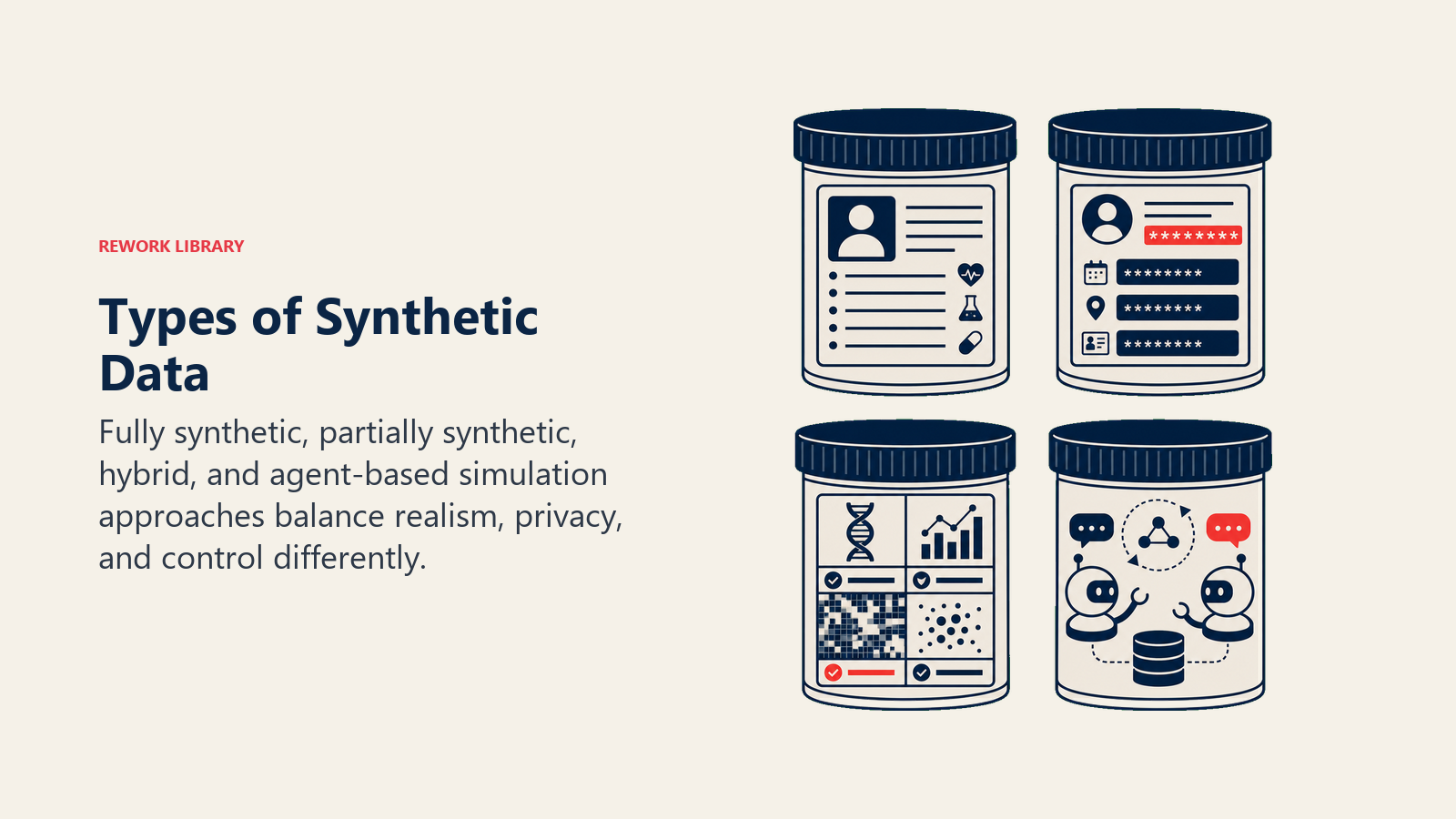
Type 1: Fully Synthetic Best for: Maximum privacy protection Key feature: Completely generated with no real data points Example: Creating an entire patient database from statistical models without using any real patient records
Type 2: Partially Synthetic Best for: Balancing realism with privacy Key feature: Real data with sensitive fields replaced Example: Using actual transaction patterns but generating synthetic customer names and account numbers
Type 3: Hybrid Synthetic Best for: Complex scenarios with rare events Key feature: Combining real and generated data Example: Augmenting limited fraud cases with synthetic variations to train detection systems
Type 4: Agent-Based Simulation Best for: Modeling complex systems Key feature: Simulating interactions and behaviors Example: Generating supply chain scenarios by simulating supplier, manufacturer, and retailer behaviors
Synthetic Data in Action
Here's how businesses actually use synthetic data:
Financial Services Example: JPMorgan uses synthetic data to train fraud detection models, generating millions of realistic fraudulent transaction patterns without exposing any customer financial information. This approach improved detection rates by 30% while maintaining complete compliance.
Healthcare Example: Mayo Clinic generates synthetic patient records that preserve medical correlations and treatment outcomes but contain no real patient information, enabling AI research collaboration across institutions without HIPAA violations.
Autonomous Vehicles Example: Waymo creates synthetic driving scenarios including rare edge cases like children running into streets or unexpected road obstacles, events too dangerous to collect in real driving but critical for safety training.
Your Path to Synthetic Data Mastery
Ready to unlock the power of synthetic data?
- Understand generation techniques with Generative AI
- Explore privacy-preserving approaches in Federated Learning
- Learn about model training with Transfer Learning
External Resources
Explore authoritative resources on synthetic data generation:
- Gartner: Synthetic Data Report - Industry analysis and market trends in synthetic data
- NVIDIA Omniverse - Platform for generating synthetic training data at scale
Learn More
Expand your understanding of related AI concepts:
- Data Augmentation - Expanding datasets through transformations
- Fine-tuning - Customizing AI models with your data
- Adversarial Examples - Understanding AI vulnerabilities
- Model Validation - Ensuring AI quality and reliability
Frequently Asked Questions about Synthetic Data
What is Synthetic Data?
Synthetic data is artificially generated information that mimics the statistical properties and patterns of real data without containing any actual real-world records or personal information.
Is synthetic data as good as real data for training AI?
When properly generated, synthetic data can be just as effective as real data for training AI models, and often superior because it can include rare scenarios and edge cases that are difficult to collect naturally.
What's the difference between synthetic data and fake data?
Synthetic data is systematically generated to preserve statistical patterns and relationships, making it realistic and useful for AI training. Fake data is random or made-up without maintaining the underlying patterns that make it valuable.
What are the main benefits of using synthetic data?
Privacy protection (no real personal information), regulatory compliance (safe to share and use), unlimited scale (generate as much as needed), and scenario control (create rare events and edge cases on demand).
Will synthetic data replace real data?
Gartner predicts 60% of AI training data will be synthetic by 2024, but it complements rather than replaces real data. Synthetic data is generated from patterns learned in real data and is most effective when used together.
Part of the AI Terms Collection. Last updated: 2026-02-09
