What is Agentic AI? Definition, How It Works, and 2026 Examples
Turn this article into takeaways for your work.


Each assistant summarizes the article only for you and suggests best practices for your work.
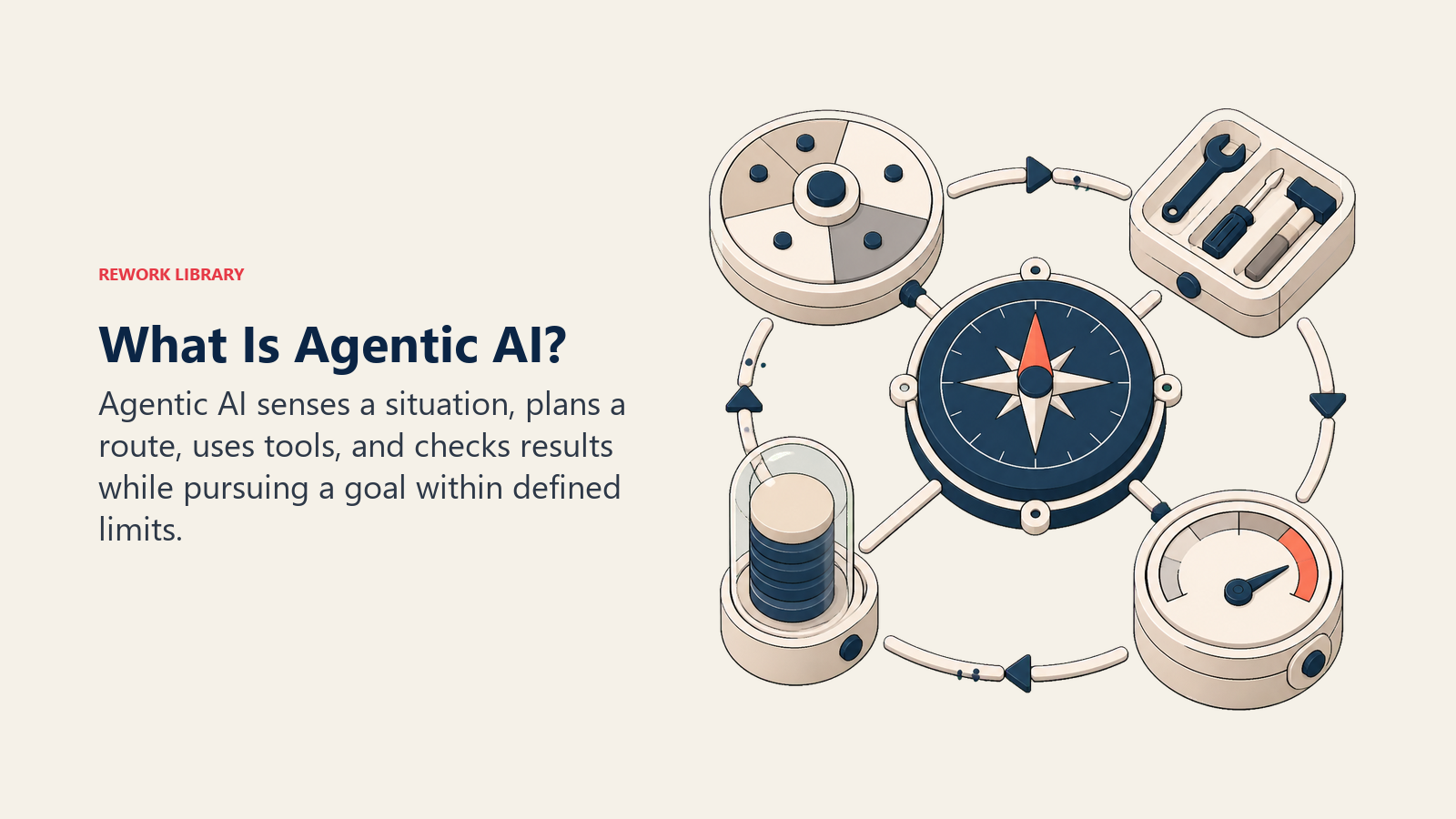
Agentic AI is artificial intelligence that pursues a goal on its own: it senses what's happening, reasons about the best next step, plans a sequence of actions, and executes them using tools and memory, checking back with a person only when the task calls for it. That's what separates it from a chatbot waiting for your next message.
For business leaders, agentic AI means software that can own a piece of work end to end, not just answer a question about it. Tell it "qualify this batch of leads" or "reconcile these invoices" and it figures out the steps, pulls data from your systems, makes judgment calls within limits you set, and only escalates when something falls outside its authority. It's the difference between a research assistant who hands you a list of links and one who reads them, writes the summary, and flags the one contract clause that needs your signature.
How Agentic AI Works: Perception to Action
Every AI agent runs some version of the same loop, whether it's answering support tickets or reviewing contracts. Understanding the loop is the fastest way to understand what "agentic" actually means in practice.
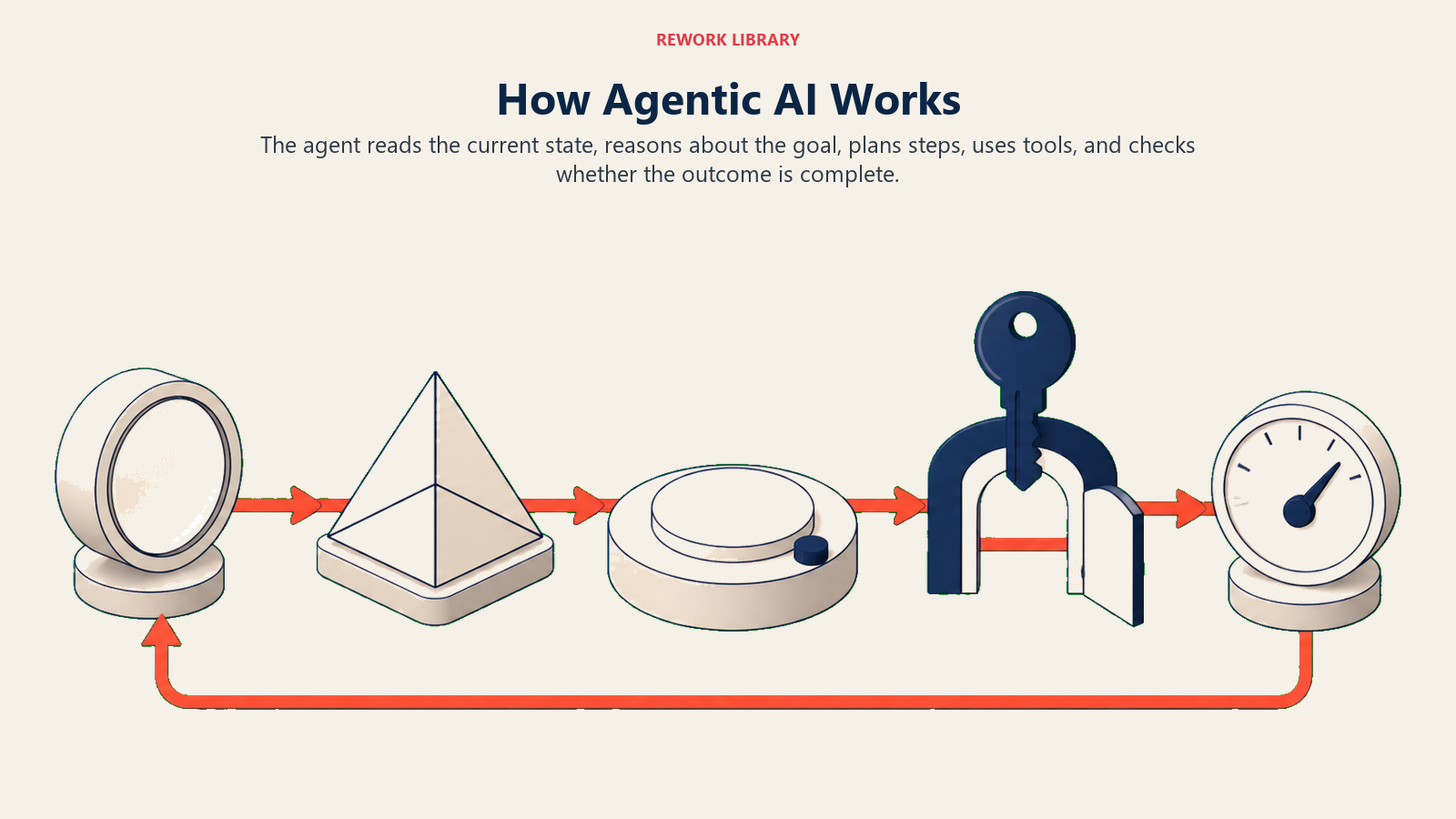
Perception: The system takes in the current state of the world, an email, a database record, a dashboard alert, a customer message, and converts it into something it can reason about. This is where it decides what matters right now.
Reasoning: Powered by a large language model or a similar reasoning core, the system interprets the goal and the situation together. It weighs options the way a person would triage a to-do list: what's urgent, what's blocked, what needs more information first.
Planning: The goal gets broken into an ordered sequence of steps, often with fallback branches. If a payment method fails, try the backup. If a data field is missing, ask for it before moving on. This planning layer is what lets the system handle a messy real-world task instead of a single scripted path.
Action: The system executes, calling APIs, updating records, sending messages, running code, using tool use capabilities to actually touch your business systems rather than just describe what should happen.
Tools and memory: Throughout the loop, the agent draws on external tools for anything it can't do natively (a CRM lookup, a search query, a calculation) and on memory to keep track of what it already tried, what worked, and what the broader goal was. Short-term memory holds the current task's context; longer-term memory, often backed by a vector database, lets the system carry lessons from one run to the next.
The loop repeats until the goal is met, a limit is hit, or the system escalates to a human. That escalation step matters as much as the autonomy does. Most production agentic systems in 2026 are built with explicit stopping points, not unlimited free rein.
Agentic AI vs Generative AI vs Traditional Automation
These three terms get used interchangeably in vendor marketing, but they solve different problems. The table below is the fastest way to tell them apart.
| Aspect | Traditional Automation (RPA) | Generative AI | Agentic AI |
|---|---|---|---|
| Decision-making | None, follows fixed rules | None, generates content for a single prompt | Independent, chooses its own next steps toward a goal |
| Trigger | A schedule or a defined event | A human prompt | A goal statement, then it self-directs |
| Adaptability | Breaks when the process or the screen layout changes | Adapts within a single response, not across steps | Adjusts its plan mid-task as new information arrives |
| Systems it touches | Scripted UI clicks or fixed API calls | Usually none, output is text, code, or an image | Calls APIs, databases, and other software on its own, via tool use |
| Memory | None beyond the current run | None beyond the current conversation | Short and long-term memory across steps and sessions, see AI memory |
| Output | A completed transaction or record update | A draft, answer, or generated asset for a person to use | A completed multi-step outcome, with an audit trail of what it did |
| Best fit | Stable, high-volume, rule-based processes | Drafting, summarizing, brainstorming | Multi-step work that requires judgment calls along the way |
The practical takeaway: robotic process automation is precise but brittle, generative AI is creative but passive, and agentic AI is the layer that can actually pick up a goal and run with it. Most real deployments in 2026 combine all three, using generative AI for language tasks, RPA for stable legacy-system plumbing, and agentic reasoning to decide what happens when.
Key Components of an Agentic AI System
Strip away the branding and every agentic system is built from the same handful of parts.
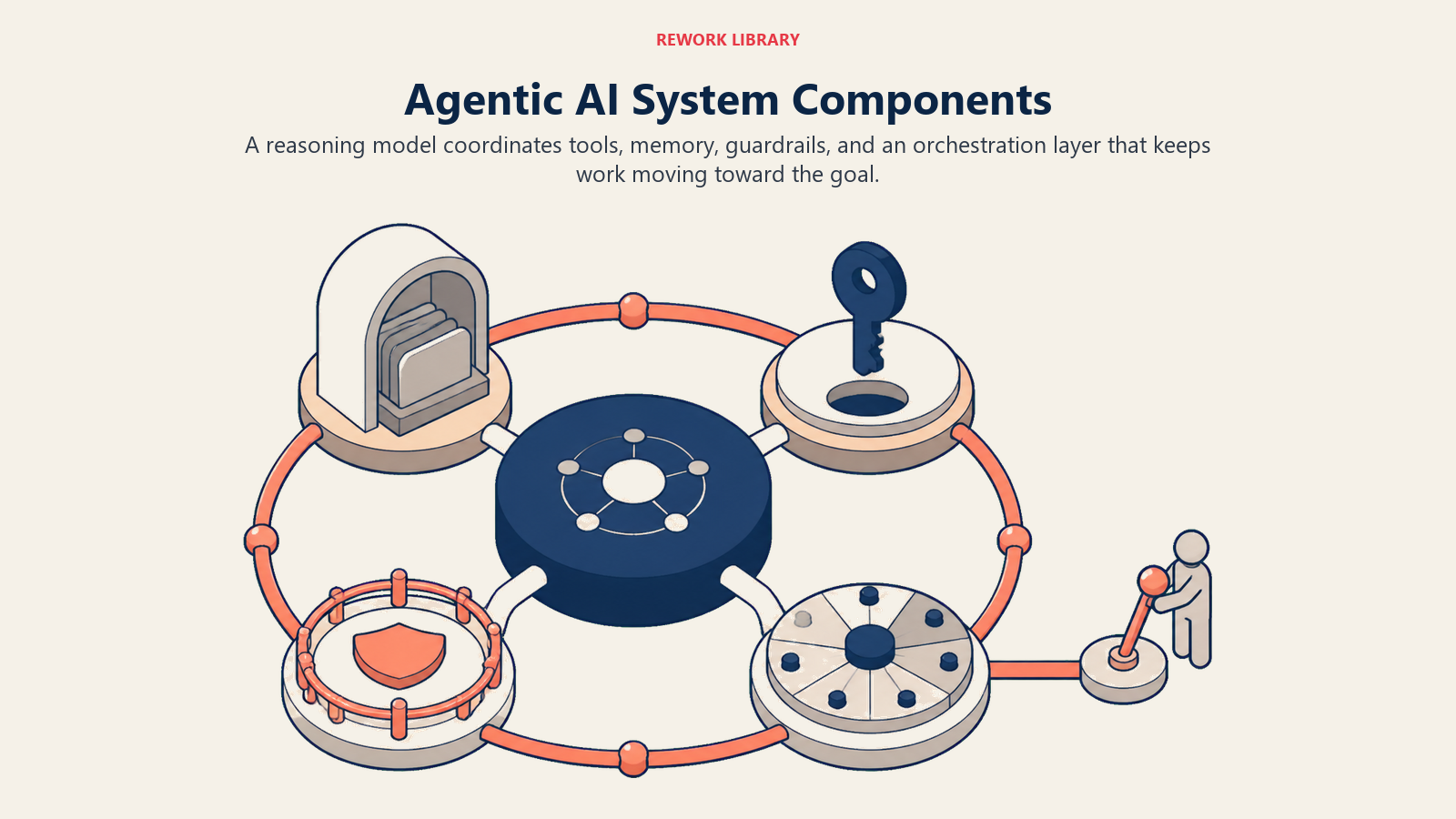
- The agent (reasoning core): Usually a large language model fine-tuned or prompted to plan and make decisions, not just generate text. This is the part doing the "thinking."
- Tools: The functions, APIs, and systems the agent is allowed to call, from a CRM to a payment processor to a code execution sandbox. Without tool use, an agent can only talk about work, not do it.
- Memory: Working memory for the current task and longer-term memory for context that should persist, past interactions, learned preferences, prior outcomes. See AI memory for how this differs from a model's training data.
- Orchestration: The layer that coordinates multiple agents or multiple steps, decides what runs in what order, and enforces guardrails. As tasks get more complex, single agents give way to coordinated systems, covered in AI orchestration and agentic workflows.
- Model Context Protocol (MCP): An open standard for connecting agents to external tools and data sources in a consistent way, instead of writing custom integration code for every system an agent might need to touch. See Model Context Protocol for the technical details. MCP is a big part of why agentic AI got easier to build and deploy through 2025 and 2026.
Related but distinct: AI copilots sit next to a human and suggest, agents act with autonomy inside guardrails you define.
Real 2026 Examples of Agentic AI in Business
Sales: Agentic systems now handle full-cycle lead qualification, researching a prospect's company, scoring fit against your ICP, drafting a personalized first touch, and booking a meeting on the rep's calendar, all before a human sees the lead. Reps step in for the conversation itself, not the busywork that used to precede it.
Support: Instead of routing every ticket to a human, agentic support systems check account status, pull the relevant policy, resolve the straightforward cases (refunds, password resets, order status) end to end, and escalate only the ones that need judgment or an apology a customer will actually feel.
Coding: Coding agents now take a ticket or a bug report, read the relevant files, write the fix, run the test suite, and open a pull request for review, compressing work that used to take a developer half a day into a task they mostly just approve. Human review stays the final gate, but the drafting work moved to the agent.
Operations: Back-office agents reconcile invoices against purchase orders, flag mismatches, chase missing approvals, and update the finance system, running the kind of repetitive cross-checking that used to eat a controller's week.
A quick honest note on where Rework fits: some teams start small by using software they already run for sales and operations, several of which, Rework included, now ship built-in AI copilots and agents for things like lead follow-up and pipeline hygiene. That's often a lower-risk way to see agentic workflows in action before building anything custom.
Benefits and Limitations of Agentic AI
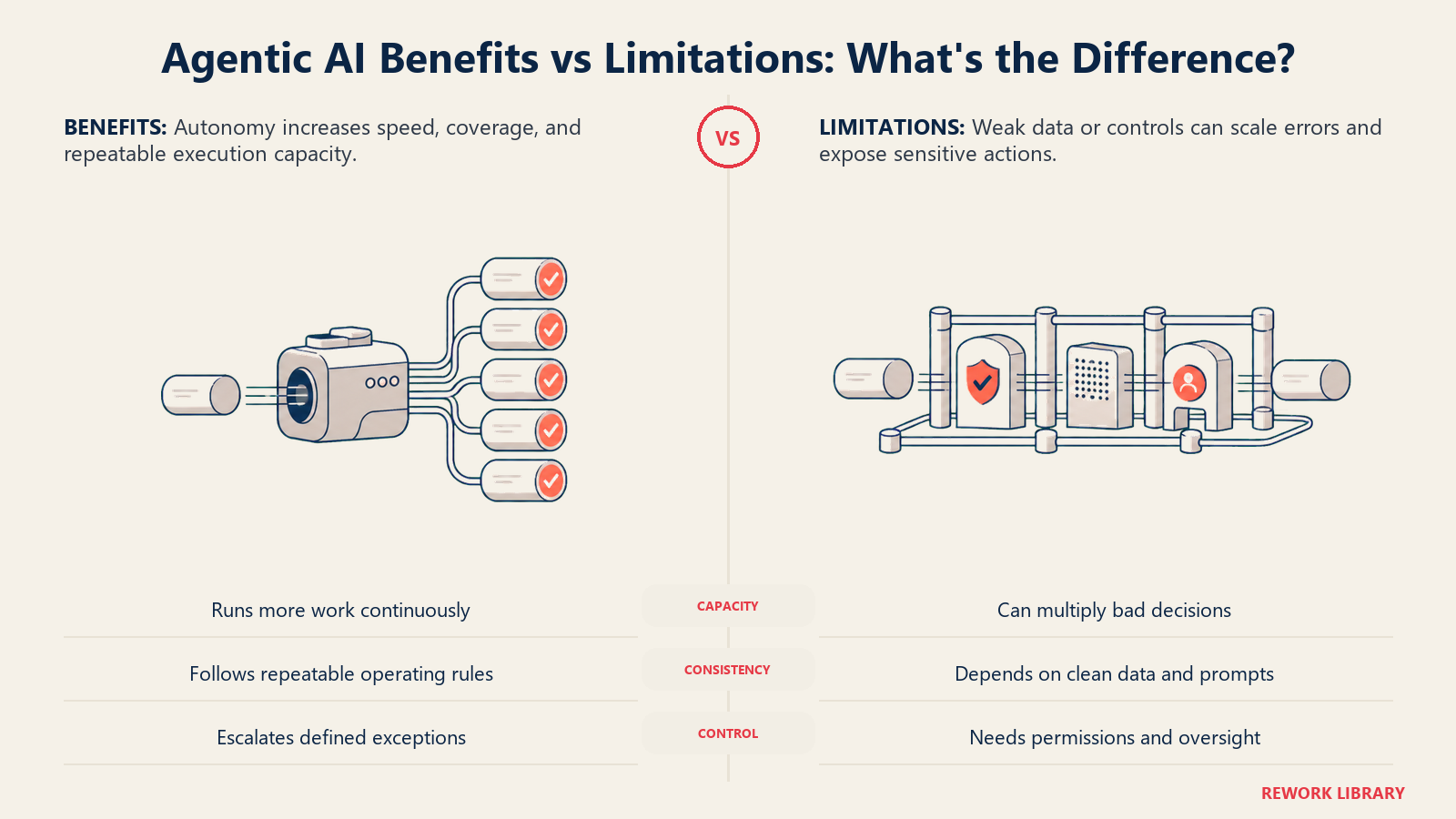
Agentic AI can accelerate multi-step work, but greater autonomy also increases the need for clear guardrails and human oversight.
Benefits:
- Work happens continuously, not just during business hours or when someone remembers to do it
- Consistency at scale: the hundredth invoice gets checked as carefully as the first
- Multi-step processes that used to take days can complete in minutes or hours
- Frees people for the judgment calls, relationship building, and strategy that software still can't do
Limitations and risks:
- Compounding errors: A small mistake early in a multi-step task can cascade into a wrong outcome by the end, and it's not always obvious where it went wrong.
- Oversight gap: Deloitte's own research found only about one in five companies has a mature governance model for autonomous agents, despite rapid rollout plans (see Key Facts below).
- "Agent washing": Gartner has flagged that many vendors rebrand existing chatbots or RPA as "agentic" without the underlying autonomy, so evaluate what a system actually does, not what it's called.
- Reliability under ambiguity: Agents are strongest on well-scoped tasks with clear success criteria and weaker when the goal itself is fuzzy.
- Cost and complexity: More moving parts, tools, memory, orchestration, mean more to build, monitor, and maintain than a single prompt-and-response system.
Human-in-the-loop design is the main way businesses manage this risk today: agents run autonomously within a scope, and anything outside that scope routes to a person.
How to Get Started with Agentic AI
- Pick one narrow, high-volume, well-defined task first. Lead qualification, invoice matching, and support ticket triage are common starting points because success looks the same every time.
- Define the guardrails before the agent goes live. What can it decide alone, and what must always go to a human? Write this down, don't leave it implicit.
- Start with human-in-the-loop, not full autonomy. Have the agent draft or recommend first, then earn more independence as accuracy proves out.
- Instrument everything. You need visibility into what the agent decided and why, not just the end result, especially while you're still building trust in it.
- Set an explicit governance owner. Someone needs to be accountable for what the agent is allowed to touch, long before it's touching anything critical. A written governance framework is a useful starting structure.
- Measure before you scale. Confirm time saved, error rate, and escalation rate on the first use case before adding a second one.
Key Facts
- 33% of enterprise software applications will include agentic AI by 2028, up from less than 1% in 2024. Gartner
- Over 40% of agentic AI projects will be canceled by the end of 2027 due to escalating costs, unclear business value, or inadequate risk controls. Gartner
- 25% of companies already using generative AI planned to launch agentic AI pilots or proofs of concept in 2025, a share Deloitte expects to reach 50% by 2027. Deloitte
- 23% of organizations report they're scaling an agentic AI system somewhere in the enterprise, and another 39% are experimenting with AI agents, per McKinsey's 2025 global AI survey. McKinsey
- Only 16% of enterprise AI deployments qualify as true agents (systems that plan, execute, observe feedback, and adapt); most are still fixed-sequence workflows. Menlo Ventures
- Within enterprise horizontal AI spending, agent platforms captured just $750 million in 2025 (about 10% of that category), while simpler AI copilots captured $7.2 billion (86%), a sign of how early true agent adoption still is. Menlo Ventures
- AI agents jumped from 12% to roughly 66% task success on the OSWorld computer-use benchmark, one of the sharpest capability gains Stanford's index tracked. Stanford HAI AI Index 2026
Frequently Asked Questions about Agentic AI
What is agentic AI in simple terms?
Agentic AI is software that can pursue a goal on its own: it figures out the steps, uses tools and data to carry them out, and only asks for help when a decision falls outside what it's allowed to do. It's closer to a digital employee than a chat window.
How is agentic AI different from generative AI?
Generative AI responds to a single prompt and produces text, code, or images for a person to use. Agentic AI takes a goal, breaks it into steps, and executes those steps across multiple systems on its own, often using generative AI as its reasoning engine along the way.
How is agentic AI different from RPA (robotic process automation)?
RPA follows a fixed script and breaks when the process changes. Agentic AI reasons about what to do next, so it can adapt to variations, missing data, or unexpected situations that would stop a traditional bot in its tracks.
Is agentic AI the same as an AI agent?
They're closely related. An "AI agent" usually refers to a single autonomous system built around one goal. "Agentic AI" is the broader term for the approach, autonomous, goal-directed, tool-using AI, which can involve one agent or several working together.
What are the main components of an agentic AI system?
A reasoning core (usually a large language model), tools it can call to take action, memory to track context across steps, and an orchestration layer that sequences everything and enforces guardrails.
What is the Model Context Protocol and how does it relate to agentic AI?
MCP is an open standard that lets AI agents connect to external tools and data sources in a consistent way, instead of custom integration code for every system. It's one of the reasons agentic AI became easier to build and deploy through 2025 and 2026.
What are the biggest risks of agentic AI?
Errors compounding across multi-step tasks, weak governance (most companies still lack a mature oversight model), vendors overselling "agentic" capability that isn't really there, and lower reliability on ambiguous, poorly scoped goals.
How much autonomy should an agentic AI system have?
Start narrow. Give the agent full autonomy only on well-defined, low-risk tasks, and route anything ambiguous or high-stakes to a human. Expand its scope gradually as accuracy and trust are demonstrated, not all at once.
What's a good first use case for agentic AI?
Pick something high-volume, repetitive, and easy to judge as right or wrong, like lead qualification, invoice matching, or support ticket triage. Clear success criteria make it much easier to trust and measure the agent's output.
Related AI Concepts
- AI Agents - The autonomous systems that power agentic AI
- Agentic Workflows - How agentic AI handles multi-step business processes end to end
- AI Copilots - The collaborative counterpart to autonomous agents
- What is an AI Agent? - A deeper look at single-agent architecture
External Resources
- Gartner: Agentic AI Project Cancellations - Adoption forecasts and project failure risk
- McKinsey: The State of AI - Global survey on enterprise AI and agent adoption
- Deloitte: Autonomous Generative AI Agents - Predictions on agentic AI pilot growth
- Menlo Ventures: State of Generative AI in the Enterprise - Enterprise spending and true-agent deployment data
- Stanford HAI: AI Index Report - Benchmark performance and adoption trends
Part of the AI Terms Collection. Last updated: 2026-07-16

Co-Founder, Rework.com