What is an AI Detector?
Turn this article into takeaways for your work.


Each assistant summarizes the article only for you and suggests best practices for your work.
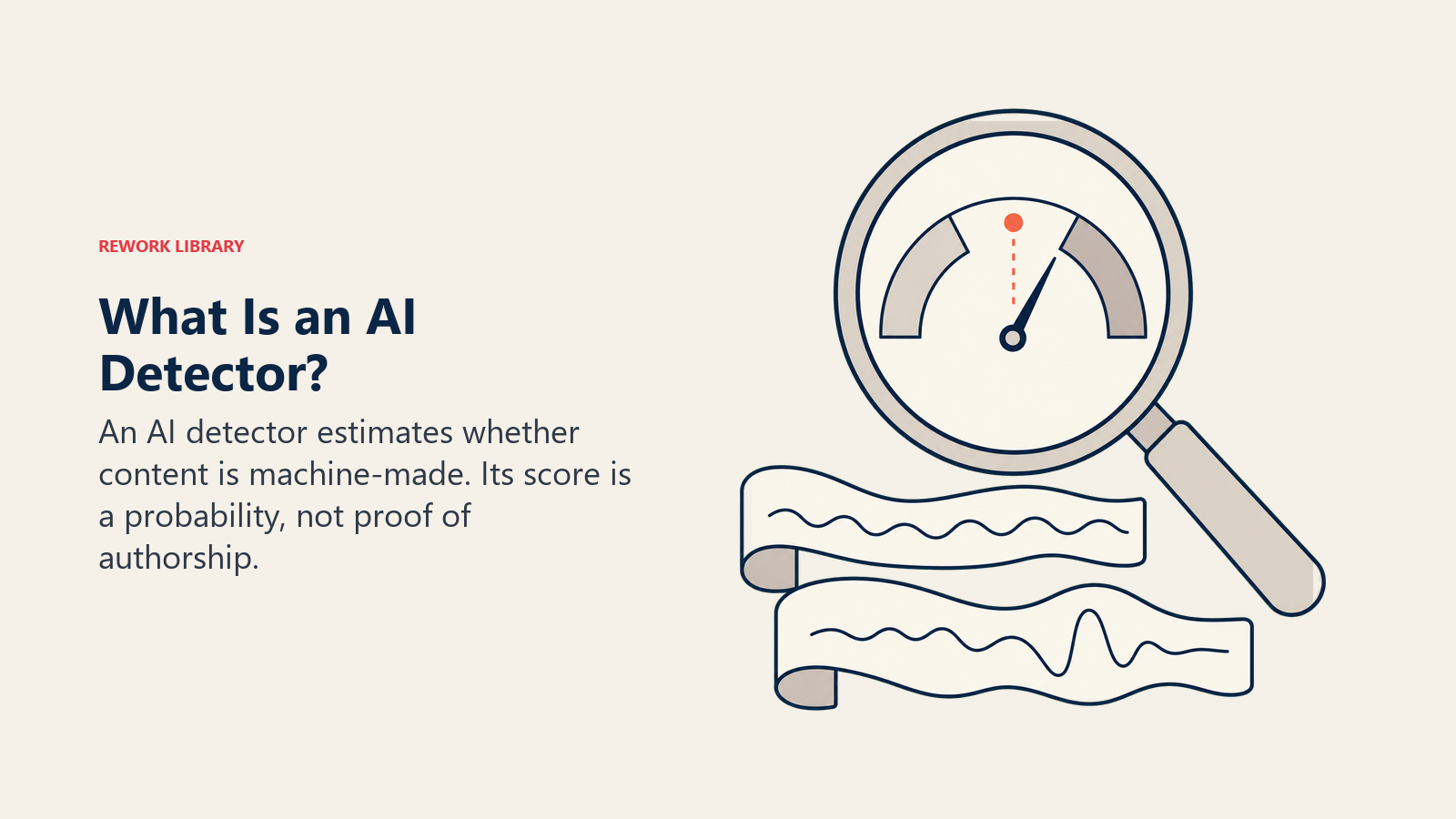
An AI detector is a tool that analyzes text, images, or audio and estimates the probability that it was generated by artificial intelligence rather than a human. It works by scoring patterns like word predictability and sentence variation, then returns a percentage or a human-vs-AI verdict. It's a probability guess, not a certainty check.
That last part matters more than most people realize. Teachers use AI detectors to screen student essays. HR teams run them on cover letters. Publishers scan submissions before they hit an editor's desk. In every case, the tool spits out a confident-looking number, 12% AI, 87% AI, and the person reading it treats that number like a fact. It isn't one. It's a statistical guess built on patterns that can be wrong in both directions: flagging real human writing as machine-made, and missing AI text that's been lightly edited.
How AI Detectors Work
Most text-based AI detectors rely on two core signals, sometimes combined with a trained classifier model.
Perplexity measures how predictable a piece of text is to a language model. AI-generated text tends to pick the statistically "safest" next word most of the time, so it reads as low-perplexity, smooth and expected. Human writing is messier. People use unusual word choices, awkward phrasing, and idiosyncratic structure, which raises perplexity. A detector that sees consistently low perplexity across a document flags it as likely AI-written.
Burstiness looks at variation in sentence length and structure across a document. Human writers naturally alternate between short punchy sentences and long winding ones. AI output, especially from earlier models, tends toward more uniform sentence rhythm. Low burstiness (everything feels the same length and shape) is treated as another AI signal.
Beyond these two signals, most commercial tools (Turnitin, GPTZero, Originality.ai, Copyleaks) layer a trained classifier model on top: a neural network fine-tuned on large sets of known human text and known AI text, learning to separate the two based on hundreds of subtle features a human reader would never consciously notice. Image and video detectors work differently, looking for compression artifacts, inconsistent lighting or reflections, and metadata traces left behind by generation tools, though many of those signals disappear once an image is re-saved or lightly edited.
None of these methods read intent, verify authorship, or check a revision history. They estimate probability from statistical fingerprints, and that's the root of the reliability problem.
Why AI Detectors Are Unreliable
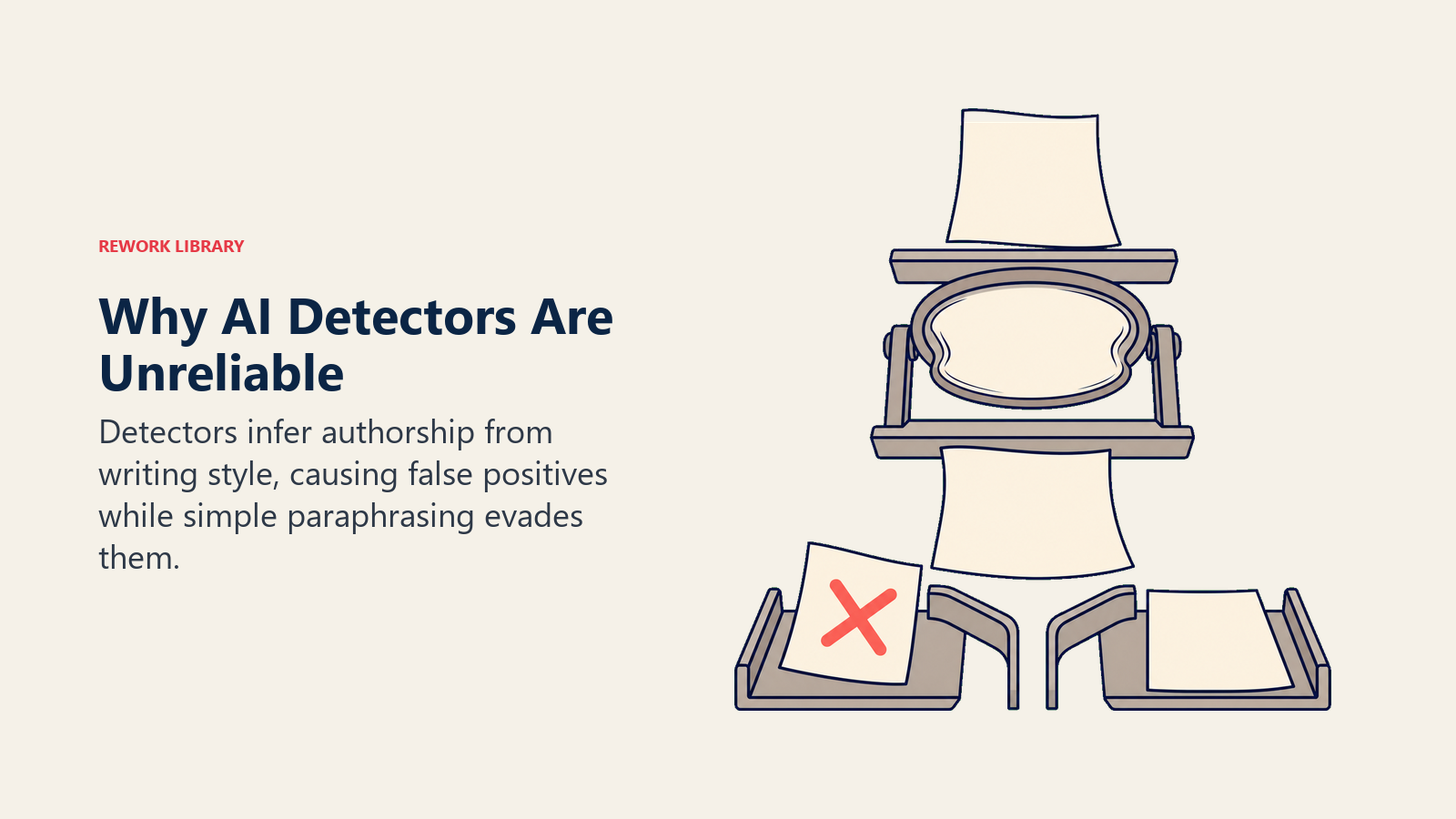
The core issue is that perplexity and burstiness aren't unique to AI. They're proxies, and proxies break down at the edges. Two groups get hit hardest by false positives, and one editing habit defeats detection almost entirely.
Key Facts: AI Detector Accuracy
- A Stanford study run against 91 TOEFL essays from non-native English speakers found 7 commercial detectors flagged them as AI-written 61.3% of the time on average, versus about 5.1% for essays from native English speakers (arXiv, Liang et al., 2023)
- A peer-reviewed test of 14 AI-text detectors, including Turnitin, found none reached 80% accuracy and only 5 topped 70%, with a systematic bias toward calling AI text "human-written" (Weber-Wulff et al., International Journal for Educational Integrity, 2023)
- Simple automated paraphrasing dropped one detector's accuracy from 70.3% to 4.6% and also evaded GPTZero and OpenAI's own classifier (Krishna et al., NeurIPS 2023)
False positives hit non-native English writers disproportionately. Because non-native writers often use simpler vocabulary and more repetitive sentence structure (the same features that produce low perplexity and low burstiness), detectors mistake careful, plain English for machine output. This isn't a fringe edge case. It's a documented, structural bias built into how the scoring works.
False positives also hit formulaic writing more broadly. Legal disclaimers, technical documentation, résumés, and anything written to a template naturally reads as more predictable and uniform, the exact pattern detectors are trained to flag.
Evasion is trivial and getting easier. Running AI-generated text through a paraphrasing tool, or asking a second AI model to "rewrite this more casually," reliably breaks perplexity- and burstiness-based detection. Researchers built a paraphrasing model specifically to test this and found it collapsed detection accuracy across multiple tools at once, watermarking included. Anyone motivated to hide AI use can do it in under a minute with free tools.
Put together, an AI detector can be simultaneously too aggressive (flagging honest human writers) and too easy to fool (missing AI text that's had a light edit pass). Those aren't two separate problems; they're two symptoms of the same underlying weakness: the tools measure style, not authorship.
The Accuracy Reality Check
Vendor marketing pages and independent testing tell two different stories, and the gap is wide enough that it should change how you use these tools.
OpenAI built and shipped its own AI text classifier in January 2023, then pulled it six months later, in July 2023, citing a "low rate of accuracy." At launch, the tool correctly identified AI-written text only 26% of the time, meaning it missed roughly three out of every four AI-generated samples it was tested against (OpenAI). If the company that trained the underlying models couldn't build a reliable detector for its own output, that's a strong signal about the ceiling on this technology.
Real-world testing backs that up. When Washington Post reporter Geoffrey Fowler ran a mix of human-written and AI-assisted student essays through Turnitin's detector, the tool misclassified more than half of the samples, including flagging a fully human-written essay as partly AI-generated (Washington Post, 2023). Turnitin itself reports a document-level false-positive rate under 1%, but has separately acknowledged a sentence-level error rate closer to 4% (a vendor-reported figure worth reading alongside the independent test) (Turnitin).
The takeaway isn't that every detector is worthless. It's that a single score, from any tool, isn't strong enough evidence to act on by itself, especially when the consequence is an accusation of cheating, plagiarism, or dishonesty.
Popular AI Detectors, Briefly
Four tools dominate the category. Each markets high accuracy; each has a documented gap between marketing and independent results.
| Detector | Primary Use | Vendor Claim | Honest Caveat |
|---|---|---|---|
| Turnitin | Academic integrity, education | Under 1% false positives at document level (Turnitin) | Independent testing found it misclassifying over half of a sample set; sentence-level errors run closer to 4% by Turnitin's own account |
| GPTZero | Education, general text | 99% accuracy on its own marketing pages (GPTZero) | Vendor claims fall in the same category as every other tool here: self-reported, not independently reproduced at that rate |
| Originality.ai | Content marketing, publishing | 99% accuracy on recent models (Originality.ai) | The company's own guidance says to "use AI detection as one signal, not a final decision," which is the right way to treat any tool in this category |
| Copyleaks | Enterprise, education, plagiarism plus AI | Markets accuracy in the same high range as competitors | No independently verified figure from a named, resolving source was available; treat vendor claims here the same way |
Every vendor in this space claims high-90s accuracy. Every peer-reviewed and journalistic test of these tools has found real-world performance well below that, particularly on paraphrased text, non-native English, and mixed human-AI documents. That gap is the single most important thing to know before you trust a detector's output.
Business and Education Use, and the Risk
Companies and schools reach for AI detectors for understandable reasons: protecting academic integrity, verifying that a candidate's writing sample is their own, checking that outsourced content wasn't mass-produced by AI with no review. The risk isn't in wanting that assurance. It's in treating a detector's percentage as proof.
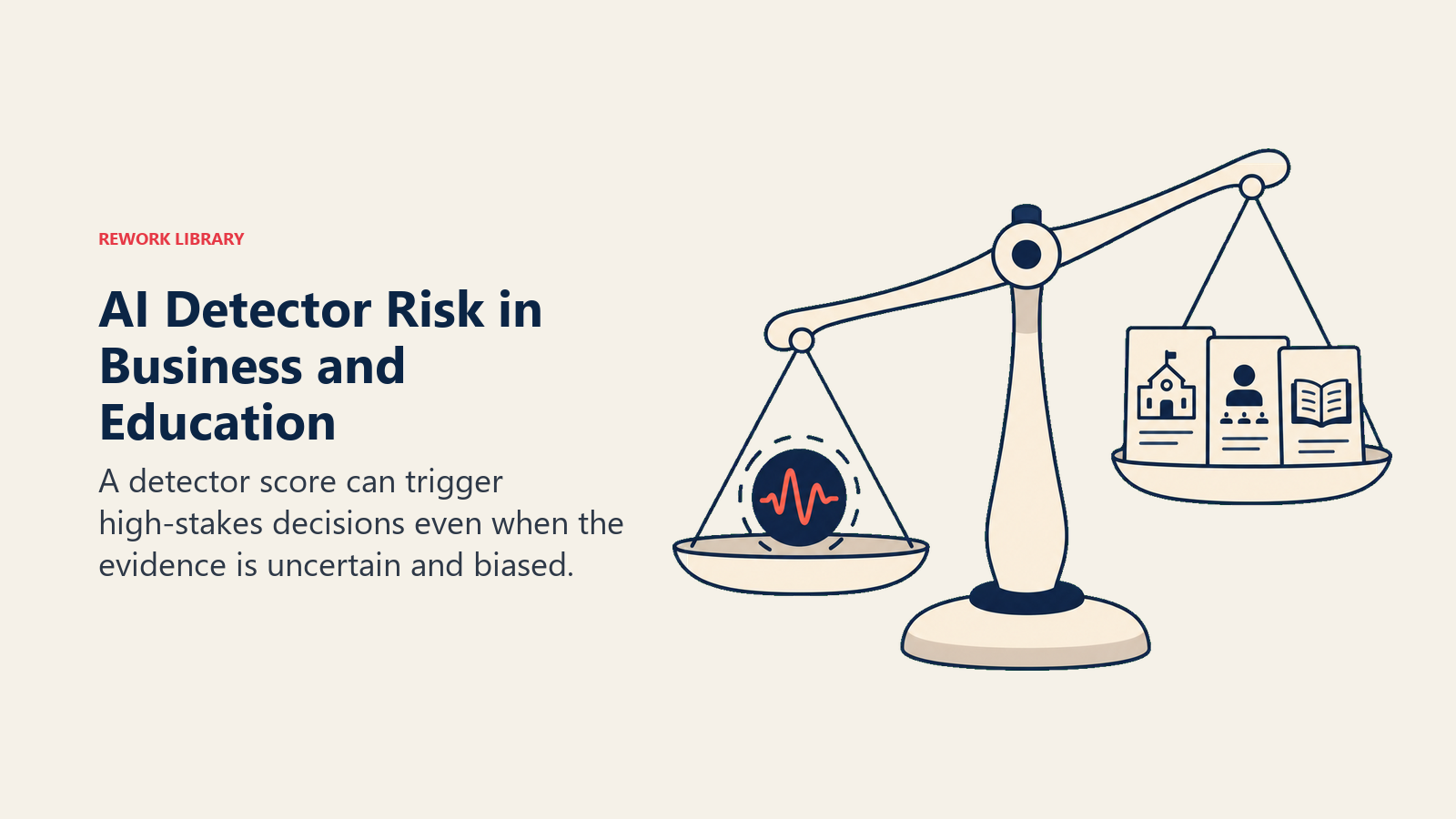
A student accused of cheating based on a flagged essay, a job candidate rejected because a cover letter "scored" as AI-written, a freelance writer penalized for a flagged article: each of these is a real decision with real consequences, made on a tool that independent research shows gets it wrong at meaningful rates, and gets it wrong more often for non-native English speakers specifically. That's a fairness and governance problem, not just a technical one, and it overlaps with the same bias issues that show up across AI systems more broadly.
There's a related, quieter risk on the other side: relying on detectors to guarantee that published or purchased content is genuinely AI-free. Given how easily paraphrasing defeats detection, a passing score doesn't mean a document is human-written. It just means it wasn't caught. Businesses worried about low-effort, mass-produced content (what's increasingly called AI slop) need a broader quality process, not a single scanning tool, to catch it.
Best-Practice Guidance
If your organization uses AI detectors, a few practices reduce the risk of acting on a wrong call.
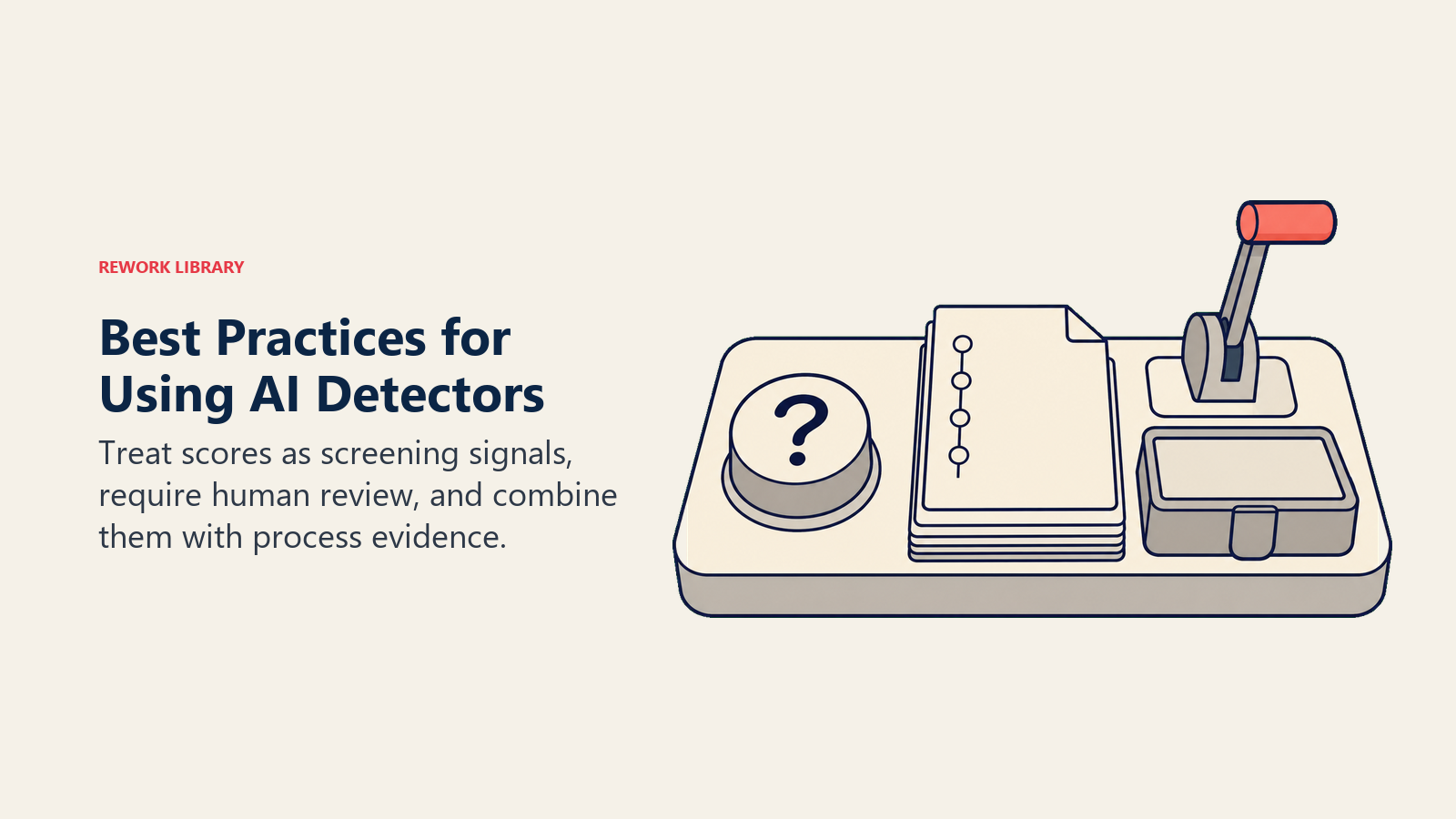
- Never treat a detector score as a verdict on its own. Use it as one input alongside process evidence like draft history, version control timestamps, or a conversation with the writer.
- Build in a human-in-the-loop review step before any punitive action, whether that's a failing grade, a rejected candidate, or a content payment dispute. A person should look at the specific flagged passage, not just the summary score.
- Expect higher false-positive rates for non-native English writers and factor that into how confident you are in a flag before escalating it.
- Disclose your policy up front rather than scanning silently after the fact. Clear rules about acceptable AI assistance, similar to the transparency principles in prompt engineering guidance, reduce disputes because expectations are set before anyone submits work.
- Don't rely on a passing score to certify content as human-written. Combine detection with editorial review, especially for anything published under your brand, since detectors are trivial to evade with light paraphrasing.
- Re-check your vendor's claims against independent testing periodically. Detector accuracy shifts as underlying language models change; a tool that performed well against GPT-3.5 output may perform differently against newer models, and vice versa.
The pattern across every study cited here is consistent: AI detectors are useful as a screening signal and unreliable as a final judgment. Treat the output the way you'd treat a spam filter flag, worth a second look, never proof on its own.
Learn More
Explore related AI concepts to deepen your understanding:
- What is AI Slop?: the low-quality, mass-produced content problem detectors are often mistakenly asked to solve
- AI Hallucination: another case where confident AI output doesn't match reality
- Bias in AI: the broader pattern behind detectors' non-native English false positives
- AI Governance: policy frameworks for using AI tools, including detectors, fairly
- Natural Language Processing: the underlying field that makes both AI writing and AI detection possible
- Large Language Models (LLMs): the models detectors are built to spot
- Best AI Writing Tools in 2026: the tools on the other side of the detection problem
External Resources
- GPT Detectors Are Biased Against Non-Native English Writers - the Stanford study on false-positive bias
- Testing of Detection Tools for AI-Generated Text - the peer-reviewed 14-detector accuracy study
- OpenAI: New AI Classifier for Indicating AI-Written Text - OpenAI's own announcement and later retirement of its classifier
Frequently Asked Questions about AI Detectors
What is an AI detector?
An AI detector is a tool that scores text, images, or audio and estimates the likelihood it was generated by artificial intelligence, using signals like word predictability, sentence variation, and trained classifier models. It produces a probability, not a definitive proof of authorship.
What is the best AI detector?
There isn't a single best AI detector. Independent testing consistently shows that even the tools rated highest in comparisons still miss a meaningful share of AI text or falsely flag human writing, so any single tool's score should be treated as a signal, not a final answer.
What is the most accurate AI detector?
No detector matches the near-100% accuracy vendors advertise. A peer-reviewed test of 14 detectors found none reached 80% accuracy, and paraphrasing tools can push even the strongest detectors' accuracy down to single digits on edited text.
Can AI detectors give false positives on human writing?
Yes, regularly. Formulaic, plain, or highly structured human writing can score as AI-generated because it shares the low-variation patterns detectors look for. This effect is documented to hit non-native English writers especially hard.
Are AI detectors biased against non-native English speakers?
Yes. A Stanford study found detectors flagged non-native English TOEFL essays as AI-written about 61% of the time on average, compared with roughly 5% for native English essays, because simpler vocabulary and repetitive structure trigger the same signals as AI text.
Can someone bypass an AI detector?
Yes, easily. Paraphrasing AI-generated text, whether by hand or with another AI tool, reliably defeats perplexity- and burstiness-based detection. Research has shown this technique collapsing detection accuracy across multiple major tools at once.
Should a business rely on an AI detector score to make a hiring or content decision?
No, not on its own. Given documented false-positive rates and how easily detection is evaded, a detector score should feed into a human review process alongside other evidence, not stand alone as the basis for rejecting a candidate or penalizing a writer.
How do AI detectors actually work?
Most combine perplexity (how predictable the word choices are), burstiness (how much sentence length and structure vary), and a trained classifier model that has learned statistical differences between large sets of human and AI text. None of these methods verify authorship directly.
Part of the AI Terms Collection. Updated July 2026.
