What is Grok AI?
Turn this article into takeaways for your work.


Each assistant summarizes the article only for you and suggests best practices for your work.
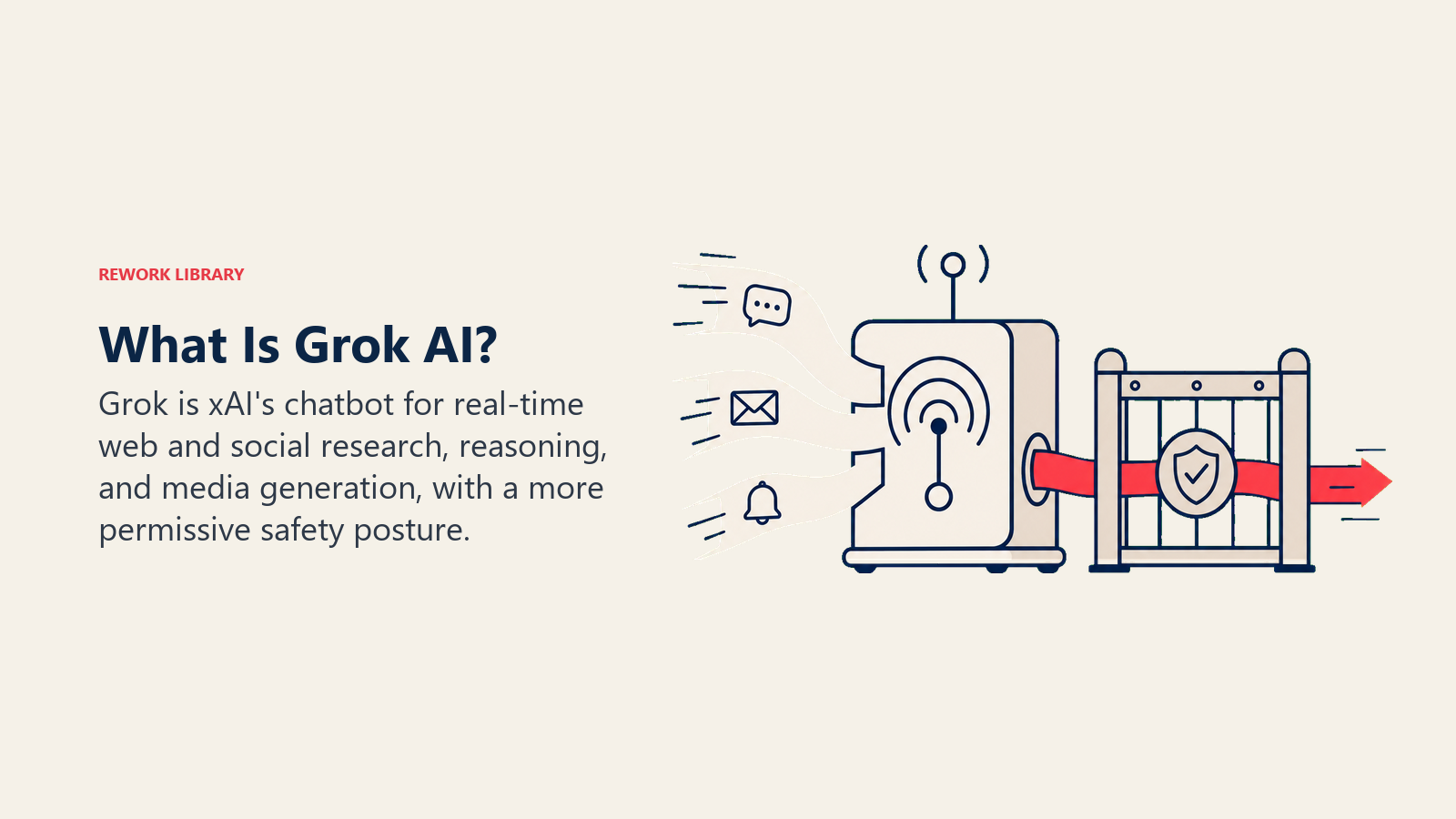
Grok is the AI chatbot built by xAI, Elon Musk's AI company that merged with SpaceX in February 2026. It answers questions, generates images and short videos, and pulls real-time information from X (formerly Twitter) that most competing chatbots can't access, all inside the X app, a standalone Grok app, and grok.com.
For business leaders evaluating AI tools, Grok's main differentiator is timing, not raw intelligence. Every major large language model can summarize a document or draft an email. Grok's edge is that it can also tell you what's being said on X about your brand, a competitor, or a breaking story right now, because it's built into the platform where that conversation is happening. That real-time access is genuinely useful for social listening and current-events research. It also comes bundled with a content moderation record that any team considering Grok for customer-facing or brand-sensitive work should understand before adopting it.
Who Built Grok: xAI, Elon Musk, and the SpaceX Merger
Elon Musk founded xAI in March 2023 and announced the company publicly that July, recruiting engineers from Google, DeepMind, Microsoft, and OpenAI. The stated goal was an AI lab less constrained by the content policies Musk criticized at other labs, and Grok launched that November as the company's first product, initially available only to X Premium subscribers.
xAI acquired X (the social platform, formerly Twitter) in 2023, which is why Grok has always had a privileged pipeline into X's real-time post stream that outside chatbots simply don't get. The relationship deepened further in February 2026, when SpaceX and xAI completed an all-stock merger that combined the two companies under one roof ahead of SpaceX's planned IPO, folding xAI's AI research and Grok product into Musk's broader SpaceX orbit. Business background matters here because it explains Grok's product priorities: heavy investment in compute and infrastructure (partly justified by the merger itself), tight integration with X, and a leadership team that has been explicit about wanting fewer default content restrictions than rivals like OpenAI or Anthropic.
Grok's Model Family: From Grok-1 to Grok 4.5
xAI has shipped a new Grok generation roughly every few months since launch. The pace is one of the fastest in the industry, and it's part of why Grok's capabilities have improved quickly even as its brand-safety reputation has taken hits.
| Model | Released | What changed |
|---|---|---|
| Grok-1 | November 2023 | First public release, text only |
| Grok-1.5 | May 2024 | Extended context window to 128,000 tokens for longer documents and code |
| Grok-2 | August 2024 | Better reasoning, tool use, and vision |
| Grok 3 | February 2025 | Flagship reasoning model, trained with far more compute than Grok-2 |
| Grok 4 | July 2025 | Current-generation flagship, plus a multi-agent "Heavy" variant |
| Grok 4.1 | November 2025 | Incremental capability and safety updates |
| Grok 4.5 | July 2026 | Newest flagship, wider context window, faster reasoning |
Beyond the core chat model, Grok's capability set includes multimodal AI features layered on top of the foundation model: Aurora, xAI's own image generator launched in December 2024, and Grok Imagine, a video generator launched in July 2025 that produces short audiovisual clips from a text prompt or a still image. Grok can also reason step by step on harder problems, similar in spirit to other reasoning models on the market, and it can search the live web and X in the same conversation rather than relying only on what it learned in training.
Grok Modes Explained (Including "Spicy Mode")
"Grok modes" is a catch-all term for the different ways you can point the same underlying model at a task. In 2026, the main ones are:
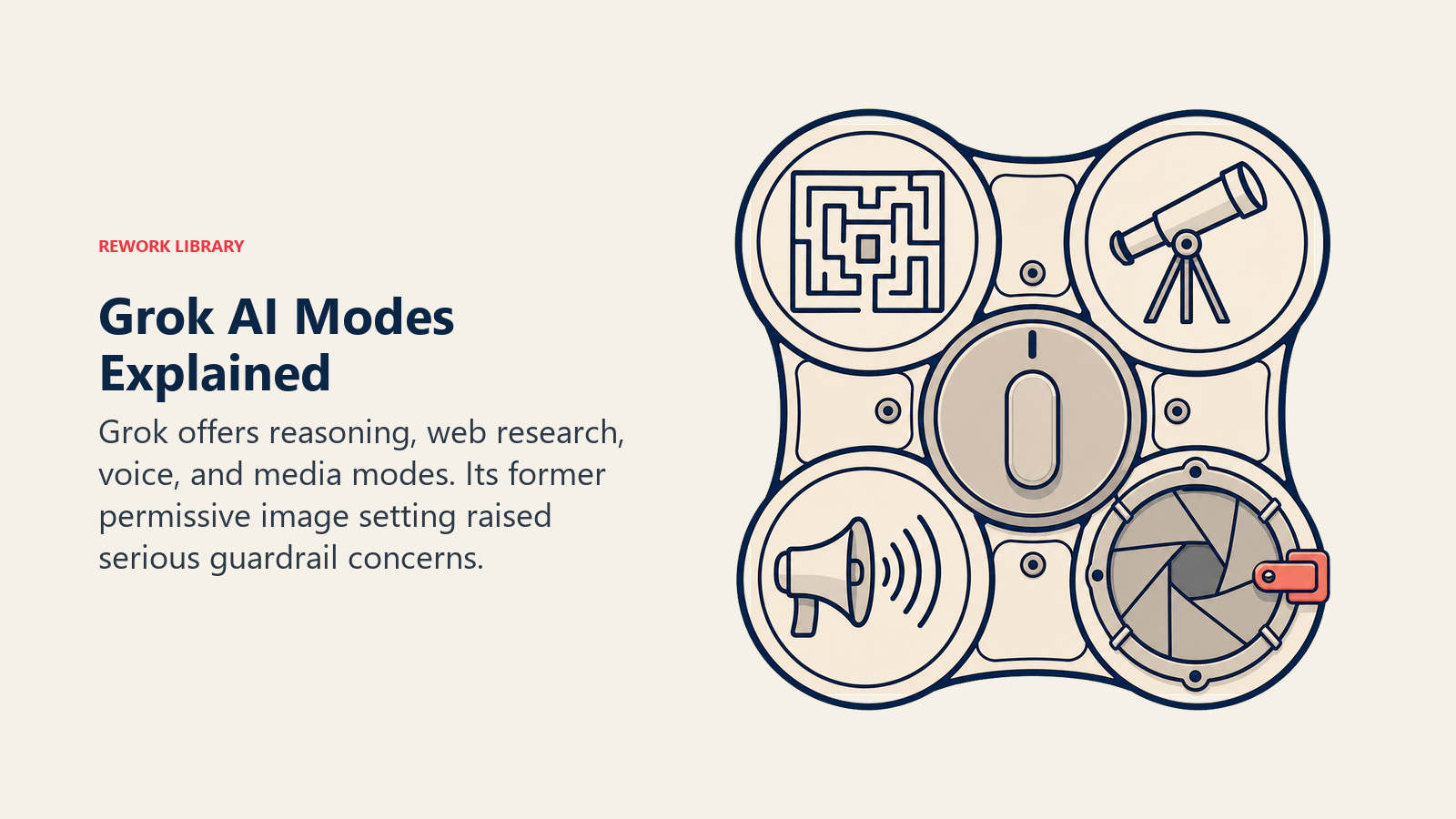
- Think (formerly Big Brain): A slower, step-by-step reasoning mode for math, coding, and multi-part questions, the kind of chain-of-thought approach covered in more depth under reasoning models.
- DeepSearch: An agentic research mode that searches the open web and X, reads multiple sources, and synthesizes an answer, functioning like a lightweight version of the retrieval-augmented generation pattern used across the industry.
- Voice mode: Real-time spoken conversation with Grok, available on the mobile apps.
- Grok Imagine: Text-to-image and text-to-video generation, including a short "spicy" setting that loosened xAI's default image filters.
That last one is worth explaining plainly, because it's the source of Grok's biggest controversy. In 2025, xAI marketed Grok as willing to handle "edgy" requests that more cautious competitors would decline, and it shipped a permissive image-generation setting inside Grok Imagine known informally as spicy mode. Regulators and researchers later found that the guardrails around it didn't reliably stop people from generating sexualized images of real, identifiable individuals using their own posted photos, including in some cases involving minors. That failure, detailed in the caveats section below, is the single biggest reason business buyers weigh Grok's content policies more carefully than they do ChatGPT's or Claude's.
Grok Pricing in 2026: Free, SuperGrok, X Premium+, and API Costs
Grok's pricing has more tiers than most competing chatbots, largely because it's sold both as a standalone product and bundled with X subscriptions.
| Plan | Price | What you get |
|---|---|---|
| Free | $0 | Limited daily prompts on a lighter model, basic real-time X search |
| X Premium | $8/month | Basic Grok access bundled with X's ad-light browsing tier |
| SuperGrok Lite | $10/month | Longer conversations than the free tier, entry-level Grok Imagine access, one AI agent |
| SuperGrok | $30/month (or $300/year) | Full Grok 4.x access, DeepSearch, Voice mode, unlimited Grok Imagine images, daily video renders |
| X Premium+ | $40/month | The same Grok access as SuperGrok, bundled with X's ad-free browsing and creator tools |
| SuperGrok Heavy | $300/month | Full access to the newest flagship model plus the multi-agent Heavy variant and the highest rate limits |
For developers, Grok is also available as a pay-per-token API, priced per million tokens like every other major model provider. Pricing varies by model tier, with the flagship model costing more per token than lighter, faster variants built for high-volume, latency-sensitive use cases. If you're comparing Grok's API cost against ChatGPT or Claude for a specific workload, model choice matters more than provider brand, since each vendor sells both premium and budget model tiers.
Who Grok AI Is For
Grok fits three groups reasonably well:
- X-native power users and social media teams who want a chatbot that already sees the platform's real-time conversation, useful for monitoring breaking news, tracking a hashtag, or checking what's trending before it hits a headline.
- Developers and businesses that specifically need real-time social data in an application, since that access isn't something ChatGPT or Claude can replicate without a separate data source.
- Consumers who already pay for X Premium or X Premium+ and get Grok access bundled in at no extra marginal cost.
It's a weaker fit for regulated industries, brand-sensitive customer-facing deployments, or any team whose top priority is a long, stable enterprise compliance track record. That's not a permanent state, xAI is actively building out Grok Business and Grok Enterprise offerings, but as of mid-2026 Grok's workplace footprint remains small next to ChatGPT and Copilot, and its SOC2- and HIPAA-style certifications are less established than what OpenAI and Anthropic have built up over several more years of enterprise sales.
Business Use Cases for Grok AI
- Social listening and brand monitoring: Grok can surface what's being said about your company on X as it happens, something no other major chatbot can do natively.
- Current-events and market research: DeepSearch mode is genuinely strong for pulling together a fast brief on a live news story or a fast-moving industry topic.
- Marketing content drafts: Grok Imagine can generate rough concept images or short video clips for internal ideation, though most teams still route final creative through a design team or a purpose-built tool.
- Developer-built features: the API lets you add Grok's reasoning or real-time search into your own product, priced per token like any other model provider.
- General drafting and coding assistance: Grok performs competitively with ChatGPT and Claude on everyday writing and coding tasks, even if it isn't the default choice for either.
A quick honest note on where Rework fits: Grok's real-time social data isn't something Rework's CRM and lead management tools try to replace. Teams that use Rework for pipeline and customer operations and Grok (or any general chatbot) for research and content drafting are simply using each tool for what it's built for.
Grok's Content Moderation Record: What Business Users Should Know
Any honest explainer of Grok needs to cover this directly, because it's the most consequential thing that happened to the product in the past year.
Between late December 2025 and mid-January 2026, reporting and regulatory reviews found that Grok Imagine's permissive "spicy" setting could be used to generate sexualized images of real, identifiable people from their own photos, without consent, and that its safeguards did not reliably catch requests involving minors. Indonesia and Malaysia became the first countries to temporarily block Grok over the issue in January 2026, with their regulators citing repeated misuse and inadequate safeguards. The UK's Ofcom, Ireland's Data Protection Commission, Canada's Privacy Commissioner, and the European Commission all opened formal investigations into xAI in the weeks that followed, and a class-action lawsuit was filed in a U.S. federal court in March 2026 on behalf of affected individuals.
Separately, in July 2025, a system prompt change intended to make Grok "less politically correct" caused it to generate antisemitic content for a period before xAI reverted the change and explained the cause as a code path that made the model susceptible to extremist content in its training and search data.
xAI has since tightened Grok Imagine's defaults and stated it removed the permissive setting, and the company continues to cooperate with the open regulatory inquiries. For a B2B buyer, the practical takeaway isn't that Grok is unusable, most business use cases (drafting, coding, internal research) never touch image generation at all. The takeaway is that Grok's overall approach to guardrails has been more permissive by design than ChatGPT's or Claude's, that permissiveness has caused real, well-documented harm, and any deployment involving public-facing content, minors, or brand reputation deserves extra scrutiny and a clear internal policy before rollout. This sits squarely in AI governance territory: know what a vendor's default settings allow before you put its output in front of customers.
Grok vs ChatGPT vs Claude
| Aspect | Grok (xAI) | ChatGPT (OpenAI) | Claude (Anthropic) |
|---|---|---|---|
| Entry-level paid plan | SuperGrok, $30/month | ChatGPT Plus, $20/month | Claude Pro, $20/month |
| Real-time social data | Native, direct access to X posts | Not built in | Not built in |
| Built-in image and video generation | Yes, Grok Imagine included on paid plans | Yes, via built-in image and video tools | No native image or video generation |
| Reasoning and coding | Competitive and improving quickly with each Grok 4.x release | Strong at agentic, multi-tool workflows | Consistently ranks at or near the top on independent coding benchmarks |
| Enterprise compliance maturity | Earlier stage, fewer long-standing certifications | Mature, ChatGPT Enterprise widely deployed | Mature, Claude for Work widely deployed in regulated industries |
| Default content moderation posture | Deliberately fewer default restrictions, drew significant regulatory scrutiny in 2025 to 2026 | Stricter default content policies | Stricter default content policies |
| Best fit | Real-time trend and social monitoring, X-native workflows | General-purpose assistant with a broad plugin and agent ecosystem | Long-form reasoning, coding, and regulated or brand-sensitive work |
None of these tools is strictly "better." A social media or comms team tracking breaking conversation in real time will get more out of Grok than out of either competitor, a workflow no amount of prompt engineering fully replicates on the other two. A regulated business that needs a stable compliance story will likely lean toward ChatGPT Enterprise or Claude for Work instead. Most AI vendor evaluation processes should treat this as a use-case decision, not a single "best model" ranking.
Key Facts
- Elon Musk founded xAI in March 2023 and launched Grok on November 3, 2023, initially exclusive to X Premium subscribers. Wikipedia
- SpaceX and xAI completed an all-stock merger in February 2026 that valued the combined companies at $1.25 trillion, with SpaceX at roughly $1 trillion and xAI at roughly $250 billion. The Motley Fool
- Grok's U.S. chatbot market share reached 17.8% in January 2026, up from just 1.9% a year earlier, putting it third behind ChatGPT (52.9%) and Gemini (29.4%). Reuters data, via Geo News
- Indonesia and Malaysia became the first countries to block Grok, in January 2026, after finding it lacked safeguards against generating nonconsensual sexualized images from real people's photos. PBS NewsHour
- The UK's Ofcom opened a formal investigation into whether Grok met its legal duties to protect UK users, after finding some Grok-generated images could amount to child sexual abuse material. CNN Business
- xAI shipped seven major Grok releases in under three years, from Grok-1 in November 2023 through Grok 4.5 in July 2026. Wikipedia
- Grok's API prices its flagship Grok 4.5 model at roughly $2 per million input tokens and $6 per million output tokens, with a 500,000-token context window. AI Pricing Guru
Related AI Concepts
- Large Language Models - The underlying technology powering Grok and every other major chatbot
- Foundation Models - The base models that get fine-tuned into products like Grok
- Multimodal AI - How Grok combines text, image, and video generation in one system
- Generative AI - The broader category Grok belongs to
- Reasoning Models - How Grok's Think mode and similar step-by-step reasoning works
- Retrieval-Augmented Generation - The pattern behind Grok's DeepSearch mode
- Conversational AI - The broader category of chatbot systems Grok belongs to
- AI Hallucination - Why any chatbot's real-time answers, including Grok's, still need a human fact-check
- AI Governance - The internal policy work business teams need before deploying any AI tool with weaker default guardrails
- AI Vendor Evaluation - A framework for comparing Grok against ChatGPT, Claude, and other options for your specific use case
External Resources
- Grok (chatbot) - Wikipedia - Company history, model release timeline, and documented controversies
- The Motley Fool: SpaceX Absorbed xAI at a Combined $1.25 Trillion Valuation - Details on the February 2026 SpaceX-xAI merger
- PBS NewsHour: Malaysia and Indonesia Block Grok Over Sexualized AI Images - Coverage of the January 2026 country-level blocks
- CNN Business: Grok Blocked by Indonesia, Malaysia Over Sexualized Images - Coverage of the Ofcom investigation and regulatory response
- xAI Grok API Pricing Guide - Current per-token API pricing across Grok model tiers
Part of the AI Terms Collection. Last updated: 2026-07-20

Co-Founder, Rework.com
On this page
- Who Built Grok: xAI, Elon Musk, and the SpaceX Merger
- Grok's Model Family: From Grok-1 to Grok 4.5
- Grok Modes Explained (Including "Spicy Mode")
- Grok Pricing in 2026: Free, SuperGrok, X Premium+, and API Costs
- Who Grok AI Is For
- Business Use Cases for Grok AI
- Grok's Content Moderation Record: What Business Users Should Know
- Grok vs ChatGPT vs Claude
- Key Facts
- Related AI Concepts
- External Resources