What is AI Literacy? The Skill Every Employee Now Needs
Turn this article into takeaways for your work.


Each assistant summarizes the article only for you and suggests best practices for your work.
Half your workforce is quietly using AI tools without any training on how they work, where they fail, or when to stop trusting the output. That gap has a name, and as of February 2025, closing it is a legal requirement for any company operating in the EU.
Defining AI Literacy
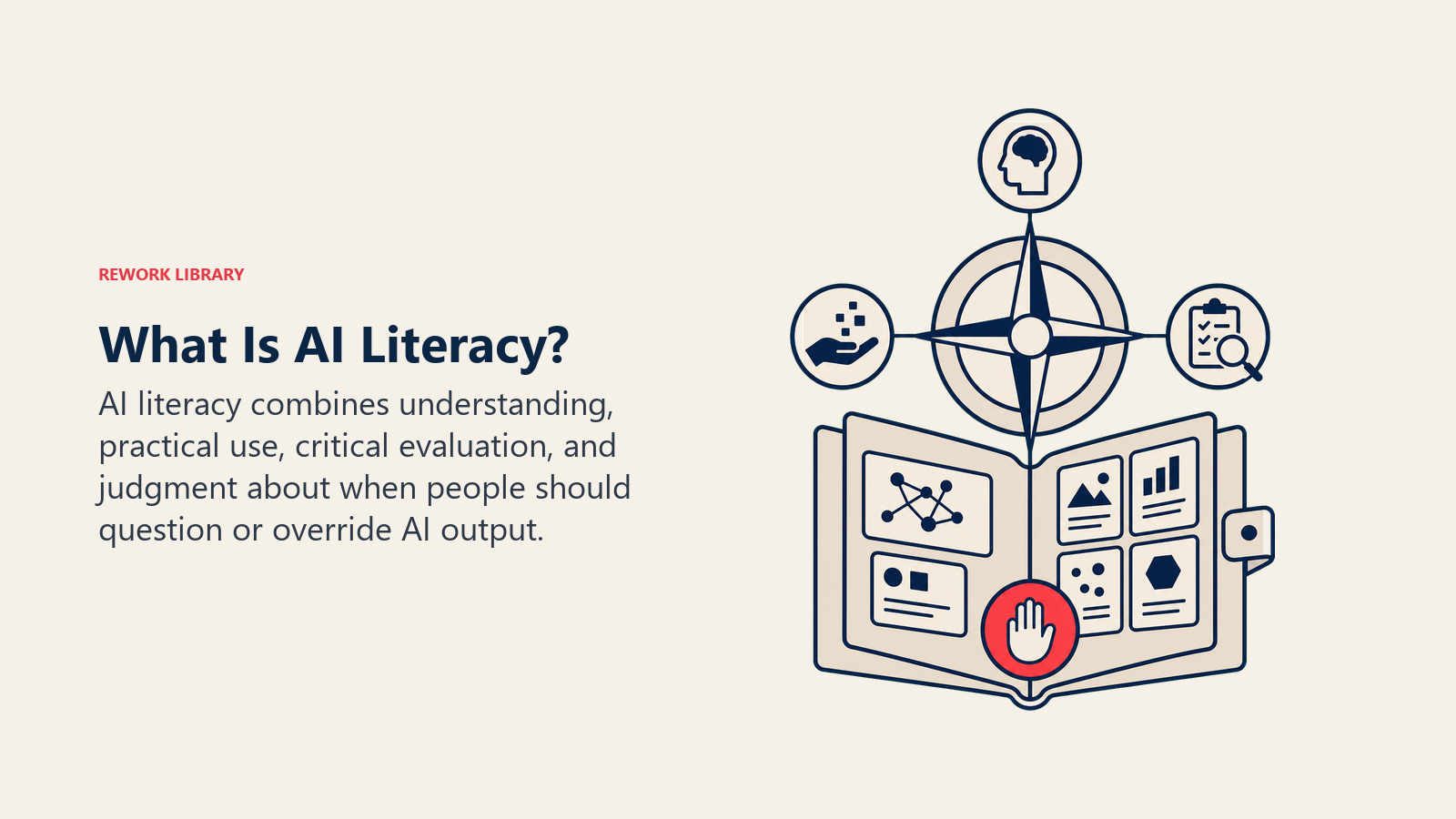
AI literacy is the set of skills, knowledge, and judgment that let someone understand how AI systems work, use them effectively for real tasks, evaluate their outputs for accuracy and bias, and know when to question or override them. It combines practical tool fluency with the critical thinking needed to spot when AI gets things wrong.
That definition matters because AI literacy is not the same as "using ChatGPT." A sales rep who pastes a prompt into a chatbot without checking the output for hallucinated facts is not AI literate. A finance manager who understands why a model might weight biased historical data, and builds a review step around it, is. Literacy is the difference between operating a tool and understanding it.
The Four Components of AI Literacy
Most frameworks (including the European Commission's own guidance under the EU AI Act) break AI literacy into four connected skill areas.
Understand: Knowing what AI systems can and cannot do, in plain terms. This means grasping that a large language model predicts likely text rather than "knows" facts, that a recommendation engine reflects the data it was trained on, and that machine learning systems can be confidently wrong.
Use: Practical fluency with the tools relevant to a person's role, from writing effective instructions (see prompt engineering) to knowing which task types AI handles well versus poorly.
Evaluate: The ability to check AI output against a source, spot fabricated information, and recognize skewed or unfair results before they reach a customer or a decision. This is where awareness of bias and error patterns turns into a habit, not a one-time training module.
Question: Judgment about when NOT to trust or use AI output at all, when to escalate to a human, and when a decision is too consequential to automate. This is the layer that most training programs skip, and it's the one regulators care about most.
None of these four sit in isolation. A support agent who can "use" an AI drafting tool but never "evaluates" the draft against policy is a liability, not an asset.
Why AI Literacy Matters for the 2026 Workforce
The skills gap is not hypothetical. According to LinkedIn's 2025 Skills on the Rise report, AI literacy ranked as the single fastest-growing skill in the United States, with AI-related skill mentions in job postings appearing roughly six times more often than a year earlier. Demand for the skill is outrunning supply.
That mismatch shows up inside companies that have already bought the tools. DataCamp's 2026 State of Data and AI Literacy report, based on a YouGov survey of enterprise leaders, found that 82% of organizations say they offer some form of AI training, yet 59% still report an active AI skills gap. Buying licenses is not the same as building capability, and the data shows most companies are learning that the hard way.
There is a payoff for getting it right. The same DataCamp report found that only 21% of leaders saw significant positive ROI from their AI investments overall, but that figure roughly doubled to 42% among organizations with mature AI and data literacy upskilling programs. Literacy is not a compliance checkbox, it is the difference between AI spend that pays for itself and AI spend that sits unused.
The World Economic Forum's Future of Jobs Report 2025 projects that employers expect 39% of core workforce skills to change by 2030, with AI as the primary driver. Separately, WEF reporting on the "AI perception gap" found that only about 26% of workers say they have received any training on how to actually collaborate with AI day to day, even as adoption of the tools themselves keeps climbing. That combination, rising skill demand and thin training coverage, is exactly the gap AI literacy programs are built to close.
The EU AI Act's Article 4 Obligation
AI literacy stopped being optional the moment the EU AI Act took effect. Article 4 of the Act states that providers and deployers of AI systems "shall take measures to ensure, to their best extent, a sufficient level of AI literacy of their staff and other persons dealing with the operation and use of AI systems on their behalf."
Three details make this obligation different from most compliance line items:
- It applies broadly. Unlike the Act's high-risk system rules, which only cover specific use cases, the AI literacy obligation applies to every organization that provides or deploys any AI system in the EU, regardless of how that system is classified.
- It started early. Article 4 became applicable on February 2, 2025, well before the Act's other major deadlines. National regulators begin enforcing it from August 2, 2026.
- "Staff" is defined broadly too. The European Commission's guidance says the obligation covers not just employees but contractors, service providers, and others operating AI systems on the organization's behalf.
There's no fixed curriculum the Act mandates. Regulators expect literacy measures scaled to a person's role, technical background, and the context in which they use AI, which means a factory floor supervisor using an AI quality-control camera needs different training than a data scientist fine-tuning a model. Ignoring the literacy requirement doesn't carry its own standalone penalty line the way prohibited practices do, but it feeds directly into the broader deployer obligations, which can carry fines up to €15 million or 3% of global turnover for non-compliance.
How Organizations Build AI Literacy
Companies that close the literacy gap tend to follow a similar pattern, whether or not they are directly caught by the EU AI Act.
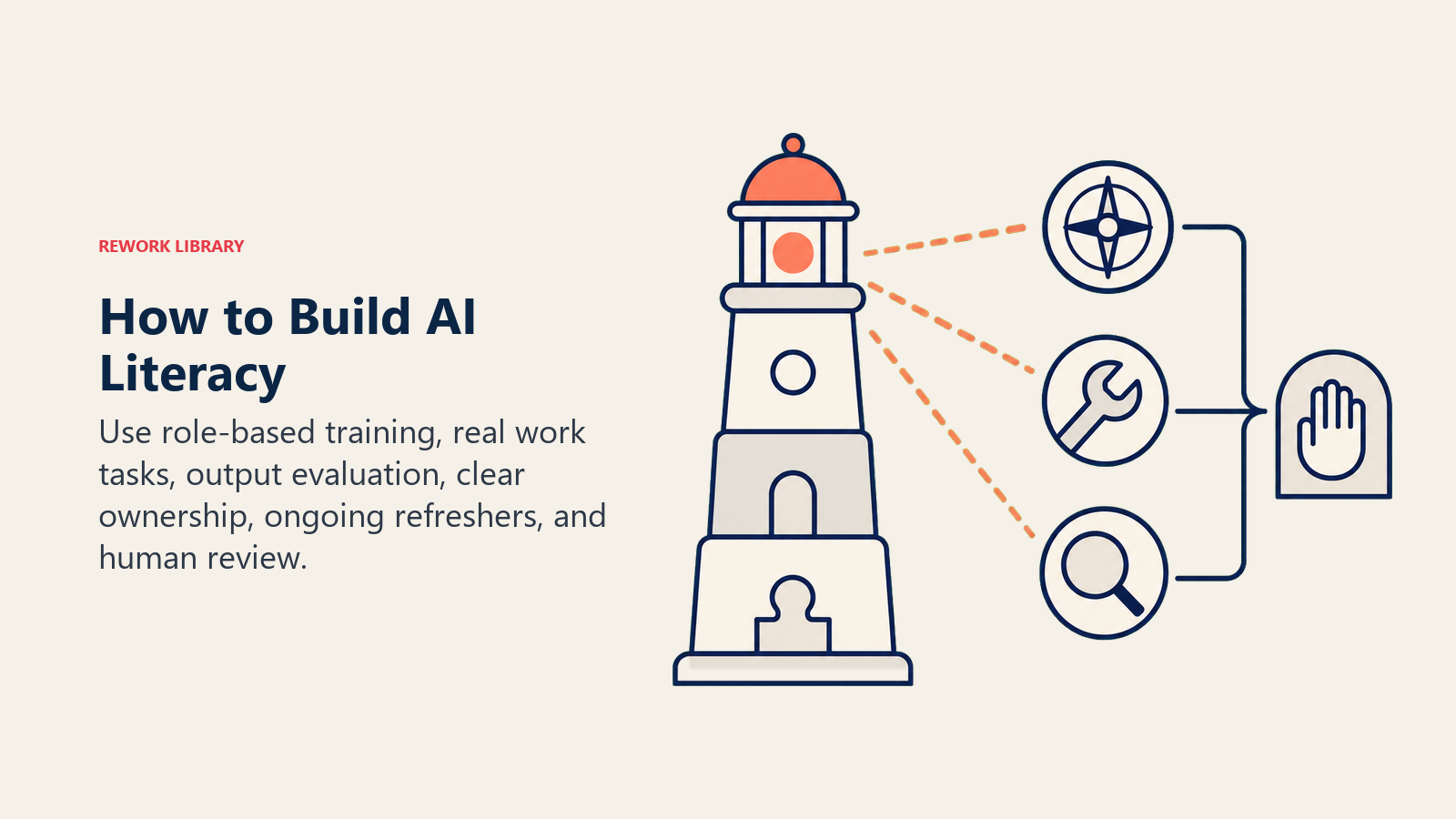
Start with role-based tiers, not one-size-fits-all training. An executive needs to understand AI's strategic limits and risks to make good investment and oversight calls. A frontline employee needs hands-on skill with the two or three tools they touch daily. A single generic course serves neither group well.
Tie training to real tools and real tasks. Programs that use the company's actual AI systems (its AI copilots, its customer-facing chatbot, its internal search) build retention that generic "intro to AI" courses don't. Training tied to a live project outperforms training delivered as a stand-alone module.
Build in evaluation practice, not just tool demos. The most-skipped part of AI literacy training is teaching people to catch bad output. Structured exercises where employees review AI-generated content for errors, bias, or fabricated claims build the "evaluate" and "question" skills that pure how-to training misses.
Assign accountable ownership. Companies with a dedicated AI Center of Excellence or a named literacy owner inside their AI governance function consistently show better training completion and retention than companies that leave AI education to individual managers.
Treat it as change management, not a one-time launch. AI tools and their failure modes shift fast. Programs that pair literacy training with ongoing AI change management, refreshers, office hours, updated guidance as tools change, hold up better than a single onboarding session that's never revisited.
Build in a human checkpoint. Literacy programs that pair training with a structural human-in-the-loop review step for consequential decisions catch errors that training alone won't. Skill and process reinforce each other.
AI Literacy Levels
Not everyone in an organization needs the same depth of AI literacy. Most maturity frameworks describe four practical levels.
| Level | What it covers | Typical audience |
|---|---|---|
| Foundational | Basic understanding of what AI is, common terms, and realistic expectations about accuracy and limits | All employees |
| Applied | Hands-on skill using specific AI tools for daily tasks, including effective prompting | Frontline staff, individual contributors |
| Critical | Ability to evaluate AI output for errors, bias, and fabricated information before it's used or shared | Managers, reviewers, QA roles |
| Strategic | Understanding AI's business risk, governance, ROI, and regulatory obligations well enough to make investment and oversight decisions | Executives, board members, AI governance leads |
Most companies underinvest in the top two rows. Tool fluency (Applied) is easy to train and easy to measure, so it gets most of the budget. Critical and Strategic literacy are harder to teach and harder to test, which is exactly why they're where the biggest gaps, and the biggest risk, tend to sit.
Key Facts
- LinkedIn's 2025 Skills on the Rise report ranked AI literacy as the fastest-growing skill in the United States, with AI-related skills appearing in job postings roughly six times more often than the year before. Source: LinkedIn Talent Blog
- 82% of enterprise leaders say their organization offers some form of AI training, yet 59% still report an active AI skills gap, according to DataCamp's 2026 State of Data and AI Literacy report. Source: DataCamp
- Only 21% of enterprise leaders reported significant positive ROI from AI investments overall, but that share roughly doubled to 42% among organizations with mature AI and data literacy upskilling programs. Source: DataCamp
- The EU AI Act's Article 4 AI literacy obligation became applicable on February 2, 2025, ahead of most of the Act's other deadlines, and applies to every organization that provides or deploys AI systems in the EU regardless of risk classification. Source: EU AI Act Article 4
- The World Economic Forum's Future of Jobs Report 2025 projects that employers expect 39% of workers' core skills to change by 2030, with AI cited as the leading driver. Source: World Economic Forum
- Only about 26% of workers report having received training on how to collaborate with AI, even as workplace AI adoption continues to rise. Source: World Economic Forum
- McKinsey's State of AI research found 78% of organizations report using AI in at least one business function, up from 72% in 2024 and 55% in 2023, a pace of adoption that is outrunning most companies' training investment. Source: McKinsey
Related Resources
Explore these related concepts to deepen your understanding of AI literacy:
- AI Governance - The framework that owns AI literacy as an organizational responsibility
- EU AI Act - The full regulation behind the Article 4 literacy obligation
- AI Talent Strategy - How to build, train, or buy the skills your AI programs need
- Prompt Engineering - The core "Use" skill inside AI literacy
- AI Change Management - Turning one-time literacy training into a lasting practice
- Human-in-the-Loop - The structural checkpoint that reinforces literacy in practice
- Bias in AI - What "evaluate" literacy skills are trained to catch
- AI Center of Excellence - A common home for owning literacy programs org-wide
Frequently Asked Questions about AI Literacy
What is AI literacy in simple terms?
AI literacy is the ability to understand how AI systems work, use them effectively for real tasks, evaluate their output for errors or bias, and know when to question or override what they produce. It's practical skill plus critical judgment, not just knowing how to type a prompt.
Is AI literacy the same as knowing how to use ChatGPT?
No. Tool fluency is only one part of AI literacy. Someone who can operate a chatbot but never checks its output for fabricated facts or bias is missing the evaluation and judgment components that make literacy useful in a business setting.
Why is AI literacy suddenly a legal requirement?
Article 4 of the EU AI Act requires providers and deployers of AI systems to ensure a sufficient level of AI literacy among staff and others operating AI on their behalf. It became applicable on February 2, 2025, and applies to any organization that provides or deploys AI systems in the EU, regardless of risk category.
Does the EU AI Act's literacy rule apply to companies outside Europe?
Yes, if the organization provides or deploys AI systems within the EU or serves EU-based staff and customers. The obligation attaches to the activity happening in the EU market, not to where the company is headquartered.
What happens if a company ignores the AI literacy requirement?
There's no single standalone fine tied only to Article 4, but the literacy obligation feeds into the Act's broader deployer duties, which can carry penalties up to €15 million or 3% of global annual turnover for non-compliance with those wider obligations.
How is AI literacy different for executives versus frontline employees?
Executives need strategic literacy, enough understanding of AI's risks, limits, and ROI drivers to make sound investment and oversight decisions. Frontline employees need applied literacy, hands-on skill with the specific tools they use daily. Both need foundational understanding of what AI can and can't do.
How long does it take to build AI literacy across an organization?
Foundational literacy can be built in a few hours of role-based training. Applied and critical literacy, the skills to use tools well and evaluate their output, typically take a few months of practice tied to real projects. Strategic literacy for leadership is an ongoing responsibility, not a one-time course.
What's the single biggest gap in most corporate AI literacy programs?
Evaluation skill. Most training teaches people how to use AI tools but skips how to catch a wrong or biased output before it reaches a customer or a decision. That gap is exactly what regulators and researchers point to when they describe AI training as widespread but shallow.
Can AI literacy training happen without a formal program?
Informally, some literacy spreads through daily use, but research shows that unstructured exposure alone doesn't close the skills gap. Companies with a named owner, role-based tiers, and built-in evaluation practice consistently outperform those relying on ad hoc, tool-only exposure.
Part of the AI Terms Collection. Updated July 2026.
