What is AI TRiSM (Trust, Risk and Security Management)?
Turn this article into takeaways for your work.


Each assistant summarizes the article only for you and suggests best practices for your work.
Your AI models are already making decisions in production: approving claims, flagging fraud, drafting contracts, routing support tickets. Most organizations have a policy document somewhere that says how AI should behave. Very few have the technical controls to check, in real time, whether it actually does. That gap is what AI TRiSM exists to close.
What is AI TRiSM?
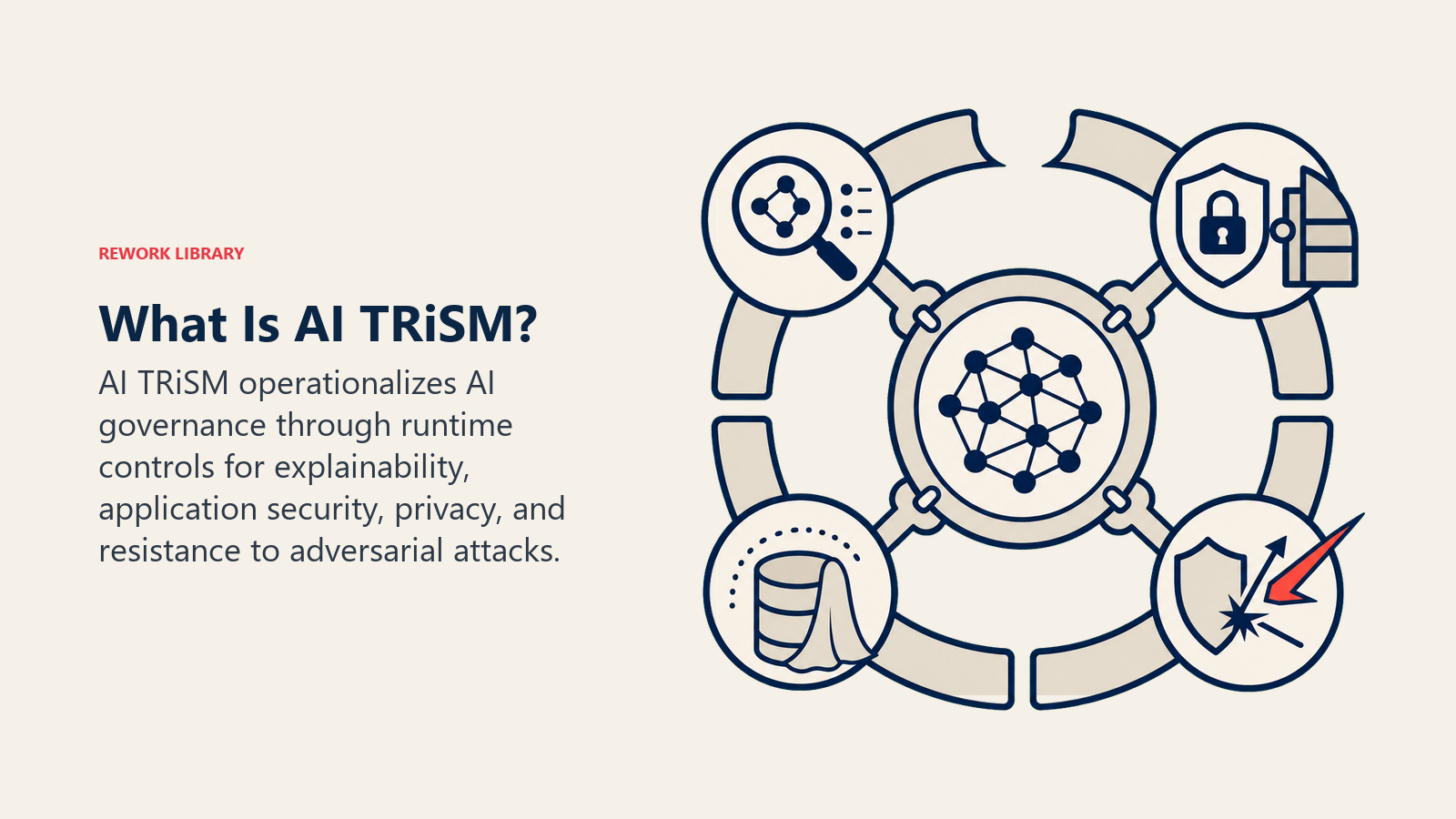
AI TRiSM (AI Trust, Risk and Security Management) is a framework Gartner introduced to help organizations operationalize AI governance in production. It unifies four disciplines, explainability and model operations, AI application security, data privacy, and adversarial attack resistance, so trust and safety controls scale with AI deployment instead of trailing behind it.
Gartner coined the term to describe the technical layer that sits underneath AI policy: the monitors, guardrails, access controls, and audit trails that make a governance document enforceable rather than aspirational. Where AI governance sets the rules, AI TRiSM is the machinery that checks every model, every prompt, and every output against them, continuously, at runtime.
Key Facts
- Gartner predicts organizations that operationalize AI transparency, trust, and security will see their AI models achieve a 50% improvement in adoption, business goals, and user acceptance. Gartner, AI Governance Needs More Than Policies
- Gartner forecasts 80% of unauthorized AI agent transactions through 2028 will stem from internal policy violations, not external attacks. Gartner, via Bigeye
- 13% of organizations reported a breach involving an AI model or application, and 97% of those said they lacked proper AI access controls. IBM, 2025 Cost of a Data Breach Report
- 63% of breached organizations have no AI governance policy in place, or are still developing one. IBM, 2025 Cost of a Data Breach Report
- Organizations with high levels of unsanctioned shadow AI use absorbed an average of $670,000 more in breach costs than those with low or no shadow AI. IBM, 2025 Cost of a Data Breach Report
- 51% of organizations using AI report at least one negative consequence from it, most commonly inaccuracy. McKinsey, State of AI
- Organizations report actively mitigating an average of four AI-related risks today, up from two in 2022. McKinsey, State of AI
The Four Pillars of AI TRiSM
Gartner's framework rests on four technical pillars. Skip one, and the other three cannot fully protect the organization.
• Explainability and Model Operations (ModelOps): The ability to explain why a model produced a given output, plus the operational discipline (versioning, testing, deployment pipelines) that keeps models reliable after launch. This is the foundation for explainable AI and ongoing model monitoring.
• AI Application Security: Protecting the application layer around a model: prompt injection defenses, API rate limiting, jailbreak detection, and access controls that stop an AI system from being manipulated into doing something it was never authorized to do.
• Privacy: Ensuring models only access data they are permissioned to see, that personal data doesn't leak into training sets or outputs, and that data handling meets regulatory requirements like GDPR and the EU AI Act.
• Adversarial Attack Resistance: Detecting and blocking attempts to manipulate model behavior through data poisoning, adversarial inputs, or model extraction, the AI-specific equivalent of a security team's threat modeling.
Why Gartner Is Pushing AI TRiSM Now
Two things changed at once. First, AI adoption stopped being experimental. Most organizations now run AI in production, not in a sandbox, and a growing share of that is agentic (see AI agents) systems that take multi-step actions without a human reviewing every step. Second, the breach data caught up with the risk. IBM's research found that organizations with AI-related breaches were overwhelmingly missing basic access controls, and Gartner's own research points the finger inward: most unauthorized AI activity comes from employees misusing sanctioned tools, not outside attackers.
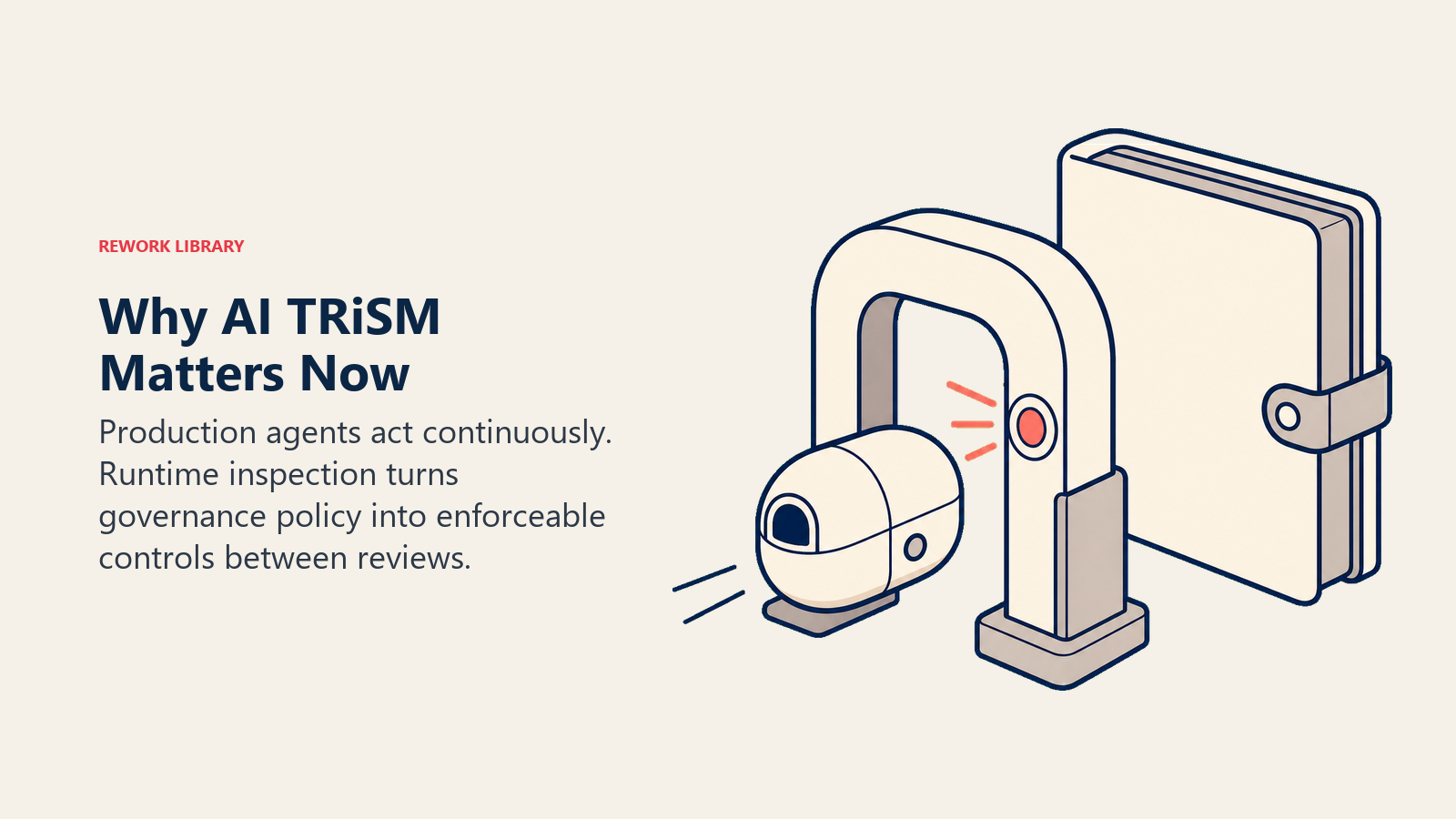
Gartner structures the AI TRiSM market into four layers of technical capability: AI governance (visibility and cataloging of every AI asset), AI runtime inspection and enforcement (real-time monitoring of models and agent behavior), information governance (making sure AI only touches properly permissioned data), and infrastructure and stack (extending existing network, endpoint, and cloud security to AI workloads). The insight behind the framework is simple: a governance policy that nobody enforces in real time is a liability, not a control. Guardrails and human-in-the-loop checkpoints only work if something is actually watching the system between reviews.
How Organizations Implement AI TRiSM
AI TRiSM implementation typically follows the four-layer structure Gartner defines, worked roughly in this order:
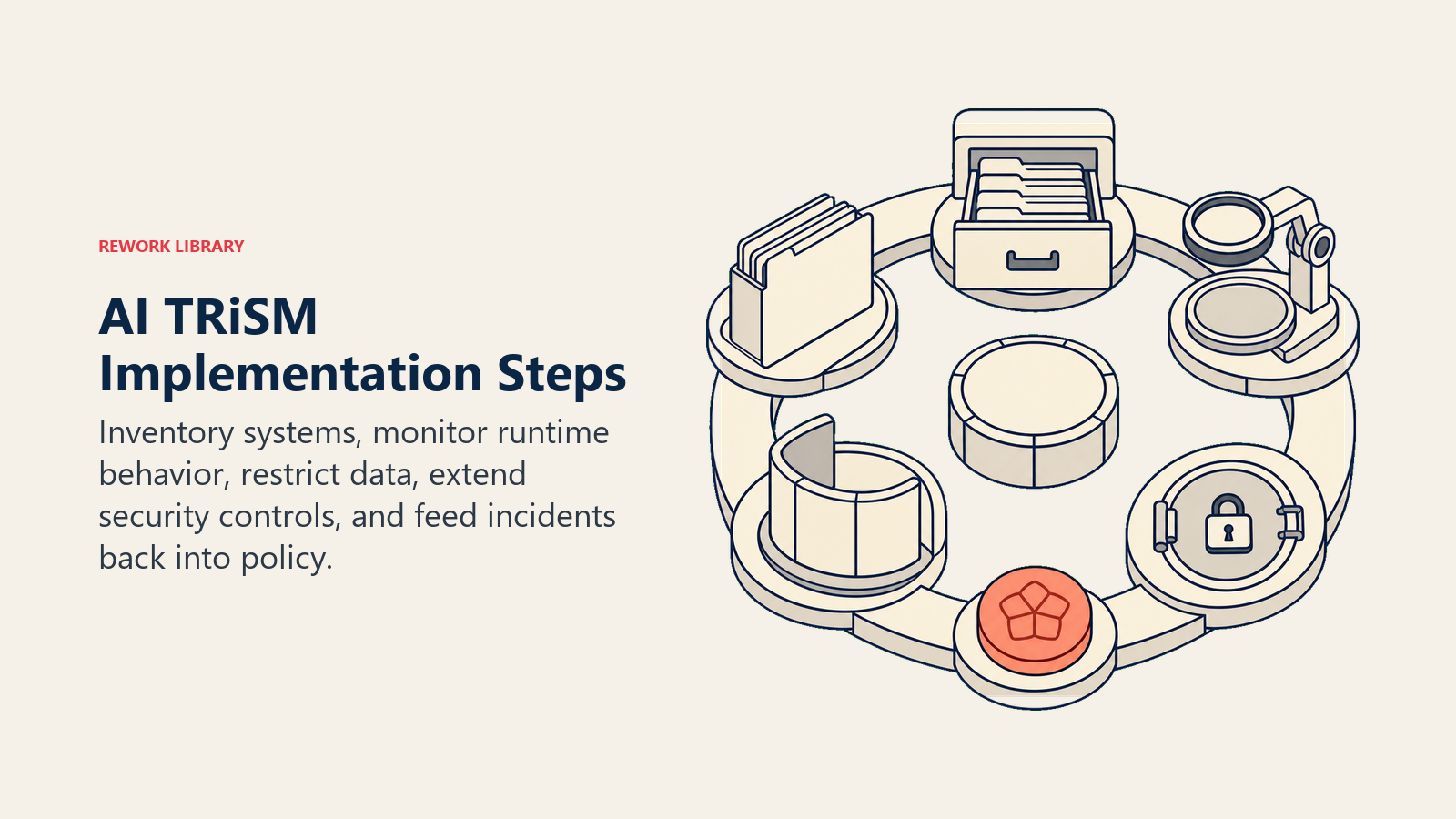
Inventory every AI system. You cannot secure what you cannot see. Build a live catalog of every model, agent, and third-party AI feature in use, including the shadow AI tools employees adopted on their own.
Add runtime monitoring and guardrails. Deploy inspection tools that flag anomalous model behavior, block prompt injection attempts, and enforce usage policies as transactions happen, not after an audit trail review weeks later.
Lock down data access. Apply the same classification and permissioning discipline to AI data access that you already apply to human data access. A model should never be able to read data its user role could not.
Extend existing security infrastructure. Route AI traffic through the network, endpoint, and cloud security controls already protecting the rest of the stack, rather than standing up a parallel, disconnected system.
Close the loop with governance. Feed what runtime monitoring finds back into policy. If bias or drift shows up in production, that should trigger a governance review, not just a technical patch.
Most organizations start with whichever layer their last incident exposed, usually runtime monitoring or data access, then work backward to build out the rest.
AI TRiSM vs AI Governance
The two terms get used interchangeably, but they describe different layers of the same problem.
| Dimension | AI TRiSM | AI Governance |
|---|---|---|
| Scope | Technical controls that enforce policy at runtime | Policy, ownership, and strategic oversight across the AI lifecycle |
| Core question | "Is this specific AI system trustworthy, secure, and monitored right now?" | "What are our AI principles, and who is accountable for them?" |
| Primary owner | Security, ML engineering, platform teams | Legal, risk, compliance, executive leadership |
| Typical artifacts | Guardrails, model monitors, access controls, audit logs | Policies, RACI charts, ethics committees, approval gates |
| Cadence | Continuous, real-time enforcement | Periodic, strategic review |
| Relationship | The operational layer that makes governance enforceable | The umbrella framework AI TRiSM operationalizes |
In practice, you need both. AI governance without AI TRiSM is a document nobody checks against. AI TRiSM without governance is a pile of technical controls with no policy telling them what "acceptable" looks like.
Business Benefits of AI TRiSM
For business leaders, AI TRiSM is what turns an AI policy into something a regulator, auditor, or board member can actually verify. Three benefits stand out.
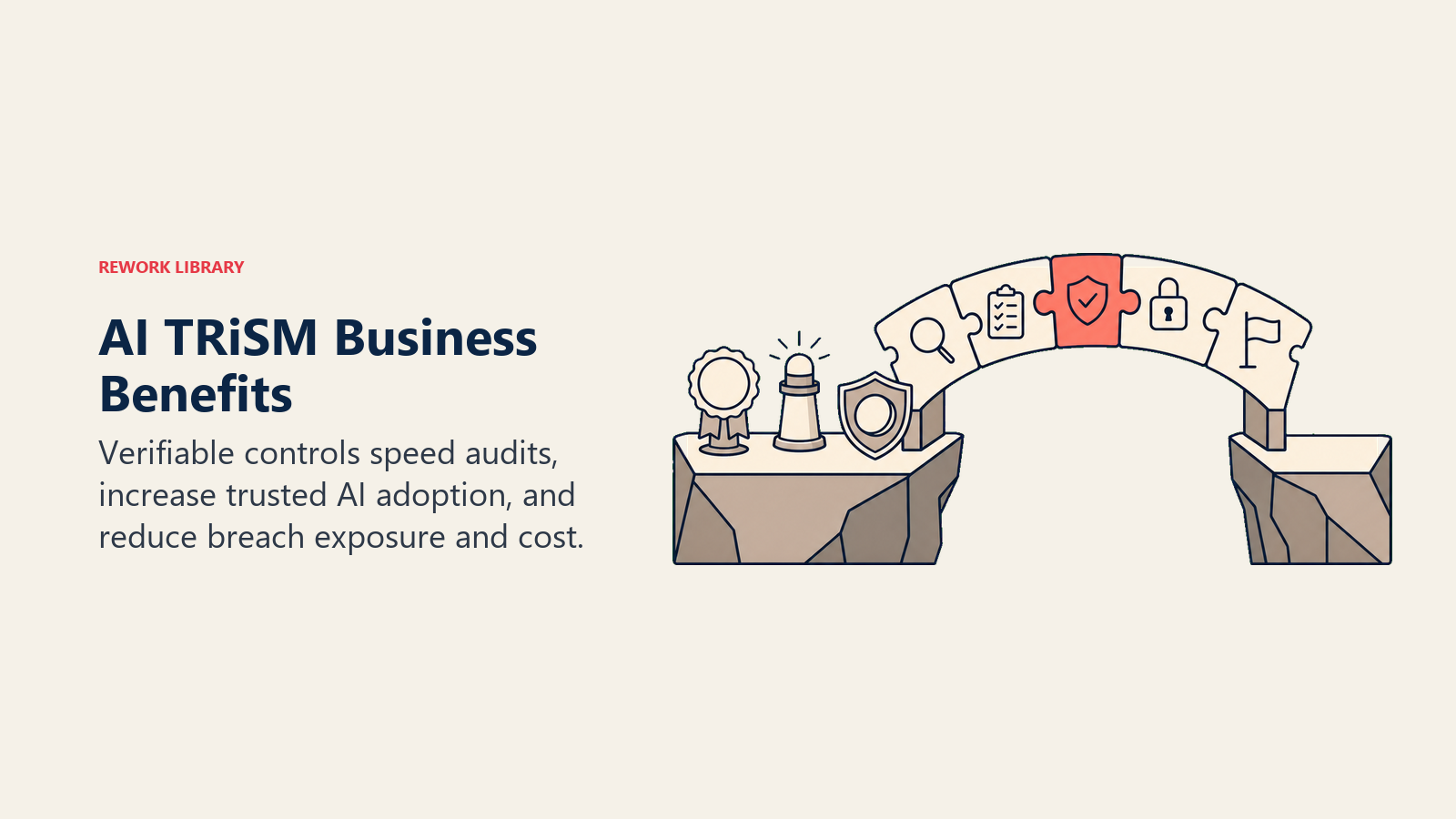
Faster, cleaner compliance. Regulations like the EU AI Act increasingly expect organizations to demonstrate ongoing monitoring, not just a signed policy. AI TRiSM controls (model monitoring, audit trails, access logs) are the evidence that satisfies an audit instead of a promise.
Higher adoption, not just lower risk. Gartner's own research ties the framework directly to adoption: organizations that operationalize AI trust and security see a measurable jump in how much their AI models actually get used and trusted internally, not just how safe they are on paper.
Lower breach exposure and cost. The gap between organizations with strong AI access controls and those without shows up directly in breach costs. Closing that gap with AI TRiSM controls is a cost-avoidance case any CFO can follow, on top of the reputational risk it prevents.
Learn More
Explore related AI risk, security, and governance concepts:
- AI Security - Protecting AI systems from attacks, misuse, and data exposure
- AI Ethics - The principles AI TRiSM controls are built to enforce
- AI Safety - Preventing harmful or unintended AI behavior at the system level
- AI Impact Assessment - Evaluating AI risk before deployment
External Resources
- Gartner: AI Governance Needs More Than Policies - Gartner's own framing of the AI TRiSM framework
- IBM: What is AI TRiSM? - Vendor-neutral overview of the four pillars
- NIST AI Risk Management Framework - Federal framework AI TRiSM controls often map to
Frequently Asked Questions about AI TRiSM
What is AI TRiSM?
AI TRiSM (AI Trust, Risk and Security Management) is a Gartner framework that unifies explainability and model operations, AI application security, data privacy, and adversarial attack resistance into one discipline for operationalizing AI governance in production.
What are the four pillars of AI TRiSM?
Explainability and Model Operations (ModelOps), AI Application Security, Privacy, and Adversarial Attack Resistance. All four work together, weakening one undermines the protection the others provide.
How is AI TRiSM different from AI governance?
AI governance sets the policies, principles, and accountability structure for AI. AI TRiSM provides the technical controls, monitoring, guardrails, access management, that enforce those policies continuously at runtime rather than only during periodic reviews.
Why did Gartner create the AI TRiSM framework?
Gartner found that most organizations had AI policies but no way to verify AI systems were actually complying with them in real time. AI TRiSM was built to close that enforcement gap as AI moved from pilot projects into production and agentic use cases.
Does AI TRiSM apply to agentic AI?
Yes. Gartner has extended AI TRiSM to cover autonomous AI agents through what it calls guardian agents, runtime enforcement mechanisms designed to monitor and control agent behavior, since agents take multi-step actions without constant human review.
What tools fall under the AI TRiSM umbrella?
Model monitoring platforms, AI guardrails and content filtering tools, data access and permissioning systems for AI, AI-specific security posture management, and audit logging tools that record what a model saw, decided, and did.
How do we start implementing AI TRiSM?
Start by inventorying every AI system and shadow AI tool in use, then add runtime monitoring and guardrails on the highest-risk systems first. Data access controls and infrastructure integration typically follow once the highest-exposure gaps are covered.
Is AI TRiSM required to comply with the EU AI Act?
The EU AI Act doesn't name AI TRiSM specifically, but its requirements for risk management, logging, and human oversight for high-risk AI systems map closely to what AI TRiSM controls already provide, making it a practical path to compliance.
Part of the AI Terms Collection. Last updated: 2026-07-16
